Packaged Salad Market Size
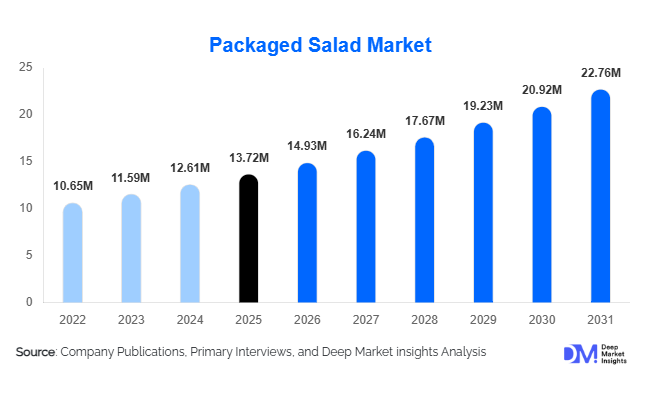
According to Deep Market Insights, the global packaged salad market size was valued at USD 13.72 billion in 2025 and is projected to grow from USD 14.93 billion in 2026 to reach USD 22.76 billion by 2031, expanding at a CAGR of 8.8% during the forecast period (2026–2031). The packaged salad market growth is primarily driven by increasing consumer demand for healthy, convenient, and ready-to-eat food options, along with the expansion of modern retail channels and improvements in cold-chain logistics that enable fresh produce distribution at scale.
Packaged salads have gained significant traction among urban consumers seeking balanced meals with minimal preparation time. The market includes a broad range of products such as leafy green salads, vegetable mixes, protein salads, and complete meal salad kits. Retailers and manufacturers are expanding their product portfolios with organic, plant-based, and high-protein varieties to cater to changing dietary preferences. Innovations in modified atmosphere packaging (MAP), resealable packaging, and pre-washed salad formats are helping extend shelf life while maintaining freshness and nutritional quality.
The growing influence of healthy lifestyle trends, including weight management diets and plant-forward nutrition, has accelerated global consumption of packaged salads. Additionally, foodservice operators such as quick-service restaurants, cafés, and salad bars are increasingly incorporating ready-to-eat salad components into their menus. As global consumers shift toward convenient yet nutritious food options, the packaged salad market is expected to witness sustained expansion across both developed and emerging economies.
Key Market Insights
- Ready-to-eat and pre-washed salad kits are driving demand, offering convenience for busy consumers seeking healthy meal options with minimal preparation.
- Leafy green salads dominate the market, accounting for the largest share due to their widespread use in diets focused on nutrition and weight management.
- North America leads global consumption, supported by high health awareness and strong retail infrastructure.
- Asia-Pacific is the fastest-growing region, driven by rising urbanization, increasing disposable incomes, and expanding organized retail sectors.
- Premium organic salads are gaining popularity, as consumers increasingly prioritize clean-label and sustainably sourced food products.
- Technological advancements in packaging, including modified atmosphere packaging and biodegradable containers, are extending product shelf life and improving sustainability.
What are the latest trends in the packaged salad market?
Growing Demand for Functional and Protein-Rich Salads
Consumers are increasingly looking for meals that provide nutritional benefits beyond basic sustenance. As a result, manufacturers are introducing packaged salads enriched with plant proteins such as chickpeas, lentils, quinoa, and tofu. These products cater to vegan, vegetarian, and flexitarian consumers who seek balanced meals with higher protein content. Functional salads featuring superfoods, probiotics, and nutrient-dense ingredients are also gaining popularity. Salad kits containing grains, nuts, and seeds are particularly attractive to consumers following high-protein or fitness-focused diets, creating new opportunities for product differentiation.
Advancements in Fresh Food Packaging Technologies
Packaging innovations are transforming the packaged salad industry by extending shelf life while preserving freshness and flavor. Technologies such as modified atmosphere packaging (MAP), vacuum-sealed containers, and breathable films help regulate oxygen and carbon dioxide levels within packaging, slowing down spoilage. In addition, biodegradable and recyclable packaging materials are gaining traction as sustainability becomes a priority for both consumers and regulators. Retailers are increasingly adopting transparent clamshell containers and resealable pouches that improve product visibility and convenience while minimizing food waste.
What are the key drivers in the packaged salad market?
Rising Health Awareness and Demand for Nutritious Foods
Growing awareness of lifestyle-related diseases such as obesity, diabetes, and cardiovascular conditions has encouraged consumers to incorporate more vegetables and fresh produce into their diets. Packaged salads offer a convenient way to increase vegetable intake while maintaining balanced nutrition. Consumers following calorie-controlled or plant-based diets frequently choose packaged salads as meal replacements or side dishes. This health-driven demand has significantly expanded the consumer base for ready-to-eat salad products across developed markets.
Expansion of Organized Retail and Online Grocery Platforms
The rapid growth of supermarkets, hypermarkets, and online grocery platforms has significantly improved accessibility to packaged salads. Modern retail chains provide extensive refrigerated storage space and display systems that maintain product freshness while offering consumers a wide range of salad options. Online grocery platforms further enhance convenience by enabling consumers to purchase fresh food products through digital channels. Subscription-based grocery services and home delivery models are also contributing to increased consumption of packaged salads.
What are the restraints for the global market?
Short Shelf Life and Supply Chain Complexity
Fresh vegetables are inherently perishable, making supply chain management a critical challenge for packaged salad manufacturers. Maintaining consistent quality requires efficient cold-chain infrastructure, rapid distribution networks, and careful inventory management. Any disruptions in temperature control during transportation or storage can lead to product spoilage, increasing operational costs and food waste.
Higher Cost Compared to Raw Vegetables
Packaged salads often carry higher prices than loose vegetables due to processing, packaging, and distribution costs. In price-sensitive markets, consumers may prefer purchasing fresh vegetables and preparing salads at home. This cost difference can limit adoption in developing regions unless manufacturers implement cost-efficient sourcing and packaging strategies to maintain competitive pricing.
What are the key opportunities in the packaged salad industry?
Expansion in Emerging Markets
Emerging economies in Asia-Pacific and Latin America present significant growth opportunities for packaged salad manufacturers. Urbanization, rising disposable incomes, and growing exposure to global food trends are encouraging consumers in countries such as China, India, Brazil, and Indonesia to adopt healthier eating habits. The expansion of organized retail chains and cold-chain logistics in these regions is enabling wider availability of fresh packaged food products. Companies that invest in localized production facilities and region-specific flavor profiles can establish strong market positions in these high-growth markets.
Integration of Sustainable and Smart Agriculture
Technological advancements in agriculture are creating new opportunities for the packaged salad market. Controlled environment agriculture, including greenhouse farming and vertical farming, enables year-round production of leafy greens while reducing dependence on seasonal weather conditions. These methods also reduce transportation costs and environmental impact by enabling production closer to urban consumption centers. Integration of smart farming technologies such as IoT-enabled irrigation systems and AI-driven crop monitoring is further improving crop yields and supply chain efficiency.
Report Scope
| Report Metric | Details |
|---|---|
| Market Size in 2025 | USD 13.72 Million |
| Market Size in 2026 | USD 14.93 Million |
| Market Size in 2031 | USD 22.76 Million |
| CAGR | 8.8% (2026-2031) |
| Base Year for Estimation | 2025 |
| Historical Data | 2022-2024 |
| Forecast Period | 2026-2031 |
| Report Coverage | Revenue Forecast, Competitive Landscape, Supply Chain Disruption, Growth Factors, Environment & Regulatory Landscape and Trends |
| Geographies Covered | North America, Europe, APAC, Middle East and Africa, LATAM |
| Countries Covered | U.S., Canada, U.K., Germany, France, Spain, Italy, Russia, Nordic, Benelux, Rest of Europe, China, Korea, Japan, India, Australia, Singapore, Taiwan, South East Asia, Rest of Asia-Pacific, UAE, Turky, Saudi Arabia, South Africa, Egypt, Nigeria, Rest of MEA, Brazil, Mexico, Argentina, Chile, Colombia, Rest of LATAM |
Explore more data points, trends and opportunities Download Free Sample Report
Product Type Insights
The packaged salad market is characterized by strong diversification across product categories, reflecting evolving consumer preferences toward convenient, nutritious, and ready-to-consume food solutions. Leafy green salads represent the largest product segment, accounting for approximately 42% of global demand, primarily driven by increasing consumer awareness regarding balanced diets and the growing adoption of plant-forward eating patterns. Products such as spinach, romaine lettuce, kale, arugula, and mixed leaf blends are widely preferred due to their high vitamin and mineral content, low calorie profile, and adaptability across multiple meal occasions including lunches, side dishes, and functional health meals. The rising popularity of fitness-oriented lifestyles and weight management programs continues to reinforce demand for leafy greens, particularly among urban working populations.Vegetable-based salads, including coleslaw mixes, shredded carrots, cabbage blends, and broccoli-based combinations, are experiencing consistent expansion as consumers seek flavorful yet convenient accompaniments for home-cooked meals and quick-service restaurant offerings. The segment benefits from increasing demand for pre-cut vegetables that reduce preparation time while maintaining freshness and nutritional value. Additionally, innovations in packaging technologies that extend shelf life without preservatives are supporting category penetration across retail channels.
Protein-based salads are emerging as one of the fastest-growing product categories as consumers increasingly prioritize satiety, functional nutrition, and meal replacement options. Salads containing chicken, tuna, eggs, legumes, or plant-based proteins cater to flexitarian and high-protein dietary trends. Growth in this segment is further supported by rising interest in low-carbohydrate and high-protein diets, particularly among younger demographics and fitness-conscious consumers. Manufacturers are also introducing plant-based protein alternatives to appeal to vegan and vegetarian consumers, expanding the addressable consumer base.Complete meal salads, which combine grains, vegetables, proteins, toppings, and dressings in single-serve formats, are gaining significant traction among urban consumers seeking nutritionally balanced meals with minimal preparation. The leading driver for this segment is the increasing demand for convenient, portion-controlled meal solutions aligned with busy lifestyles and hybrid work patterns. These products are particularly popular in metropolitan areas where time constraints and on-the-go consumption habits influence purchasing behavior. Continuous product innovation through global flavor profiles and premium ingredient combinations further enhances consumer engagement within this category.
Application Insights
Household consumption represents the largest application segment, accounting for nearly 63% of the packaged salad market, supported by rising health consciousness and the growing preference for convenient meal solutions. Consumers increasingly integrate ready-to-eat salads into daily diets as quick lunches, light dinners, healthy snacks, and meal replacements. The leading driver of household adoption is the increasing shift toward preventive healthcare and nutrition-focused consumption, as individuals seek fresh food options that require minimal preparation while supporting wellness goals. Expansion of refrigeration infrastructure in residential retail channels and improved product availability across supermarkets have further strengthened household penetration.The foodservice sector is emerging as a significant growth contributor as restaurants and institutional kitchens increasingly rely on pre-washed and pre-cut salad ingredients to enhance operational efficiency. Quick-service restaurants, cafés, salad chains, and fast-casual dining establishments incorporate packaged salad mixes to maintain consistency, reduce labor costs, and improve food safety standards. Additionally, corporate cafeterias, educational institutions, hospitals, and catering companies are adopting packaged salads to streamline large-scale food preparation processes while meeting growing consumer demand for healthier menu options. The expansion of delivery-based dining models and ready-meal concepts is expected to further accelerate adoption within the foodservice segment.
Distribution Channel Insights
Supermarkets and hypermarkets dominate global packaged salad sales, accounting for over 50% of market revenue, primarily due to their extensive cold storage infrastructure and ability to offer diverse product assortments under controlled temperature conditions. The leading driver for this channel is consumer preference for one-stop shopping experiences that allow comparison across multiple brands, price tiers, and product varieties. Large retail chains also benefit from strong supplier partnerships and efficient supply chain networks that ensure product freshness and consistent availability.Convenience stores and specialty organic retailers play an increasingly important role, particularly in densely populated urban markets where consumers prioritize accessibility and quick purchasing decisions. These outlets cater to impulse purchases and health-conscious shoppers seeking premium or organic salad options. Growth in this segment is reinforced by increasing urbanization and the expansion of smaller retail formats located near residential and commercial hubs.Online grocery platforms are witnessing rapid expansion as digital commerce transforms fresh food retailing. Rising consumer comfort with e-commerce, improved last-mile cold-chain logistics, and subscription-based grocery models are encouraging online purchases of packaged salads. Retailers and e-commerce platforms are also investing in temperature-controlled delivery systems to maintain product quality. Furthermore, the expansion of private-label packaged salad brands across both physical and digital retail channels enables retailers to offer competitively priced alternatives while strengthening customer loyalty and improving profit margins.
Explore more data points, trends and opportunities Download Free Sample Report
Packaged Salad Market Segmentations
By Product Type
- Leafy Green Salads
- Vegetable-Based Salads
- Protein-Based Salads
- Complete Meal Salads
- Specialty & Organic Salads
By Packaging Type
- Clamshell Containers
- Flexible Bags
- Resealable Pouches
- Multi-Compartment Trays
- Vacuum-Sealed Packaging
By Distribution Channel
- Supermarkets & Hypermarkets
- Convenience Stores
- Online Grocery Platforms
- Specialty Organic Stores
- Foodservice & Institutional Supply
By End-Use
- Household Consumption
- Quick Service Restaurants
- Cafés & Salad Bars
- Catering & Institutional Dining
Regional Insights
North America
North America remains the largest packaged salad market, accounting for approximately 38% of global demand, supported by mature retail infrastructure and strong consumer adoption of ready-to-eat food products. The United States represents the majority of regional consumption, driven by high health awareness, widespread availability of convenience foods, and strong penetration of refrigerated retail formats. Regional growth is further supported by increasing demand for fresh and minimally processed foods, expansion of premium salad kits, and rising consumer interest in organic and clean-label products. Advanced cold-chain logistics, large-scale salad processing facilities, and continuous product innovation by major manufacturers ensure consistent supply and product quality across the region. Canadian consumers are also increasingly embracing packaged salads due to growing wellness trends and expanding availability of fresh meal solutions through both retail and online grocery platforms.
Europe
Europe accounts for roughly 31% of the global packaged salad market, with strong demand across Germany, the United Kingdom, France, Italy, and Spain. Regional growth is primarily driven by consumer preference for sustainably sourced and organic food products, alongside stringent food safety regulations that enhance trust in packaged fresh produce. European retailers play a central role in market expansion through extensive private-label offerings that combine affordability with high quality standards. Increasing environmental awareness has encouraged manufacturers to adopt recyclable packaging materials and locally sourced ingredients, further strengthening consumer acceptance. Additionally, the growing popularity of plant-based diets and Mediterranean-style eating patterns continues to stimulate demand for fresh salad mixes across both retail and foodservice sectors.
Asia-Pacific
The Asia-Pacific region represents the fastest-growing packaged salad market, fueled by rapid urbanization, rising disposable incomes, and changing dietary habits influenced by globalization. China and Japan remain the largest markets due to strong convenience food cultures and expanding modern retail networks. Regional growth drivers include increasing exposure to Western dining formats, growing health awareness among middle-class consumers, and expansion of organized supermarket chains. India is emerging as a high-potential market supported by the rapid development of modern retail infrastructure, growth in online grocery platforms, and increasing adoption of healthier eating habits among younger populations. Improvements in cold-chain logistics and investment in domestic fresh food processing facilities are expected to significantly enhance market accessibility across the region.
Latin America
Latin America is witnessing gradual but steady growth in packaged salad consumption, particularly in Brazil and Mexico, where expanding urban populations and modern retail expansion are improving product availability. Regional growth is supported by increasing consumer awareness of nutrition and rising demand for convenient meal solutions among working households. Supermarket expansion, improvements in refrigerated transportation networks, and growing investments in food processing capabilities are enabling wider distribution of fresh packaged products. Additionally, the influence of international foodservice chains and evolving dietary preferences toward lighter meals are contributing to rising adoption of packaged salads across metropolitan areas.
Middle East & Africa
The Middle East and Africa region is experiencing steady expansion in the packaged salad market, particularly in the United Arab Emirates, Saudi Arabia, and South Africa. Growth across the region is driven by high urbanization rates, increasing disposable incomes, and strong demand from hospitality and tourism sectors that require consistent supplies of fresh ingredients. The expansion of modern retail formats, including hypermarkets and premium grocery stores, has improved product visibility and accessibility. In several Middle Eastern countries, dependence on imported fresh produce encourages the adoption of packaged salads that offer longer shelf life and consistent quality. Rising health awareness, expatriate population growth, and increasing adoption of Western dietary patterns continue to support long-term market development across the region.
Key Players in the Packaged Salad Market
- Dole Food Company
- Fresh Express
- Taylor Farms
- Bonduelle Group
- Earthbound Farm
- Ready Pac Foods
- BrightFarms
- Mann Packing
- Del Monte Fresh Produce
- Greenyard
- Florette
- Apio Inc.
- Duda Farm Fresh Foods
- Vegpro International
- Church Brothers Farms