Overnight Face Mask Market Size
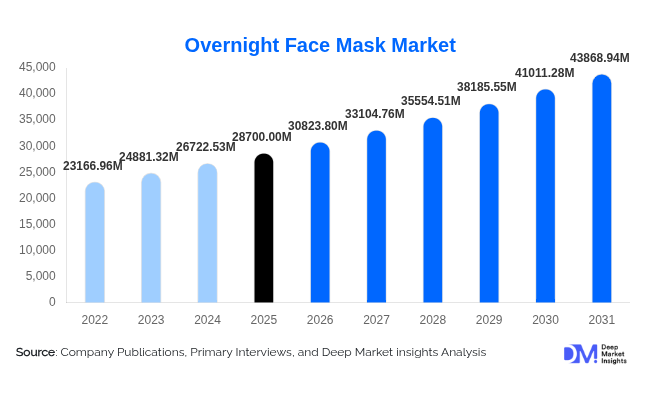
According to Deep Market Insights, the global overnight face mask market size was valued at USD 28700 million in 2025 and is projected to grow from USD 30823.8 million in 2026 to reach USD 43868.94 million by 2031, expanding at a CAGR of 7.4% during the forecast period (2026–2031). The overnight face mask market growth is primarily driven by rising consumer demand for convenient, multi-functional skincare solutions, increased adoption of digital retail platforms, and a growing focus on hydration, anti-aging, and targeted skin treatments across diverse demographics.
Key Market Insights
- Consumer preference is shifting toward multifunctional, leave-on overnight skincare products, offering hydration, anti-aging, and restorative benefits without time-consuming routines.
- Asia-Pacific dominates the market, led by South Korea, Japan, and China, where skincare routines are culturally ingrained and innovation adoption is high.
- Online retail channels are the fastest-growing distribution segment, supported by D2C brand portals, e-commerce platforms, and social commerce.
- Millennials and Gen Z are driving growth, leveraging social media and influencer marketing to discover and purchase premium and specialized overnight face masks.
- Sustainable and clean beauty formulations are gaining traction, with consumers increasingly demanding vegan, cruelty-free, and eco-friendly packaging solutions.
- Technological integration, including AI-based skin analysis, personalized skincare recommendations, and virtual try-ons, is enhancing consumer engagement and purchase decisions.
What are the latest trends in the overnight face mask market?
Personalized and Tech-Enhanced Skincare
Brands are increasingly offering personalized overnight masks through AI-driven skin diagnostics and subscription-based models. These products cater to specific skin concerns such as hydration, brightening, anti-aging, or sensitivity. Mobile apps, virtual try-ons, and social media tutorials enhance consumer engagement, helping them select products suited to their skin type and lifestyle. This trend is particularly strong among Millennials and Gen Z, who prioritize digital-first, convenient, and results-driven skincare solutions.
Sustainable and Clean Formulations
Eco-conscious formulations and sustainable packaging are becoming critical trends in the overnight face mask market. Brands are integrating natural and organic actives, biodegradable sheets, and recyclable containers to meet consumer demand. Regulatory support in regions like Europe encourages transparency and safety, while consumer awareness campaigns highlight environmental impact, allowing brands to differentiate themselves and justify premium pricing. This trend aligns with the broader clean beauty movement and appeals to ethically-conscious consumers.
What are the key drivers in the overnight face mask market?
Growing Skincare and Self-Care Awareness
Consumers are increasingly prioritizing skincare routines that save time while delivering visible results. Overnight face masks provide convenience, allowing hydration, barrier repair, and anti-aging benefits during sleep. Rising awareness about the importance of self-care, wellness, and skin health is fueling adoption across age groups globally, especially in urban centers with fast-paced lifestyles.
Advances in Cosmetic Formulations
Innovations in actives such as peptides, ceramides, hyaluronic acid complexes, and botanical extracts have significantly enhanced product efficacy. Slow-release delivery systems enable prolonged hydration and repair overnight, making these products appealing for anti-aging and skin-repair routines. Continuous R&D efforts and product diversification are enabling premium positioning and consumer loyalty.
Digital Retail and Influencer Marketing
The proliferation of e-commerce and social commerce platforms has boosted market reach and product discovery. Consumers are increasingly influenced by online reviews, tutorials, and influencer endorsements, particularly in the millennial and Gen Z segments. D2C portals and mobile apps allow brands to personalize offerings, track consumer behavior, and foster repeat purchases, driving revenue growth.
What are the restraints for the global market?
Price Sensitivity in Developing Markets
High-end overnight face masks face challenges in emerging economies where consumers may prioritize basic skincare products over premium treatments. Affordability constraints and limited awareness about advanced formulations can restrict market penetration in price-sensitive regions.
Regulatory and Compliance Challenges
Stricter cosmetic regulations, particularly in Europe and Japan, create challenges for product launches. Ingredient approval, labeling, and claims substantiation require significant investment in R&D and compliance, potentially slowing time-to-market and adding operational costs.
What are the key opportunities in the overnight face mask market?
Expansion into Emerging Markets
Regions like India, China, Brazil, and Southeast Asia offer untapped potential due to rising disposable income, increasing urbanization, and growing beauty awareness. Localized product portfolios catering to regional preferences, such as herbal or brightening formulations, can drive significant growth for both global and local brands.
Digital and Direct-to-Consumer Innovation
AI-driven personalization, virtual skincare diagnostics, and subscription-based models provide brands with opportunities to increase engagement and retention. Social commerce and influencer partnerships further amplify reach, particularly among tech-savvy Millennials and Gen Z consumers.
Integration of Clean Beauty and Wellness Trends
Consumers increasingly demand vegan, cruelty-free, and eco-friendly products. Brands that focus on sustainability, natural actives, and biodegradable packaging can differentiate themselves while addressing regulatory pressures and appealing to ethically conscious buyers.
Report Scope
| Report Metric | Details |
|---|---|
| Market Size in 2025 | USD 28700 Million |
| Market Size in 2026 | USD 30823.8 Million |
| Market Size in 2031 | USD 43868.94 Million |
| CAGR | 7.4% (2026-2031) |
| Base Year for Estimation | 2025 |
| Historical Data | 2022-2024 |
| Forecast Period | 2026-2031 |
| Report Coverage | Revenue Forecast, Competitive Landscape, Supply Chain Disruption, Growth Factors, Environment & Regulatory Landscape and Trends |
| Geographies Covered | North America, Europe, APAC, Middle East and Africa, LATAM |
| Countries Covered | U.S., Canada, U.K., Germany, France, Spain, Italy, Russia, Nordic, Benelux, Rest of Europe, China, Korea, Japan, India, Australia, Singapore, Taiwan, South East Asia, Rest of Asia-Pacific, UAE, Turky, Saudi Arabia, South Africa, Egypt, Nigeria, Rest of MEA, Brazil, Mexico, Argentina, Chile, Colombia, Rest of LATAM |
Explore more data points, trends and opportunities Download Free Sample Report
Product Type Insights
Cream & Gel Masks dominate the market with 58% of the 2025 market share, driven by their versatility, high efficacy in hydration and anti-aging, and broad appeal across demographics. Sheet masks are popular for targeted concerns but remain secondary in overall revenue contribution. Cream and gel masks lead globally due to their adaptability to diverse skin types, premium formulations, and easy integration into daily routines.
Application Insights
Hydration-focused overnight masks account for 50%+ of market consumption, appealing to all age groups and climates. Anti-aging formulations, brightening treatments, and sensitive-skin solutions represent growing niche applications. Spas and wellness centers are increasingly incorporating overnight masks into premium services, expanding professional and institutional demand beyond personal use.
Distribution Channel Insights
Online retail channels account for 45%+ of global market revenue, driven by e-commerce platforms, brand D2C portals, and mobile marketplaces. Offline channels such as supermarkets, specialty stores, and pharmacies retain importance for premium and mass-market consumers seeking consultation and physical trial options. Omnichannel strategies combining online and offline touchpoints are increasingly effective in driving sales.
End-Use Insights
Personal skincare remains the largest end-use segment, with female consumers historically dominating demand. Male skincare adoption is increasing, particularly in hydration and anti-aging products. Millennials and Gen Z are the fastest-growing segments, influenced by social media trends and online recommendations. Wellness and spa sectors are emerging as new applications, further expanding market reach. Export demand is strong, particularly from South Korea, Japan, and Europe to North America, LATAM, and the Middle East.
Explore more data points, trends and opportunities Download Free Sample Report
Overnight Face Mask Market Segmentations
By Product Type
- Cream-Based Overnight Masks
- Gel-Based Overnight Masks
- Sheet-Based Overnight Masks
- Specialty Treatment Masks (Peptide, Vitamin, Collagen)
By Skin Concern / Application
- Hydration & Moisture Retention
- Anti-Aging & Wrinkle Repair
- Brightening & Tone Correction
- Acne Control & Blemish Reduction
- Sensitive & Calming Treatments
By Distribution Channel
- Online Retail (E-commerce & Brand D2C)
- Supermarkets & Hypermarkets
- Specialty Beauty Stores
- Pharmacies & Drugstores
- Department Stores
By Demographic
- Gen Z (18–24)
- Millennials (25–40)
- Gen X & Baby Boomers (40+)
Regional Insights
North America
The U.S. and Canada account for 25–28% of the global market, driven by high disposable income, strong e-commerce adoption, and preference for premium and multifunctional skincare. Consumers increasingly prioritize anti-aging and hydration-focused products with digital shopping convenience.
Europe
Europe holds 20–22% of the market, led by France, Germany, and the U.K. Demand is fueled by clean beauty preferences, regulatory confidence, and sustainable product offerings. Eco-conscious and anti-aging formulations dominate premium segments.
Asia-Pacific
APAC dominates with a 38–42% share, driven by South Korea, Japan, China, and India. K-Beauty and J-Beauty influence trends globally, while rising urbanization and middle-class growth support mass-market adoption. The region is both a major consumer and exporter of innovative overnight mask formulations.
Latin America
Brazil and Mexico are leading LATAM markets (8–10% share), with demand driven by urbanized, beauty-conscious consumers seeking mid-range and premium products. Outbound travel trends also influence product adoption and exposure to international brands.
Middle East & Africa
GCC countries such as the UAE and Saudi Arabia drive 6–8% of market share due to high-income populations and preference for premium skincare. Africa is emerging for localized demand, leveraging natural ingredients and culturally relevant formulations.
Key Players in the Overnight Face Mask Market
- L’Oréal S.A.
- Estée Lauder Companies
- Amorepacific
- Shiseido Co.
- Procter & Gamble
- Unilever
- Beiersdorf
- Kao Corporation
- Johnson & Johnson
- Dr. Jart+
- Neutrogena
- Innisfree
- The Body Shop
- Paula’s Choice
- Glossier