Outdoor Toys Market Size
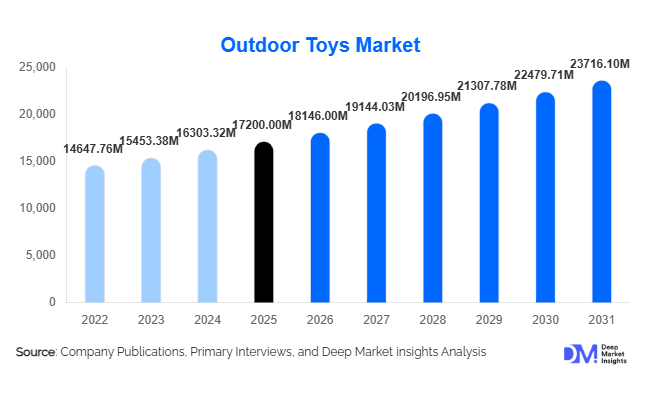
According to Deep Market Insights, the global outdoor toys market size was valued at USD 17,200 million in 2025 and is projected to grow from USD 18,146.00 million in 2026 to reach USD 23,716.10 million by 2031, expanding at a CAGR of 5.5% during the forecast period (2026–2031). The outdoor toys market growth is primarily driven by increasing awareness of physical activity for child development, rising parental focus on reducing screen time, and the growing popularity of backyard play equipment and recreational toys.
Outdoor toys include a wide range of products such as ride-on vehicles, trampolines, sports kits, play structures, water toys, and educational outdoor activity sets designed to encourage physical engagement and social interaction among children. The market has experienced steady expansion due to rising disposable income among families, urban residential development featuring play areas, and the expansion of e-commerce channels that make outdoor toys more accessible globally.
Key Market Insights
- Rising awareness of children’s physical health and active play is increasing demand for outdoor toys such as trampolines, ride-on vehicles, and sports kits.
- Backyard play structures and large playsets are gaining popularity, particularly in North America and Europe, driven by suburban housing trends.
- North America dominates the global market, supported by strong consumer spending on children's recreational products.
- Asia-Pacific is the fastest-growing regional market, driven by increasing middle-class income and growing demand for children’s recreational products in China and India.
- E-commerce platforms are rapidly expanding, enabling toy manufacturers to reach global consumers and showcase diverse product portfolios.
- Eco-friendly materials and sustainable toy manufacturing are emerging as major trends as consumers increasingly prefer environmentally responsible products.
What are the latest trends in the outdoor toys market?
Growing Demand for Eco-Friendly and Sustainable Toys
Sustainability is becoming a defining trend in the outdoor toys industry. Parents are increasingly choosing toys manufactured from environmentally friendly materials such as recycled plastics, bamboo, and sustainably sourced wood. Manufacturers are responding by introducing eco-conscious product lines that reduce plastic content and adopt recyclable packaging. These initiatives not only appeal to environmentally aware consumers but also help companies comply with tightening environmental regulations in major markets such as Europe and North America.
In addition to materials innovation, companies are exploring circular economy practices such as toy recycling programs and modular product designs that extend product life cycles. Eco-friendly playground equipment and biodegradable toy materials are gaining traction among schools and municipal authorities that prioritize sustainability in procurement processes.
Technology-Enhanced Outdoor Play Equipment
The integration of technology into outdoor toys is transforming the traditional play experience. Smart ride-on vehicles with app connectivity, GPS tracking, and safety alerts are increasingly popular among parents seeking enhanced supervision capabilities. Outdoor STEM exploration kits and augmented reality (AR) activity sets are also gaining traction as they combine digital learning with physical outdoor play.
These technology-enabled toys are designed to bridge the gap between digital entertainment and physical activity, encouraging children to spend more time outdoors while still benefiting from interactive learning. The trend is particularly appealing to tech-savvy families and younger parents who prioritize educational value and safety features in toy purchases.
What are the key drivers in the outdoor toys market?
Rising Focus on Physical Activity for Child Development
Growing concerns regarding childhood obesity and sedentary lifestyles are prompting parents, educators, and healthcare organizations to promote outdoor activities for children. Outdoor toys encourage physical exercise, improve motor skills, and foster social interaction among children. As a result, products such as trampolines, climbing frames, and ride-on vehicles are gaining popularity among families seeking active play solutions.
Educational institutions and daycare centers are also investing in outdoor play equipment as part of early childhood development programs. Government initiatives promoting active lifestyles and outdoor recreation further support the adoption of outdoor toys in schools and community playgrounds.
Expansion of E-Commerce and Direct-to-Consumer Sales
The rapid growth of e-commerce platforms has significantly transformed the outdoor toys industry. Online retail channels enable manufacturers to reach a broader customer base while offering consumers convenient product comparisons, detailed reviews, and competitive pricing. Direct-to-consumer brand websites are also becoming increasingly important sales channels as companies invest in digital marketing strategies and personalized shopping experiences.
The availability of large product catalogs, seasonal promotions, and home delivery options through online platforms has further accelerated market growth, particularly in emerging economies where traditional toy retail infrastructure may be limited.
What are the restraints for the global market?
Safety Regulations and Compliance Costs
Outdoor toys must meet strict safety standards to prevent accidents and injuries. Regulatory frameworks such as ASTM safety standards in the United States and EN71 toy safety directives in Europe require manufacturers to adhere to rigorous testing and certification procedures. While these regulations ensure product safety, they also increase production costs and extend product development timelines for manufacturers.
Seasonal Demand Fluctuations
Demand for outdoor toys is often seasonal, with peak sales occurring during summer months and holiday periods in many regions. This seasonality creates inventory management challenges for manufacturers and retailers. Weather conditions and climate variations also influence purchasing behavior, as outdoor play equipment sales tend to decline during colder months in certain regions.
What are the key opportunities in the outdoor toys industry?
Expansion of Outdoor Play Infrastructure in Emerging Markets
Rapid urbanization in emerging economies such as India, China, and Southeast Asian countries is creating significant opportunities for outdoor toy manufacturers. New residential complexes, urban parks, and recreational facilities increasingly include dedicated play areas equipped with swings, slides, and climbing structures. Governments and municipalities are also investing in public playground infrastructure as part of urban development programs aimed at improving community well-being.
These investments create strong demand for commercial-grade outdoor toys and playground equipment, opening new revenue streams for manufacturers targeting institutional buyers and public sector projects.
Integration of Educational and STEM-Based Outdoor Toys
The growing emphasis on experiential learning presents opportunities for manufacturers to develop educational outdoor toys that combine play with skill development. Products such as outdoor science kits, nature exploration tools, and gardening sets encourage curiosity, environmental awareness, and hands-on learning among children.
Schools and educational organizations increasingly incorporate outdoor learning activities into their curricula, driving demand for toys that support STEM education and nature exploration. This trend is expected to create niche growth opportunities for innovative toy manufacturers.
Report Scope
| Report Metric | Details |
|---|---|
| Market Size in 2025 | USD 17200 Million |
| Market Size in 2026 | USD 18146 Million |
| Market Size in 2031 | USD 23716.10 Million |
| CAGR | 5.5% (2026-2031) |
| Base Year for Estimation | 2025 |
| Historical Data | 2022-2024 |
| Forecast Period | 2026-2031 |
| Report Coverage | Revenue Forecast, Competitive Landscape, Supply Chain Disruption, Growth Factors, Environment & Regulatory Landscape and Trends |
| Geographies Covered | North America, Europe, APAC, Middle East and Africa, LATAM |
| Countries Covered | U.S., Canada, U.K., Germany, France, Spain, Italy, Russia, Nordic, Benelux, Rest of Europe, China, Korea, Japan, India, Australia, Singapore, Taiwan, South East Asia, Rest of Asia-Pacific, UAE, Turky, Saudi Arabia, South Africa, Egypt, Nigeria, Rest of MEA, Brazil, Mexico, Argentina, Chile, Colombia, Rest of LATAM |
Explore more data points, trends and opportunities Download Free Sample Report
Product Type Insights
Ride-on toys and vehicles represent the largest product segment within the outdoor toys market, accounting for approximately 27% of global revenue in 2025. This segment includes scooters, pedal cars, battery-powered ride-ons, balance bikes, and mini electric vehicles designed for children. The strong performance of this category is primarily driven by increasing parental focus on toys that combine physical activity with imaginative play. Ride-on toys support the development of coordination, balance, and motor skills while providing engaging entertainment for children.
Play structures and playground equipment such as swing sets, slides, climbing frames, jungle gyms, and playhouses also represent a significant portion of the outdoor toys market. These products are particularly popular among households with backyard spaces and residential communities with shared recreational areas. The segment is driven by increasing investments in backyard entertainment and family-centric outdoor recreation, especially in suburban housing developments. Water and sand toys remain popular seasonal products, particularly in regions with warm climates, as they offer interactive and sensory play experiences for younger children. Additionally, trampolines and inflatable bounce houses are gaining popularity due to their ability to accommodate group play activities and social interaction among children, making them attractive for family gatherings and recreational facilities.
Application Insights
The household consumer segment dominates the outdoor toys market, accounting for nearly 68% of global demand. Families are increasingly investing in outdoor play equipment to encourage children to spend more time outdoors and reduce dependence on digital screens. Products such as trampolines, ride-on vehicles, inflatable pools, and backyard playsets have become common purchases for households seeking to create engaging recreational environments at home. The increasing prevalence of suburban housing with outdoor spaces and the growing emphasis on child wellness and physical activity are key drivers supporting this segment.
Educational institutions and daycare centers represent another important application segment, driven by growing recognition of the role of outdoor play in early childhood development. Schools are increasingly incorporating playground equipment such as slides, climbing frames, and activity structures into their infrastructure to promote physical development, teamwork, and social interaction among students. Governments and educational organizations are also promoting active learning environments that integrate outdoor play with educational activities. Recreational facilities such as amusement parks, resorts, family entertainment centers, and community recreation zones are also contributing to demand in the outdoor toys market. These venues frequently install large outdoor play structures, trampolines, inflatable slides, and adventure playgrounds to enhance visitor engagement and provide family-friendly entertainment experiences. As tourism and leisure industries expand globally, particularly in emerging economies, demand from these commercial applications is expected to increase steadily.
Distribution Channel Insights
Hypermarkets and supermarkets continue to account for a significant share of outdoor toy sales due to their wide product assortments, competitive pricing, and strong promotional campaigns during peak shopping seasons such as summer holidays and festive periods. Large retail chains provide consumers with convenient access to a variety of toy brands and allow families to compare multiple products within a single shopping location. Seasonal promotions and bundled offers further stimulate demand through these retail channels.
Specialty toy stores remain an important distribution channel, particularly for premium and branded outdoor toys. These stores often provide curated product selections and expert recommendations, which are valued by parents seeking high-quality or educational toys. Specialty retailers also play a critical role in introducing innovative outdoor toys and premium play structures that may not be widely available in mass retail outlets. E-commerce platforms have experienced rapid expansion in recent years and now account for approximately 29% of global outdoor toy sales. Online retail channels allow consumers to browse extensive product catalogs, compare prices across brands, and access customer reviews before making purchase decisions. The convenience of home delivery and the availability of seasonal discounts have further accelerated the adoption of online toy shopping. Additionally, many manufacturers are investing in direct-to-consumer (D2C) online platforms to strengthen customer relationships, improve brand loyalty, and offer customized product experiences.
Age Group Insights
Preschool children aged 3–5 years account for the largest share of the outdoor toys market, representing approximately 31% of global demand. At this developmental stage, children actively engage in activities that enhance coordination, balance, and motor skills. Outdoor toys such as slides, ride-on vehicles, sandboxes, and water play equipment are particularly popular among this age group because they provide safe and stimulating environments for exploration and physical activity. The strong demand within this age group is also influenced by parental preferences for toys that encourage early physical development and social interaction. Educational institutions and daycare centers also purchase outdoor play equipment specifically designed for preschool children, further reinforcing the segment’s leading position in the market.
School-age children aged 6–10 years represent another significant segment, with increasing demand for sports equipment, bicycles, scooters, and adventure-style outdoor toys. These products support more physically demanding activities and encourage competitive play and teamwork. Meanwhile, pre-teens and teenagers are increasingly interested in outdoor sports kits, skateboards, and recreational activity products that allow them to participate in outdoor sports and social activities with peers.
Explore more data points, trends and opportunities Download Free Sample Report
Outdoor Toys Market Segmentations
By Product Type
- Ride-On Toys & Vehicles
- Play Structures & Playground Equipment
- Water & Sand Toys
- Sports & Active Play Equipment
- Trampolines & Bounce Toys
- Outdoor Creative & Educational Toys
- Inflatable Outdoor Toys
By Application
- Household Consumers
- Educational Institutions & Daycare Centers
- Commercial Recreation Facilities
- Public Parks & Municipal Playgrounds
By Distribution Channel
- Hypermarkets & Supermarkets
- Specialty Toy Stores
- E-Commerce Platforms
- Direct-to-Consumer Brand Stores
- Institutional / B2B Procurement
By Age Group
- Infants & Toddlers (0–3 Years)
- Preschool Children (3–5 Years)
- School-Age Children (6–10 Years)
- Pre-Teens (11–13 Years)
- Teenagers (14–18 Years)
By Material
- Plastic-Based Outdoor Toys
- Wooden Outdoor Toys
- Metal-Based Outdoor Toys
- Rubber & Foam Toys
- Composite / Eco-Friendly Materials
Regional Insights
North America
North America is the largest regional market for outdoor toys, accounting for approximately 38% of global demand in 2025. The United States represents the dominant market within the region due to high consumer spending on children’s recreational products and widespread availability of backyard play spaces. Suburban housing patterns in the U.S. have historically encouraged the installation of backyard playground equipment, trampolines, and ride-on vehicles, which continue to drive demand.
Another key growth driver in North America is the increasing emphasis on active lifestyles and child wellness. Schools and community organizations are promoting outdoor recreation to counter sedentary lifestyles and excessive screen time among children. Additionally, strong retail infrastructure and a well-developed e-commerce ecosystem allow consumers to access a wide range of outdoor toys from both global and regional manufacturers. Canada also contributes significantly to regional demand, supported by government investments in community playground infrastructure and strong family-oriented recreational culture. Seasonal outdoor activities and public park developments across major Canadian cities further support steady market growth in the region.
Europe
Europe accounts for approximately 21% of the global outdoor toys market, with major demand coming from countries such as Germany, the United Kingdom, and France. The region has a strong tradition of outdoor recreation and public park usage, which encourages families to purchase outdoor play equipment for both private and community use. One of the key drivers of market growth in Europe is the increasing consumer preference for sustainable and eco-friendly toys. European consumers are highly environmentally conscious, prompting manufacturers to develop outdoor toys made from recycled plastics, sustainably sourced wood, and biodegradable materials. Strict regulatory standards such as EN71 toy safety directives also ensure high product quality and safety, which enhances consumer confidence in the market. Furthermore, strong government support for playground infrastructure in schools and public parks continues to stimulate demand for outdoor play equipment across European countries.
Asia-Pacific
Asia-Pacific accounts for roughly 34% of global market revenue and represents the fastest-growing region in the outdoor toys industry. Rapid urbanization, rising disposable incomes, and expanding middle-class populations are key factors driving demand for children’s recreational products in countries such as China, India, and Southeast Asian nations. China plays a dual role in the market as both a major manufacturing hub and a large consumer market for outdoor toys. Rising living standards and increased spending on child development products are encouraging families to invest in recreational toys. In India, growing awareness regarding the importance of physical activity for children and the expansion of modern retail and e-commerce platforms are driving market growth.
Japan and Australia represent mature markets within the region, with stable demand for high-quality outdoor toys and sports equipment. Increasing investments in school playground infrastructure and family entertainment facilities are also contributing to the region’s rapid growth.
Latin America
Latin America accounts for approximately 7% of global market demand, with Brazil and Mexico representing the largest markets in the region. Rapid urbanization and expanding middle-class populations are increasing consumer spending on children’s products, including outdoor toys. Government initiatives aimed at improving public recreational spaces and urban park development are also driving demand for playground equipment and outdoor play structures. Additionally, the growth of organized retail and e-commerce platforms in Latin America is improving consumer access to branded outdoor toys, which is expected to further stimulate regional market growth.
Middle East & Africa
The Middle East and Africa region is experiencing steady growth in the outdoor toys market, supported by increasing investments in family entertainment infrastructure and urban recreational projects. Countries such as the United Arab Emirates and Saudi Arabia are expanding public parks, tourism facilities, and family entertainment zones, which require outdoor play equipment and recreational installations.
Another important growth driver in this region is the rapid expansion of shopping malls and indoor-outdoor entertainment complexes that include dedicated play areas for children. Governments in several Middle Eastern countries are investing heavily in leisure and tourism development as part of economic diversification strategies, which is creating opportunities for outdoor toy manufacturers and playground equipment suppliers. In Africa, increasing investments in urban infrastructure and community recreation programs are gradually expanding the market for outdoor toys, particularly in growing urban centers.
Key Players in the Outdoor Toys Market
- Mattel
- Hasbro
- The LEGO Group
- Step2 Company
- Little Tikes
- Smoby Toys
- Radio Flyer
- Plum Products
- BERG Toys
- Micro Kickboard
- Wham-O
- VTech
- Decathlon
- Spin Master
- PlayMonster