Outdoor Storage Sheds Market Size
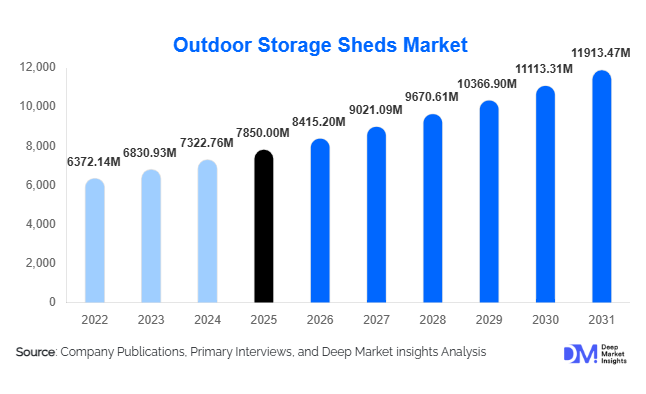
According to Deep Market Insights, the global outdoor storage sheds market size was valued at USD 7,850 million in 2025 and is projected to grow from USD 8,415.20 million in 2026 to reach USD 11,913.47 million by 2031, expanding at a CAGR of 7.2% during the forecast period (2026–2031). The market growth is primarily driven by increasing residential construction, rising interest in backyard optimization and outdoor living, growing DIY trends, and demand for durable, low-maintenance storage solutions.
Key Market Insights
- Plastic/resin sheds dominate globally, accounting for 38% of the market in 2025 due to their durability, low maintenance, and weather resistance.
- Gable roof sheds are highly preferred, holding 30% share, driven by better storage capacity and adaptability to different climates.
- North America leads the market, with the U.S. alone contributing nearly 28% of global demand, supported by high disposable income and suburban backyard adoption.
- Asia-Pacific is the fastest-growing region, projected to expand at 9% CAGR, led by China, India, and Australia, driven by urbanization and rising middle-class affluence.
- Modular, smart, and eco-friendly sheds are emerging trends, with growing adoption in developed markets where smart homes and sustainable products are in demand.
- Online retail channels are gaining traction, complementing traditional offline sales through home improvement stores and specialty retailers.
What are the latest trends in the outdoor storage sheds market?
Modular and Customizable Designs
Consumers increasingly prefer sheds that can be customized in size, design, and material. Modular kits allow flexibility in assembly and expansion, aligning with DIY trends and urban living, where space optimization is crucial. Customizable sheds cater to aesthetic preferences, enabling homeowners to match structures with landscaping and architectural styles. This trend has boosted adoption in residential markets, especially in North America and Europe, where buyers seek both functionality and visual appeal.
Smart and Connected Storage Solutions
Integration of IoT-enabled features such as remote locking systems, climate monitoring, and solar-powered lighting is becoming a differentiating factor. Smart sheds appeal to tech-savvy consumers in developed countries, combining home security and energy efficiency. Manufacturers are leveraging these technologies to create premium product offerings, which also support higher margins while enhancing consumer engagement with value-added features.
What are the key drivers in the outdoor storage sheds market?
Expansion of Residential Construction and Renovation
Rising urban and suburban housing developments are driving shed demand, as homeowners seek to maximize outdoor space. Renovation trends post-pandemic, coupled with increasing disposable incomes, have accelerated investments in backyard storage, gardens, and hobby spaces. Medium-sized sheds (51–150 sq. ft.) lead adoption due to their balance of affordability and storage capacity.
Popularity of Outdoor Living and Gardening
Outdoor lifestyles and gardening have gained significant traction globally, especially in developed countries. Demand for lawn equipment storage, bicycles, and hobby-related structures has grown in tandem with lifestyle trends. Consumers increasingly invest in aesthetically designed sheds that also serve as functional outdoor extensions of their homes.
Material Innovation and Durability
Modern materials, such as high-density polyethylene, galvanized steel, and composite wood-plastic blends, have enhanced product durability while minimizing maintenance. These innovations reduce long-term costs for consumers and increase the lifespan of sheds, encouraging purchase over traditional wooden or low-quality metal alternatives.
What are the restraints for the global market?
Raw Material Price Volatility
Fluctuations in steel, aluminum, and plastic prices can impact manufacturing costs and profit margins. This volatility affects pricing strategies, particularly in regions where imports dominate raw material supply, such as North America and Europe.
Space Constraints and Regulatory Limitations
Urban areas often lack sufficient outdoor space for large sheds. Zoning restrictions and building codes in residential neighborhoods further limit installation possibilities. Such constraints restrict adoption and may slow growth, especially in densely populated cities across Europe and APAC.
What are the key opportunities in the outdoor storage sheds industry?
Emerging Demand in Asia-Pacific and Latin America
Urbanization, rising incomes, and housing developments in China, India, and Brazil are creating new growth pockets. Companies focusing on localized production, price-sensitive models, and regional marketing can capitalize on high-growth potential in these emerging markets. Governments promoting housing infrastructure indirectly support shed demand in these regions.
Integration of Smart Features
The incorporation of IoT-enabled security systems, solar lighting, and climate control offers premium differentiation. Early adoption of smart sheds can provide competitive advantage, especially in developed countries where smart homes are mainstream. These features attract tech-savvy consumers and allow manufacturers to capture higher margins.
Sustainable and Eco-Friendly Materials
Increasing consumer preference for environmentally responsible products is driving demand for sheds made from recycled plastics, sustainably sourced wood, and composites. Green-certified production practices and eco-friendly products can help manufacturers access premium segments and align with global sustainability trends.
Report Scope
| Report Metric | Details |
|---|---|
| Market Size in 2025 | USD 7850 Million |
| Market Size in 2026 | USD 8415.20 Million |
| Market Size in 2031 | USD 11913.47 Million |
| CAGR | 7.2% (2026-2031) |
| Base Year for Estimation | 2025 |
| Historical Data | 2022-2024 |
| Forecast Period | 2026-2031 |
| Report Coverage | Revenue Forecast, Competitive Landscape, Supply Chain Disruption, Growth Factors, Environment & Regulatory Landscape and Trends |
| Geographies Covered | North America, Europe, APAC, Middle East and Africa, LATAM |
| Countries Covered | U.S., Canada, U.K., Germany, France, Spain, Italy, Russia, Nordic, Benelux, Rest of Europe, China, Korea, Japan, India, Australia, Singapore, Taiwan, South East Asia, Rest of Asia-Pacific, UAE, Turky, Saudi Arabia, South Africa, Egypt, Nigeria, Rest of MEA, Brazil, Mexico, Argentina, Chile, Colombia, Rest of LATAM |
Explore more data points, trends and opportunities Download Free Sample Report
Product Type Insights
Gable roof sheds dominate the global outdoor storage sheds market, accounting for approximately 30% of total demand, primarily due to their superior structural efficiency, enhanced storage capacity, and effective water drainage capabilities. The sloped roof design enables better resistance to harsh weather conditions such as heavy rainfall and snow accumulation, making it highly suitable across diverse climatic regions, including North America and Europe. The leading driver for this segment is its versatility in residential applications, where homeowners require durable and spacious storage for gardening tools, seasonal equipment, and recreational items.
Barn-style and lean-to sheds are gaining traction, particularly in agricultural and semi-urban residential applications, driven by their modular expandability and ease of installation. These designs cater to users seeking flexible storage solutions that can be extended or customized over time. Meanwhile, horizontal storage sheds are increasingly preferred in compact urban environments, especially in Europe and parts of the Asia-Pacific, where space constraints necessitate low-profile and space-efficient solutions. A broader market trend indicates a shift toward multi-functional and modular designs, supported by rising DIY culture and demand for aesthetically integrated outdoor structures. This trend is particularly strong in North America and APAC, where consumers are prioritizing convenience, customization, and long-term durability.
Application Insights
Garden and lawn equipment storage remains the leading application, contributing nearly 40% of the global market share in 2025. The primary driver for this dominance is the growing global interest in outdoor living, gardening, and landscaping activities, particularly in developed markets such as the U.S., Canada, Germany, and the U.K. Increased spending on home improvement and backyard enhancement has directly fueled demand for dedicated storage solutions. Tool storage and bicycle storage segments are witnessing rapid growth, especially in urban areas where organized storage is essential for space optimization. This growth is driven by rising urbanization, increasing adoption of bicycles for commuting and recreation, and the need for secure storage in compact residential settings. Additionally, multi-purpose applications, such as sheds used for workshops, home offices, hobby spaces, and fitness areas, are emerging as a strong growth segment. This shift is supported by changing lifestyle patterns, including remote working trends and increased time spent at home.
Agricultural storage, while currently a niche segment, is gaining momentum in developing regions such as the Asia-Pacific and Latin America. The key driver here is the growing need for cost-effective storage solutions among small-scale farmers, particularly for tools, seeds, and equipment. This segment is expected to expand steadily as rural infrastructure improves and mechanization increases.
Distribution Channel Insights
Offline retail channels continue to dominate the market, accounting for approximately 60% of total sales, driven by the consumer preference for physical inspection, product validation, and in-store consultation. Home improvement retailers, specialty stores, and dealer networks play a critical role in influencing purchasing decisions, particularly for mid-range and premium products where quality assessment is a key factor.
However, online channels are experiencing rapid growth, supported by the expansion of e-commerce platforms and direct-to-consumer (D2C) strategies by manufacturers. The leading driver for online channel growth is the increasing availability of detailed product information, customer reviews, competitive pricing, and doorstep delivery options. Additionally, advancements in digital tools such as 3D visualization, virtual assembly guides, and augmented reality are enhancing customer confidence in online purchases. E-commerce is particularly influential in the mid-range and premium segments, where consumers actively compare features and pricing before making decisions. The integration of logistics networks and improved last-mile delivery capabilities further strengthens online channel adoption, especially in emerging markets where physical retail infrastructure may be limited.
End-User Insights
The residential segment dominates the outdoor storage sheds market, accounting for over 65% of total demand in 2025. The primary growth driver for this segment is the expansion of suburban housing and increasing investment in home improvement and outdoor space utilization. Homeowners are increasingly adopting sheds for storage, gardening, and multi-purpose usage, particularly in North America and Europe. Commercial applications, including retail outlets, hospitality establishments, and small businesses, are growing at a robust pace with an estimated CAGR of around 8%. The key driver here is the need for secure and weather-resistant outdoor storage solutions for equipment, supplies, and seasonal inventory. Hotels, resorts, and restaurants are also using sheds for landscaping and maintenance storage.
Industrial and agricultural end-users represent smaller but emerging segments, particularly in the Asia-Pacific. Growth in these segments is driven by infrastructure development, construction activities, and small-scale farming operations. Additionally, export-driven demand plays a significant role, with manufacturing hubs such as China and Southeast Asia supplying sheds to North America and Europe. This global trade dynamic is supported by cost advantages and large-scale production capabilities in these regions.
Explore more data points, trends and opportunities Download Free Sample Report
Outdoor Storage Sheds Market Segmentations
By Material Type
- Metal Sheds
- Plastic/Resin Sheds
- Wood Sheds
- Composite Sheds
By Product Type
- Vertical Storage Sheds
- Horizontal Storage Sheds
- Lean-to Sheds
- Barn-style Sheds
- Gable Roof Sheds
- Custom/Modular Sheds
By Application
- Garden & Lawn Equipment Storage
- Tool Storage
- Vehicle & Bicycle Storage
- Outdoor Living & Hobby Space
- Agricultural Storage
By End-User
- Residential
- Commercial
- Industrial
- Agricultural
By Distribution Channel
- Online Retail
- Offline Retail
Regional Insights
North America
North America leads the global outdoor storage sheds market with approximately 35% market share, with the United States alone contributing nearly 28% of global demand. The region’s dominance is driven by high homeownership rates, widespread suburban housing, and a strong DIY culture. Consumers in the U.S. and Canada actively invest in backyard improvement projects, including storage sheds for gardening, tools, and recreational equipment.
Additional growth drivers include the presence of well-established retail networks, high disposable income levels, and strong adoption of durable materials such as resin and metal. The increasing popularity of outdoor living spaces and home organization solutions further supports demand. Technological adoption, including smart sheds and modular kits, is also higher in this region, contributing to sustained market growth.
Europe
Europe accounts for approximately 25% of the global market share, with key demand centers in Germany, the United Kingdom, and France. The market is driven by strong gardening culture, limited urban space, and increasing preference for organized outdoor storage solutions. European consumers prioritize aesthetic appeal and sustainability, leading to higher adoption of eco-friendly and compact shed designs.
The leading growth drivers in this region include urban space optimization, rising interest in DIY gardening, and stringent environmental regulations promoting sustainable materials. Additionally, the growing penetration of e-commerce and digital platforms among younger consumers is accelerating online sales of sheds across the region.
Asia-Pacific
Asia-Pacific is the fastest-growing region, expanding at an estimated CAGR of ~9%, driven by rapid urbanization and rising disposable incomes in countries such as China, India, and Australia. The region is witnessing increasing adoption of outdoor storage solutions due to expanding residential construction, suburban development, and a growing middle-class population. Key growth drivers include government initiatives supporting housing infrastructure, increasing consumer awareness of space optimization, and the rise of e-commerce platforms. China plays a dual role as both a major manufacturer and exporter, while India is emerging as a high-growth consumption market. Demand for modular, affordable, and easy-to-install sheds is particularly strong in this region.
Latin America
Latin America exhibits moderate growth, with Brazil and Mexico leading regional demand. The market is primarily driven by increasing residential construction and the gradual adoption of outdoor lifestyle trends. Affluent consumers in urban areas are investing in backyard optimization solutions, including storage sheds. Key drivers include rising disposable income, expansion of housing projects, and growing awareness of organized storage solutions. However, market growth is somewhat constrained by economic volatility and limited penetration in rural areas. Mid-range sheds dominate due to price sensitivity among consumers.
Middle East & Africa
The Middle East & Africa region is experiencing gradual growth, supported by ongoing residential and infrastructure development projects in countries such as the UAE, Saudi Arabia, and South Africa. Demand is concentrated in urban centers with higher income levels. The primary growth drivers include increasing urbanization, rising demand for premium outdoor solutions, and expansion of construction activities. High-income consumers in the Middle East are adopting premium and modular sheds, while in Africa, demand is driven by practical storage needs. The market also benefits from imported resin-based sheds and localized manufacturing strategies, enabling cost-effective expansion across the region.
Key Players in the Outdoor Storage Sheds Market
- Lifetime Products Inc.
- Keter Group
- Rubbermaid (Newell Brands)
- Arrow Storage Products
- Suncast Corporation
- ShelterLogic Group
- Tuff Shed Inc.
- Palram Applications
- Duramax (US Polymers Inc.)
- YardMaster International
- Biohort GmbH
- Asgard Secure Steel Storage
- Grosfillex Group
- Craftsman (Outdoor Storage Division)
- Handy Home Products