Outdoor Lighting Market Size
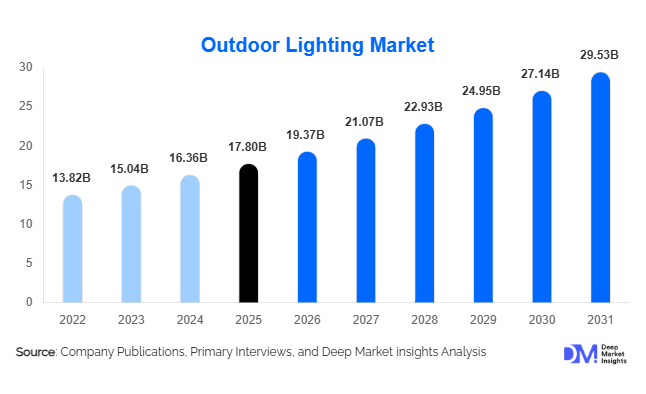
According to Deep Market Insights, the global outdoor lighting market size was valued at USD 17.8 billion in 2025 and is projected to grow from USD 19.37 billion in 2026 to reach USD 29.53 billion by 2031, expanding at a CAGR of 8.8% during the forecast period (2026–2031). The outdoor lighting market growth is primarily driven by rapid urbanization, large-scale infrastructure development, and the global transition toward energy-efficient LED lighting systems.
Outdoor lighting plays a critical role in urban infrastructure by enhancing road safety, improving visibility, supporting nighttime commercial activities, and strengthening security in public spaces. Governments worldwide are accelerating the replacement of conventional high-pressure sodium and metal halide lamps with energy-efficient LED systems to reduce electricity consumption and maintenance costs.
In addition to efficiency improvements, smart lighting technologies are transforming outdoor lighting networks into intelligent infrastructure systems. Integration of IoT sensors, adaptive dimming, centralized control platforms, and motion detection systems allows municipalities and infrastructure operators to optimize energy use and monitor lighting assets remotely. Emerging economies across Asia-Pacific, the Middle East, and Latin America are witnessing strong demand for outdoor lighting due to urban expansion, highway development, and growing smart city investments. Meanwhile, mature markets such as North America and Europe are focusing on large-scale retrofit programs that replace legacy lighting systems with advanced LED and smart lighting solutions.
Key Market Insights
- LED lighting dominates the outdoor lighting market, accounting for over 70% of installations due to its energy efficiency, long lifespan, and declining costs.
- Municipal infrastructure projects such as highways, bridges, and public spaces represent the largest application segment globally.
- Asia-Pacific dominates global demand, supported by rapid urban development and government infrastructure spending in China and India.
- Smart lighting systems integrating IoT connectivity, sensors, and centralized management platforms are gaining rapid adoption in developed markets.
- Solar-powered outdoor lighting is expanding across emerging markets, particularly in rural and off-grid regions.
- Urban beautification initiatives are increasing demand for architectural façade lighting, landscape illumination, and decorative outdoor lighting.
What are the latest trends in the outdoor lighting market?
Smart and Connected Lighting Infrastructure
Smart lighting technologies are transforming the traditional outdoor lighting ecosystem. Modern systems integrate IoT-enabled sensors, wireless communication modules, and centralized management platforms that enable municipalities to control lighting networks remotely. These systems can automatically adjust brightness levels based on traffic patterns, weather conditions, or pedestrian movement, significantly reducing energy consumption. Smart lighting poles are also being deployed as multi-functional urban infrastructure assets that support surveillance cameras, EV charging stations, environmental sensors, and 5G communication nodes. As cities invest in digital infrastructure under smart city initiatives, connected lighting systems are becoming an essential foundation for intelligent urban management.
Rapid Expansion of Solar Outdoor Lighting
Solar-powered outdoor lighting systems are gaining popularity as governments and infrastructure developers seek sustainable alternatives to grid-powered lighting. Solar streetlights combine photovoltaic panels, LED luminaires, and battery storage systems to provide autonomous illumination without dependence on electrical grids. This technology is particularly attractive for rural electrification projects and remote infrastructure developments where grid connectivity is limited. Improvements in solar panel efficiency and battery storage capacity are making solar lighting solutions increasingly cost-effective. Countries across Africa, Southeast Asia, and Latin America are investing heavily in solar street lighting to expand nighttime mobility while minimizing energy costs and environmental impact.
What are the key drivers in the outdoor lighting market?
Global Transition Toward Energy-Efficient Lighting
Energy efficiency regulations and sustainability initiatives are accelerating the global shift from traditional lighting technologies to LED-based outdoor lighting systems. LED luminaires consume significantly less electricity and offer longer operating lifespans compared with high-pressure sodium and metal halide lamps. Governments and municipalities are implementing LED retrofitting programs for public infrastructure to reduce energy costs and carbon emissions. Large-scale LED street lighting projects are being implemented across Europe, North America, and Asia-Pacific, driving strong demand for advanced lighting systems.
Urbanization and Infrastructure Expansion
Rapid urbanization is driving the development of transportation infrastructure, residential complexes, commercial districts, and industrial facilities. Outdoor lighting is a fundamental requirement for ensuring road safety, pedestrian security, and nighttime operations in urban environments. Emerging economies are investing heavily in highways, airports, ports, and logistics hubs, all of which require extensive outdoor lighting systems. In addition, real estate developers are increasingly integrating advanced outdoor lighting to enhance the aesthetic appeal and security of residential and commercial properties.
What are the restraints for the global market?
High Initial Installation Costs
Despite their long-term operational benefits, LED and smart outdoor lighting systems require higher upfront investment compared with traditional lighting technologies. Municipalities often face budget constraints when implementing large-scale lighting upgrades, particularly in developing regions where infrastructure funding is limited. The cost of intelligent control systems, communication networks, and specialized installation services further increases initial project expenses, slowing adoption in some markets.
Integration and Infrastructure Complexity
Advanced outdoor lighting systems require integration with communication networks, software platforms, and sensor technologies. Many cities lack the digital infrastructure necessary to support smart lighting deployments. Additionally, maintenance of connected lighting systems requires skilled technicians and specialized equipment, which can create operational challenges for municipalities with limited technical resources.
What are the key opportunities in the outdoor lighting industry?
Smart City Development Programs
Global smart city initiatives are creating significant opportunities for outdoor lighting manufacturers and technology providers. Lighting infrastructure is increasingly being integrated with urban data networks to support traffic monitoring, environmental sensing, and public safety applications. Governments are investing billions of dollars in digital infrastructure projects where smart lighting systems serve as the backbone for connected urban services. Lighting poles are evolving into multi-functional platforms capable of supporting sensors, cameras, and communication equipment, creating new revenue streams for technology providers.
Urban Beautification and Tourism Infrastructure
City governments are increasingly investing in architectural façade lighting, landscape lighting, and decorative illumination to enhance urban aesthetics and attract tourism. Landmarks, historical monuments, public parks, and waterfront districts are being illuminated with dynamic lighting systems that create visually appealing nighttime environments. These projects not only boost tourism but also stimulate economic activity in the hospitality and retail sectors. As cities compete to create iconic night-time skylines, demand for advanced architectural lighting solutions continues to expand.
Report Scope
| Report Metric | Details |
|---|---|
| Market Size in 2025 | USD 17.8 Billion |
| Market Size in 2026 | USD 19.37 Billion |
| Market Size in 2031 | USD 29.53 Billion |
| CAGR | 8.8% (2026-2031) |
| Base Year for Estimation | 2025 |
| Historical Data | 2022-2024 |
| Forecast Period | 2026-2031 |
| Report Coverage | Revenue Forecast, Competitive Landscape, Supply Chain Disruption, Growth Factors, Environment & Regulatory Landscape and Trends |
| Geographies Covered | North America, Europe, APAC, Middle East and Africa, LATAM |
| Countries Covered | U.S., Canada, U.K., Germany, France, Spain, Italy, Russia, Nordic, Benelux, Rest of Europe, China, Korea, Japan, India, Australia, Singapore, Taiwan, South East Asia, Rest of Asia-Pacific, UAE, Turky, Saudi Arabia, South Africa, Egypt, Nigeria, Rest of MEA, Brazil, Mexico, Argentina, Chile, Colombia, Rest of LATAM |
Explore more data points, trends and opportunities Download Free Sample Report
Product Type Insights
Street and roadway lighting represent the largest product category in the outdoor lighting market, accounting for nearly 38% of global demand. Governments and municipal authorities invest heavily in street lighting systems to ensure road safety, improve visibility, and support nighttime transportation infrastructure. Area and site lighting systems are widely used in parking facilities, industrial complexes, and commercial properties. Architectural and façade lighting is gaining popularity as cities focus on urban beautification and tourism infrastructure development. Flood lighting is commonly deployed in stadiums, airports, construction sites, and industrial facilities where high-intensity illumination is required. Landscape and garden lighting is expanding rapidly in residential developments, luxury hospitality properties, and public parks, reflecting growing emphasis on outdoor aesthetics and nighttime usability of open spaces.
Application Insights
Public infrastructure remains the largest application segment for outdoor lighting systems, driven by investments in highways, bridges, transportation corridors, and urban public spaces. Municipal authorities continue to replace aging lighting infrastructure with LED-based systems that deliver improved energy efficiency and reduced maintenance requirements. Commercial outdoor lighting applications include office complexes, shopping centers, hospitality properties, and mixed-use developments that require reliable illumination for safety and aesthetics. Industrial facilities rely on high-intensity outdoor lighting for operational safety, security monitoring, and logistics operations. Recreational and sports lighting systems are widely used in stadiums, sports arenas, and public recreational facilities, where advanced lighting solutions ensure uniform illumination for events and broadcast requirements.
Distribution Channel Insights
Direct project sales represent the dominant distribution channel in the outdoor lighting market, particularly for large infrastructure projects such as municipal street lighting systems and transportation hubs. Lighting manufacturers often collaborate directly with governments, engineering contractors, and infrastructure developers to deliver customized lighting solutions. Electrical distributors and wholesalers play a key role in supplying lighting products to commercial and residential markets through established retail networks. Lighting contractors and system integrators are increasingly involved in the installation and maintenance of smart lighting systems, offering turnkey solutions that include design, installation, and software integration. E-commerce platforms are gradually emerging as a distribution channel for residential and small commercial outdoor lighting products, providing convenient access to a wide range of lighting fixtures and accessories.
End-Use Industry Insights
Municipal and government infrastructure represents the largest end-use industry for outdoor lighting systems, accounting for nearly 40% of global demand. Governments are investing heavily in street lighting upgrades and smart city infrastructure to improve energy efficiency and urban safety. Commercial real estate developers are increasingly deploying advanced outdoor lighting to enhance property aesthetics and security, particularly in shopping centers, office parks, and hospitality properties. Industrial facilities require robust lighting systems for warehouses, logistics centers, and manufacturing plants that operate around the clock. Transportation infrastructure—including airports, seaports, highways, and railway stations—also represents a rapidly growing end-use segment, driven by expanding global trade and logistics networks.
Explore more data points, trends and opportunities Download Free Sample Report
Outdoor Lighting Market Segmentations
By Product Type
- Street & Roadway Lighting
- Area & Site Lighting
- Architectural & Façade Lighting
- Flood Lighting
- Landscape & Garden Lighting
- Security & Perimeter Lighting
- Decorative & Urban Furniture Lighting
- Sports & Stadium Lighting
- Tunnel Lighting
By Light Source Technology
- LED Lighting
- High-Intensity Discharge (HID)
- Fluorescent Lighting
- Solar-Powered LED Lighting
- Induction Lighting
By Application
- Public Infrastructure Lighting
- Commercial Outdoor Lighting
- Industrial Outdoor Lighting
- Residential Outdoor Lighting
- Recreational & Sports Lighting
- Transportation Infrastructure Lighting
By Distribution Channel
- Direct Project Sales
- Electrical Distributors & Wholesalers
- Lighting Contractors & System Integrators
- E-commerce Platforms
Regional Insights
North America
North America represents approximately 24% of the global outdoor lighting market, led by strong demand in the United States and Canada. Municipal LED retrofit programs and smart city initiatives are driving significant investments in energy-efficient street lighting infrastructure. Cities across the United States are deploying connected lighting systems that enable centralized monitoring and automated brightness control. Canada is also investing in sustainable urban infrastructure, including energy-efficient lighting systems that reduce carbon emissions and operational costs.
Europe
Europe accounts for nearly 22% of global demand for outdoor lighting. Countries such as Germany, the United Kingdom, France, and Italy are leading the transition toward LED and smart lighting technologies. Strict environmental regulations and energy efficiency standards have accelerated the replacement of conventional lighting systems across the region. European cities are also focusing on reducing light pollution while maintaining high levels of urban safety and illumination quality.
Asia-Pacific
Asia-Pacific dominates the global outdoor lighting market with nearly 40% market share. China remains the largest market due to extensive urban development projects and large-scale infrastructure investments. India is also experiencing strong demand for outdoor lighting driven by smart city initiatives, highway expansion, and rapid urbanization. Southeast Asian countries including Indonesia, Vietnam, and Thailand, are investing heavily in transportation infrastructure, creating additional demand for street lighting and area lighting systems.
Latin America
Latin America is witnessing steady growth in outdoor lighting demand, particularly in Brazil and Mexico. Governments in these countries are investing in urban infrastructure modernization and energy-efficient lighting systems to improve public safety and reduce electricity consumption. Commercial real estate development is also contributing to increased demand for outdoor lighting in shopping centers and hospitality properties.
Middle East & Africa
The Middle East is experiencing rapid growth in outdoor lighting demand due to large-scale urban development and tourism infrastructure projects. Countries such as the United Arab Emirates and Saudi Arabia are deploying advanced lighting systems in smart city developments and entertainment districts. In Africa, solar-powered outdoor lighting solutions are gaining popularity as governments expand rural electrification programs and infrastructure development initiatives.
Key Players in the Outdoor Lighting Market
- Signify
- Acuity Brands
- Zumtobel Group
- Osram
- Cree Lighting
- Hubbell Incorporated
- Panasonic Holdings
- Samsung Electronics
- GE Lighting
- Eaton Corporation
- Legrand
- Syska LED Lights
- Crompton Greaves Consumer Electricals
- Fagerhult Group
- Havells India