Outdoor Jacket Market Size
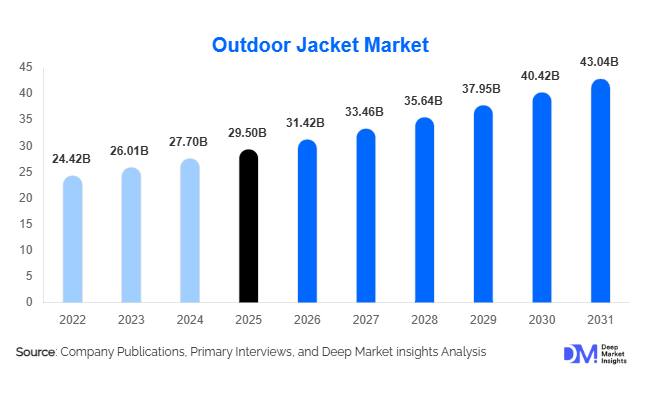
According to Deep Market Insights, the global outdoor jacket market size was valued at USD 29.5 billion in 2025 and is projected to grow from USD 31.42 billion in 2026 to reach USD 43.04 billion by 2031, expanding at a CAGR of 6.5% during the forecast period (2026–2031). The market growth is primarily driven by rising consumer participation in outdoor activities, growing preference for high-performance and sustainable fabrics, and the expansion of urban and adventure-oriented lifestyle apparel.
Key Market Insights
- Insulated jackets dominate the market, offering versatility across seasons and superior thermal protection for outdoor enthusiasts and urban consumers alike.
- Waterproof and softshell jackets are gaining traction, driven by increasing outdoor adventure tourism and changing weather patterns in major regions.
- Online retail is the fastest-growing distribution channel, accounting for nearly one-third of sales due to convenience, wide product selection, and direct-to-consumer strategies.
- Asia-Pacific is the fastest-growing regional market, led by China, India, and South Korea, fueled by rising middle-class affluence and outdoor lifestyle adoption.
- Europe and North America remain significant markets, with demand shaped by high disposable incomes, adventure tourism, and a preference for premium and sustainable jackets.
- Technological integration, including heated jackets, breathable membranes, and smart apparel, is reshaping product offerings and consumer engagement.
What are the latest trends in the outdoor jacket market?
Sustainable and Eco-Friendly Materials
Brands are increasingly adopting recycled fabrics, biodegradable insulation, and low-impact manufacturing processes to meet growing consumer demand for eco-conscious products. This trend not only enhances brand equity but also enables premium pricing. Leading players are actively marketing sustainable collections, leveraging certifications and transparency to differentiate themselves in competitive markets. In Europe and North America, sustainable jackets are gaining popularity among millennials and Gen Z consumers who prioritize environmental responsibility in purchasing decisions.
Integration of Smart and Technical Features
Technological advancements, such as heated elements, GPS-enabled tracking, and moisture-adaptive fabrics, are driving demand for performance-oriented outdoor jackets. These innovations appeal to both professional athletes and casual outdoor enthusiasts seeking safety, comfort, and convenience. Smart apparel also allows brands to introduce interactive features and data-driven customization, creating new product differentiation opportunities. Retailers are increasingly highlighting these capabilities in marketing campaigns to capture tech-savvy consumers.
What are the key drivers in the outdoor jacket market?
Rising Participation in Outdoor Activities
The growing global interest in hiking, trekking, skiing, and urban outdoor recreation is fueling demand for durable, weather-resistant jackets. Increased adventure tourism, fitness awareness, and lifestyle trends are expanding the market beyond traditional outdoor enthusiasts. This trend is particularly strong in North America, Europe, and emerging APAC markets, where outdoor adventure tourism is experiencing a steady rise.
Advancements in Performance Fabrics
Lightweight, breathable, waterproof, and insulated fabrics are enabling jacket manufacturers to meet a wider range of consumer requirements. Innovations such as hybrid insulation, softshell membranes, and sustainable synthetics are increasing functional appeal while supporting premium pricing strategies. Technical performance jackets are especially popular in extreme weather and high-altitude applications, driving growth in specialized segments like mountaineering and skiing.
E-Commerce and Omnichannel Retail Expansion
The growth of online retail platforms, brand D2C websites, and mobile apps is making outdoor jackets more accessible globally. Consumers benefit from extensive product information, customization options, and seamless delivery, further boosting adoption rates. The trend has accelerated post-pandemic and continues to favor brands investing in strong digital engagement and omnichannel strategies.
What are the restraints for the global market?
Seasonal Demand Fluctuations
Sales of outdoor jackets remain influenced by seasonal weather variations, causing uneven demand cycles. Retailers and manufacturers must manage inventory and production schedules carefully to avoid overstocking or stockouts. Seasonal dependency also limits consistent revenue streams, especially for highly specialized jackets such as insulated and waterproof variants.
High Production Costs of Technical Fabrics
Advanced materials like Gore-Tex, recycled insulation, and smart textile components increase production costs. Price-sensitive markets may limit accessibility, and intense competition often compresses margins. Companies must balance innovation with cost-efficiency to sustain profitability and market share.
What are the key opportunities in the outdoor jacket market?
Expansion into Emerging Geographies
Asia-Pacific, Latin America, and parts of Africa offer high-growth potential due to rising disposable incomes, urbanization, and growing interest in outdoor lifestyles. Entry strategies targeting localized design, competitive pricing, and e-commerce penetration can significantly increase revenue opportunities for both new entrants and established players.
Integration of Technology in Apparel
Smart jackets with heated elements, GPS, and performance tracking appeal to tech-savvy consumers and professionals seeking enhanced comfort and safety. This segment presents opportunities for differentiation and premium product offerings, expanding both revenue and brand loyalty.
Sustainability-Driven Product Lines
Consumers are increasingly choosing eco-friendly jackets made from recycled fabrics and low-impact processes. Brands that emphasize sustainability in design, marketing, and supply chain practices can capture high-value segments while aligning with regulatory and social expectations, enhancing long-term growth potential.
Report Scope
| Report Metric | Details |
|---|---|
| Market Size in 2025 | USD 29.5 Billion |
| Market Size in 2026 | USD 31.42 Billion |
| Market Size in 2031 | USD 43.04 Billion |
| CAGR | 6.5% (2026-2031) |
| Base Year for Estimation | 2025 |
| Historical Data | 2022-2024 |
| Forecast Period | 2026-2031 |
| Report Coverage | Revenue Forecast, Competitive Landscape, Supply Chain Disruption, Growth Factors, Environment & Regulatory Landscape and Trends |
| Geographies Covered | North America, Europe, APAC, Middle East and Africa, LATAM |
| Countries Covered | U.S., Canada, U.K., Germany, France, Spain, Italy, Russia, Nordic, Benelux, Rest of Europe, China, Korea, Japan, India, Australia, Singapore, Taiwan, South East Asia, Rest of Asia-Pacific, UAE, Turky, Saudi Arabia, South Africa, Egypt, Nigeria, Rest of MEA, Brazil, Mexico, Argentina, Chile, Colombia, Rest of LATAM |
Explore more data points, trends and opportunities Download Free Sample Report
Product Type Insights
Insulated jackets lead the global outdoor jacket market, accounting for approximately 30% of the 2025 market share. Their dominance is primarily driven by their superior thermal efficiency, multi-season usability, and broad consumer appeal across both extreme outdoor environments and urban settings. The increasing frequency of cold-weather travel, winter sports participation, and demand for lightweight yet high-performance insulation technologies (such as synthetic fill and advanced down alternatives) further strengthens this segment’s leadership. Additionally, innovations in packable insulated jackets and hybrid designs are enhancing portability and versatility, making them attractive to a wider consumer base.
Waterproof jackets represent one of the fastest-growing segments, supported by rising climate variability, unpredictable weather conditions, and increasing participation in adventure tourism activities such as hiking, trekking, and camping. Technological advancements in waterproof-breathable membranes and seam-sealing techniques are improving comfort and durability, further driving adoption. Softshell jackets, on the other hand, are gaining popularity among casual outdoor users and urban consumers due to their flexibility, breathability, and suitability for moderate weather conditions. Their growing use in everyday wear highlights the increasing convergence between performance apparel and lifestyle fashion.
Application Insights
Hiking and trekking remain the dominant application segment, contributing approximately 32% of the total market demand in 2025. This leadership is driven by the global rise in adventure tourism, increasing health and wellness awareness, and the accessibility of hiking as a recreational activity across age groups. Governments and tourism boards worldwide are actively promoting eco-tourism and trail infrastructure, further supporting demand for performance outdoor apparel. Skiing and snow sports represent high-value segments, particularly in North America and Europe, where consumers invest in premium insulated and waterproof jackets for extreme weather conditions. Mountaineering and expedition-based applications also contribute significantly, driven by demand for highly technical, durable jackets capable of withstanding harsh environments.
Urban outdoor wear is an increasingly influential application segment, as consumers adopt outdoor jackets for daily commuting and lifestyle use. This trend is fueled by the growing “athleisure” and “functional fashion” movements, where consumers prioritize comfort, durability, and weather protection in everyday clothing. Emerging applications such as trail running, cycling, and fitness travel are further expanding the market by introducing lightweight and breathable jacket requirements.
Distribution Channel Insights
Online retail dominates the distribution landscape, accounting for approximately 33% of global sales, and continues to expand at the fastest pace. The growth of e-commerce is driven by increasing digital penetration, convenience, competitive pricing, and the ability to access a wide range of global brands. Direct-to-consumer (D2C) strategies adopted by leading manufacturers are further strengthening this channel, enabling brands to improve margins, enhance customer engagement, and offer personalized product recommendations.
Specialty outdoor stores remain highly relevant, particularly for premium and technical jackets, where consumers seek expert guidance, product testing, and brand authenticity. Department stores and mass retailers continue to serve the mid-range and entry-level segments, providing accessibility and price competitiveness. Meanwhile, branded retail stores are gaining traction as companies invest in experiential retail formats to strengthen brand loyalty and showcase product innovation.
Traveler Type Insights
Men’s outdoor jackets dominate the demographic segment, accounting for over 55% of the total market share in 2025. This leadership is primarily driven by historically higher participation rates in outdoor and adventure activities, as well as stronger demand for technical performance gear. However, the women’s segment is witnessing rapid growth, supported by increasing female participation in outdoor sports, fitness activities, and adventure tourism. Brands are responding with gender-specific designs, improved fit, and expanded product portfolios tailored to women.
The youth and kids segment is also expanding steadily, driven by rising family-oriented outdoor activities and increasing awareness of health and fitness from an early age. Urban consumers across all demographics are contributing to market growth by adopting outdoor jackets as part of everyday fashion, blending functionality with style. This shift is particularly evident in metropolitan areas, where weather variability and commuting needs drive demand for versatile outerwear.
Explore more data points, trends and opportunities Download Free Sample Report
Outdoor Jacket Market Segmentations
By Product Type
- Insulated Jackets
- Waterproof Jackets
- Softshell Jackets
- Windproof Jackets
- Fleece Jackets
- Hybrid & Technical Performance Jackets
By Application
- Hiking & Trekking
- Skiing & Snow Sports
- Mountaineering & Expedition
- Camping & Backpacking
- Urban / Everyday Outdoor Wear
- Cycling & Trail Running
By Distribution Channel
- Online Retail
- Sports & Outdoor Specialty Stores
- Department Stores / Mass Retailers
- Direct-to-Consumer (D2C) Brand Stores
Regional Insights
North America
North America holds the largest share of the global outdoor jacket market, accounting for approximately 32% in 2025, led by the United States and Canada. The region’s dominance is driven by a well-established outdoor recreation culture, high disposable income levels, and strong consumer preference for premium and performance-oriented apparel. The presence of leading global brands, advanced retail infrastructure, and widespread adoption of winter sports such as skiing and snowboarding further support demand.
Additionally, increasing awareness of sustainable fashion and eco-friendly products is driving demand for recycled and ethically produced jackets. Government investments in national parks, hiking trails, and outdoor infrastructure are also encouraging participation in outdoor activities, further boosting market growth. The region’s strong e-commerce ecosystem and high digital adoption rates contribute to the rapid expansion of online sales channels.
Europe
Europe accounts for approximately 29% of the global market, with key demand centers in Germany, France, the United Kingdom, Italy, and the Nordic countries. The region’s growth is primarily driven by strong environmental awareness, a preference for sustainable and eco-certified apparel, and a well-established culture of outdoor activities such as hiking, skiing, and mountaineering.
Climatic conditions, particularly in Northern and Alpine regions, create consistent demand for insulated and waterproof jackets. Additionally, stringent environmental regulations and government initiatives promoting sustainable textiles are encouraging manufacturers to innovate in eco-friendly materials. The region also benefits from strong intra-European tourism and outdoor sports events, which drive seasonal demand for high-performance jackets.
Asia-Pacific
Asia-Pacific is the fastest-growing region in the outdoor jacket market, with an expected CAGR of 9–12% during the forecast period. Major contributors include China, India, Japan, and South Korea. Growth in this region is driven by rapid urbanization, rising disposable incomes, and increasing adoption of outdoor lifestyles among the expanding middle class. The influence of social media and digital platforms is significantly shaping consumer preferences, particularly among younger demographics who are adopting outdoor fashion as a lifestyle statement. Government initiatives promoting domestic tourism and outdoor recreation, along with the expansion of e-commerce platforms, are further accelerating market growth. Additionally, Asia-Pacific serves as a major manufacturing hub, supporting both domestic consumption and export-driven demand.
Latin America
Latin America is experiencing steady growth, led by Brazil, Argentina, and Mexico. The region’s expansion is driven by increasing participation in adventure tourism, particularly in mountainous and forested regions, as well as growing urban outdoor trends. Rising disposable incomes among middle- and upper-income groups are supporting demand for premium and mid-range outdoor jackets. Improving retail infrastructure and expanding online platforms are enhancing product accessibility. Additionally, government efforts to promote eco-tourism and outdoor recreation are contributing to long-term market growth. However, price sensitivity remains a key factor influencing purchasing decisions in this region.
Middle East & Africa
The Middle East & Africa region presents emerging opportunities in the outdoor jacket market. Africa benefits from its strong tourism sector, particularly adventure and safari tourism, which drives demand for lightweight and functional outdoor apparel. Government initiatives to promote tourism and infrastructure development are supporting growth in this segment. In the Middle East, countries such as the UAE, Saudi Arabia, and Qatar are witnessing increasing demand for premium and luxury outdoor jackets, driven by high disposable incomes and a growing interest in international travel and winter tourism. The region’s affluent consumer base is particularly inclined toward branded and technologically advanced products. Additionally, increasing participation in outdoor recreational activities such as desert trekking and mountain tourism is contributing to demand growth.