Outdoor Gear & Equipment Market Size
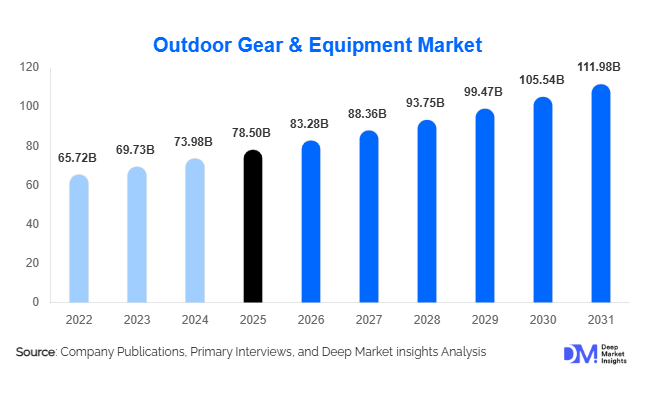
According to Deep Market Insights, the global outdoor gear & equipment market size was valued at USD 78.5 billion in 2025 and is projected to grow from USD 83.28 billion in 2026 to reach USD 111.98 billion by 2031, expanding at a CAGR of 6.1% during the forecast period (2026–2031). Market growth is primarily driven by increasing participation in outdoor recreational activities, rising health and wellness awareness, and the rapid expansion of adventure tourism worldwide. Additionally, technological advancements in lightweight materials and the growing influence of e-commerce platforms are reshaping consumer access and product innovation.
Key Market Insights
- Camping and hiking equipment dominate the market, supported by widespread participation in entry-level outdoor activities globally.
- E-commerce channels lead distribution, accounting for a significant share due to convenience, competitive pricing, and product variety.
- North America holds the largest market share, driven by a strong outdoor culture and high consumer spending.
- Asia-Pacific is the fastest-growing region, fueled by rising disposable incomes and increasing adventure tourism.
- Sustainability is becoming a core purchasing factor, with growing demand for eco-friendly and durable products.
- Technological innovation, including smart gear and advanced materials, is enhancing product performance and user experience.
What are the latest trends in the outdoor gear & equipment market?
Sustainable and Eco-Friendly Product Innovation
Sustainability has become a central trend in the outdoor gear & equipment market, with manufacturers increasingly adopting recycled materials, biodegradable components, and low-impact production processes. Consumers are prioritizing durable and repairable gear to reduce environmental impact, leading brands to introduce circular economy initiatives such as gear recycling and refurbishment programs. Regulatory support in Europe and North America is further accelerating this shift, with stricter environmental standards encouraging innovation in eco-friendly materials. Companies are also incorporating transparency in supply chains, allowing consumers to track the environmental footprint of their purchases, thereby strengthening brand loyalty and long-term market growth.
Technology-Integrated Outdoor Gear
The integration of technology into outdoor equipment is transforming user experiences. Products such as GPS-enabled backpacks, solar-powered chargers, and smart wearable devices are gaining traction among tech-savvy consumers. These innovations enhance safety, navigation, and convenience, particularly for professional adventurers and long-distance trekkers. Mobile applications are also playing a role by providing real-time tracking, route mapping, and weather updates. As digital adoption increases, companies are investing heavily in R&D to develop connected outdoor ecosystems that integrate hardware and software, appealing to younger demographics and expanding the premium product segment.
What are the key drivers in the outdoor gear & equipment market?
Rising Participation in Outdoor Activities
Global interest in outdoor recreation has surged, driven by lifestyle changes and a growing emphasis on physical and mental well-being. Activities such as hiking, camping, and cycling have become mainstream, particularly among urban populations seeking nature-based experiences. This shift has significantly increased demand for entry-level and mid-range outdoor gear, supporting steady market expansion. Governments are also promoting outdoor tourism through infrastructure development, further boosting participation rates and equipment sales.
Expansion of E-commerce and Direct-to-Consumer Channels
The rapid growth of online retail has transformed the outdoor gear market by improving accessibility and product visibility. Consumers can easily compare products, read reviews, and access global brands through digital platforms. Direct-to-consumer models are enabling manufacturers to build stronger relationships with customers while improving margins. The rise of digital marketing and influencer-driven promotions is also accelerating online sales, particularly among younger consumers who prefer convenience and personalized shopping experiences.
What are the restraints for the global market?
High Cost of Premium Equipment
Advanced outdoor gear, particularly that incorporating high-performance materials and smart technologies, often comes at a premium price. This limits adoption in price-sensitive markets and restricts accessibility for entry-level consumers. While mid-range products are gaining popularity, the cost barrier remains a key challenge for expanding the consumer base in emerging economies.
Seasonal Demand and Weather Dependency
The market is highly influenced by seasonal and climatic conditions, with demand for certain products fluctuating based on weather patterns. For example, winter sports equipment sales depend heavily on snowfall levels, while camping gear demand peaks during favorable seasons. This variability creates challenges in inventory management and revenue stability for manufacturers and retailers.
What are the key opportunities in the outdoor gear & equipment industry?
Expansion into Emerging Markets
Emerging economies in the Asia-Pacific and Latin America present significant growth opportunities due to rising disposable incomes and increasing exposure to global travel trends. Countries such as China, India, and Brazil are witnessing growing interest in outdoor activities, supported by urbanization and expanding middle-class populations. Companies that localize product offerings and pricing strategies can effectively capture these untapped markets.
Smart Gear and Technological Integration
The adoption of smart technologies in outdoor equipment offers a high-growth opportunity for manufacturers. Innovations such as IoT-enabled devices, wearable safety systems, and energy-efficient gear are attracting tech-savvy consumers. These products not only enhance user experience but also command higher profit margins, making them attractive for both established players and new entrants.
Report Scope
| Report Metric | Details |
|---|---|
| Market Size in 2025 | USD 78.5 Billion |
| Market Size in 2026 | USD 83.28 Billion |
| Market Size in 2031 | USD 111.98 Billion |
| CAGR | 6.1% (2026-2031) |
| Base Year for Estimation | 2025 |
| Historical Data | 2022-2024 |
| Forecast Period | 2026-2031 |
| Report Coverage | Revenue Forecast, Competitive Landscape, Supply Chain Disruption, Growth Factors, Environment & Regulatory Landscape and Trends |
| Geographies Covered | North America, Europe, APAC, Middle East and Africa, LATAM |
| Countries Covered | U.S., Canada, U.K., Germany, France, Spain, Italy, Russia, Nordic, Benelux, Rest of Europe, China, Korea, Japan, India, Australia, Singapore, Taiwan, South East Asia, Rest of Asia-Pacific, UAE, Turky, Saudi Arabia, South Africa, Egypt, Nigeria, Rest of MEA, Brazil, Mexico, Argentina, Chile, Colombia, Rest of LATAM |
Explore more data points, trends and opportunities Download Free Sample Report
Product Type Insights
Camping and hiking equipment represents the largest product segment, accounting for approximately 32% of the global market in 2025. This dominance is primarily driven by the low entry barriers associated with hiking and camping activities, which require relatively affordable and easy-to-use gear compared to specialized outdoor sports. The rising popularity of weekend travel, national park tourism, and wellness-focused outdoor activities has further accelerated demand for tents, backpacks, and sleeping systems. Additionally, increasing participation from first-time users and family groups continues to expand the addressable market.
Outdoor apparel and footwear constitute the second-largest segment, supported by growing consumer demand for multifunctional, weather-resistant, and performance-enhancing clothing. The trend toward athleisure and everyday outdoor wear has blurred the lines between recreational and casual apparel, significantly boosting sales volumes. Meanwhile, water sports and winter sports equipment remain niche but high-growth segments, driven by increasing participation in adventure tourism and seasonal sports. Innovations in lightweight materials, safety features, and portability are further strengthening adoption across these categories.
Application Insights
Trekking and hiking remain the leading application segment, contributing nearly 28% of the market. The segment’s leadership is driven by its global accessibility, minimal skill requirements, and strong alignment with health and wellness trends. The increasing number of trekking trails, government investments in eco-tourism infrastructure, and rising popularity of solo and group hiking expeditions are key growth drivers.
Camping follows closely, supported by the growing trend of experiential travel, family outings, and recreational vehicle (RV) tourism. Water-based activities and cycling are witnessing rapid growth, particularly among younger demographics seeking adventure and fitness-oriented experiences. The expansion of cycling infrastructure in urban and semi-urban areas is further boosting demand for related equipment. Climbing and mountaineering, although niche, continue to grow steadily due to increasing interest in extreme sports and professional adventure activities, driving demand for high-performance and safety-certified gear.
Distribution Channel Insights
E-commerce dominates the distribution landscape, accounting for approximately 35% of total sales, and continues to gain share due to its ability to offer extensive product variety, competitive pricing, and global accessibility. The convenience of doorstep delivery, combined with detailed product comparisons and user reviews, has significantly influenced consumer purchasing behavior. The rise of digital-native brands and direct-to-consumer (D2C) strategies is further accelerating online sales growth.
Specialty outdoor stores remain critical for premium and technical products, where consumers rely on expert advice and in-store experiences before making high-value purchases. These stores often serve as brand experience centers, offering demonstrations and personalized recommendations. Meanwhile, direct-to-consumer channels are expanding rapidly as companies invest in proprietary digital platforms to improve margins, control brand positioning, and enhance customer engagement. Offline retail formats such as sports chains and hypermarkets continue to contribute, particularly in emerging markets where physical retail penetration remains strong.
End-Use Insights
Individual consumers account for the majority of demand, representing nearly 70% of the market, driven by increasing participation in recreational outdoor activities and lifestyle-driven purchases. The rise of social media influence, fitness awareness, and experiential travel has significantly boosted consumer spending on outdoor gear.
The commercial segment, including adventure tourism operators and outdoor activity service providers, is the fastest-growing end-use category. This growth is fueled by the expansion of organized tourism, where operators invest in high-quality and durable equipment to ensure safety and enhance customer experiences. Institutional buyers, including defense forces, disaster management agencies, and rescue organizations, contribute stable demand. These segments require specialized, high-performance gear, ensuring consistent procurement cycles and long-term contracts for manufacturers.
Explore more data points, trends and opportunities Download Free Sample Report
Outdoor Gear & Equipment Market Segmentations
By Product Type
- Camping & Hiking Equipment
- Climbing & Mountaineering Equipment
- Water Sports Equipment
- Winter Sports Equipment
- Cycling Equipment
- Outdoor Apparel & Footwear
- Accessories & Survival Gear
By Application
- Trekking & Hiking
- Camping
- Climbing & Mountaineering
- Cycling & Mountain Biking
- Water-Based Activities
- Snow & Winter Sports
- Hunting & Fishing
- Adventure Racing & Others
By Distribution Channel
- E-commerce Platforms
- Specialty Outdoor Stores
- Sports Retail Chains
- Direct-to-Consumer (Brand Websites)
- Hypermarkets/Supermarkets
Regional Insights
North America
North America holds the largest share of approximately 38% in 2025, with the United States accounting for the majority of regional demand. The region’s dominance is driven by a deeply ingrained outdoor culture, high disposable incomes, and widespread access to national parks and recreational areas. Government investments in park infrastructure and conservation programs further support participation rates. Additionally, the strong presence of leading outdoor brands, high adoption of premium gear, and early integration of technological innovations such as smart equipment contribute to sustained market leadership. The growing trend of wellness tourism and outdoor fitness activities continues to reinforce demand across product categories.
Europe
Europe accounts for around 27% of the global market, with major contributions from Germany, the UK, and France. Regional growth is strongly influenced by sustainability-driven consumer behavior and stringent environmental regulations promoting eco-friendly products. Government initiatives supporting outdoor recreation, including hiking trails and cycling infrastructure, play a crucial role in driving demand. The region also benefits from a well-established adventure tourism industry, particularly in Alpine regions. Increasing adoption of sustainable materials and circular economy practices is further shaping product innovation and consumer preferences across Europe.
Asia-Pacific
Asia-Pacific is the fastest-growing region, expanding at a CAGR exceeding 7.5%. China and India are the primary growth engines, driven by rising disposable incomes, rapid urbanization, and increasing exposure to global travel trends. Government initiatives promoting domestic tourism and outdoor recreation are significantly boosting participation rates. In China, large-scale investments in tourism infrastructure and winter sports development are accelerating demand, while in India, the growing popularity of trekking and camping is driving entry-level gear sales. Japan and Australia represent mature markets with strong demand for premium and technologically advanced outdoor equipment. The region’s expanding middle class and increasing digital penetration are further supporting e-commerce-driven growth.
Latin America
Latin America holds approximately 5% of the market, with Brazil and Chile leading demand. Regional growth is driven by expanding eco-tourism, increasing government focus on promoting natural attractions, and rising interest in adventure travel. Countries such as Chile benefit from diverse landscapes suitable for trekking and mountaineering, while Brazil’s growing middle class is contributing to increased participation in outdoor recreational activities. Improvements in tourism infrastructure and rising awareness of outdoor fitness are expected to further boost market growth in the region.
Middle East & Africa
The Middle East & Africa region accounts for about 4% of the market, supported by growing tourism initiatives and infrastructure development. In the Middle East, countries such as the UAE and Saudi Arabia are investing heavily in adventure tourism projects, including desert camping and hiking trails, to diversify their economies. In Africa, South Africa leads demand due to its well-established outdoor tourism sector and strong domestic participation. The region’s growth is further driven by increasing government support, rising international tourist inflows, and the development of new outdoor recreational hubs. Despite its smaller market size, the region offers long-term growth potential due to untapped natural resources and expanding tourism ecosystems.
Key Players in the Outdoor Gear & Equipment Market
- VF Corporation
- Amer Sports
- Columbia Sportswear Company
- Patagonia
- The North Face
- Arc’teryx
- Mammut Sports Group
- Black Diamond Equipment
- Yeti Holdings
- Shimano Inc.
- Trek Bicycle Corporation
- Giant Manufacturing
- Johnson Outdoors
- Osprey Packs
- Deuter Sport