Outdoor Furniture Market Size
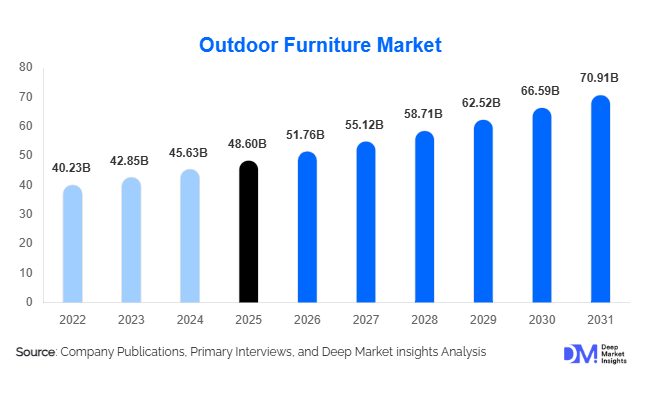
According to Deep Market Insights, the global outdoor furniture market size was valued at USD 48.6 billion in 2025 and is projected to grow from USD 51.76 billion in 2026 to reach USD 70.91 billion by 2031, expanding at a CAGR of 6.5% during the forecast period (2026–2031). The outdoor furniture market growth is primarily driven by increasing investments in outdoor living spaces, rising consumer spending on home improvement, and the rapid expansion of hospitality infrastructure worldwide. Growing demand for aesthetically appealing, weather-resistant, and multifunctional furniture products is reshaping purchasing trends across residential and commercial applications.
Key Market Insights
- Outdoor living spaces are increasingly being designed as extensions of indoor environments, driving strong demand for modular seating, outdoor dining sets, and luxury patio furniture.
- Hospitality and tourism infrastructure development is accelerating commercial outdoor furniture demand, particularly across hotels, resorts, rooftop lounges, cafes, and recreational spaces.
- North America dominates the outdoor furniture market, supported by high residential renovation spending and strong consumer preference for backyard entertainment spaces.
- Asia-Pacific is the fastest-growing regional market, driven by urbanization, premium housing projects, rising disposable incomes, and expanding middle-class populations.
- Sustainable and eco-friendly furniture materials are gaining significant traction, with consumers increasingly preferring recycled plastics, FSC-certified wood, and low-carbon manufacturing processes.
- Technological integration in outdoor furniture, including smart lighting, wireless charging, solar-powered systems, and modular multifunctional designs, is reshaping premium product innovation.
Outdoor Furniture Market Trends
Rise of Sustainable and Eco-Friendly Outdoor Furniture
Sustainability has emerged as one of the most influential trends in the outdoor furniture market. Consumers are increasingly prioritizing environmentally responsible products made from recycled plastics, sustainably sourced wood, bamboo, and recyclable metals. Hospitality operators and luxury residential developers are also integrating eco-conscious procurement strategies into their purchasing decisions. Manufacturers are responding by introducing low-carbon production processes, recyclable packaging, and furniture collections certified under sustainable forestry programs. Synthetic wicker made from recycled polymers and weather-resistant composite materials are gaining popularity because they combine durability with sustainability. The trend is particularly strong in Europe and North America, where environmental regulations and consumer awareness continue to shape buying behavior. Companies investing in circular manufacturing models and sustainable product innovation are achieving stronger brand positioning and premium pricing advantages.
Growth of Smart and Multifunctional Outdoor Furniture
Smart outdoor furniture solutions are rapidly gaining traction across residential and commercial applications. Manufacturers are increasingly integrating wireless charging stations, solar-powered lighting, Bluetooth-enabled speakers, and IoT connectivity into outdoor seating and tables. Multifunctional and modular furniture systems are also becoming highly popular due to space optimization requirements in urban apartments, rooftop spaces, and hospitality lounges. Foldable dining systems, convertible seating arrangements, and storage-integrated furniture products are witnessing growing demand among urban consumers. Luxury hotels and premium resorts are especially investing in technologically enhanced outdoor environments to improve customer experiences and differentiate their properties. Augmented reality visualization tools and digital customization platforms are also enhancing online furniture purchasing experiences globally.
Outdoor Furniture Market Drivers
Growing Demand for Outdoor Living and Home Renovation
The increasing consumer preference for outdoor living spaces is one of the primary drivers supporting outdoor furniture market growth. Homeowners are increasingly transforming patios, balconies, gardens, terraces, and poolside areas into functional leisure environments. Hybrid working models and lifestyle shifts have encouraged consumers to invest more heavily in home improvement projects, including outdoor entertainment and relaxation spaces. Premium outdoor seating, modular lounge systems, and dining furniture are witnessing strong demand in developed economies such as the United States, Canada, Germany, and Australia. Rising spending on luxury residential projects and smart homes is further accelerating the adoption of aesthetically appealing and weather-resistant outdoor furniture products.
Expansion of Hospitality and Commercial Infrastructure
The rapid expansion of hotels, resorts, cafes, restaurants, and entertainment venues globally is driving significant demand for commercial outdoor furniture. Hospitality operators increasingly rely on open-air dining, rooftop lounges, beachfront seating, and poolside leisure areas to enhance customer engagement and maximize seating capacity. Tourism infrastructure investments across the Middle East, Southeast Asia, and Mediterranean Europe are positively impacting demand for premium outdoor furniture collections. Luxury resorts and commercial property developers increasingly prioritize durable, customizable, and visually attractive outdoor furniture solutions that align with premium guest experiences. Growing investments in smart city projects and public recreational infrastructure are also supporting institutional outdoor furniture procurement.
Outdoor Furniture Market Restraints
Volatility in Raw Material Prices
The outdoor furniture market remains highly exposed to fluctuations in raw material costs, particularly for wood, aluminum, steel, and petroleum-based polymers. Rising freight expenses, global supply chain disruptions, and trade tariffs continue to impact production economics for manufacturers. Premium materials such as teak wood and high-grade aluminum are especially vulnerable to pricing volatility, creating challenges for manufacturers attempting to maintain stable margins. Supply shortages and increasing environmental restrictions on timber sourcing also contribute to cost pressures within the industry. Smaller manufacturers operating in highly competitive pricing environments are particularly affected by raw material inflation and transportation cost instability.
Seasonal Demand and Weather Dependency
Outdoor furniture demand remains highly seasonal across major markets such as North America and Europe. Sales volumes typically peak during spring and summer months, while colder weather and prolonged winters negatively impact short-term purchasing activity. Unpredictable climate conditions, including excessive rainfall and heatwaves, can also reduce outdoor leisure spending and delay residential renovation projects. Retailers often face inventory management challenges due to concentrated seasonal demand cycles. In addition, outdoor furniture products require durable weather-resistant construction, increasing manufacturing complexity and production costs for companies operating across varying climatic regions.
Outdoor Furniture Market Opportunities
Expansion of Hospitality and Tourism Infrastructure
The rapid development of global hospitality and tourism infrastructure presents substantial growth opportunities for outdoor furniture manufacturers. Governments across the Middle East, Southeast Asia, and Europe are investing heavily in luxury resorts, tourism projects, smart cities, and mixed-use leisure developments. Outdoor lounges, rooftop restaurants, poolside relaxation zones, and beachfront hospitality concepts require premium weather-resistant furniture products that combine durability with aesthetics. Countries such as the UAE, Saudi Arabia, Thailand, Indonesia, and Vietnam are experiencing particularly strong commercial demand growth. Manufacturers specializing in modular lounge seating, premium dining systems, and customized commercial outdoor solutions are expected to benefit significantly from these infrastructure investments.
Growth of Direct-to-Consumer and E-Commerce Furniture Retail
The increasing adoption of online furniture purchasing is creating major opportunities for both established brands and new market entrants. E-commerce platforms allow manufacturers to expand geographic reach while reducing dependency on physical retail networks. Consumers increasingly prefer online channels due to broader product variety, competitive pricing, customization capabilities, and doorstep delivery convenience. Augmented reality visualization tools and virtual outdoor design platforms are improving online conversion rates by helping customers visualize products within real-life settings. Emerging markets such as India, Brazil, and Southeast Asia are expected to generate particularly strong online outdoor furniture demand as internet penetration and digital payment infrastructure continue expanding.
Report Scope
| Report Metric | Details |
|---|---|
| Market Size in 2025 | USD 48.6 Billion |
| Market Size in 2026 | USD 51.76 Billion |
| Market Size in 2031 | USD 70.91 Billion |
| CAGR | 6.5% (2026-2031) |
| Base Year for Estimation | 2025 |
| Historical Data | 2022-2024 |
| Forecast Period | 2026-2031 |
| Report Coverage | Revenue Forecast, Competitive Landscape, Supply Chain Disruption, Growth Factors, Environment & Regulatory Landscape and Trends |
| Geographies Covered | North America, Europe, APAC, Middle East and Africa, LATAM |
| Countries Covered | U.S., Canada, U.K., Germany, France, Spain, Italy, Russia, Nordic, Benelux, Rest of Europe, China, Korea, Japan, India, Australia, Singapore, Taiwan, South East Asia, Rest of Asia-Pacific, UAE, Turky, Saudi Arabia, South Africa, Egypt, Nigeria, Rest of MEA, Brazil, Mexico, Argentina, Chile, Colombia, Rest of LATAM |
Explore more data points, trends and opportunities Download Free Sample Report
Product Type Insights
Seating sets represent the largest product segment within the outdoor furniture market, accounting for nearly 37% of global revenue in 2025. Consumers increasingly prefer complete outdoor seating arrangements that provide comfort, modularity, and visual consistency across patios, balconies, and poolside spaces. Modular sectional seating systems are gaining popularity due to customization flexibility and space optimization capabilities. Outdoor dining furniture remains another major category, driven by rising outdoor entertainment culture and hospitality sector expansion. Lounge chairs, sunbeds, and daybeds are witnessing strong growth in luxury residential and resort applications. Shade structures, including umbrellas, pergolas, and gazebos, are also increasingly integrated into premium outdoor furniture collections to enhance functionality and climate protection. Smart and multifunctional furniture products featuring storage integration and technology-enabled functionality are rapidly emerging as high-growth product categories.
Material Type Insights
Wood-based outdoor furniture dominates the market with approximately 43% share of global revenue, supported by strong consumer preference for premium aesthetics and natural durability. Teak wood remains highly preferred due to its weather resistance, longevity, and luxury appeal, particularly across high-end residential and hospitality projects. Metal-based furniture, especially aluminum and powder-coated steel, is experiencing rapid growth because of lightweight construction, corrosion resistance, and modern design compatibility. Synthetic wicker and recycled polymer furniture are increasingly popular in both residential and commercial applications due to low maintenance requirements and sustainability benefits. Composite materials combining wood-plastic blends and reinforced fibers are also gaining traction as manufacturers focus on enhancing product durability and reducing environmental impact. Sustainable material innovation is expected to remain a major competitive differentiator throughout the forecast period.
Distribution Channel Insights
Offline retail channels continue to dominate the outdoor furniture market, accounting for nearly 58% of global sales in 2025. Consumers often prefer physical inspection of furniture quality, comfort, and material durability before making high-value purchases. Specialty furniture stores, home improvement retailers, and branded showrooms remain important sales channels globally. However, online retail is the fastest-growing distribution segment due to increasing digital commerce adoption and improved logistics infrastructure. Direct-to-consumer platforms are enabling manufacturers to strengthen margins and customer engagement through customized product offerings and personalized shopping experiences. Omnichannel retail strategies integrating online browsing with in-store experiences are becoming increasingly important for premium brands. Social media marketing, influencer-driven product promotions, and augmented reality visualization tools are also reshaping consumer purchasing behavior across the market.
End-Use Insights
The residential sector remains the dominant end-use segment in the outdoor furniture market, accounting for approximately 64% of global demand in 2025. Increasing investments in home renovation, luxury housing projects, balconies, rooftop spaces, and backyard entertainment areas continue to support strong residential demand growth. Urban apartment owners increasingly prefer compact and multifunctional outdoor furniture solutions optimized for limited spaces. The hospitality sector is the fastest-growing commercial application area due to rising investments in hotels, resorts, rooftop bars, and outdoor dining concepts. Restaurants and cafes increasingly use outdoor seating to expand operational capacity and improve customer experiences. Corporate campuses, educational institutions, public parks, and smart city infrastructure projects are also emerging as important end-use applications for durable outdoor seating and recreational furniture products.
Price Category Insights
Mid-range outdoor furniture products account for the largest share of global demand, representing approximately 46% of total market revenue in 2025. Consumers increasingly seek products that balance affordability, durability, and aesthetic appeal. Premium and luxury outdoor furniture segments are witnessing strong expansion due to rising disposable incomes and growth in luxury residential and hospitality infrastructure. Luxury outdoor collections featuring teak wood, designer fabrics, smart technology integration, and customized modular systems are especially popular among affluent homeowners and premium hospitality operators. Economy outdoor furniture continues to maintain steady demand in price-sensitive markets, supported by mass-market retailers and online platforms offering affordable and functional product options.
Explore more data points, trends and opportunities Download Free Sample Report
Outdoor Furniture Market Segmentations
By Product Type
- Seating Sets
- Dining Furniture
- Loungers & Daybeds
- Outdoor Tables
- Shade & Accessories
- Specialty Outdoor Furniture
By Material Type
- Wood
- Metal
- Plastic & Polymer
- Rattan & Wicker
- Composite & Hybrid Materials
By End Use
- Residential
- Hotels & Resorts
- Restaurants & Cafes
- Corporate & Commercial Spaces
- Public Infrastructure & Recreation
- Institutional & Government Projects
By Distribution Channel
- Offline Retail
- Online Retail
- Direct-to-Consumer Platforms
- Contract & B2B Sales
- Interior Designers & Architects
By Price Category
- Economy
- Mid-Range
- Premium
- Luxury Outdoor Furniture
Regional Insights
North America
North America accounted for approximately 34% of the global outdoor furniture market in 2025, making it the leading regional market. The United States dominates regional demand due to strong residential renovation spending, widespread suburban housing development, and a well-established outdoor entertainment culture. Backyard patios, poolside leisure spaces, and outdoor kitchens are major contributors to consumer spending on premium outdoor furniture products. The hospitality sector also supports strong commercial demand through hotel, resort, and restaurant expansion. Canada demonstrates stable growth due to rising outdoor lifestyle adoption and increasing investments in residential landscaping and leisure infrastructure.
Europe
Europe represented nearly 28% of the global outdoor furniture market revenue in 2025. Germany, the United Kingdom, France, Italy, and Spain are among the largest contributors to regional demand. European consumers strongly prioritize sustainable materials, premium craftsmanship, and minimalist design aesthetics. Tourism-driven economies such as Spain, Italy, and Greece generate substantial commercial demand from hotels, restaurants, and beachside hospitality infrastructure. Northern European countries increasingly invest in weather-resistant outdoor furniture products capable of withstanding harsh climatic conditions. Sustainability certifications and recyclable materials are becoming critical purchasing factors across the region.
Asia-Pacific
Asia-Pacific is the fastest-growing regional market, accounting for nearly 24% of global revenue in 2025. China dominates regional manufacturing and consumption due to strong urbanization, residential construction activity, and expanding middle-class spending power. India is emerging as one of the fastest-growing country markets globally, supported by premium housing projects, hospitality expansion, and rising e-commerce penetration. Australia maintains strong demand for outdoor furniture due to outdoor lifestyle preferences and favorable climatic conditions. Japan and South Korea contribute significantly through compact urban outdoor furniture demand and premium residential renovation activity. Increasing tourism infrastructure investments across Southeast Asia are also positively impacting regional growth.
Latin America
Latin America represents a steadily growing market for outdoor furniture, led primarily by Brazil and Mexico. Brazil benefits from strong residential housing activity and outdoor leisure culture, while Mexico supports growth through tourism infrastructure development and export-oriented manufacturing operations. Rising middle-class incomes and increasing urbanization across Chile, Colombia, and Argentina are also contributing to market expansion. Commercial demand from resorts, beachfront hotels, and outdoor dining establishments remains a major growth contributor within the region.
Middle East & Africa
The Middle East & Africa region is witnessing robust growth due to expanding tourism investments, luxury hospitality infrastructure, and smart city developments. The UAE and Saudi Arabia are major demand centers driven by large-scale resort developments, luxury residential projects, and premium outdoor leisure concepts. Rooftop hospitality spaces, poolside lounges, and beachfront tourism infrastructure are generating substantial commercial demand for high-end outdoor furniture products. South Africa remains a leading African market due to tourism activity and hospitality sector growth. The region is expected to experience strong premium segment expansion throughout the forecast period.
Key Players in the Outdoor Furniture Market
- Brown Jordan
- Herman Miller
- IKEA
- Ashley Furniture Industries
- Agio International
- Century Furniture
- Homecrest Outdoor Living
- Keter Group
- Dedon
- Gloster Furniture
- Royal Botania
- Tuuci
- Inter IKEA Systems
- Manutti
- EMU Group