Outdoor Fabric Market Size
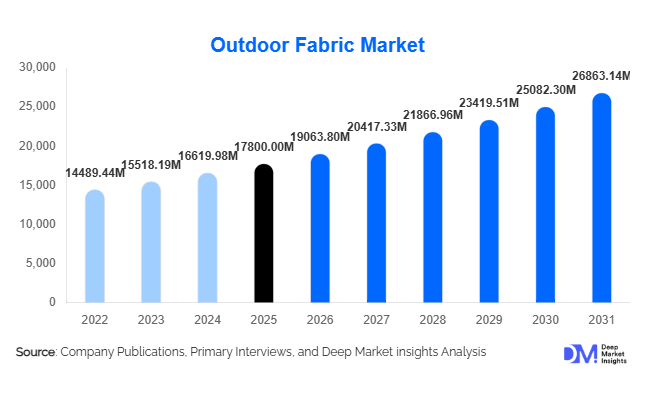
According to Deep Market Insights, the global outdoor fabric market size was valued at USD 17,800 million in 2025 and is projected to grow from USD 19,063.80 million in 2026 to reach USD 26,863.14 million by 2031, expanding at a CAGR of 7.1% during the forecast period (2026–2031). The outdoor fabric market growth is primarily driven by increasing consumer preference for outdoor living spaces, rising investments in hospitality infrastructure, and advancements in high-performance textile technologies designed for durability and weather resistance.
Key Market Insights
- Outdoor living trends are significantly boosting demand, particularly in residential patios, gardens, and balconies across urban regions.
- Performance fabrics with UV resistance and water repellency dominate demand, driven by durability requirements in extreme weather conditions.
- North America leads the global market, supported by high consumer spending on home improvement and outdoor furnishings.
- Asia-Pacific is the fastest-growing region, driven by rapid urbanization and increasing disposable income in countries like China and India.
- Sustainability is emerging as a key differentiator, with rising adoption of recyclable fibers and eco-friendly production methods.
- Technological advancements, including solution-dyed fabrics and nano-coatings, are enhancing product lifespan and performance.
What are the latest trends in the outdoor fabric market?
Sustainable and Eco-Friendly Fabric Innovation
The outdoor fabric industry is witnessing a strong shift toward sustainability, with manufacturers focusing on recyclable materials, bio-based fibers, and low-impact production processes. Solution-dyed fabrics, which consume less water and energy, are becoming industry standards. Companies are also investing in closed-loop recycling systems and adopting certifications for environmental compliance. This trend is driven by both regulatory pressure and growing consumer demand for eco-conscious products, particularly in developed markets. Sustainability is no longer a niche offering but a central strategy shaping product development and brand positioning.
Rise of Smart and Functional Textiles
Technological innovation is transforming outdoor fabrics into multifunctional solutions. Advanced coatings now offer self-cleaning, anti-microbial, and temperature-regulating properties. Emerging applications include sensor-integrated fabrics for environmental monitoring and energy-efficient shading systems. These innovations are particularly relevant in commercial and industrial settings where performance and longevity are critical. The integration of smart textiles is also opening opportunities in premium segments, allowing manufacturers to differentiate through value-added features.
What are the key drivers in the outdoor fabric market?
Growing Demand for Outdoor Living Spaces
The increasing popularity of outdoor living areas is a major driver of the outdoor fabric market. Consumers are investing in aesthetically appealing and durable outdoor furniture, driving demand for high-performance fabrics. This trend has accelerated post-pandemic, as people prioritize home improvement and lifestyle upgrades. Urban housing developments are increasingly incorporating outdoor spaces, further boosting demand for upholstery, awnings, and decorative fabrics.
Expansion of Hospitality and Tourism Infrastructure
The global growth of the hospitality sector is significantly contributing to market expansion. Hotels, resorts, and restaurants are investing in outdoor seating and décor to enhance customer experience. This has led to increased demand for premium outdoor fabrics that combine durability with visual appeal. Tourism-driven economies in regions such as the Middle East and Southeast Asia are particularly strong contributors to this trend.
Advancements in Fabric Engineering
Technological advancements in textile manufacturing are improving product performance and longevity. Innovations such as UV-resistant coatings, water-repellent finishes, and mold-resistant treatments are enhancing the functional value of outdoor fabrics. These advancements are encouraging adoption across new applications, including automotive exteriors and industrial covers, thereby expanding the overall market scope.
What are the restraints for the global market?
Volatility in Raw Material Prices
The outdoor fabric market is heavily dependent on petrochemical-based raw materials such as polyester and acrylic. Fluctuations in crude oil prices directly impact production costs, leading to pricing instability and margin pressures for manufacturers. This volatility poses challenges in maintaining competitive pricing while ensuring product quality.
Availability of Low-Cost Substitutes
The presence of low-cost and counterfeit products, particularly in emerging markets, acts as a restraint on market growth. These alternatives often compromise on quality and durability, affecting consumer trust and slowing the adoption of premium outdoor fabrics. Price-sensitive consumers may opt for cheaper options, limiting the growth potential of high-performance segments.
What are the key opportunities in the outdoor fabric industry?
Expansion in Emerging Markets
Rapid urbanization and infrastructure development in Asia-Pacific, the Middle East, and Latin America present significant growth opportunities. Increasing disposable income and evolving lifestyle preferences are driving demand for outdoor furnishings and fabrics. Governments promoting tourism and smart city initiatives are further boosting market potential, creating opportunities for manufacturers to expand geographically.
Integration of Smart Textile Technologies
The development of smart fabrics with advanced functionalities such as temperature control, self-cleaning properties, and environmental responsiveness is opening new avenues for growth. These innovations enable manufacturers to target high-value segments and differentiate their offerings in a competitive market. The adoption of such technologies is expected to accelerate in commercial and industrial applications.
Sustainable Product Development
The growing emphasis on sustainability offers opportunities for companies to innovate and capture environmentally conscious consumers. Investments in recyclable materials, eco-friendly coatings, and energy-efficient production processes are likely to drive long-term growth. Companies that align with global sustainability standards can gain a competitive advantage and access premium market segments.
Report Scope
| Report Metric | Details |
|---|---|
| Market Size in 2025 | USD 17800 Million |
| Market Size in 2026 | USD 19063.80 Million |
| Market Size in 2031 | USD 26863.14 Million |
| CAGR | 7.1% (2026-2031) |
| Base Year for Estimation | 2025 |
| Historical Data | 2022-2024 |
| Forecast Period | 2026-2031 |
| Report Coverage | Revenue Forecast, Competitive Landscape, Supply Chain Disruption, Growth Factors, Environment & Regulatory Landscape and Trends |
| Geographies Covered | North America, Europe, APAC, Middle East and Africa, LATAM |
| Countries Covered | U.S., Canada, U.K., Germany, France, Spain, Italy, Russia, Nordic, Benelux, Rest of Europe, China, Korea, Japan, India, Australia, Singapore, Taiwan, South East Asia, Rest of Asia-Pacific, UAE, Turky, Saudi Arabia, South Africa, Egypt, Nigeria, Rest of MEA, Brazil, Mexico, Argentina, Chile, Colombia, Rest of LATAM |
Explore more data points, trends and opportunities Download Free Sample Report
Material Type Insights
Polyester dominates the outdoor fabric market, accounting for approximately 38% of the global share in 2025. Its widespread adoption is attributed to cost-effectiveness, durability, and versatility across applications. Acrylic fabrics follow closely, particularly in premium segments, due to superior UV resistance and color retention. Polyolefin fabrics are gaining traction for their lightweight and moisture-resistant properties, while natural fibers such as cotton are limited to niche applications due to lower durability. Blended fabrics are emerging as a balanced solution, combining performance and aesthetic appeal.
Application Insights
Upholstery remains the largest application segment in the outdoor fabric market, contributing nearly 35% of the total market share in 2025. This dominance is primarily driven by the rapid expansion of outdoor living concepts across residential and commercial spaces, where consumers increasingly invest in patio furniture, garden seating, and balcony décor. The shift toward lifestyle-oriented housing, particularly in urban environments, has accelerated the demand for durable, weather-resistant, and aesthetically appealing upholstery fabrics. Additionally, the hospitality sector, including hotels, resorts, and restaurants, is heavily investing in outdoor seating infrastructure to enhance customer experience, further strengthening this segment’s leadership.
Awnings and canopies represent another significant application area, supported by growing demand for energy-efficient shading solutions in residential buildings, commercial complexes, and public infrastructure. These fabrics help reduce indoor heat gain, aligning with sustainability goals and energy-saving regulations. Marine applications are witnessing steady growth, driven by rising recreational boating, yacht ownership, and marine tourism, particularly in North America and Europe. Outdoor fabrics used in this segment require high resistance to UV exposure, saltwater, and harsh weather, making them a premium sub-segment. Automotive applications, including convertible tops, covers, and protective coatings, are also expanding steadily due to increasing demand for high-performance materials that combine durability with lightweight properties, particularly in luxury and specialty vehicles.
Distribution Channel Insights
Direct B2B sales dominate the outdoor fabric market, accounting for approximately 45% of total distribution in 2025. This leadership is driven by large-scale procurement by industries such as hospitality, construction, automotive, and marine, where bulk purchasing, long-term contracts, and product customization are critical requirements. Manufacturers often engage directly with these clients to provide tailored solutions, ensuring consistent quality and performance standards.
Specialty stores play a crucial role in the premium segment, offering curated product portfolios and technical expertise to customers seeking high-performance or designer outdoor fabrics. These stores cater primarily to architects, interior designers, and high-end residential buyers. Meanwhile, online retail is emerging as the fastest-growing channel, fueled by increasing digital adoption, e-commerce penetration, and the availability of a wide range of products with transparent pricing. Consumers, particularly in urban areas, are increasingly purchasing outdoor fabrics online for DIY and small-scale projects. Wholesale distributors continue to serve regional markets and small businesses, ensuring product accessibility across fragmented geographies and supporting supply chain efficiency in emerging economies.
End-Use Industry Insights
The residential segment leads the outdoor fabric market with approximately 40% share in 2025, driven by strong home improvement trends, increasing disposable income, and the growing popularity of outdoor living spaces. Consumers are prioritizing comfort, aesthetics, and durability in outdoor décor, leading to higher adoption of performance fabrics in furniture, cushions, and decorative elements. The rise of compact urban housing with balconies and terraces has further amplified demand in this segment.
The commercial segment, particularly hospitality, is the fastest-growing end-use category, supported by global tourism expansion and increasing investments in outdoor dining and leisure spaces. Hotels, resorts, and restaurants are continuously upgrading their outdoor infrastructure to create immersive customer experiences, driving demand for premium and long-lasting fabrics. The marine and automotive industries contribute to steady demand, especially in high-value applications requiring superior durability and resistance to environmental stress. Industrial applications, including construction covers, agricultural shading systems, and equipment protection, are gaining traction in emerging markets, where infrastructure development and mechanization are driving new use cases for outdoor fabrics.
Explore more data points, trends and opportunities Download Free Sample Report
Outdoor Fabric Market Segmentations
By Material Type
- Polyester
- Acrylic
- Polyolefin
- Nylon
- Cotton & Natural Fibers
- Blended Fabrics
By Application
- Upholstery
- Awnings & Canopies
- Marine Applications
- Automotive Exterior
- Protective Covers
- Outdoor Apparel & Accessories
By Distribution Channel
- Direct B2B Sales
- Specialty Stores
- Online Retail
- Wholesale Distributors
By End-Use Industry
- Residential
- Commercial
- Marine Industry
- Automotive Industry
- Industrial
Regional Insights
North America
North America accounts for approximately 30% of the global outdoor fabric market in 2025, with the United States representing the largest share within the region. The market is driven by high consumer spending on home improvement, a strong culture of outdoor living, and widespread adoption of premium outdoor furniture. The region also benefits from advanced manufacturing capabilities and early adoption of innovative fabric technologies such as solution-dyed and eco-friendly materials. Additionally, the presence of a well-established hospitality industry and increasing investments in outdoor commercial spaces further support market growth. Seasonal climate variations, including high UV exposure in certain states, also drive demand for protective and durable outdoor fabrics.
Europe
Europe holds around 25% of the global market share, with key demand centers in Germany, France, Italy, and the United Kingdom. The region’s growth is strongly influenced by stringent environmental regulations and a high level of consumer awareness regarding sustainability, driving the adoption of eco-friendly and recyclable outdoor fabrics. The automotive industry, particularly in Germany and Italy, contributes significantly to the demand for high-performance fabrics used in convertible tops and protective applications. Additionally, Europe’s mature hospitality and tourism sectors continue to invest in outdoor infrastructure, while architectural trends emphasizing outdoor living spaces further boost market demand.
Asia-Pacific
Asia-Pacific is the fastest-growing region in the outdoor fabric market, with a projected CAGR exceeding 8% during the forecast period. China dominates global production due to its large-scale manufacturing capabilities and cost advantages, while India is emerging as a key consumption market driven by rapid urbanization, rising middle-class income, and increasing residential construction. Southeast Asian countries are also witnessing strong demand growth, supported by tourism development and infrastructure expansion. The region’s growth is further fueled by government initiatives promoting manufacturing, such as “Make in India” and “Made in China 2026,” as well as increasing exports to North America and Europe.
Middle East & Africa
The Middle East & Africa region is experiencing steady growth, driven by large-scale investments in tourism, hospitality, and infrastructure development in countries such as the UAE, Saudi Arabia, and South Africa. The region’s hot climate creates a strong demand for UV-resistant and heat-reflective outdoor fabrics, particularly for shading systems, awnings, and outdoor seating areas. Mega-projects, luxury resorts, and smart city developments are further accelerating demand. In Africa, growing urbanization and increasing construction activities are contributing to market expansion, although at a relatively moderate pace compared to the Middle East.
Latin America
Latin America shows moderate growth, with Brazil and Mexico leading the market. The region’s expansion is supported by residential construction growth, improving economic conditions, and increasing consumer awareness of outdoor living trends. The hospitality sector, particularly in tourist destinations, is driving demand for outdoor fabrics in commercial applications. Additionally, favorable climatic conditions in many parts of the region encourage outdoor lifestyles, supporting steady demand for furniture and shading solutions. However, market growth is somewhat constrained by economic volatility and price sensitivity, which influence the adoption of premium outdoor fabric products.
Key Players in the Outdoor Fabric Market
- Glen Raven Inc.
- Serge Ferrari Group
- Sattler AG
- Parà Group
- Twitchell Corporation
- Phifer Incorporated
- Herculite Products
- Heytex Group
- Mehler Technologies
- Trelleborg AB
- Saint-Gobain Performance Plastics
- Recasens USA
- Awning Technologies
- Sunbrella
- Dickson Constant