Online Laundry Service Market Size
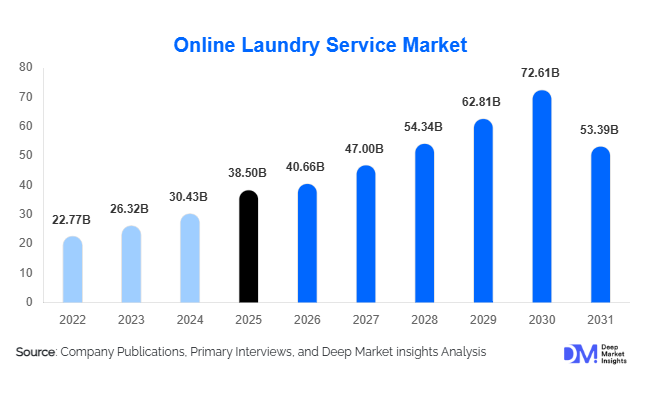
According to Deep Market Insights, the global online laundry service market size was valued at USD 38.5 billion in 2025 and is projected to grow from USD 40.66 billion in 2026 to reach USD 53.39 billion by 2031, expanding at a CAGR of 15.6% during the forecast period (2026–2031). The market growth is primarily driven by increasing urbanization, rising demand for convenience-based services, and the rapid adoption of digital platforms for household service management. The shift toward time-saving solutions among dual-income households and working professionals is significantly boosting demand for app-based laundry services globally.
Key Market Insights
- Convenience-driven consumption patterns are accelerating demand, with consumers increasingly outsourcing routine household tasks such as laundry.
- Doorstep pickup and delivery services dominate, accounting for a majority share due to time efficiency and ease of access.
- North America leads the market, supported by high disposable income and strong digital infrastructure.
- Asia-Pacific is the fastest-growing region, driven by urbanization and rising smartphone penetration in countries like India and China.
- Commercial demand from hospitality and healthcare sectors is rising, contributing to high-volume service contracts.
- Technology adoption, including AI-based logistics, automated laundry systems, and smart lockers, is transforming operational efficiency.
What are the latest trends in the online laundry service market?
Technology-Driven Laundry Ecosystems
The online laundry service market is witnessing rapid adoption of advanced technologies such as AI-driven route optimization, IoT-enabled washing systems, and automated sorting facilities. These innovations are enabling service providers to improve turnaround times, reduce operational costs, and maintain consistent service quality. Mobile applications now offer real-time order tracking, digital payments, and subscription management, enhancing user experience. Smart lockers and contactless delivery models are also gaining popularity, especially in urban residential complexes and corporate campuses. Additionally, data analytics is being used to forecast demand patterns, optimize pricing, and personalize service offerings, making operations more scalable and efficient.
Shift Toward Eco-Friendly and Sustainable Laundry Solutions
Sustainability is emerging as a key trend shaping the market. Companies are increasingly adopting water-efficient machines, biodegradable detergents, and energy-saving processes to reduce environmental impact. Consumers are becoming more environmentally conscious and prefer service providers that follow sustainable practices. Many companies are introducing green laundry services, promoting reduced water consumption and chemical-free cleaning methods. Regulatory pressures and environmental compliance standards are further encouraging the adoption of eco-friendly practices, particularly in developed markets such as Europe and North America. This trend is expected to strengthen brand differentiation and customer loyalty in the long term.
What are the key drivers in the online laundry service market?
Rapid Urbanization and Busy Lifestyles
The increasing urban population and the rise of dual-income households are significantly driving demand for online laundry services. Consumers in metropolitan areas have limited time for household chores, leading to increased reliance on outsourced services. The growing working population and hectic schedules are making convenience services a necessity rather than a luxury, thereby accelerating market growth.
Growth in Digital and Mobile Platform Adoption
The widespread use of smartphones and mobile applications has revolutionized service accessibility. Consumers can easily schedule pickups, track orders, and make payments through digital platforms. The integration of user-friendly interfaces, subscription models, and personalized recommendations is enhancing customer engagement and retention. This digital transformation is a major driver of market expansion across both developed and emerging economies.
What are the restraints for the global market?
High Operational and Logistics Costs
The need for efficient logistics, including pickup and delivery services, significantly increases operational expenses. Costs related to transportation, labor, and fuel can impact profitability, especially in low-density or semi-urban areas. Maintaining cost efficiency while ensuring timely service delivery remains a key challenge for market participants.
Fragmented Market and Quality Variability
The presence of numerous small-scale and local service providers leads to inconsistent service quality across regions. Standardization of processes, maintaining hygiene standards, and ensuring uniform customer experience are major challenges. This fragmentation can hinder brand trust and scalability for larger players.
What are the key opportunities in the online laundry service industry?
Expansion into Emerging Urban Markets
Tier-2 and Tier-3 cities represent a significant untapped opportunity for online laundry service providers. Rising disposable incomes, increasing urbanization, and growing digital adoption in these regions are creating new demand pockets. Companies that establish early presence in these markets can benefit from lower competition and high growth potential.
B2B Institutional Partnerships
The commercial segment, particularly hospitality, healthcare, and corporate sectors, offers substantial growth opportunities. Hotels, hospitals, and co-living spaces are increasingly outsourcing laundry operations to specialized service providers. Long-term contracts with these institutions provide stable revenue streams and enable operational scalability through centralized processing units.
Service Type Insights
Wash & fold services dominate the online laundry service market, accounting for approximately 34% of the global share in 2025. This leadership is primarily driven by their affordability, standardized processing, and high-frequency usage for everyday laundry needs. Urban households, particularly in densely populated cities, rely heavily on this segment due to time constraints and cost-effectiveness. Additionally, operational scalability for service providers is highest in this category, enabling bulk processing and optimized margins. Dry cleaning services represent a significant premium segment, driven by increasing demand for delicate fabric care, formal wear maintenance, and specialized garment treatment. Growth in corporate employment, luxury apparel consumption, and occasion-based clothing usage is supporting this segment globally. Ironing and pressing services continue to be widely adopted as add-on offerings, particularly in urban regions where professional presentation standards are high.
Premium services such as stain removal, shoe and leather cleaning, and household textile cleaning (including curtains, carpets, and bedding) are gaining traction among high-income consumers. These services are benefiting from rising disposable income and growing awareness of professional fabric care. Meanwhile, subscription-based laundry services are emerging as a rapidly growing sub-segment, driven by demand for predictable pricing, convenience, and recurring service delivery. These models are particularly popular among working professionals, co-living residents, and students.
Report Scope
| Report Metric | Details |
|---|---|
| Market Size in 2025 | USD 38.5 Billion |
| Market Size in 2026 | USD 40.66 Billion |
| Market Size in 2031 | USD 53.39 Billion |
| CAGR | 15.6% (2026-2031) |
| Base Year for Estimation | 2025 |
| Historical Data | 2022-2024 |
| Forecast Period | 2026-2031 |
| Report Coverage | Revenue Forecast, Competitive Landscape, Supply Chain Disruption, Growth Factors, Environment & Regulatory Landscape and Trends |
| Geographies Covered | North America, Europe, APAC, Middle East and Africa, LATAM |
| Countries Covered | U.S., Canada, U.K., Germany, France, Spain, Italy, Russia, Nordic, Benelux, Rest of Europe, China, Korea, Japan, India, Australia, Singapore, Taiwan, South East Asia, Rest of Asia-Pacific, UAE, Turky, Saudi Arabia, South Africa, Egypt, Nigeria, Rest of MEA, Brazil, Mexico, Argentina, Chile, Colombia, Rest of LATAM |
Explore more data points, trends and opportunities Download Free Sample Report
Service Model Insights
On-demand services lead the market with a share of approximately 58% in 2025, driven by consumer preference for flexibility, instant service access, and pay-per-use convenience. This model aligns well with modern consumption behavior, where users prefer avoiding long-term commitments. The rise of mobile apps and real-time booking systems has further strengthened the adoption of on-demand services globally. Subscription-based models are gaining traction, particularly among frequent users who seek cost efficiency and service reliability. These models offer bundled pricing, scheduled pickups, and priority service, making them attractive for households with consistent laundry needs. The predictability of demand also helps service providers optimize operations and logistics.
Hybrid models combining subscription and on-demand services are emerging as a strategic growth avenue. These models allow companies to balance recurring revenue streams with flexibility, improving customer retention and lifetime value. Increasing competition in the market is encouraging providers to adopt such hybrid strategies to differentiate their offerings and enhance user engagement.
End-User Insights
The residential segment dominates the market with approximately 65% share in 2025, supported by rising urbanization, smaller living spaces, and increasing reliance on outsourced household services. The growth of dual-income households and time-constrained consumers is a key driver for this segment. Additionally, younger demographics and millennials are more inclined toward app-based service consumption, further boosting residential demand. The commercial segment is the fastest-growing, driven by high-volume requirements and increasing outsourcing trends. Key industries such as hospitality, healthcare, and corporate offices are major contributors. Hotels require large-scale linen management, while hospitals demand strict hygiene compliance, making professional laundry services essential.
Emerging demand from co-living spaces, student housing, gyms, and salons is further expanding the commercial segment. These industries prefer outsourcing laundry operations to reduce operational complexity and ensure service consistency, thereby contributing to sustained growth.
Platform Insights
Mobile app-based platforms account for approximately 61% of the market, reflecting the growing dominance of mobile-first consumer behavior. Features such as real-time tracking, digital payments, service customization, and subscription management are enhancing user experience and driving adoption. The increasing penetration of smartphones and affordable internet access, particularly in emerging economies, is further accelerating this trend. Web-based platforms continue to serve a segment of traditional users and corporate clients who prefer desktop-based interactions for bulk bookings. However, their share is gradually declining as mobile usage increases.
Omni-channel models integrating mobile apps, websites, and offline touchpoints are gaining traction. These models enhance accessibility, build trust, and provide a seamless customer journey. Service providers are increasingly investing in integrated platforms to offer consistent service experiences across multiple channels.
Explore more data points, trends and opportunities Download Free Sample Report
Online Laundry Service Market Segmentations
By Service Type
- Wash & Fold Services
- Dry Cleaning Services
- Ironing & Pressing Services
- Premium Care Services
- Household Textile Cleaning
- Subscription-Based Laundry Services
By Service Model
- On-Demand Services
- Subscription-Based Services
- Hybrid Model
By End-User
- Residential Consumers
- Commercial
By Platform Type
- Mobile App-Based Platforms
- Web-Based Platforms
- Omni-channel Platforms
By Pricing Tier
- Economy/Budget Services
- Mid-Range Services
- Premium/Express Services
Regional Insights
North America
North America holds the largest market share of approximately 32% in 2025, with the United States accounting for the majority of regional demand. Growth in this region is driven by high disposable income, strong digital infrastructure, and a well-established culture of outsourcing household services. Busy lifestyles, particularly among working professionals, are a key demand driver. Additionally, the presence of organized service providers, widespread adoption of subscription-based models, and increasing demand for premium and eco-friendly laundry services are supporting market expansion. Technological advancements, including automated laundry facilities and AI-driven logistics, are further enhancing operational efficiency in the region.
Europe
Europe accounts for around 25% of the global market, with significant contributions from the UK, Germany, and France. Growth in this region is strongly influenced by environmental awareness and stringent regulatory frameworks promoting sustainable practices. The demand for eco-friendly laundry solutions, including water-efficient technologies and biodegradable detergents, is a major growth driver. Additionally, high urban density and smaller living spaces in European cities are encouraging consumers to outsource laundry services. The region is also witnessing increasing adoption of premium and specialized services, particularly in Western Europe.
Asia-Pacific
Asia-Pacific holds approximately 28% of the market and is the fastest-growing region, with a CAGR exceeding 18%. China and India are the primary growth engines, driven by rapid urbanization, a growing middle-class population, and rising smartphone penetration. Key growth drivers include increasing disposable incomes, expansion of digital payment ecosystems, and rising awareness of convenience services. The proliferation of startups and local service providers is intensifying competition and improving service accessibility. Additionally, high population density and changing lifestyles are creating strong demand for outsourced laundry services, particularly in metropolitan areas.
Latin America
Latin America accounts for approximately 7% of the global market, with Brazil and Mexico leading demand. Growth in this region is driven by increasing urbanization, rising internet penetration, and growing adoption of digital services. Although the market remains relatively underpenetrated, improving economic conditions and an expanding middle-class population are expected to drive future growth. The increasing presence of organized players and app-based platforms is also contributing to market development.
Middle East & Africa
The Middle East & Africa region holds around 8% of the market, with the UAE and Saudi Arabia as key contributors. Growth in this region is driven by high disposable income, a strong expatriate population, and a well-developed hospitality sector. The demand from luxury hotels and serviced apartments is a major growth driver, as these establishments require high-quality and large-scale laundry services. Additionally, increasing urbanization and the adoption of digital platforms are supporting market expansion. In Africa, growth is slower but gradually improving due to rising urban centers and increasing awareness of professional laundry services.
Key Players in the Online Laundry Service Market
- Alsco Inc.
- Aramark Corporation
- Cintas Corporation
- Elis SA
- Ecolab Inc.
- UniFirst Corporation
- Mission Linen Supply
- Cleanly Inc.
- Laundryheap Ltd.
- FlyCleaners
- Rinse Inc.
- Laundrapp Ltd.
- Tide Cleaners (Procter & Gamble)
- DhobiLite
- Zipjet