Online Jewellery Market Size
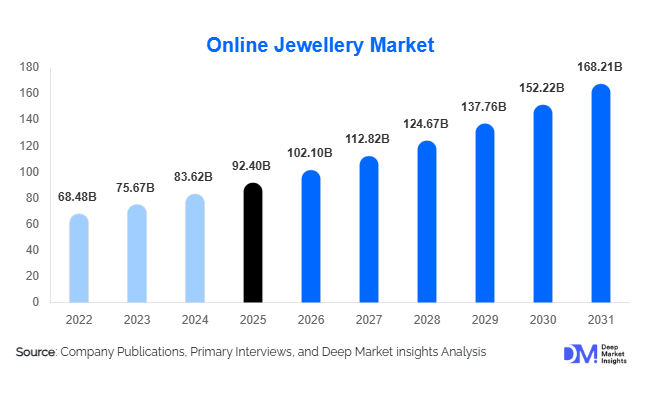
According to Deep Market Insights, the global online jewellery market size was valued at USD 92.4 billion in 2025 and is projected to grow from USD 102.10 billion in 2026 to reach USD 168.21 billion by 2031, expanding at a CAGR of 10.5% during the forecast period (2026–2031). The online jewellery market growth is primarily driven by the rapid expansion of e-commerce platforms, increasing consumer preference for personalised jewellery, rising adoption of digital payment ecosystems, and growing acceptance of purchasing luxury products through online channels. The integration of AI-driven customization, AR-based virtual try-on technologies, and blockchain-enabled authentication systems is further transforming the digital jewellery retail landscape globally.
Key Market Insights
- Online jewellery retail is increasingly shifting toward personalized and sustainable product offerings, attracting younger consumers seeking ethical sourcing and unique customization options.
- Lab-grown diamonds and recycled precious metals are gaining strong market traction, particularly among environmentally conscious consumers across North America and Europe.
- Asia-Pacific dominates the global market, led by strong online jewellery demand from India and China supported by expanding digital commerce ecosystems.
- North America remains one of the fastest-growing technology-driven markets, driven by premium online engagement ring sales and luxury e-commerce adoption.
- Social commerce and influencer-driven retailing are reshaping consumer purchasing behavior, especially among Gen Z and millennial consumers.
- Technological integration, including AR virtual try-ons, AI-powered recommendation engines, and blockchain certification, is redefining digital jewellery shopping experiences.
Online Jewellery Market Trends
Rising Demand for Sustainable and Lab-Grown Jewellery
The online jewellery industry is witnessing a major shift toward sustainability-focused products, particularly lab-grown diamonds, recycled gold jewellery, and ethically sourced gemstones. Consumers increasingly prioritize transparency, environmental responsibility, and responsible sourcing practices when purchasing jewellery online. Lab-grown diamonds are gaining widespread acceptance due to their affordability and lower environmental impact compared to mined diamonds. Several online-first jewellery brands are integrating blockchain traceability systems to verify sourcing authenticity and improve customer trust. Sustainability certifications, carbon-neutral packaging, and ESG-focused branding are also becoming critical competitive differentiators across premium and luxury jewellery categories.
Technology-Driven Digital Shopping Experiences
Emerging technologies are transforming how consumers browse and purchase jewellery online. Augmented reality virtual try-on tools allow users to visualize rings, necklaces, and earrings before purchasing, significantly improving customer confidence and reducing return rates. AI-driven recommendation engines are helping brands deliver personalized product suggestions based on customer preferences, purchase history, and browsing patterns. Advanced 3D visualization tools and digital customization platforms are enabling consumers to design unique jewellery products in real time. Social commerce integrations across Instagram, TikTok, and livestream shopping platforms are also accelerating product discovery and consumer engagement among younger demographics.
Online Jewellery Market Drivers
Growing Penetration of E-commerce and Digital Payments
The rapid expansion of e-commerce infrastructure and digital payment adoption globally is one of the key drivers supporting online jewellery market growth. Consumers are increasingly comfortable purchasing premium and luxury products through online platforms due to improved payment security, easy financing options, and seamless user experiences. Emerging economies such as India, Indonesia, and Brazil are witnessing strong digital commerce expansion, allowing online jewellery brands to access broader customer bases beyond metropolitan regions. The rise of mobile commerce and smartphone-based shopping behavior is further accelerating online jewellery demand.
Increasing Preference for Personalized Jewellery
Consumers are increasingly seeking customized jewellery products that reflect personal identity, emotions, and exclusivity. Online jewellery platforms provide extensive customization options including engraved jewellery, birthstone jewellery, made-to-order rings, and personalized gifting collections. Millennials and Gen Z consumers particularly value self-expression through fashion and accessories, driving strong demand for unique jewellery designs. AI-assisted design tools and CAD/CAM-enabled manufacturing technologies are enabling jewellery companies to offer scalable personalization while improving operational efficiency and production speed.
Online Jewellery Market Restraints
Consumer Trust and Product Authentication Challenges
Despite rapid digital adoption, consumer concerns regarding authenticity, gemstone certification, metal purity, and product quality continue to restrain online jewellery purchases, particularly in premium categories. High-value purchases often require physical inspection and assurance before final transaction completion. Counterfeit products, misleading product images, and certification inconsistencies remain significant concerns across international markets. Although blockchain-based authentication and digital certification technologies are improving transparency, consumer trust barriers remain a key challenge for online jewellery retailers.
High Logistics and Return Management Costs
Jewellery products require secure transportation, insured shipping, tamper-proof packaging, and specialized reverse logistics systems. Managing product returns, resizing requests, damaged shipments, and international customs regulations significantly increases operational expenses for online jewellery companies. Return fraud and cross-border shipping complexities also create additional financial pressures for market participants, especially smaller digital-first jewellery startups operating across multiple international regions.
Online Jewellery Market Opportunities
Expansion of Social Commerce and Influencer-Led Retail
The rapid rise of social commerce platforms presents substantial growth opportunities for online jewellery companies. Consumers increasingly discover and purchase jewellery products directly through Instagram, TikTok, YouTube, and livestream commerce channels. Influencer collaborations, celebrity endorsements, and creator-led jewellery launches are significantly improving brand visibility and customer engagement. Social commerce lowers customer acquisition barriers for emerging jewellery brands while enabling global reach without heavy physical retail investments. This trend is expected to create strong growth opportunities among Gen Z and millennial consumers over the coming years.
Growth of Omnichannel and Virtual Shopping Experiences
Jewellery brands are increasingly integrating digital storefronts with physical retail experiences through omnichannel business models. Virtual consultations, click-and-collect services, appointment-based showroom visits, and AR-enabled product visualization are improving customer confidence in online purchases. Traditional jewellery retailers are investing heavily in AI-driven customer engagement platforms, automated fulfillment systems, and immersive digital commerce technologies. This hybrid retail model enables brands to balance online convenience with offline trust and experiential shopping benefits, creating long-term opportunities for market expansion globally.
Report Scope
| Report Metric | Details |
|---|---|
| Market Size in 2025 | USD 92.4 Billion |
| Market Size in 2026 | USD 102.10 Billion |
| Market Size in 2031 | USD 168.21 Billion |
| CAGR | 10.5% (2026-2031) |
| Base Year for Estimation | 2025 |
| Historical Data | 2022-2024 |
| Forecast Period | 2026-2031 |
| Report Coverage | Revenue Forecast, Competitive Landscape, Supply Chain Disruption, Growth Factors, Environment & Regulatory Landscape and Trends |
| Geographies Covered | North America, Europe, APAC, Middle East and Africa, LATAM |
| Countries Covered | U.S., Canada, U.K., Germany, France, Spain, Italy, Russia, Nordic, Benelux, Rest of Europe, China, Korea, Japan, India, Australia, Singapore, Taiwan, South East Asia, Rest of Asia-Pacific, UAE, Turky, Saudi Arabia, South Africa, Egypt, Nigeria, Rest of MEA, Brazil, Mexico, Argentina, Chile, Colombia, Rest of LATAM |
Explore more data points, trends and opportunities Download Free Sample Report
Product Type Insights
Rings dominate the online jewellery market, particularly engagement rings and wedding bands, due to growing consumer confidence in online diamond certification and customization platforms. Premium online jewellers are increasingly offering made-to-order engagement rings featuring personalized settings, gemstones, and engravings. Necklaces and pendants represent another significant segment supported by strong gifting demand and fashion-oriented purchases among younger consumers. Earrings and bracelets continue witnessing steady growth due to high purchase frequency and lower average selling prices compared to bridal jewellery categories. Men’s jewellery is emerging as one of the fastest-growing segments globally, driven by changing fashion preferences, celebrity influence, and rising demand for chains, bracelets, and signet rings among younger male consumers.
Jewellery Category Insights
Fine jewellery accounts for the largest share of the online jewellery market due to strong demand for gold, diamond, and premium gemstone products. Consumers increasingly view fine jewellery as both a luxury purchase and a long-term investment asset, particularly during periods of economic uncertainty and inflation. Fashion jewellery continues expanding rapidly among younger demographics seeking affordable, trend-driven accessories for daily wear. Luxury jewellery brands are focusing on exclusive digital collections, limited-edition launches, and personalized luxury experiences to strengthen premium positioning online. Lab-grown diamond jewellery represents one of the fastest-growing categories globally due to affordability advantages and sustainability-focused consumer preferences.
Platform Type Insights
Brand-owned e-commerce platforms dominate the online jewellery market by providing greater transparency, direct customer relationships, product authentication assurance, and customized shopping experiences. Consumers increasingly prefer direct-to-consumer jewellery websites due to certification visibility, flexible financing options, and exclusive product collections. Online marketplaces remain important distribution channels for affordable and fashion jewellery categories, especially in emerging economies. Social commerce platforms are rapidly gaining popularity among younger consumers, driven by influencer marketing, livestream shopping events, and integrated checkout functionalities. Omnichannel jewellery retailers are also expanding significantly by combining physical showrooms with digital storefronts and virtual consultation services.
Consumer Group Insights
Women represent the largest consumer segment in the online jewellery market, accounting for the majority of purchases across bridal, fashion, luxury, and personalized jewellery categories. Daily wear jewellery, gifting products, and occasion-based purchases continue driving strong demand among female consumers globally. Men’s jewellery is witnessing accelerated growth due to rising acceptance of fashion accessories among male consumers and increasing availability of digitally marketed masculine jewellery collections. Unisex jewellery products featuring minimalist designs and gender-neutral styling are also gaining popularity among younger demographics. Children’s jewellery remains a niche but steadily growing category, particularly for gifting and ceremonial purchases in Asian and Middle Eastern markets.
Purchase Occasion Insights
Wedding and engagement purchases remain the dominant demand driver within the online jewellery market. Consumers increasingly prefer digital platforms for engagement ring purchases due to broader product variety, transparent pricing structures, and customization capabilities. Daily wear and fashion jewellery purchases are expanding rapidly due to social media influence and growing preference for affordable luxury products among millennials and Gen Z consumers. Festival and cultural purchases continue supporting strong seasonal demand across India, China, and Middle Eastern markets, where jewellery holds significant cultural value. Corporate gifting and investment-oriented jewellery purchases are also emerging as important demand categories, particularly for gold and diamond jewellery products.
Explore more data points, trends and opportunities Download Free Sample Report
Online Jewellery Market Segmentations
By Product Type
- Rings
- Necklaces & Pendants
- Earrings
- Bracelets & Bangles
- Bridal Jewellery Sets
- Customized & Personalized Jewellery
- Men’s Jewellery
- Children’s Jewellery
By Jewellery Category
- Fine Jewellery
- Fashion Jewellery
- Luxury Jewellery
- Demi-Fine Jewellery
- Lab-Grown Diamond Jewellery
By Material Type
- Gold Jewellery
- Diamond Jewellery
- Silver Jewellery
- Platinum Jewellery
- Gemstone Jewellery
- Pearl Jewellery
- Stainless Steel Jewellery
- Alternative Metal Jewellery
By Consumer Group
- Women
- Men
- Unisex Consumers
- Children & Teen Consumers
By Platform Type
- Brand-Owned E-commerce Platforms
- Online Marketplaces
- Social Commerce Platforms
- Omnichannel Jewellery Retailers
- Subscription-Based Jewellery Platforms
By Purchase Occasion
- Wedding & Engagement
- Daily Wear & Fashion
- Festival & Cultural Purchases
- Gifting
- Investment Purchases
- Corporate Gifting
Regional Insights
North America
North America represents one of the most technologically advanced online jewellery markets globally, led primarily by the United States and Canada. Strong consumer confidence in online luxury purchases, widespread adoption of digital payments, and high demand for engagement rings support regional market growth. Consumers in the region increasingly prefer sustainable jewellery products including lab-grown diamonds and recycled precious metals. Direct-to-consumer jewellery brands and premium online retailers are investing heavily in AI-powered personalization tools, virtual try-on technologies, and omnichannel shopping experiences to improve customer engagement and conversion rates.
Europe
Europe remains a mature and innovation-driven online jewellery market supported by strong demand from the United Kingdom, Germany, France, and Italy. Consumers across the region increasingly prioritize ethical sourcing, sustainability certifications, and luxury craftsmanship. European luxury jewellery houses are rapidly expanding digital commerce capabilities through omnichannel retail integration and exclusive online product launches. Fashion jewellery and demi-fine jewellery categories are also witnessing strong adoption among younger urban consumers seeking affordable premium accessories. Regulatory emphasis on transparency and hallmarking standards further strengthens consumer confidence in online jewellery purchases across Europe.
Asia-Pacific
Asia-Pacific dominates the global online jewellery market, driven primarily by India and China. Rising disposable incomes, expanding middle-class populations, increasing smartphone penetration, and rapid e-commerce growth are supporting regional demand expansion. India remains one of the fastest-growing markets globally due to strong cultural affinity toward gold jewellery and accelerating digital adoption among traditional jewellers. Chinese consumers continue driving strong demand for luxury jewellery and digitally integrated shopping experiences. Southeast Asian markets including Indonesia, Vietnam, and Thailand are also emerging as important growth hubs due to expanding online retail ecosystems and increasing fashion-conscious consumer populations.
Latin America
Latin America is witnessing steady growth in online jewellery demand led by Brazil and Mexico. Expanding smartphone penetration, rising adoption of digital payment solutions, and increasing social commerce engagement are supporting regional market expansion. Consumers in the region increasingly purchase fashion jewellery and affordable luxury products through online marketplaces and social media-driven retail channels. International jewellery brands are also expanding their presence through localized e-commerce platforms and influencer-led marketing campaigns targeting younger urban consumers.
Middle East & Africa
The Middle East & Africa region represents a rapidly growing market for online luxury jewellery and gold jewellery products. Countries such as the UAE and Saudi Arabia benefit from affluent consumer bases, strong luxury spending patterns, and high cultural affinity toward gold and diamond jewellery purchases. Expanding digital infrastructure and premium e-commerce adoption are supporting online jewellery market growth across Gulf Cooperation Council countries. In Africa, increasing smartphone penetration and mobile payment adoption are gradually supporting online jewellery retail development, particularly within urban population centers.
Key Players in the Online Jewellery Market
- Signet Jewelers Ltd.
- Titan Company Limited
- Pandora A/S
- Chow Tai Fook Jewellery Group Ltd.
- Compagnie Financière Richemont SA
- LVMH Moët Hennessy Louis Vuitton SE
- Swarovski AG
- Kalyan Jewellers India Limited
- Malabar Gold & Diamonds
- Brilliant Earth Group, Inc.