Online Baby Products Retailing Market Size
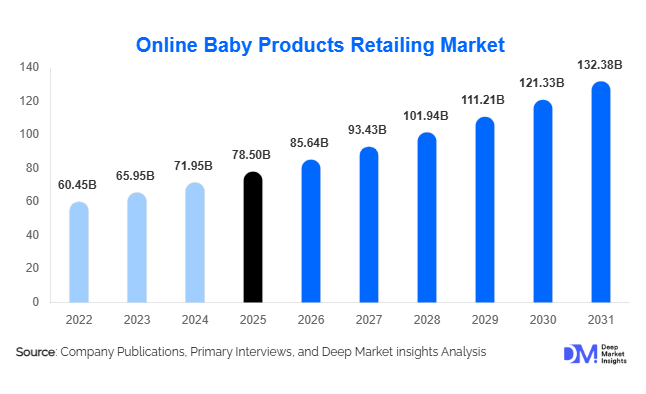
According to Deep Market Insights, the global online baby products retailing market size was valued at USD 78.5 billion in 2025 and is projected to grow from USD 85.64 billion in 2026 to reach USD 132.38 billion by 2031, expanding at a CAGR of 9.1% during the forecast period (2026–2031). The market growth is primarily driven by increasing digital adoption among parents, rising demand for convenience-based shopping, and growing awareness of baby health and safety products. The shift toward e-commerce platforms, supported by mobile penetration and digital payment ecosystems, has significantly transformed purchasing behavior across both developed and emerging economies.
Key Market Insights
- E-commerce marketplaces dominate the market, accounting for over 50% of total online baby product sales due to wide product availability and competitive pricing.
- Diapers & wipes remain the leading product category, contributing nearly 28% of total market demand, driven by recurring purchases and subscription models.
- Asia-Pacific dominates the global market, supported by strong demand from China and India and rapid digital penetration.
- India is the fastest-growing country, driven by rising middle-class income, high birth rates, and expanding internet access.
- Organic and eco-friendly baby products are gaining traction, especially in North America and Europe, reflecting changing consumer preferences.
- AI-driven personalization and subscription services are transforming customer engagement and improving retention rates.
What are the latest trends in the online baby products retailing market?
Rising Demand for Organic and Sustainable Baby Products
Consumers are increasingly prioritizing safety, health, and environmental sustainability when purchasing baby products online. This has led to a surge in demand for organic baby food, chemical-free skincare, and biodegradable diapers. Brands are responding by introducing certified organic product lines, transparent labeling practices, and eco-friendly packaging solutions. Sustainability is becoming a key differentiator, particularly in premium segments, where consumers are willing to pay higher prices for safer and environmentally responsible products. Additionally, regulatory standards in developed markets are encouraging manufacturers to adopt cleaner production methods, further accelerating this trend.
Expansion of Subscription-Based Retail Models
Subscription-based purchasing models are gaining popularity for essential baby products such as diapers, wipes, and formula. These services offer convenience, cost savings, and consistent supply, making them highly attractive to busy parents. E-commerce platforms are integrating predictive analytics to automate replenishment cycles based on consumption patterns. This model not only enhances customer loyalty but also provides stable revenue streams for companies. Subscription services are particularly effective in urban markets where convenience and time efficiency are critical decision factors.
What are the key drivers in the online baby products retailing market?
Increasing Digital and Mobile Commerce Adoption
The widespread adoption of smartphones and internet connectivity has significantly boosted online retail penetration. Parents increasingly rely on mobile platforms for product research, reviews, and purchases. The integration of user-friendly interfaces, secure payment gateways, and fast delivery options has made online platforms the preferred shopping channel for baby products globally.
Changing Parental Lifestyles and Preferences
Modern parenting trends, including dual-income households and busy lifestyles, are driving demand for convenient shopping solutions. Online retail platforms offer time-saving benefits, doorstep delivery, and a wider range of product choices compared to traditional retail. Additionally, first-time parents tend to spend more on premium and specialized products, further fueling market growth.
What are the restraints for the global market?
Concerns Over Product Authenticity and Quality
One of the major challenges in the market is the presence of counterfeit or low-quality products, particularly on third-party marketplaces. Parents are highly sensitive to product safety, which can limit online purchases if trust is compromised. Ensuring product authenticity and maintaining quality standards remain critical for sustained growth.
Logistics and Supply Chain Challenges
In emerging markets, inadequate logistics infrastructure and high delivery costs pose significant challenges. Delays in shipping, inefficient last-mile delivery, and high return rates can negatively impact customer experience and profitability. Companies need to invest in robust supply chain systems to overcome these limitations.
What are the key opportunities in the online baby products retailing industry?
Expansion of Direct-to-Consumer (D2C) Channels
Brands are increasingly leveraging D2C platforms to directly engage with consumers, offering personalized experiences and better pricing control. This approach allows companies to collect valuable consumer data, optimize marketing strategies, and improve customer retention. D2C channels are expected to grow rapidly, particularly among premium and niche brands.
Emerging Market Penetration
Developing regions such as Asia-Pacific, Latin America, and Africa present significant growth opportunities due to rising disposable incomes, increasing birth rates, and expanding digital infrastructure. Localized strategies, including vernacular content and affordable pricing, are essential for capturing these markets.
Report Scope
| Report Metric | Details |
|---|---|
| Market Size in 2025 | USD 78.5 Billion |
| Market Size in 2026 | USD 85.64 Billion |
| Market Size in 2031 | USD 132.38 Billion |
| CAGR | 9.1% (2026-2031) |
| Base Year for Estimation | 2025 |
| Historical Data | 2022-2024 |
| Forecast Period | 2026-2031 |
| Report Coverage | Revenue Forecast, Competitive Landscape, Supply Chain Disruption, Growth Factors, Environment & Regulatory Landscape and Trends |
| Geographies Covered | North America, Europe, APAC, Middle East and Africa, LATAM |
| Countries Covered | U.S., Canada, U.K., Germany, France, Spain, Italy, Russia, Nordic, Benelux, Rest of Europe, China, Korea, Japan, India, Australia, Singapore, Taiwan, South East Asia, Rest of Asia-Pacific, UAE, Turky, Saudi Arabia, South Africa, Egypt, Nigeria, Rest of MEA, Brazil, Mexico, Argentina, Chile, Colombia, Rest of LATAM |
Explore more data points, trends and opportunities Download Free Sample Report
Product Category Insights
Diapers & wipes continue to dominate the online baby products retailing market, accounting for approximately 28% of total revenue in 2025. The leadership of this segment is primarily driven by its high consumption frequency, making it a recurring purchase category ideally suited for online and subscription-based models. Parents increasingly prefer automated replenishment services for diapers and wipes, which enhances customer retention and lifetime value for retailers. Additionally, strong brand loyalty and continuous product innovation, such as ultra-absorbent and eco-friendly variants, further reinforce segment dominance.
Baby food and formula represent another significant segment, supported by rising awareness of infant nutrition and increasing demand for organic and fortified food products. Regulatory compliance and trust in established brands are critical drivers here, particularly in developed markets. Baby apparel and toys are gaining traction due to gifting trends, seasonal demand spikes, and the growing influence of social media on purchasing decisions. Meanwhile, premium baby gear such as strollers, car seats, and high chairs is witnessing steady growth, driven by increasing safety awareness, urban mobility needs, and rising disposable incomes, especially in metropolitan areas.
Platform Type Insights
E-commerce marketplaces lead the market with a share of approximately 52% in 2025, driven by their extensive product assortment, competitive pricing strategies, and well-established logistics networks. The ability to compare products, access reviews, and benefit from promotional discounts makes marketplaces the preferred channel for price-sensitive consumers. Their dominance is further strengthened by strong last-mile delivery capabilities and integration with digital payment systems.
Brand-owned websites (D2C) are rapidly gaining traction as companies focus on building direct relationships with consumers. These platforms enable better control over branding, pricing, and customer data, allowing for personalized marketing and improved margins. Subscription-based platforms are emerging as a high-potential niche, particularly for essential products such as diapers and formula. The convenience of scheduled deliveries and cost savings associated with subscriptions are key drivers of growth in this segment.
Consumer Type Insights
First-time parents represent the largest consumer segment, accounting for approximately 40% of total demand. This segment leads due to a higher propensity to spend on premium, branded, and specialized products, driven by concerns around safety, quality, and convenience. Lack of prior experience often leads to increased reliance on online reviews and recommendations, further boosting online purchases.
Experienced parents, on the other hand, tend to be more price-conscious and value-driven, often opting for mid-range products or bulk purchases. Institutional buyers, including daycare centers, hospitals, and maternity clinics, represent a smaller but steadily growing segment. Their demand is driven by bulk procurement needs, particularly for diapers, wipes, and basic baby care products, contributing to stable, volume-driven sales for suppliers.
Delivery Model Insights
Standard delivery remains the dominant delivery model, accounting for nearly 60% of total shipments, primarily due to its cost-effectiveness and widespread availability. This model is particularly popular among price-sensitive consumers who prioritize affordability over speed. However, express delivery is the fastest-growing segment, driven by increasing consumer expectations for faster fulfillment and the expansion of same-day and next-day delivery services in urban areas. The growth of quick commerce platforms is further accelerating this trend. Subscription-based auto-delivery models are also gaining popularity, especially for frequently used products, as they offer convenience, eliminate stockouts, and strengthen customer loyalty.
Payment Mode Insights
Online payments dominate the market, accounting for approximately 68% of total transactions, supported by the rapid adoption of digital wallets, UPI systems, and secure payment gateways. The convenience, speed, and availability of cashback offers and discounts have significantly boosted digital payment adoption. Cash on delivery (COD) remains relevant in certain emerging markets where trust in online transactions is still evolving. Meanwhile, Buy Now Pay Later (BNPL) options are gaining traction among younger consumers, enabling higher-value purchases such as baby gear and equipment by offering flexible payment solutions.
Explore more data points, trends and opportunities Download Free Sample Report
Online Baby Products Retailing Market Segmentations
By Product Category
- Baby Food & Formula
- Baby Apparel
- Diapers & Wipes
- Baby Gear & Equipment
- Baby Care Products
- Toys & Learning Products
By Platform Type
- E-commerce Marketplaces
- Brand-Owned Websites (D2C)
- Subscription-Based Platforms
By Consumer Type
- First-Time Parents
- Experienced Parents
- Institutional Buyers
By Delivery Model
- Standard Delivery
- Express Delivery
- Subscription-Based Auto-Delivery
By Payment Mode
- Online Payments
- Cash on Delivery
- Buy Now Pay Later
Regional Insights
Asia-Pacific
Asia-Pacific dominates the global market with a share of approximately 38% in 2025, driven by strong demand from China and India. China alone contributes nearly 18% of global revenue, supported by its advanced e-commerce ecosystem, high smartphone penetration, and integrated digital payment infrastructure. India is the fastest-growing market, with a CAGR exceeding 11%, fueled by rising middle-class income, increasing birth rates, and rapid digitalization. Additional growth drivers include government initiatives promoting digital commerce, expansion of logistics networks into Tier 2 and Tier 3 cities, and growing awareness of branded and premium baby products.
North America
North America accounts for approximately 26% of the global market, with the United States being the primary contributor. The region’s growth is driven by high disposable income, strong preference for premium and organic baby products, and widespread adoption of subscription-based purchasing models. Advanced logistics infrastructure, high internet penetration, and consumer trust in online platforms further support market expansion. Additionally, increasing demand for eco-friendly and sustainable baby products is shaping purchasing behavior in this region.
Europe
Europe holds around 22% of the market share, with key contributions from Germany, the UK, and France. The region’s growth is primarily driven by stringent safety regulations, high awareness of product quality, and strong demand for organic and eco-friendly baby products. Consumers in Europe are highly inclined toward sustainable purchasing, which has encouraged brands to adopt environmentally friendly practices. The presence of established retail networks and cross-border e-commerce within the European Union further enhances market growth.
Latin America
Latin America represents approximately 8% of the global market, with Brazil and Mexico leading regional demand. Growth in this region is driven by increasing internet penetration, expanding middle-class populations, and improving digital payment infrastructure. The rise of mobile commerce and social media-driven marketing is also influencing purchasing behavior. Additionally, urbanization and growing awareness of branded baby products are contributing to increased online retail adoption.
Middle East & Africa
The Middle East & Africa account for around 6% of the market, with the UAE and South Africa being key contributors. Growth in this region is supported by rising urbanization, increasing disposable incomes, and expanding e-commerce ecosystems. In the Middle East, high-income consumers are driving demand for premium and imported baby products, while in Africa, improving logistics infrastructure and mobile payment adoption are enabling market expansion. Government initiatives to promote digital economies and the entry of global e-commerce players are further accelerating growth in this region.