Novelty Socks Market Size
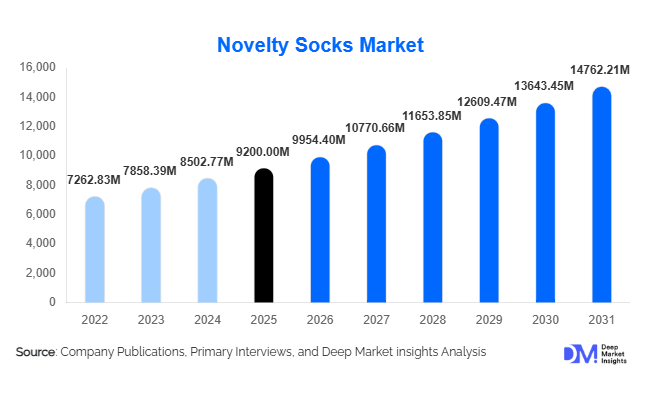
According to Deep Market Insights, the global novelty socks market size was valued at USD 9,200 million in 2025 and is projected to grow from USD 9,954.40 million in 2026 to reach USD 14,762.21 million by 2031, expanding at a CAGR of 8.2% during the forecast period (2026–2031). The novelty socks market growth is primarily driven by rising demand for personalized fashion, increasing popularity of gifting culture, and rapid expansion of e-commerce platforms enabling global accessibility for niche apparel brands.
Key Market Insights
- Personalization and self-expression trends are reshaping demand, with consumers increasingly opting for custom and themed socks reflecting individual identity.
- Online retail channels dominate distribution, supported by D2C brands and social media-driven marketing strategies.
- North America leads the global market, driven by a strong gifting culture and high per capita fashion spending.
- Asia-Pacific is the fastest-growing region, fueled by rising disposable incomes and urbanization.
- Corporate merchandising is emerging as a key growth driver, with businesses leveraging novelty socks for branding and employee engagement.
- Sustainable materials and ethical production are gaining traction, particularly in Europe and premium segments.
What are the latest trends in the novelty socks market?
Rise of Customization and Limited-Edition Collections
Customization has become a defining trend in the novelty socks market, with brands offering personalized designs, names, logos, and even AI-generated patterns. Consumers are increasingly seeking exclusivity, leading to the growth of limited-edition collections and collaborations with pop culture franchises, influencers, and artists. This trend is particularly strong among millennials and Gen Z, who value individuality and social media visibility. Digital printing technologies have significantly reduced production costs for customized products, enabling brands to offer mass personalization at scale while maintaining profitability.
Shift Toward Sustainable and Eco-Friendly Products
Sustainability is emerging as a critical trend, with manufacturers adopting organic cotton, bamboo fibers, and recycled materials. Consumers, particularly in Europe and North America, are prioritizing environmentally responsible products, pushing brands to enhance transparency in sourcing and production. Companies are also implementing eco-friendly packaging and reducing water-intensive dyeing processes. This shift is not only driven by consumer demand but also by regulatory frameworks promoting sustainable textile manufacturing, making sustainability a long-term competitive advantage in the novelty socks market.
What are the key drivers in the novelty socks market?
Growing Influence of Fashion as Self-Expression
Novelty socks have evolved into a key fashion accessory that allows individuals to express personality, humor, and cultural preferences. Social media platforms have amplified this trend, encouraging consumers to experiment with bold and unique designs. This cultural shift has significantly expanded the consumer base beyond traditional apparel buyers, driving consistent demand growth.
Expansion of E-commerce and Direct-to-Consumer Brands
The rapid growth of online retail has transformed the novelty socks market by enabling brands to reach global audiences without heavy reliance on physical retail infrastructure. Direct-to-consumer (D2C) models allow companies to maintain higher margins, gather customer data, and offer personalized experiences. Subscription-based sock services and online customization tools are further enhancing customer engagement and repeat purchases.
What are the restraints for the global market?
High Price Competition in Mass Segments
The novelty socks market faces intense price competition, particularly in the economy and mid-range segments where product differentiation is limited. Mass-produced designs often compete primarily on price, leading to margin pressures for manufacturers and retailers. This challenge is particularly significant for smaller players lacking strong brand recognition.
Volatility in Raw Material Prices
Fluctuations in the prices of cotton, polyester, and other textile inputs pose a major challenge for manufacturers. Rising raw material costs can impact production expenses and reduce profitability, especially in price-sensitive segments where passing costs to consumers is difficult. Supply chain disruptions further exacerbate this issue.
What are the key opportunities in the novelty socks industry?
Expansion into Emerging Markets
Emerging economies such as India, Brazil, and Indonesia present significant growth opportunities due to rising disposable incomes and increasing exposure to global fashion trends. Localized designs catering to cultural preferences can enhance market penetration. The growing middle class in these regions is expected to drive demand for mid-range and affordable premium novelty socks.
Corporate Gifting and Promotional Merchandise
Corporate gifting is becoming a major growth avenue, with companies using novelty socks as cost-effective promotional tools. Customized socks featuring brand logos or campaign themes are widely used for employee engagement, events, and marketing initiatives. This segment offers consistent bulk demand and higher margins for manufacturers.
Report Scope
| Report Metric | Details |
|---|---|
| Market Size in 2025 | USD 9200 Million |
| Market Size in 2026 | USD 9954.40 Million |
| Market Size in 2031 | USD 14762.21 Million |
| CAGR | 8.2% (2026-2031) |
| Base Year for Estimation | 2025 |
| Historical Data | 2022-2024 |
| Forecast Period | 2026-2031 |
| Report Coverage | Revenue Forecast, Competitive Landscape, Supply Chain Disruption, Growth Factors, Environment & Regulatory Landscape and Trends |
| Geographies Covered | North America, Europe, APAC, Middle East and Africa, LATAM |
| Countries Covered | U.S., Canada, U.K., Germany, France, Spain, Italy, Russia, Nordic, Benelux, Rest of Europe, China, Korea, Japan, India, Australia, Singapore, Taiwan, South East Asia, Rest of Asia-Pacific, UAE, Turky, Saudi Arabia, South Africa, Egypt, Nigeria, Rest of MEA, Brazil, Mexico, Argentina, Chile, Colombia, Rest of LATAM |
Explore more data points, trends and opportunities Download Free Sample Report
Product Type Insights
Printed socks dominate the novelty socks market, accounting for approximately 32% of the global share in 2025. This leadership position is primarily driven by their strong alignment with fast-changing fashion trends, social media influence, and the growing demand for expressive apparel. Printed designs allow rapid scalability and shorter production cycles, enabling brands to quickly respond to viral trends, seasonal events, and pop culture moments. Additionally, collaborations with entertainment franchises, influencers, and artists have significantly boosted demand for printed socks, making them the most commercially viable and frequently refreshed product category.
Patterned and themed socks also contribute significantly, particularly during seasonal peaks such as holidays, festivals, and sporting events, where demand surges for occasion-based designs. Character and licensed socks are witnessing accelerated growth due to partnerships with global entertainment brands, gaming companies, and streaming platforms, enhancing brand visibility and consumer engagement. Meanwhile, personalized socks represent one of the fastest-growing niches, supported by advancements in digital printing and customization technologies. These products command premium pricing and higher margins, especially in gifting and corporate merchandise applications, making them a key growth driver for market participants.
Material Type Insights
Cotton-based novelty socks lead the market with nearly 45% share, driven by their superior comfort, breathability, and cost-effectiveness. Cotton remains the preferred material for everyday wear, particularly in the personal fashion segment, due to its skin-friendly properties and widespread availability. The segment’s dominance is further reinforced by its compatibility with various printing techniques, enabling high-quality designs without compromising fabric integrity.
Synthetic blends, including polyester and spandex, are widely used for their durability, elasticity, and moisture-wicking properties, making them particularly suitable for athleisure and performance-oriented novelty socks. These materials also allow for enhanced color retention and design longevity, which is critical for maintaining product appeal over time. Meanwhile, eco-friendly materials such as bamboo fibers, organic cotton, and recycled yarns are gaining strong traction, especially in premium and developed markets. This shift is driven by increasing consumer awareness regarding sustainability and tightening environmental regulations, positioning eco-friendly materials as a key differentiator and long-term growth driver in the novelty socks market.
Distribution Channel Insights
Online retail dominates the novelty socks market with approximately 48% share, driven by the rapid expansion of e-commerce platforms and direct-to-consumer (D2C) brands. The online channel offers significant advantages, including wider product variety, easy customization, competitive pricing, and global accessibility. The integration of AI-driven recommendations, targeted advertising, and seamless logistics has further enhanced the consumer purchasing experience, making online platforms the primary growth engine for the market.
Offline channels, including specialty stores, supermarkets, and apparel chains, continue to play a vital role in driving impulse purchases and providing tactile product experiences. Physical retail is particularly important in emerging markets where digital penetration is still developing. Additionally, corporate bulk sales are emerging as a stable and scalable distribution segment, driven by increasing demand for customized socks in promotional campaigns, employee engagement initiatives, and event merchandising. This segment offers predictable demand cycles and higher order volumes, contributing significantly to overall market stability.
End-Use Insights
Personal fashion and lifestyle applications account for nearly 50% of the market, making it the dominant end-use segment. This growth is fueled by increasing consumer inclination toward casualization of fashion and the integration of novelty elements into everyday attire. The influence of social media, fashion influencers, and celebrity endorsements has further accelerated the adoption of novelty socks as a key style statement.
Corporate gifting and promotional merchandise represent the fastest-growing segment, driven by rising corporate spending on branding and employee engagement. Companies are increasingly using novelty socks as cost-effective, customizable marketing tools that combine utility with brand visibility. Event-based usage, including weddings, festivals, and themed celebrations, is also expanding rapidly, particularly in emerging economies where experiential consumption is on the rise. Additionally, the integration of novelty designs into athleisure and sportswear is opening new application avenues, further diversifying demand across end-use segments.
Explore more data points, trends and opportunities Download Free Sample Report
Novelty Socks Market Segmentations
By Product Type
- Printed Socks
- Patterned Socks
- Character & Licensed Socks
- Themed Socks
- Personalized/Custom Socks
By Material Type
- Cotton-Based Socks
- Synthetic Blends
- Wool & Specialty Fibers
- Eco-Friendly Materials
By Distribution Channel
- Online Retail
- Offline Retail
- Corporate/Bulk Sales
By End-Use
- Personal Fashion & Lifestyle
- Corporate Gifting & Promotional Merchandise
- Events & Seasonal Usage
- Sports & Athleisure
Regional Insights
North America
North America holds approximately 34% of the global novelty socks market share in 2025, with the United States accounting for nearly 30% of global demand. The region’s dominance is driven by high disposable incomes, strong consumer spending on lifestyle and fashion products, and a deeply ingrained gifting culture. The presence of leading D2C brands and advanced e-commerce infrastructure has further accelerated market growth. Additionally, the increasing popularity of subscription-based sock services and customized products has strengthened consumer engagement. Demand for premium and sustainable socks is particularly strong in this region, supported by growing environmental awareness and preference for high-quality apparel.
Europe
Europe accounts for around 28% of the market, led by key countries such as the UK, Germany, and France. The region’s growth is primarily driven by strong consumer preference for sustainable and ethically produced products, supported by stringent environmental regulations. European consumers are highly receptive to eco-friendly materials, including organic cotton and recycled fibers, making sustainability a core driver of market expansion. Additionally, the region’s well-established fashion industry and emphasis on premium and designer products are boosting demand for high-end novelty socks. Seasonal demand linked to holidays and cultural events also contributes significantly to sales volumes.
Asia-Pacific
Asia-Pacific is the fastest-growing region, with a projected CAGR of around 10%. China dominates global production and exports due to its large-scale manufacturing capabilities and cost advantages, while India is emerging as a high-growth consumption market driven by rising disposable incomes, urbanization, and increasing exposure to global fashion trends. Japan and South Korea contribute significantly through their fashion-forward consumer base and high demand for premium and innovative designs. The rapid expansion of e-commerce platforms and mobile commerce in the region is further accelerating market penetration, making Asia-Pacific a critical growth hub for the novelty socks market.
Latin America
Latin America, led by Brazil and Mexico, is experiencing steady growth due to increasing urbanization, improving retail infrastructure, and rising middle-class incomes. The adoption of global fashion trends and the growing influence of social media are driving demand for novelty socks in the region. Additionally, the expansion of organized retail and e-commerce platforms is improving product accessibility. Seasonal demand linked to festivals and events also plays a significant role in driving sales, while the growing popularity of affordable fashion accessories supports market expansion.
Middle East & Africa
The Middle East & Africa region shows moderate growth, with key markets including the UAE and South Africa. Growth in this region is driven by expanding retail infrastructure, increasing tourism, and rising demand for premium lifestyle products. The UAE, in particular, benefits from high consumer spending and a strong preference for branded and luxury products. In Africa, improving economic conditions and urbanization are supporting gradual market expansion. Additionally, the increasing penetration of international retail brands and e-commerce platforms is enhancing product availability and driving demand for novelty socks across the region.
Key Players in the Novelty Socks Market
- Happy Socks
- Stance Inc.
- Sock It to Me
- Hot Sox
- Foot Cardigan
- Sock Fancy
- Many Mornings
- United Oddsocks
- Yo Sox
- Paul Smith
- H&M
- Uniqlo
- Adidas
- Nike
- Puma