Non-Alcoholic Smart Beverages Machine Market Size
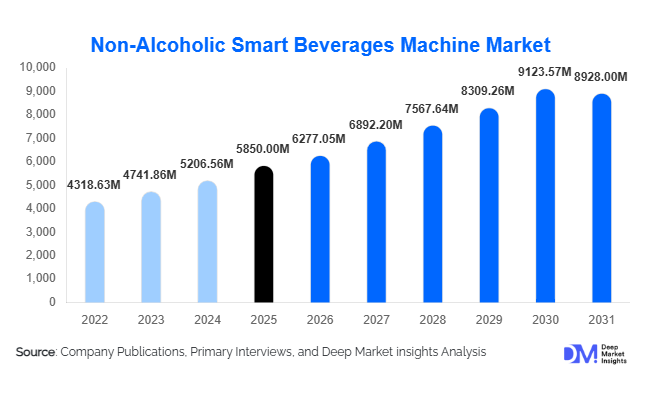
According to Deep Market Insights, the global non-alcoholic smart beverages machine market size was valued at USD 5,850 million in 2025 and is projected to grow from USD 6,277.05 million in 2026 to reach USD 8,928.00 million by 2031, expanding at a CAGR of 9.8% during the forecast period (2026–2031). The market growth is primarily driven by increasing demand for automated, contactless beverage dispensing systems, rising adoption of IoT-enabled machines, and the expansion of smart retail and foodservice ecosystems globally.
Key Market Insights
- Smart vending machines and automated beverage kiosks are rapidly replacing traditional systems, driven by demand for convenience and operational efficiency.
- IoT and AI integration is transforming beverage dispensing, enabling real-time monitoring, predictive maintenance, and personalized consumer experiences.
- North America dominates the market, supported by high adoption of automation technologies and the strong presence of key manufacturers.
- Asia-Pacific is the fastest-growing region, fueled by urbanization, digital payments, and smart city initiatives.
- Health-focused and functional beverages are gaining traction, influencing machine design and beverage offerings.
- Leasing and subscription-based models are expanding, reducing upfront costs and accelerating adoption across SMEs.
What are the latest trends in the non-alcoholic smart beverages machine market?
AI-Driven Personalization and Data Analytics
Smart beverage machines are increasingly leveraging AI and data analytics to deliver personalized drink experiences. These machines analyze user preferences, purchase history, and location-based demand to recommend customized beverages. This trend is enhancing consumer engagement while enabling operators to optimize product offerings and pricing strategies. Data-driven insights are also helping businesses improve inventory management and reduce waste, contributing to higher operational efficiency and profitability.
Shift Toward Health-Focused and Functional Beverages
Consumer preferences are rapidly shifting toward healthier beverage options such as low-sugar drinks, infused water, and nutraceutical beverages. Smart machines capable of dispensing freshly prepared and customizable healthy drinks are gaining popularity in corporate offices, gyms, and healthcare facilities. This trend is encouraging manufacturers to integrate advanced dispensing technologies that support a wide variety of beverage formulations, including probiotic and vitamin-enriched drinks.
What are the key drivers in the non-alcoholic smart beverages machine market?
Growing Demand for Contactless and Automated Solutions
The increasing emphasis on hygiene and convenience has accelerated the adoption of contactless beverage dispensing systems. Features such as QR-based ordering, mobile payments, and touchless interfaces are becoming standard, particularly in high-traffic environments such as airports and retail stores. This shift is significantly boosting market growth.
Advancements in IoT and Connected Technologies
IoT-enabled machines allow real-time monitoring of inventory levels, machine performance, and consumer behavior. These capabilities reduce downtime, improve service efficiency, and enable predictive maintenance. The integration of cloud-based platforms further enhances operational control, making connected technologies a major growth driver.
Expansion of Smart Retail and Unattended Commerce
The rise of unattended retail and smart stores is driving demand for automated beverage solutions. Businesses are adopting smart machines to reduce labor costs and provide 24/7 service. This trend is particularly strong in developed markets and is gradually expanding into emerging economies.
What are the restraints for the global market?
High Initial Investment Costs
Advanced smart beverage machines require significant upfront investment, which can be a barrier for small and medium enterprises. Although leasing models are gaining traction, cost sensitivity remains a challenge in developing markets, limiting widespread adoption.
Technical Complexity and Maintenance Challenges
The integration of advanced hardware and software components increases the complexity of these machines. Regular maintenance and the need for skilled technicians can lead to higher operational costs and potential downtime, impacting overall efficiency.
What are the key opportunities in the non-alcoholic smart beverages machine industry?
Expansion in Emerging Markets and Smart Cities
Rapid urbanization and government investments in smart city infrastructure across Asia-Pacific, the Middle East, and Latin America present significant growth opportunities. Smart beverage machines can be integrated into public spaces such as metro stations, airports, and commercial complexes, creating new revenue streams for market participants.
Adoption of Subscription and Leasing Models
The shift toward subscription-based and leasing models is enabling businesses to adopt smart beverage machines without heavy upfront investments. This approach is particularly attractive to SMEs and startups, ensuring steady revenue streams for manufacturers while expanding market penetration.
Report Scope
| Report Metric | Details |
|---|---|
| Market Size in 2025 | USD 5850 Million |
| Market Size in 2026 | USD 6277.05 Million |
| Market Size in 2031 | USD 8928.00 Million |
| CAGR | 9.8% (2026-2031) |
| Base Year for Estimation | 2025 |
| Historical Data | 2022-2024 |
| Forecast Period | 2026-2031 |
| Report Coverage | Revenue Forecast, Competitive Landscape, Supply Chain Disruption, Growth Factors, Environment & Regulatory Landscape and Trends |
| Geographies Covered | North America, Europe, APAC, Middle East and Africa, LATAM |
| Countries Covered | U.S., Canada, U.K., Germany, France, Spain, Italy, Russia, Nordic, Benelux, Rest of Europe, China, Korea, Japan, India, Australia, Singapore, Taiwan, South East Asia, Rest of Asia-Pacific, UAE, Turky, Saudi Arabia, South Africa, Egypt, Nigeria, Rest of MEA, Brazil, Mexico, Argentina, Chile, Colombia, Rest of LATAM |
Explore more data points, trends and opportunities Download Free Sample Report
Machine Type Insights
Smart vending machines continue to dominate the global non-alcoholic smart beverages machine market, accounting for approximately 32% of the total market share in 2025. This leadership is primarily driven by their high scalability, modular design, and ability to dispense a wide range of beverages, including carbonated drinks, juices, and functional beverages from a single unit. Their relatively lower installation complexity compared to robotic systems and compatibility with both indoor and outdoor environments make them highly attractive for retail stores, transportation hubs, and corporate environments. Additionally, the integration of cashless payment systems, AI-based recommendation engines, and remote monitoring capabilities has significantly enhanced their value proposition. Automated beverage kiosks and robotic beverage systems are gaining traction, particularly in premium and high-footfall locations such as airports and malls, where speed, customization, and novelty factor are key demand drivers.
Beverage Type Insights
Carbonated soft drink dispensing machines hold the largest share at approximately 28% of the global market in 2025, largely due to long-standing consumer preference and strong partnerships between machine manufacturers and global beverage brands. These machines benefit from established supply chains, standardized dispensing technology, and high-volume consumption patterns, particularly in quick-service restaurants and entertainment venues. However, the market is witnessing a significant shift toward functional beverages, which represent the fastest-growing segment. Increasing health awareness, rising demand for low-sugar and nutrient-enriched drinks, and the growing popularity of personalized nutrition are driving this trend. Smart machines capable of dispensing vitamin-infused water, protein drinks, and probiotic beverages are gaining traction, especially in corporate offices, fitness centers, and healthcare settings.
Technology Integration Insights
IoT-enabled machines lead the market with an estimated 35% share in 2025, as connectivity has become a critical requirement for efficient machine operations. These systems enable real-time tracking of inventory, consumption patterns, and machine performance, allowing operators to optimize supply chains and reduce downtime. The increasing adoption of cloud-based platforms further enhances centralized control and scalability across multiple locations. AI-driven systems are rapidly emerging as a key differentiator, enabling advanced features such as predictive maintenance, demand forecasting, and personalized beverage recommendations. The growing emphasis on data-driven decision-making and enhanced customer engagement is accelerating the adoption of these intelligent technologies across both developed and emerging markets.
End-Use Insights
The foodservice sector remains the leading end-use segment, contributing approximately 30% of the global market share in 2025. This dominance is driven by the rapid adoption of automation in quick-service restaurants, cafes, and casual dining chains, where operational efficiency, speed, and consistency are critical. Smart beverage machines help reduce labor dependency while improving customer experience through faster service and customization options. Corporate offices and healthcare facilities are among the fastest-growing segments, supported by increasing demand for convenient, hygienic, and health-oriented beverage solutions. Offices are adopting these machines to enhance employee satisfaction and productivity, while healthcare facilities prioritize touchless and contamination-free dispensing systems. Educational institutions and transportation hubs are also emerging as important end-use segments due to high daily footfall and demand for self-service solutions.
Explore more data points, trends and opportunities Download Free Sample Report
Non-Alcoholic Smart Beverages Machine Market Segmentations
By Machine Type
- Smart Vending Machines
- Automated Beverage Dispensing Kiosks
- IoT-Enabled Beverage Preparation Machines
- Smart Fountain Machines
- Robotic Beverage Systems
By Beverage Type
- Carbonated Soft Drinks
- Functional Beverages
- Juice & Fresh Beverages
- Coffee & Tea
- Flavored & Infused Water
By Technology Integration
- IoT-Connected Machines
- AI & Machine Learning Enabled Systems
- Touchless/Contactless Systems
- Cloud-Based Monitoring Systems
- Data Analytics & Personalization Platforms
By End-Use Industry
- Foodservice
- Corporate Offices
- Retail & Supermarkets
- Transportation Hubs
- Healthcare Facilities
- Educational Institutions
- Hospitality
By Ownership Model
- Direct Purchase
- Leasing/Subscription Model
- Revenue Sharing Model
Regional Insights
North America
North America dominates the global market, accounting for approximately 35% of total revenue in 2025, with the United States representing the largest contributor. The region’s leadership is driven by high adoption of advanced automation technologies, strong presence of leading market players, and widespread deployment across corporate offices, retail chains, and transportation hubs. Additionally, the mature ecosystem for cashless payments and digital infrastructure supports seamless integration of smart beverage machines. The growing demand for personalized consumer experiences and premium beverage offerings further accelerates market growth. Increasing labor costs in the foodservice sector are also pushing businesses toward automation, strengthening demand for smart dispensing solutions.
Europe
Europe holds around 25% of the global market share in 2025, with key countries including Germany, the United Kingdom, and France leading adoption. The region’s growth is strongly influenced by stringent sustainability regulations and a high focus on energy-efficient technologies. Smart beverage machines with low power consumption, recyclable components, and reduced plastic usage are gaining traction. Additionally, the growing popularity of unattended retail and smart kiosks across urban centers is supporting market expansion. Consumer preference for healthier beverages and premium coffee solutions is also driving innovation in machine capabilities. Government policies promoting digitalization and green technologies further act as catalysts for regional growth.
Asia-Pacific
Asia-Pacific is the fastest-growing region, expanding at a CAGR exceeding 12%, with China, Japan, and India as key markets. China dominates both manufacturing and domestic consumption, supported by large-scale production capabilities and government initiatives promoting smart retail infrastructure. Japan, known for its advanced vending machine culture, continues to lead in technological innovation and high-density deployments. India is emerging as a high-growth market due to rapid urbanization, increasing disposable incomes, and widespread adoption of digital payment systems. The expansion of smart cities, growing middle-class population, and rising demand for convenience are key drivers accelerating regional growth. Additionally, increasing investments in retail automation and foodservice expansion are further boosting demand.
Latin America
Latin America is experiencing steady growth, with Brazil and Mexico accounting for the majority of regional demand. The expansion of organized retail, shopping malls, and quick-service restaurant chains is a major driver for market growth. Increasing urbanization and improving digital payment infrastructure are also facilitating the adoption of smart beverage machines. While cost sensitivity remains a challenge, the introduction of leasing and subscription models is helping overcome this barrier. Additionally, rising consumer awareness regarding hygiene and convenience is gradually shifting demand toward automated beverage solutions.
Middle East & Africa
The Middle East & Africa region is emerging as a promising growth market, particularly in countries such as the UAE and Saudi Arabia. Strong investments in smart city projects, tourism infrastructure, and premium retail environments are key drivers for adoption. High disposable incomes and a growing preference for luxury and convenience-oriented solutions are further supporting demand in the Middle East. In Africa, adoption is still at a nascent stage but is gradually increasing in urban centers due to expanding retail infrastructure and rising awareness of automated solutions. Government initiatives aimed at digital transformation and economic diversification are expected to play a crucial role in accelerating market growth across the region.
Key Players in the Non-Alcoholic Smart Beverages Machine Market
- Crane Company
- Azkoyen Group
- Fuji Electric Co., Ltd.
- Sanden Holdings Corporation
- Evoca Group
- Bianchi Industry
- Royal Vendors Inc.
- Westomatic Vending Services Ltd.
- Seaga Manufacturing Inc.
- Jofemar Corporation
- FAS International S.p.A.
- Rheavendors Group
- Selecta Group
- Sielaff GmbH & Co. KG
- Glory Ltd.