Necktie Market Size
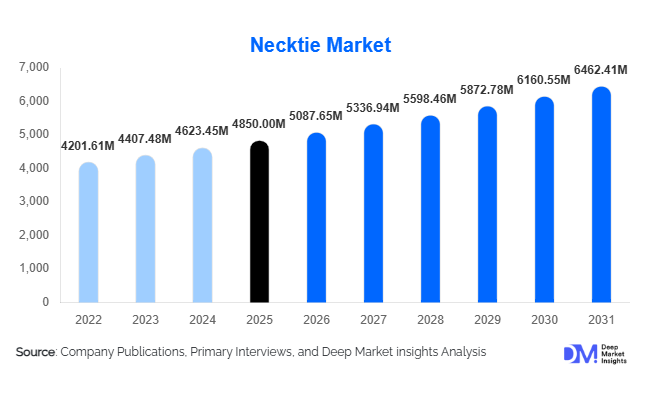
According to Deep Market Insights, the global necktie market size was valued at USD 4,850 million in 2025 and is projected to grow from USD 5,087.65 million in 2026 to reach USD 6,462.41 million by 2031, expanding at a CAGR of 4.9% during the forecast period (2026–2031). The necktie market growth is primarily driven by sustained demand in corporate dress codes, increasing consumption during formal events and weddings, and the expansion of fashion-driven accessories across both premium and mass-market segments. While casual workplace trends have moderated daily usage, the market continues to benefit from uniform-based demand and growing interest in customized and sustainable fashion accessories.
Key Market Insights
- Silk neckties continue to dominate premium segments, driven by luxury branding, durability, and high perceived value among formal wear consumers.
- Mid-range pricing categories lead overall sales, offering a balance between affordability and quality for working professionals.
- North America and Europe collectively account for over 55% of global demand, supported by established corporate cultures and formal event consumption.
- Asia-Pacific is the fastest-growing region, driven by urbanization, expanding middle-class populations, and increasing adoption of Western business attire.
- E-commerce platforms are reshaping distribution, enabling global access to diverse designs and fostering the growth of niche and direct-to-consumer brands.
- Customization and sustainable materials are emerging as key differentiators, particularly among younger and environmentally conscious consumers.
What are the latest trends in the necktie market?
Shift Toward Sustainable and Ethical Materials
The necktie market is witnessing a growing shift toward sustainability, with manufacturers increasingly adopting eco-friendly materials such as organic cotton, recycled polyester, and ethically sourced silk. Consumers, particularly in Europe and North America, are prioritizing products that align with environmental and ethical values. Brands are investing in transparent supply chains, low-impact dyeing processes, and biodegradable packaging to appeal to this segment. Sustainability certifications and labeling are also gaining importance, helping brands differentiate themselves in a competitive market. This trend is further supported by regulatory frameworks promoting environmentally responsible textile production, making sustainability a long-term growth driver for the industry.
Rise of Customization and Personalization
Personalization is emerging as a key trend in the necktie market, with consumers seeking unique designs for special occasions, including weddings, corporate events, and gift-giving. Digital platforms are enabling made-to-order ties with custom prints, monograms, and fabric selections. This trend is particularly strong in premium segments, where consumers are willing to pay higher prices for exclusivity. Corporate clients are also driving demand for customized ties as part of branding and uniform strategies. The integration of digital design tools and on-demand manufacturing is allowing companies to scale customization efficiently while maintaining profitability.
What are the key drivers in the necktie market?
Continued Demand from Corporate and Institutional Sectors
Corporate environments, including finance, legal, hospitality, and aviation sectors, continue to enforce formal dress codes that include neckties. Uniform-based demand from these industries ensures consistent baseline consumption, even as workplace dress norms evolve. Additionally, formal meetings, presentations, and events within corporate settings sustain demand for high-quality ties. This institutional reliance on neckties provides stability to the market despite broader shifts toward casual wear.
Growth of Global Events and Wedding Industry
The expanding global events industry, particularly in the areas of weddings and formal gatherings, is a significant driver of necktie demand. Consumers are increasingly opting for coordinated outfits and themed events, boosting sales of premium and customized ties. Wedding-related purchases often include multiple ties for groomsmen and guests, contributing to bulk demand. This segment is also characterized by higher spending, supporting revenue growth in premium categories.
Expansion of E-commerce and Direct-to-Consumer Channels
The rapid growth of e-commerce platforms has transformed the necktie market by improving accessibility and offering a wider range of products. Online channels allow consumers to compare designs, materials, and prices, driving informed purchasing decisions. Direct-to-consumer models enable brands to engage directly with customers, reducing distribution costs and increasing margins. Social media and influencer marketing are further amplifying online sales, particularly among younger consumers.
What are the restraints for the global market?
Decline in Daily Formal Wear Usage
The increasing adoption of casual and business-casual dress codes, particularly in Western markets, has reduced the frequency of necktie usage in daily work environments. Remote work trends and flexible workplace policies have further accelerated this shift, posing a structural challenge to long-term demand growth. While formal occasions continue to drive sales, the decline in everyday usage remains a key restraint.
Price Competition from Low-Cost Manufacturers
The presence of low-cost manufacturers, particularly in Asia, has intensified price competition in the necktie market. Polyester and blended fabric ties are widely available at low prices, putting pressure on margins for premium brands. This competitive environment makes it challenging for companies to maintain differentiation while balancing cost efficiency and quality.
What are the key opportunities in the necktie industry?
Expansion in Emerging Markets
Emerging economies in the Asia-Pacific and Latin America present significant growth opportunities for the necktie market. Rapid urbanization, increasing disposable incomes, and the adoption of Western-style business attire are driving demand in countries such as China, India, and Brazil. Companies that localize pricing and distribution strategies can tap into these high-growth markets effectively.
Corporate Branding and Uniform Integration
The use of neckties as part of corporate uniforms and branding strategies is expanding across industries such as hospitality, airlines, and retail. Customized ties featuring company logos and colors are increasingly used to enhance brand identity. This trend provides stable, bulk demand and long-term contracts for manufacturers, making it a lucrative opportunity for market participants.
Report Scope
| Report Metric | Details |
|---|---|
| Market Size in 2025 | USD 4850 Million |
| Market Size in 2026 | USD 5087.65 Million |
| Market Size in 2031 | USD 6462.41 Million |
| CAGR | 4.9% (2026-2031) |
| Base Year for Estimation | 2025 |
| Historical Data | 2022-2024 |
| Forecast Period | 2026-2031 |
| Report Coverage | Revenue Forecast, Competitive Landscape, Supply Chain Disruption, Growth Factors, Environment & Regulatory Landscape and Trends |
| Geographies Covered | North America, Europe, APAC, Middle East and Africa, LATAM |
| Countries Covered | U.S., Canada, U.K., Germany, France, Spain, Italy, Russia, Nordic, Benelux, Rest of Europe, China, Korea, Japan, India, Australia, Singapore, Taiwan, South East Asia, Rest of Asia-Pacific, UAE, Turky, Saudi Arabia, South Africa, Egypt, Nigeria, Rest of MEA, Brazil, Mexico, Argentina, Chile, Colombia, Rest of LATAM |
Explore more data points, trends and opportunities Download Free Sample Report
Product Type Insights
Standard neckties dominate the global market, accounting for approximately 55% of total demand in 2025, primarily due to their entrenched position in corporate and formal dress codes across industries such as finance, legal services, hospitality, and aviation. The leading driver for this segment is the continued institutional reliance on formal attire, particularly in professional environments and uniform-based industries, which ensures steady and recurring demand. Additionally, standard ties offer high versatility in terms of width, patterns, and fabrics, making them suitable for both daily office wear and formal occasions.
Bow ties and skinny ties represent niche but growing segments, driven by fashion-forward consumer preferences and event-specific demand, particularly in weddings, themed events, and creative industries. Skinny ties, in particular, have gained traction among younger demographics due to their modern aesthetic. Meanwhile, clip-on ties and cravats cater to specialized applications such as school uniforms, hospitality staff attire, and ceremonial use, where ease of wear and uniformity are key drivers. The diversification of product types reflects the market’s ability to cater to both traditional and evolving fashion needs.
Material Insights
Silk neckties lead the market with an estimated 42% share, driven by their premium appeal, superior texture, and association with luxury fashion. The primary driver for this segment is the strong demand for high-quality formal accessories, particularly in corporate settings and high-end events where silk ties are perceived as a symbol of professionalism and status. Luxury brands and designer labels continue to reinforce silk’s dominance through innovation in patterns and craftsmanship.
Polyester ties hold a significant share in the economy segment, supported by their cost-effectiveness, durability, and low maintenance requirements, making them ideal for bulk purchases in uniforms and budget-conscious consumers. Cotton and wool ties are gaining traction casually and seasonally, driven by shifting consumer preferences toward textured and versatile accessories. Blended fabrics offer a balance between affordability and quality, appealing to mid-range consumers. Meanwhile, sustainable materials are emerging as a high-growth segment, fueled by increasing environmental awareness, regulatory pressures, and demand for ethical fashion, particularly in developed markets.
Distribution Channel Insights
Offline retail channels continue to dominate, accounting for nearly 60% of total sales, driven by the consumer preference for tactile product evaluation, brand experience, and immediate availability. Department stores, specialty apparel outlets, and brand-exclusive stores remain key contributors, particularly for premium and luxury segments, where in-store experience plays a crucial role in purchasing decisions.
However, online retail is rapidly expanding and is the fastest-growing distribution channel, supported by the increasing penetration of e-commerce platforms, wider product assortments, and competitive pricing. Brand-owned websites and marketplaces are enabling direct-to-consumer engagement, allowing companies to improve margins and build customer loyalty. The rise of omnichannel strategies—integrating physical stores with digital platforms—is a key driver, as consumers increasingly expect seamless shopping experiences across multiple touchpoints. Social media and influencer marketing are further accelerating online sales, particularly among younger consumers.
End-Use Insights
The corporate and professional segment remains the largest end-use category, driven by the continued enforcement of formal dress codes and the need for professional appearance in workplace environments. This segment benefits from consistent demand across industries such as banking, consulting, and hospitality, where ties are often mandatory. The hospitality and aviation industries are among the fastest-growing segments, supported by the global expansion of tourism, increasing airline operations, and the need for standardized uniforms. Bulk procurement by these industries ensures steady demand and long-term contracts for manufacturers. The events and wedding industry also plays a significant role, driven by rising expenditure on celebrations and the growing trend of coordinated and customized attire, which boosts demand for premium and personalized ties.
Additionally, emerging applications in fashion styling and gender-neutral fashion are expanding the market’s scope. The increasing acceptance of ties as a unisex fashion accessory and their incorporation into casual and creative outfits are opening new avenues for growth, particularly among younger and urban consumers.
Explore more data points, trends and opportunities Download Free Sample Report
Necktie Market Segmentations
By Product Type
- Standard Neckties
- Skinny Ties
- Bow Ties
- Cravats / Ascots
- Clip-on Ties
By Material
- Silk Neckties
- Polyester Neckties
- Cotton Neckties
- Wool Neckties
- Blended Fabrics
- Sustainable / Eco-friendly Materials
By Distribution Channel
- Offline Retail
- Online Retail
By End-Use
- Corporate & Professional
- Hospitality & Aviation
- Events & Weddings
- Fashion & Casual Styling
- Institutional / Uniform Wear
Regional Insights
North America
North America accounts for approximately 30% of the global necktie market, with the United States as the dominant contributor. The primary growth driver in this region is the strong presence of corporate sectors and formal business culture, particularly in industries such as finance, law, and consulting. Additionally, high consumer spending power and a well-established premium apparel market support demand for luxury and customized ties. The region also benefits from a mature retail infrastructure and strong brand presence. However, growth is moderated by the increasing adoption of business-casual dress codes, although demand remains resilient for formal events and executive wear.
Europe
Europe holds around 28% market share, with key countries including the United Kingdom, Germany, France, and Italy. A major driver for regional growth is the strong heritage of formal fashion and luxury textile manufacturing, particularly in Italy, which is globally recognized for high-quality silk ties. The region also benefits from rising demand for sustainable and ethically produced fashion, encouraging innovation in eco-friendly materials and production processes. Corporate culture, formal events, and a robust luxury goods market further support demand, while tourism-driven retail sales contribute to overall growth.
Asia-Pacific
Asia-Pacific represents approximately 25% of the global market and is the fastest-growing region with a CAGR of around 6.5%. The key growth drivers include rapid urbanization, expanding middle-class populations, and increasing adoption of Western business attire in countries such as China and India. The growth of the service sector and multinational corporate presence is further boosting demand for formal wear. Additionally, the region’s strong textile manufacturing base supports both domestic consumption and export-driven growth. Japan and South Korea contribute steady demand through premium segments, while Southeast Asia is emerging as a new growth frontier.
Latin America
Latin America accounts for approximately 9% of the global market, led by Brazil and Mexico. The primary driver for growth in this region is the expansion of the middle class and increasing participation in formal social and corporate events. Economic development and urbanization are contributing to higher disposable incomes, enabling consumers to spend more on apparel and accessories. Additionally, the growing influence of Western fashion trends is driving the adoption of neckties in both professional and social settings. While the market remains relatively small, improving economic stability presents significant growth potential.
Middle East & Africa
The Middle East & Africa region holds around 8% market share, with demand concentrated in countries such as the UAE and South Africa. The key growth driver is the expansion of corporate sectors and the hospitality industry, particularly in the Middle East, where formal business attire is widely adopted. The region also benefits from increasing investments in tourism and aviation, which drive uniform-based demand for neckties. In Africa, gradual economic development and urbanization are contributing to the rising adoption of formal wear. Although the market is smaller compared to other regions, ongoing infrastructure and business growth are expected to support steady demand.
Key Players in the Necktie Market
- Ralph Lauren Corporation
- Hugo Boss AG
- Brooks Brothers
- Burberry Group plc
- Hermès International
- Giorgio Armani S.p.A.
- Zegna Group
- Paul Smith Ltd
- Van Heusen (PVH Corp.)
- H&M Group
- Zara (Inditex)
- Charles Tyrwhitt
- TM Lewin
- Ermenegildo Zegna
- Salvatore Ferragamo