Natural Toothpaste Market Size
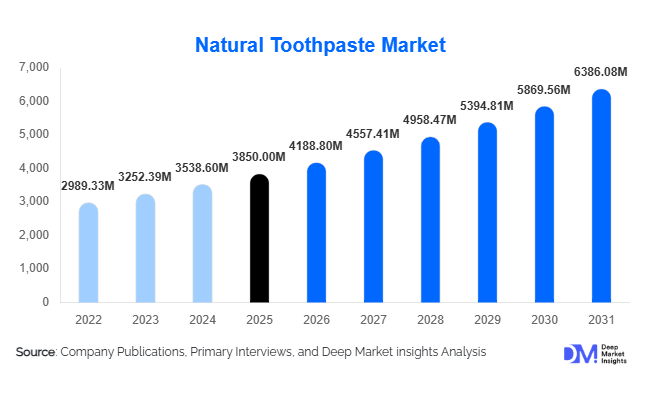
According to Deep Market Insights, the global natural toothpaste market size was valued at USD 3,850 million in 2025 and is projected to grow from USD 4,188.80 million in 2026 to reach USD 6,386.08 million by 2031, expanding at a CAGR of 8.8% during the forecast period (2026–2031). The market growth is primarily driven by increasing consumer awareness regarding the harmful effects of synthetic ingredients, rising adoption of organic and plant-based personal care products, and the growing shift toward sustainable and eco-friendly oral hygiene solutions.
Key Market Insights
- Consumer preference is shifting toward clean-label and chemical-free oral care products, driven by health-conscious lifestyles and ingredient transparency.
- Plant-based and herbal formulations dominate the market, particularly in the Asia-Pacific region, where traditional medicine systems influence purchasing behavior.
- North America leads the market, supported by premium product adoption and strong retail penetration.
- Asia-Pacific is the fastest-growing region, driven by urbanization, rising disposable incomes, and growing awareness of natural products.
- E-commerce channels are rapidly expanding, enabling niche and emerging brands to gain global visibility.
- Sustainable packaging innovations, including refillable and zero-waste formats, are reshaping consumer expectations.
What are the latest trends in the natural toothpaste market?
Rise of Zero-Waste and Sustainable Packaging
One of the most prominent trends in the natural toothpaste market is the shift toward sustainable packaging solutions. Brands are increasingly adopting biodegradable tubes, glass containers, and refillable systems to align with environmental concerns. Toothpaste tablets and powders, which eliminate the need for plastic packaging, are gaining traction among eco-conscious consumers. Companies are also investing in circular economy models, encouraging recycling and reuse. This trend is particularly strong in Europe and North America, where regulatory frameworks and consumer activism are accelerating the adoption of sustainable practices.
Growth of Functional and Specialized Formulations
Consumers are increasingly seeking multifunctional benefits beyond basic oral hygiene. Natural toothpaste products now incorporate features such as enamel strengthening, gum care, whitening, and sensitivity relief. Innovations in botanical extracts and essential oils are enabling brands to develop high-performance formulations that compete with conventional products. Additionally, microbiome-friendly and probiotic oral care solutions are emerging as a niche but rapidly growing segment, appealing to consumers interested in holistic health and wellness.
What are the key drivers in the natural toothpaste market?
Increasing Health and Wellness Awareness
The global shift toward healthier lifestyles has significantly boosted demand for natural and organic personal care products. Consumers are becoming more aware of the potential risks associated with synthetic chemicals such as fluoride, parabens, and SLS, leading to a preference for safer alternatives. This trend is particularly strong among millennials and Gen Z, who prioritize transparency and sustainability in their purchasing decisions.
Expansion of E-commerce and Direct-to-Consumer Channels
The rapid growth of online retail has made natural toothpaste products more accessible to a global audience. Direct-to-consumer brands are leveraging digital platforms, subscription models, and influencer marketing to reach targeted customer segments. This has reduced barriers to entry for new players and increased competition, driving innovation and product diversity.
What are the restraints for the global market?
Premium Pricing and Cost Constraints
Natural toothpaste products are generally priced higher than conventional alternatives due to the use of organic ingredients and sustainable packaging. This limits adoption among price-sensitive consumers, particularly in developing regions. The higher cost structure also poses challenges for manufacturers in maintaining competitive pricing while ensuring product quality.
Limited Clinical Validation and Consumer Skepticism
Despite growing popularity, some consumers remain skeptical about the efficacy of natural toothpaste compared to fluoride-based products. Lack of standardized certifications and limited clinical evidence for certain formulations can hinder widespread adoption, especially in markets with strong regulatory oversight.
What are the key opportunities in the natural toothpaste industry?
Expansion in Emerging Markets
Emerging economies such as India, China, and Brazil present significant growth opportunities due to rising disposable incomes and increasing awareness of natural products. Localized formulations incorporating traditional ingredients such as neem and clove can help companies establish a strong market presence. Government support for the herbal and organic industries further enhances growth prospects.
Innovation in Product Formats and Personalization
The introduction of innovative formats such as toothpaste tablets, powders, and liquid cleansers is creating new growth avenues. Personalized oral care solutions, driven by digital diagnostics and subscription models, are also gaining traction. These innovations not only enhance consumer convenience but also differentiate brands in a competitive market.
Report Scope
| Report Metric | Details |
|---|---|
| Market Size in 2025 | USD 3850 Million |
| Market Size in 2026 | USD 4188.80 Million |
| Market Size in 2031 | USD 6386.08 Million |
| CAGR | 8.8% (2026-2031) |
| Base Year for Estimation | 2025 |
| Historical Data | 2022-2024 |
| Forecast Period | 2026-2031 |
| Report Coverage | Revenue Forecast, Competitive Landscape, Supply Chain Disruption, Growth Factors, Environment & Regulatory Landscape and Trends |
| Geographies Covered | North America, Europe, APAC, Middle East and Africa, LATAM |
| Countries Covered | U.S., Canada, U.K., Germany, France, Spain, Italy, Russia, Nordic, Benelux, Rest of Europe, China, Korea, Japan, India, Australia, Singapore, Taiwan, South East Asia, Rest of Asia-Pacific, UAE, Turky, Saudi Arabia, South Africa, Egypt, Nigeria, Rest of MEA, Brazil, Mexico, Argentina, Chile, Colombia, Rest of LATAM |
Explore more data points, trends and opportunities Download Free Sample Report
Product Type Insights
Herbal toothpaste continues to dominate the natural toothpaste market, accounting for approximately 28% of the global market share in 2025. This leadership is primarily driven by strong demand in Asia-Pacific, where traditional medicine systems such as Ayurveda and Traditional Chinese Medicine (TCM) are deeply ingrained in consumer habits. The widespread availability of herbal ingredients like neem, clove, and basil, coupled with growing trust in their therapeutic benefits, has reinforced this segment’s dominance. Additionally, increasing government support for herbal and natural product industries in countries like India further accelerates adoption. Charcoal-based and whitening natural toothpaste segments are gaining traction globally, particularly among younger consumers influenced by social media trends and aesthetic-driven oral care preferences. Sensitivity relief and children’s natural toothpaste segments are also expanding steadily, supported by rising awareness of specialized oral care needs and increasing parental preference for chemical-free products for children.
Formulation Insights
Paste formulations remain the most widely used format, holding over 60% of the market share, primarily due to their familiarity, convenience, and compatibility with existing consumer habits. The dominance of paste is further supported by its ease of manufacturing, cost efficiency, and compatibility with a wide range of natural ingredients. However, alternative formats such as toothpaste tablets and powders are emerging as fast-growing segments, driven by increasing demand for sustainable and travel-friendly solutions. These formats appeal particularly to eco-conscious consumers seeking zero-waste alternatives and reduced plastic usage. Gel-based formulations are also gaining traction, especially in premium segments, due to their visual appeal, smooth texture, and perceived effectiveness in delivering targeted benefits such as whitening and freshness.
Distribution Channel Insights
Supermarkets and hypermarkets lead the distribution landscape, accounting for around 40% of the market share, driven by their extensive reach, strong consumer trust, and ability to offer a wide variety of products under one roof. The dominance of this channel is further reinforced by strategic shelf placements and promotional activities by leading brands. However, online retail is the fastest-growing distribution channel, expanding at a double-digit CAGR due to increasing internet penetration, convenience, and the availability of a broader product range, including niche and premium brands. Direct-to-consumer (D2C) platforms are also gaining prominence, enabling brands to build stronger customer relationships and offer personalized experiences. Specialty organic stores continue to play a critical role in promoting premium and certified natural products, particularly in developed markets where consumers actively seek authenticity and product transparency.
End-Use Insights
Household consumption dominates the market, accounting for more than 75% of total demand, as natural toothpaste is primarily used for daily oral hygiene. The segment’s leadership is driven by increasing consumer awareness of preventive healthcare and the shift toward safer, chemical-free personal care products. Dental clinics are emerging as a high-growth segment, with professionals increasingly recommending natural toothpaste for patients with sensitivities, allergies, or concerns about synthetic ingredients. This trend is supported by growing clinical acceptance of certain natural formulations. The hospitality sector is also witnessing rising adoption, particularly in premium hotels and eco-resorts, where natural toothpaste is included as part of sustainable guest amenities. This shift is driven by the broader trend of eco-conscious tourism and corporate sustainability commitments.
Explore more data points, trends and opportunities Download Free Sample Report
Natural Toothpaste Market Segmentations
By Product Type
- Fluoride-Free Natural Toothpaste
- Herbal Toothpaste
- Charcoal Toothpaste
- Whitening Natural Toothpaste
- Sensitivity Relief Natural Toothpaste
- Children’s Natural Toothpaste
- Multi-Benefit Natural Toothpaste
By Formulation Type
- Paste
- Gel
- Powder
- Tablets/Chewable
- Liquid Tooth Cleanser
By Distribution Channel
- Supermarkets & Hypermarkets
- Pharmacies/Drug Stores
- Specialty Organic Stores
- Online Retail
- Convenience Stores
Regional Insights
North America
North America holds approximately 32% of the global market share in 2025, with the United States leading demand due to high consumer awareness, strong preference for organic and clean-label products, and well-established retail infrastructure. The region’s growth is driven by increasing adoption of premium personal care products, widespread availability of certified organic brands, and strong marketing through digital channels. Regulatory support for ingredient transparency and sustainability further strengthens market expansion. Canada is also witnessing steady growth, supported by rising environmental consciousness and government initiatives promoting eco-friendly consumer goods.
Europe
Europe accounts for around 28% of the market share, with Germany, the UK, and France as key contributors. The region’s growth is primarily driven by stringent regulations on chemical ingredients, which encourage the adoption of natural alternatives. High environmental awareness among consumers and strong demand for sustainable packaging solutions further boost market growth. Additionally, the presence of established natural personal care brands and increasing investments in organic product innovation contribute to the region’s steady expansion. Consumer preference for certified organic and vegan products is particularly strong in Western Europe.
Asia-Pacific
Asia-Pacific is the fastest-growing region, with a CAGR exceeding 10%, driven by rapid urbanization, rising disposable incomes, and strong cultural acceptance of herbal and natural products. India and China are the primary growth engines, with India alone contributing nearly 12% of global demand. The region benefits from the widespread use of traditional remedies, government support for herbal industries, and the availability of low-cost natural raw materials. Increasing penetration of e-commerce platforms and growing middle-class populations further accelerate market growth. Additionally, rising awareness of oral hygiene and preventive healthcare is expanding the consumer base.
Latin America
Latin America holds approximately 6% of the market share, with Brazil and Mexico leading demand. The region’s growth is driven by increasing health awareness, rising middle-class incomes, and expanding retail infrastructure. The growing influence of global wellness trends and the introduction of affordable natural toothpaste products are also contributing to market expansion. Additionally, improving access to online retail platforms is enabling consumers to explore a wider range of natural and organic oral care products.
Middle East & Africa
The Middle East and Africa account for around 6% of the global market, with the UAE and South Africa as key markets. Growth in this region is supported by rising tourism, particularly in the Middle East, where premium hotels and resorts are adopting natural toothpaste as part of sustainable hospitality initiatives. Increasing disposable incomes, urbanization, and growing awareness of personal care products are also driving demand. In Africa, gradual improvements in retail infrastructure and rising health awareness are contributing to market growth, although adoption remains at an early stage compared to other regions.
Key Players in the Natural Toothpaste Market
- Colgate-Palmolive
- Procter & Gamble
- Unilever
- GlaxoSmithKline
- Himalaya Wellness
- Dabur
- Patanjali Ayurved
- Tom’s of Maine
- Weleda
- Dr. Bronner’s
- Jason Natural Products
- Burt’s Bees
- Schmidt’s Naturals
- Hello Products
- Desert Essence