Natural Hair Care Product Market Size
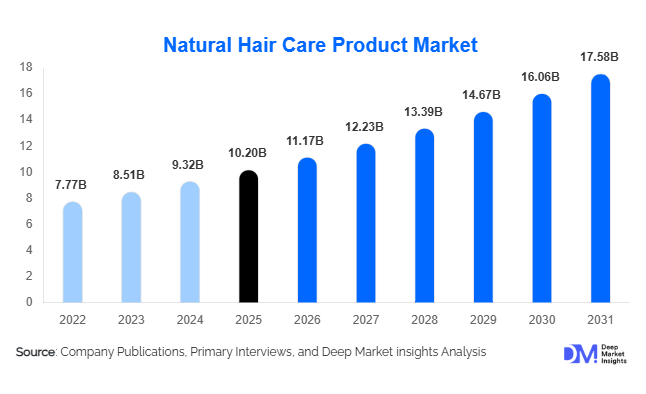
According to Deep Market Insights, the global natural hair care product market size was valued at USD 10.2 billion in 2025 and is projected to grow from USD 11.17 billion in 2026 to reach USD 17.58 billion by 2031, expanding at a CAGR of 9.5% during the forecast period (2026–2031). The natural hair care market growth is primarily driven by increasing consumer preference for chemical-free and plant-based formulations, rising awareness of hair and scalp health, and the expansion of premium and sustainable product offerings across global markets.
Key Market Insights
- Consumer preference is shifting toward clean, sustainable hair care solutions, with increasing demand for organic, vegan, and cruelty-free formulations.
- Premium hair oils, serums, and conditioners are driving market growth, particularly in North America and Europe, as consumers invest in performance-driven and luxury natural products.
- Emerging markets in the Asia Pacific and Latin America are rapidly growing, fueled by rising disposable incomes, urbanization, and cultural affinity for traditional botanical hair care practices.
- Online distribution channels are expanding reach, allowing brands to engage younger, digitally-savvy consumers and support direct-to-consumer and marketplace sales.
- Ingredient innovation and personalized formulations are transforming product portfolios, with plant-based actives, scalp-health-focused treatments, and performance-backed solutions gaining popularity.
- Technological adoption in marketing and product transparency, including AI-driven personalization, mobile apps, and ingredient traceability, is reshaping consumer engagement.
What are the latest trends in the natural hair care product market?
Ingredient-Driven Personalization
Brands are increasingly developing personalized hair care solutions that cater to specific hair concerns such as dryness, hair fall, and scalp health. Products integrating botanicals, probiotics, adaptogens, and natural oils are gaining traction, as consumers seek clinically backed efficacy combined with sustainability. Personalization extends to hair type and texture, with solutions for curly, straight, and textured hair becoming mainstream. This trend is reinforced by data-driven recommendations, e-commerce quizzes, and AI-based guidance, allowing consumers to select products tailored to individual needs.
Sustainable and Ethical Product Innovation
Sustainability is a key differentiator, with brands adopting biodegradable packaging, refillable formats, and ethically sourced natural ingredients. Certifications such as ECOCERT and COSMOS provide credibility and drive consumer confidence. Companies are emphasizing transparent supply chains, cruelty-free testing, and carbon-neutral production. Additionally, the “skinification” trend, where scalp health is treated with the same rigor as skincare, is influencing formulation innovations, including scalp serums, hair masks, and nutrient-rich oils.
What are the key drivers in the natural hair care product market?
Health and Wellness Awareness
Rising awareness about the harmful effects of sulfates, parabens, and synthetic chemicals is a major driver for natural hair care products. Consumers are increasingly conscious of long-term hair and scalp health, fueling demand for botanical, chemical-free alternatives. Social media platforms, influencer endorsements, and ingredient transparency tools play a key role in educating consumers and influencing purchase behavior.
Premiumization and Grooming Trends
The growth of the self-care and grooming culture is expanding demand for high-end natural hair care products. Women continue to invest in multi-step regimes, while men’s grooming is also emerging as a significant growth segment. Products promising performance benefits such as strengthening, moisturizing, and styling without chemicals are commanding premium pricing, especially in North America and Europe.
Expansion in Emerging Markets
Emerging economies in the Asia Pacific and Latin America offer significant opportunities. Rising disposable incomes, urbanization, and increasing retail penetration are driving natural hair care adoption. Cultural affinity toward traditional hair oils and botanical remedies in countries like India and Brazil further support the market’s rapid expansion.
What are the restraints for the global market?
High Price Sensitivity
Natural hair care products are generally priced higher than conventional products due to costlier ingredients and sustainable packaging. Price-sensitive consumers in developing regions may find adoption challenging, limiting penetration and market expansion.
Fragmented Ingredient and Certification Standards
The lack of globally harmonized definitions for “natural” claims can create confusion and increase compliance costs. Differing regulations across regions require separate certifications and testing, posing challenges for global product launches and consistent consumer trust.
What are the key opportunities in the natural hair care industry?
Expansion of E-Commerce and Digital Marketing
The surge in online shopping provides brands with a low-cost, high-reach platform to educate consumers and drive sales. Direct-to-consumer models, social commerce, and influencer marketing allow niche brands to target younger audiences, test product innovations, and scale rapidly without heavy offline infrastructure investments.
Innovative Ingredient and Formulation Development
Opportunities lie in developing products with clinically validated botanicals, adaptogens, probiotics, and plant-based actives. Personalized and performance-focused products for different hair types and scalp conditions allow premiumization and differentiation. Integrating sustainability with high efficacy, through upcycled ingredients, eco-friendly packaging, and ethical sourcing, enhances market appeal.
Emerging Regional Demand
Rapid urbanization and rising disposable incomes in the Asia Pacific and Latin America are creating new growth corridors. Countries like India, China, and Brazil combine traditional botanical practices with modern hair care aspirations. Regulatory support and certification infrastructure in these regions enable global brands to enter with confidence, creating export and domestic growth opportunities.
Report Scope
| Report Metric | Details |
|---|---|
| Market Size in 2025 | USD 10.2 Billion |
| Market Size in 2026 | USD 11.17 Billion |
| Market Size in 2031 | USD 17.58 Billion |
| CAGR | 9.5% (2026-2031) |
| Base Year for Estimation | 2025 |
| Historical Data | 2022-2024 |
| Forecast Period | 2026-2031 |
| Report Coverage | Revenue Forecast, Competitive Landscape, Supply Chain Disruption, Growth Factors, Environment & Regulatory Landscape and Trends |
| Geographies Covered | North America, Europe, APAC, Middle East and Africa, LATAM |
| Countries Covered | U.S., Canada, U.K., Germany, France, Spain, Italy, Russia, Nordic, Benelux, Rest of Europe, China, Korea, Japan, India, Australia, Singapore, Taiwan, South East Asia, Rest of Asia-Pacific, UAE, Turky, Saudi Arabia, South Africa, Egypt, Nigeria, Rest of MEA, Brazil, Mexico, Argentina, Chile, Colombia, Rest of LATAM |
Explore more data points, trends and opportunities Download Free Sample Report
Product Type Insights
Hair oils and serums dominate the natural hair care product market, accounting for approximately 22–25% of total revenue in 2025. This leadership is primarily driven by strong cultural adoption in regions such as Asia Pacific and Africa, where oil-based hair care rituals are deeply embedded in daily routines. Additionally, increasing scientific validation of botanical oils such as argan, coconut, and castor oil for strengthening hair, reducing breakage, and improving scalp health has reinforced consumer confidence. Premiumization also plays a key role, as oils and serums are often positioned as high-value, multifunctional treatments with visible results.
Shampoos and conditioners represent the next largest segment, supported by rising demand for sulfate-free, paraben-free, and herbal formulations. Consumers are increasingly transitioning from conventional cleansing products to gentle, plant-based alternatives that maintain scalp balance and reduce long-term damage. A key growth driver within this segment is the integration of plant-based active ingredients such as aloe vera, tea tree oil, and biotin, enabling brands to offer multifunctional benefits such as hydration, anti-dandruff treatment, and hair strengthening. Furthermore, the premium segment captures approximately 35–40% of the market, driven by affluent consumers prioritizing product efficacy, sustainability, and brand transparency.
Application Insights
Women remain the dominant end-user segment, contributing approximately 70–75% of global revenue in 2025. This leadership is driven by higher engagement in multi-step hair care routines, greater spending on beauty and wellness products, and increasing demand for targeted solutions addressing concerns such as hair fall, dryness, and scalp sensitivity. The segment’s growth is further supported by the rising popularity of customized and premium natural formulations tailored to specific hair types and textures. The men’s grooming segment is emerging as a significant growth driver, fueled by evolving perceptions of personal care and increasing awareness of natural and chemical-free grooming products. Demand for natural shampoos, conditioners, and styling products among men is growing steadily, particularly in urban markets.
Emerging applications such as scalp microbiome treatments, anti-pollution sprays, and botanical styling creams are gaining traction, especially among younger consumers seeking specialized and performance-driven solutions. Additionally, export-driven demand is expanding, with countries such as India and South Korea leveraging their strong manufacturing capabilities and botanical heritage to supply global markets with natural hair oils, sulfate-free shampoos, and herbal conditioners.
Distribution Channel Insights
Offline retail continues to dominate the market, accounting for approximately 55–60% of global revenue in 2025. This dominance is driven by consumer preference for physical product evaluation, trust in established retail formats, and the availability of expert recommendations in salons and specialty stores. Supermarkets, pharmacies, and professional salons remain critical touchpoints, particularly in developing markets where in-store purchasing is still prevalent.
However, online channels represent the fastest-growing segment, supported by increasing internet penetration, smartphone usage, and the expansion of e-commerce ecosystems. Digital platforms enable brands to reach niche audiences, offer personalized recommendations, and educate consumers about ingredient benefits. Social media marketing, influencer collaborations, and direct-to-consumer strategies are key drivers of online growth, particularly in Asia Pacific and other emerging regions. Subscription-based and membership-driven models are also gaining traction, allowing brands to enhance customer retention through personalized product offerings and recurring purchase incentives.
Age Group Insights
Consumers aged 31–50 years represent the largest segment in the natural hair care product market, driven by high disposable incomes and a strong preference for premium, performance-oriented products. This demographic prioritizes hair health, anti-aging benefits, and long-term scalp care, leading to higher adoption of natural and organic formulations.
The 18–30 age group is the fastest-growing segment, fueled by digital engagement, social media influence, and a strong inclination toward sustainability and clean beauty. This group actively seeks innovative products such as vegan formulations, eco-friendly packaging, and personalized solutions. Consumers aged above 50 years contribute significantly to the premium segment, with demand focused on restorative and wellness-oriented products addressing concerns such as thinning hair, scalp sensitivity, and overall hair vitality.
Explore more data points, trends and opportunities Download Free Sample Report
Natural Hair Care Product Market Segmentations
By Product Type
- Natural Shampoos
- Conditioners & Hair Masks
- Hair Oils & Serums
- Styling & Finishing Products
- Hair Growth & Scalp Treatments
By Application
- Women’s Hair Care
- Men’s Grooming
- Children & Teen Hair Care
- Scalp Health & Treatment Applications
By Distribution Channel
- Online Retail
- Supermarkets & Hypermarkets
- Specialty Stores
- Pharmacies & Drugstores
- Salons & Professional Retail
Regional Insights
North America
North America accounts for approximately 25–28% of the global market share in 2025, with the United States being the primary contributor. Growth in this region is driven by high consumer awareness regarding ingredient safety, strong demand for premium and organic products, and well-established retail and e-commerce infrastructure. The increasing popularity of clean beauty trends, coupled with stringent regulatory standards and widespread availability of certified natural products, further supports market expansion. Additionally, high spending capacity and the presence of leading global brands contribute to sustained demand.
Europe
Europe holds the largest share of the market at approximately 35–38% in 2025, led by countries such as Germany, France, and the United Kingdom. Regional growth is driven by strong environmental consciousness, stringent regulatory frameworks governing cosmetic ingredients, and widespread adoption of certified organic products. Consumers in Europe demonstrate a high preference for sustainable packaging, cruelty-free formulations, and ethically sourced ingredients. The presence of established natural and organic beauty brands, combined with advanced R&D capabilities, positions Europe as a key innovation hub in the market.
Asia Pacific
Asia Pacific is the fastest-growing region, driven by countries such as India, China, and Japan. Rapid urbanization, rising disposable incomes, and increasing awareness of hair health are key growth drivers. The region benefits from a strong cultural foundation of traditional botanical hair care practices, particularly in India, where natural oils and herbal formulations are widely used. In China and Japan, the influence of K-beauty and J-beauty trends, along with increasing digital retail penetration, is accelerating adoption. Additionally, the region’s role as a manufacturing hub for natural ingredients and finished products supports both domestic consumption and export growth.
Latin America
Latin America, led by Brazil and Mexico, is experiencing steady growth in the natural hair care market. Regional demand is driven by a strong cultural emphasis on hair care, increasing awareness of natural ingredients, and rising middle-class incomes. Brazil, in particular, stands out due to its diverse hair types and high consumption of hair care products. Growth is further supported by local production of botanical ingredients and expanding retail distribution networks. Increasing marketing campaigns and influencer-driven awareness are also encouraging the adoption of premium and mid-range natural products.
Middle East & Africa
The Middle East & Africa region accounts for approximately 9–11% of the global market share in 2025, with key markets including the UAE, South Africa, and Kenya. Growth in this region is driven by rising grooming awareness, increasing urbanization, and higher disposable incomes in Gulf countries. The region’s proximity to natural and botanical raw materials supports local production and enhances product authenticity. In Africa, a young population and a growing shift toward natural alternatives over chemical-based products are key demand drivers. Additionally, expanding retail infrastructure and increasing penetration of international brands are contributing to market growth.
Key Players in the Natural Hair Care Market
- Estée Lauder Companies
- Procter & Gamble Co
- Unilever
- L’Oréal Group
- Johnson & Johnson
- Coty Inc.
- Natura & Co
- Henkel AG & Co.
- Beiersdorf AG
- Kao Corporation
- Shiseido Company
- Unicity Brands Inc
- The Honest Company
- Mamaearth (Honasa Consumer)
- Davines S.p.A