Natural Deodorant Market Size
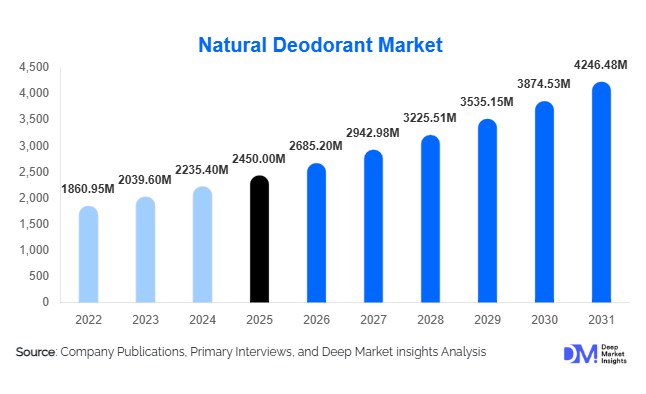
According to Deep Market Insights, the global natural deodorant market size was valued at USD 2,450 million in 2025 and is projected to grow from USD 2,685.20 million in 2026 to reach USD 4,246.48 million by 2031, expanding at a CAGR of 9.6% during the forecast period (2026–2031). The growth of the natural deodorant market is primarily driven by increasing consumer preference for chemical-free personal care products, heightened awareness of health and sustainability, and the rapid expansion of e-commerce channels facilitating wider access to niche, clean-label brands.
Key Market Insights
- Consumers are increasingly prioritizing health and clean-label personal care products, boosting demand for natural deodorants free from aluminum, parabens, and synthetic fragrances.
- Sustainable and eco-friendly packaging innovations, including refillable, biodegradable, and compostable options, are influencing purchasing decisions and fostering brand loyalty.
- North America dominates the global market, with the U.S. leading adoption due to higher disposable incomes and awareness of clean beauty trends.
- Asia-Pacific is the fastest-growing region, driven by rising middle-class populations in China and India and increasing awareness of natural personal care alternatives.
- Direct-to-consumer (D2C) and online retail channels are expanding, allowing niche brands to reach global consumers and leverage subscription-based and personalized offerings.
- Innovation in ingredient technology, including essential oil formulations, probiotic-based deodorants, and microbiome-friendly products, is enhancing product performance and differentiating brands.
What are the latest trends in the natural deodorant market?
Shift Toward Clean-Label and Ethical Products
Consumers are increasingly favoring products that are organic, vegan, cruelty-free, and free from synthetic chemicals. Natural deodorants that meet these criteria are experiencing strong growth across all regions, particularly among millennials and Gen Z. This trend is supported by increased transparency, clear labeling, and third-party certifications, which strengthen consumer trust. Brands are also promoting ethically sourced ingredients and environmentally conscious supply chains, which align with rising consumer demand for sustainable personal care.
Innovation in Formulations and Technology
Recent technological innovations in natural deodorants focus on improving efficacy and longevity. Formulations incorporating probiotics, magnesium compounds, essential oils, and charcoal are being used to neutralize odor and manage sweat effectively. Brands are investing in clinical studies and dermatologically tested products to enhance credibility. Subscription-based and customizable deodorant offerings further allow consumers to tailor products according to skin type, sensitivity, and fragrance preference, increasing market penetration.
What are the key drivers in the natural deodorant market?
Growing Health and Wellness Consciousness
Consumers are increasingly aware of the potential health risks associated with conventional deodorants containing aluminum, parabens, and synthetic fragrances. This awareness has led to higher adoption of natural and chemical-free alternatives. Health-conscious consumers, particularly in developed markets, are driving demand for products that combine efficacy with skin safety, boosting market growth.
Rising Demand for Sustainable and Ethical Products
Eco-conscious consumers are favoring natural deodorants that align with sustainability principles, including biodegradable packaging, cruelty-free formulations, and ethical sourcing of ingredients. This trend is amplified by government regulations supporting environmental responsibility and the global push toward a circular economy, positioning sustainability as a key driver of market growth.
Expansion of E-Commerce and D2C Channels
Digital channels have transformed the distribution landscape for natural deodorants. Direct-to-consumer models, subscription services, and online marketplaces allow brands to reach niche audiences, scale quickly, and reduce dependence on traditional retail. Personalized marketing and social media engagement further enhance customer acquisition and loyalty, supporting market expansion.
What are the restraints for the global market?
Premium Pricing
The higher cost of natural deodorants compared to conventional products limits mass adoption, particularly in developing regions. Price-sensitive consumers may be deterred, affecting market penetration. Strategies such as mid-range product offerings and localized production can help mitigate this restraint.
Performance Perception Challenges
Despite advances in formulation, some consumers perceive natural deodorants as less effective in controlling odor and sweat compared to traditional products. Overcoming this perception requires ongoing R&D, marketing, and consumer education to highlight product efficacy and benefits.
What are the key opportunities in the natural deodorant market?
Expansion in Emerging Markets
Asia-Pacific and Latin America present significant growth opportunities due to rising disposable incomes, urbanization, and increasing awareness of clean-label products. Tailoring formulations to local climates and preferences, combined with affordable pricing strategies, can accelerate adoption in these regions. India, China, and Brazil are expected to contribute substantially to global market growth over the forecast period.
Innovation in Formulation Technologies
Technological advancements, such as microbiome-based deodorants, probiotic formulations, and enzymatic odor neutralizers, allow brands to deliver superior performance without synthetic chemicals. Investment in R&D and clinical validation provides a competitive edge, helping to attract new users and retain existing consumers.
Sustainable Packaging and Circular Economy Models
Eco-friendly packaging and refillable systems address the growing demand for environmentally responsible products. Government initiatives and consumer awareness support the adoption of sustainable solutions, allowing brands to differentiate themselves and command premium pricing. Companies integrating sustainability into their production and supply chains benefit from stronger brand loyalty and long-term market positioning.
Report Scope
| Report Metric | Details |
|---|---|
| Market Size in 2025 | USD 2450 Million |
| Market Size in 2026 | USD 2685.20 Million |
| Market Size in 2031 | USD 4246.48 Million |
| CAGR | 9.6% (2026-2031) |
| Base Year for Estimation | 2025 |
| Historical Data | 2022-2024 |
| Forecast Period | 2026-2031 |
| Report Coverage | Revenue Forecast, Competitive Landscape, Supply Chain Disruption, Growth Factors, Environment & Regulatory Landscape and Trends |
| Geographies Covered | North America, Europe, APAC, Middle East and Africa, LATAM |
| Countries Covered | U.S., Canada, U.K., Germany, France, Spain, Italy, Russia, Nordic, Benelux, Rest of Europe, China, Korea, Japan, India, Australia, Singapore, Taiwan, South East Asia, Rest of Asia-Pacific, UAE, Turky, Saudi Arabia, South Africa, Egypt, Nigeria, Rest of MEA, Brazil, Mexico, Argentina, Chile, Colombia, Rest of LATAM |
Explore more data points, trends and opportunities Download Free Sample Report
Product Type Insights
Stick deodorants continue to dominate the natural deodorant market, accounting for approximately 38% of the global market share in 2025. Their leadership is largely driven by convenience, ease of application, and consumer familiarity, making them a preferred choice among mass-market and premium users alike. Within the ingredient segment, essential oil-based deodorants lead with a 30% share, valued for their natural fragrance, antimicrobial properties, and wellness appeal, which aligns with the global clean-label and holistic personal care trend. Scented deodorants hold around 72% of the fragrance segment, reflecting consumer preference for pleasant, long-lasting aromas, while mid-range products dominate the pricing segment with 46% share due to their balance of quality and affordability. Online retail emerges as the fastest-growing distribution channel, capturing 34% of the global market, fueled by the rise of D2C models, subscription services, and targeted digital marketing campaigns that improve consumer reach and engagement.
Application Insights
The primary application for natural deodorants remains personal care, which benefits from increasing consumer inclination toward wellness-oriented lifestyles and active fitness regimens. Athletes and gym-goers, in particular, drive demand for high-performance, long-lasting formulations free from skin irritants. Emerging applications include dermatologically tested and medical-grade deodorants targeting sensitive skin or clinical needs. Export-driven demand remains strong from North America and Europe, with Asia-Pacific becoming a high-growth target for international brands due to rising middle-class populations, expanding urbanization, and increasing awareness of natural and ethical personal care products.
Distribution Channel Insights
Online retail and direct-to-consumer (D2C) platforms dominate the market due to the convenience of doorstep delivery, subscription models, and the ability to personalize products according to skin type, scent preferences, and sensitivity. Specialty stores and pharmacies maintain importance for premium, dermatologically tested, and certified natural deodorants. Traditional supermarkets and hypermarkets continue to serve the mass-market segment, particularly in regions where e-commerce penetration is still developing. E-commerce further enables smaller niche brands to access international markets and compete effectively with established global players.
End-User Insights
Women account for 48% of the natural deodorant market, leading adoption due to a stronger focus on personal care, wellness, and ethical consumption. Male and unisex deodorants are rapidly gaining traction, driven by increasing awareness among men of chemical-free, skin-safe alternatives. Teen and adolescent segments are early adopters, influenced by social media trends, sustainability awareness, and peer recommendations. Fitness and wellness enthusiasts across all age groups are key drivers of demand for long-lasting, non-irritant formulations that perform under active conditions.
Explore more data points, trends and opportunities Download Free Sample Report
Natural Deodorant Market Segmentations
By Product Type
- Stick Deodorants
- Roll-On Deodorants
- Spray Deodorants
- Cream-Based Deodorants
- Gel-Based Deodorants
- Powder Deodorants
By Application
- Personal Care
- Fitness & Active Lifestyle
- Dermatological & Sensitive Skin Applications
- Medical/Clinical Use
By Distribution Channel
- Online Retail
- Supermarkets & Hypermarkets
- Pharmacies & Drugstores
- Specialty Stores
- Convenience Stores
Regional Insights
North America
North America remains the largest market, contributing approximately 35% of the global market share in 2025. The U.S. leads adoption due to high consumer awareness, disposable income, and preference for clean-label, premium personal care products. Key growth drivers include strong e-commerce adoption, sustainability-conscious consumer behavior, and innovative product launches in essential oil and probiotic-based deodorants. Regulatory support for chemical-free and organic personal care products further enhances market growth.
Europe
Europe accounts for around 28% of the global market, with Germany, the U.K., and France as primary contributors. The market is driven by stringent regulatory frameworks promoting product safety, organic certifications, and sustainability standards, alongside a growing eco-conscious consumer base. Premium and mid-range natural deodorants dominate due to high disposable income and preference for ethical, dermatologist-approved products. The rise of online retail and specialty wellness stores has strengthened market penetration, particularly for niche formulations such as essential oil and probiotic-based deodorants.
Asia-Pacific
Asia-Pacific is the fastest-growing region, with a CAGR exceeding 11%, led by China and India. Rapid urbanization, rising middle-class incomes, and growing awareness of chemical-free personal care products are primary growth drivers. Younger demographics are increasingly purchasing via online platforms and D2C models. The market growth is further accelerated by health-conscious trends, increasing fitness and wellness adoption, and the rising demand for products with natural fragrances and long-lasting performance.
Latin America
Brazil, Mexico, and Argentina are emerging markets for natural deodorants, with growth driven by rising disposable income, urbanization, and increasing adoption of premium wellness products. Key drivers include expanding retail infrastructure, awareness campaigns about natural personal care, and targeted product launches catering to lifestyle and active consumers. Niche brands offering localized scents and natural formulations are gaining traction among urban populations seeking sustainable alternatives.
Middle East & Africa
Demand is growing steadily in the UAE, Saudi Arabia, and South Africa. Africa serves as both a production hub and a consumer market, while Middle Eastern markets benefit from high-income populations and a strong preference for luxury, ethically produced natural deodorants. Market growth is driven by premiumization, increasing wellness awareness, and consumer willingness to invest in sustainable, chemical-free products. International brands are leveraging ethical positioning, eco-friendly packaging, and innovative formulations to establish market share, while government initiatives supporting health and personal care awareness further propel adoption.
Key Players in the Natural Deodorant Market
- Unilever
- Procter & Gamble
- L’Oréal
- Beiersdorf
- Colgate-Palmolive
- Native (P&G brand)
- Schmidt’s Naturals
- Tom’s of Maine
- Weleda
- Dr. Hauschka
- Burt’s Bees
- EO Products
- Crystal (French Transit Ltd.)
- Kopari Beauty
- Ursa Major