Natural Cosmetics Market Size
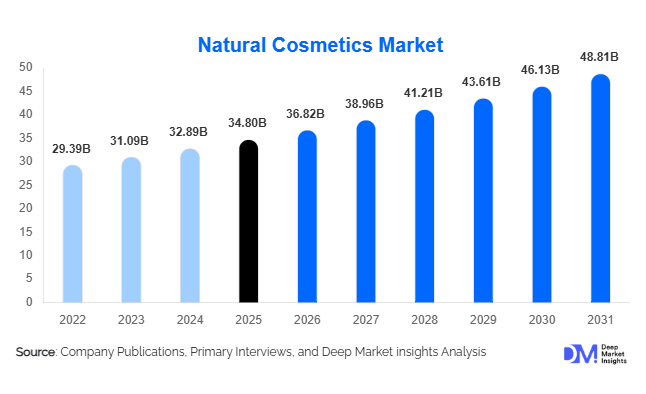
According to Deep Market Insights, the global natural cosmetics market size was valued at USD 34.8 billion in 2025 and is projected to grow from USD 36.82 billion in 2026 to reach USD 48.81 billion by 2031, expanding at a CAGR of 5.8% during the forecast period (2026–2031). The natural cosmetics market growth is primarily driven by rising consumer preference for clean-label beauty products, increasing awareness regarding harmful synthetic ingredients, and growing demand for sustainable and ethically sourced personal care products. Expanding adoption of vegan, cruelty-free, and eco-certified cosmetics across skincare, haircare, and wellness applications is further accelerating market expansion globally.
Key Market Insights
- Consumer preference is rapidly shifting toward clean beauty and ingredient transparency, increasing demand for plant-based and naturally derived cosmetic formulations.
- Skincare dominates the natural cosmetics market, accounting for nearly 38% of global revenue in 2025 due to rising anti-aging and sensitive-skin product demand.
- Europe remains the largest regional market, supported by strict cosmetic ingredient regulations and strong consumer focus on sustainability.
- Asia-Pacific is the fastest-growing market, driven by rising disposable income, Ayurveda-inspired products, and K-beauty innovation trends.
- Online retail and D2C channels are transforming product distribution, enabling rapid expansion of indie and premium clean beauty brands.
- Technological innovations, including biotechnology-derived ingredients, AI-based personalization, and sustainable packaging systems, are reshaping product development strategies.
Natural Cosmetics Market Trends
Sustainable Packaging and Refillable Beauty Solutions Gaining Momentum
Consumers are increasingly evaluating cosmetic products not only on formulation quality but also on environmental impact throughout the product lifecycle. As a result, cosmetic manufacturers are rapidly investing in refillable containers, biodegradable packaging, recycled plastics, and waterless beauty formats. Luxury and premium beauty brands are introducing refill stations and reusable packaging systems to reduce single-use plastic waste while improving customer loyalty. Governments across Europe and North America are also strengthening packaging sustainability regulations, encouraging companies to adopt circular economy principles. Brands integrating eco-friendly packaging with carbon-neutral supply chains are gaining stronger competitive positioning among environmentally conscious consumers.
Biotechnology-Derived Natural Ingredients Expanding Product Innovation
Biotechnology is becoming increasingly important within the natural cosmetics industry as companies seek sustainable alternatives to traditional agricultural sourcing. Fermentation-derived actives, lab-cultivated botanical extracts, microbiome-friendly ingredients, and plant stem-cell technologies are improving product efficacy while maintaining clean-label positioning. Biotechnology helps reduce dependency on climate-sensitive crops and stabilizes ingredient supply chains. Cosmetic brands are also using AI-assisted formulation development and personalized skincare diagnostics to create premium, customized beauty solutions. This trend is especially strong in skincare and anti-aging categories where consumers demand clinically validated performance alongside natural ingredient positioning.
Natural Cosmetics Market Drivers
Growing Consumer Awareness Regarding Synthetic Chemical Exposure
Consumers globally are becoming increasingly aware of the potential risks associated with synthetic cosmetic ingredients such as parabens, sulfates, phthalates, silicones, and artificial fragrances. This growing health consciousness is driving demand for natural, organic, and clean-label beauty products perceived as safer alternatives. Social media platforms, beauty influencers, dermatologists, and wellness advocates are significantly influencing consumer purchasing behavior by promoting ingredient transparency and non-toxic beauty routines. Demand is particularly strong among millennials and Gen Z consumers who prioritize wellness-oriented lifestyles and environmentally responsible consumption patterns.
Expansion of Digital Commerce and Social Media Beauty Marketing
The rapid expansion of e-commerce and social commerce platforms is accelerating natural cosmetics market growth globally. Online retail allows emerging clean beauty brands to directly reach consumers without relying heavily on traditional retail infrastructure. Influencer marketing, virtual product demonstrations, subscription beauty boxes, and AI-powered product recommendations are strengthening customer engagement. Digital channels also enable brands to educate consumers regarding ingredient sourcing, sustainability practices, and certification standards. The growing popularity of direct-to-consumer business models is improving margins while enabling faster product launches and personalized consumer experiences.
Natural Cosmetics Market Restraints
High Raw Material and Production Costs
Natural cosmetic formulations often involve higher production costs due to certified organic cultivation, sustainable sourcing requirements, and ingredient traceability systems. Climate-related agricultural disruptions and volatility in essential oil and botanical extract pricing can significantly impact supply chain stability. In addition, eco-friendly packaging materials and sustainable manufacturing practices increase operational costs, creating pricing challenges for brands targeting mass-market consumers. These factors continue to limit affordability compared to conventional synthetic cosmetic products.
Lack of Standardized Global Regulations
The absence of universally accepted definitions for terms such as “natural,” “organic,” and “clean beauty” creates regulatory inconsistencies across international markets. Different certification systems and labeling requirements increase compliance costs for manufacturers operating globally. Greenwashing concerns have also intensified market scrutiny, requiring brands to invest heavily in transparency, third-party certifications, and scientific validation. Inconsistent regulations may reduce consumer trust and complicate international product commercialization strategies.
Natural Cosmetics Market Opportunities
Premium Clean Beauty Expansion Across Emerging Economies
Emerging markets such as India, China, Indonesia, Brazil, and Vietnam are creating significant growth opportunities for natural cosmetics manufacturers. Rising middle-class populations, urbanization, and increasing disposable incomes are driving demand for premium beauty and wellness products. Consumers in these markets are increasingly attracted to herbal formulations, Ayurveda-inspired skincare, and eco-certified cosmetics. International brands are expanding through e-commerce partnerships, localized product development, and strategic retail collaborations. Regional ingredient sourcing and localized marketing campaigns are also helping companies strengthen brand relevance and affordability in high-growth developing economies.
Men’s Grooming and Gender-Neutral Beauty Products
The growing popularity of men’s skincare, beard care, scalp wellness, and minimalist grooming routines presents major opportunities within the natural cosmetics market. Male consumers are increasingly seeking products free from harsh chemicals and artificial additives. At the same time, gender-neutral beauty products emphasizing simplicity, sustainability, and inclusive branding are gaining strong traction among younger consumers. Brands investing in multifunctional formulations and wellness-oriented grooming solutions are expected to benefit from expanding consumer demographics and premiumization trends.
Report Scope
| Report Metric | Details |
|---|---|
| Market Size in 2025 | USD 34.8 Billion |
| Market Size in 2026 | USD 36.82 Billion |
| Market Size in 2031 | USD 48.81 Billion |
| CAGR | 5.8% (2026-2031) |
| Base Year for Estimation | 2025 |
| Historical Data | 2022-2024 |
| Forecast Period | 2026-2031 |
| Report Coverage | Revenue Forecast, Competitive Landscape, Supply Chain Disruption, Growth Factors, Environment & Regulatory Landscape and Trends |
| Geographies Covered | North America, Europe, APAC, Middle East and Africa, LATAM |
| Countries Covered | U.S., Canada, U.K., Germany, France, Spain, Italy, Russia, Nordic, Benelux, Rest of Europe, China, Korea, Japan, India, Australia, Singapore, Taiwan, South East Asia, Rest of Asia-Pacific, UAE, Turky, Saudi Arabia, South Africa, Egypt, Nigeria, Rest of MEA, Brazil, Mexico, Argentina, Chile, Colombia, Rest of LATAM |
Explore more data points, trends and opportunities Download Free Sample Report
Product Type Insights
Skincare remains the dominant product category within the natural cosmetics market, accounting for approximately 38% of global revenue in 2025. Consumers increasingly prefer natural moisturizers, serums, anti-aging creams, and sensitive-skin solutions formulated with botanical extracts and essential oils. Haircare products are also witnessing strong growth, driven by rising awareness regarding sulfate-free shampoos, herbal hair oils, and scalp wellness treatments. Color cosmetics incorporating plant-derived pigments and vegan formulations are gaining popularity among younger consumers seeking cruelty-free alternatives. Bath and body care products, including natural soaps, deodorants, and body lotions, continue to benefit from rising wellness-focused consumption trends. Men’s grooming products and baby-care formulations represent rapidly expanding niche segments due to growing demand for safe and hypoallergenic personal care solutions.
Ingredient Source Insights
Plant-based ingredients dominate the market and account for more than 52% of total demand, supported by strong consumer familiarity and widespread use of botanical extracts such as aloe vera, turmeric, green tea, chamomile, and tea tree oil. Essential oils and herbal actives are widely incorporated into skincare and aromatherapy-focused cosmetic products. Biotechnology-derived natural actives are emerging as one of the fastest-growing ingredient categories because they improve ingredient consistency and reduce dependency on climate-sensitive agricultural production. Marine-derived ingredients, mineral-based compounds, and vegan-certified formulations are also gaining popularity as brands diversify product development strategies to meet evolving consumer preferences.
Distribution Channel Insights
Online retail and direct-to-consumer channels are the fastest-growing distribution platforms and represented nearly 29% of global natural cosmetics sales in 2025. E-commerce platforms enable brands to expand globally while leveraging influencer marketing, customer reviews, and AI-powered product recommendations. Specialty beauty stores and pharmacies remain important channels for premium and dermatologist-recommended natural products. Supermarkets and hypermarkets continue to dominate mass-market product accessibility, particularly in developed economies. Brand-owned stores and subscription-based beauty models are gaining traction as companies seek to improve customer retention and collect direct consumer data for personalized marketing strategies.
Consumer Group Insights
Women account for approximately 71% of global natural cosmetics demand due to higher adoption rates across skincare, haircare, and color cosmetics categories. Female consumers are especially driving premium anti-aging and wellness-oriented beauty product demand. Men’s grooming represents one of the fastest-growing consumer segments, particularly in North America and Asia-Pacific, where rising awareness regarding skincare and self-care routines is expanding market potential. Gender-neutral beauty products are increasingly appealing to younger consumers seeking minimalist, inclusive, and sustainable personal care solutions. Demand for baby-care and sensitive-skin formulations is also rising among health-conscious parents prioritizing hypoallergenic and chemical-free products.
Price Range Insights
Mid-range and premium mass products account for nearly 45% of global market demand, as consumers increasingly seek affordable products with natural formulations and transparent ingredient labeling. Premium natural cosmetics continue to dominate revenue generation due to strong consumer willingness to pay for organic certifications, luxury packaging, and clinically validated botanical ingredients. Luxury natural beauty brands are particularly successful in skincare and anti-aging categories, where personalization and sustainability significantly influence purchasing decisions. Economy products are gradually expanding in emerging markets through local manufacturing and herbal formulations tailored for price-sensitive consumers.
Explore more data points, trends and opportunities Download Free Sample Report
Natural Cosmetics Market Segmentations
By Product Type
- Skincare
- Haircare
- Color Cosmetics
- Bath & Body Care
- Fragrances
- Men’s Grooming
- Baby & Sensitive Skin Products
By Ingredient Source
- Plant-based Ingredients
- Mineral-based Ingredients
- Marine-derived Ingredients
- Biotechnology-derived Natural Actives
- Essential Oils & Herbal Extracts
- Organic Certified Ingredients
- Vegan Formulations
By Distribution Channel
- Online Retail
- Supermarkets & Hypermarkets
- Specialty Beauty Stores
- Pharmacies & Drugstores
- Department Stores
- Brand-owned Stores
- Direct-to-Consumer Channels
By Consumer Group
- Women
- Men
- Gender-neutral Consumers
- Children & Infants
- Senior Consumers
By Price Range
- Economy/Mass Market
- Mid-range/Premium Mass
- Premium
- Luxury Natural Cosmetics
Regional Insights
North America
North America accounted for nearly 28% of the global natural cosmetics market in 2025, led primarily by the United States. Strong consumer awareness regarding clean beauty, vegan formulations, and cruelty-free products continues to drive market growth across the region. U.S. consumers increasingly prioritize ingredient transparency and environmentally sustainable packaging, supporting demand for premium skincare and wellness-oriented beauty products. Canada is also witnessing strong growth in vegan and eco-certified cosmetics due to rising sustainability-focused consumer behavior and expanding digital beauty retail infrastructure.
Europe
Europe remains the largest regional market and represented approximately 34% of global revenue in 2025. Germany, France, the United Kingdom, and Italy lead regional demand due to strict cosmetic safety regulations and strong consumer preference for sustainable products. European consumers are highly receptive to organic certifications, biodegradable packaging, and cruelty-free formulations. France continues to dominate premium skincare and luxury beauty manufacturing, while Germany leads demand for herbal and eco-certified cosmetic products. The region also benefits from strong regulatory enforcement supporting clean-label product development.
Asia-Pacific
Asia-Pacific is the fastest-growing regional market, supported by rapid urbanization, rising disposable income, and expanding middle-class populations. China dominates regional consumption due to strong premium beauty demand and rapid e-commerce expansion. South Korea remains a global innovation hub for K-beauty natural skincare technologies, while India is witnessing significant growth in Ayurveda-inspired cosmetics and herbal personal care products. Japan continues to support stable demand for minimalist, sensitive-skin formulations emphasizing safety and ingredient purity. Southeast Asian markets are also emerging as important growth centers due to increasing digital commerce adoption.
Latin America
Latin America is emerging as a promising growth region led by Brazil and Mexico. Brazil benefits from strong biodiversity resources and increasing domestic demand for botanical and vegan cosmetic products. Consumers across the region are increasingly prioritizing natural ingredients and sustainability-driven beauty brands. International cosmetic companies are also strengthening investments in localized production and digital retail channels to capture expanding middle-class demand.
Middle East & Africa
The Middle East & Africa region is witnessing rising demand for premium natural fragrances, halal-certified cosmetics, and luxury skincare products. The UAE and Saudi Arabia are emerging as important markets due to high disposable income levels and growing wellness-oriented beauty consumption. South Africa is gradually expanding its natural beauty market through increasing adoption of locally sourced botanical ingredients and eco-conscious personal care products. Rising tourism and luxury hospitality demand are also supporting institutional procurement of natural cosmetic products across the region.
Key Players in the Natural Cosmetics Market
- L'Oréal S.A.
- Estée Lauder Companies Inc.
- Unilever PLC
- Shiseido Company, Limited
- The Procter & Gamble Company
- Beiersdorf AG
- Natura &Co
- Amorepacific Corporation
- Weleda AG
- KORRES S.A.