Nail Care Products Market Size
According to Deep Market Insights, the global nail care products market size was valued at USD 24.8 billion in 2025 and is projected to grow from USD 26.11 billion in 2026 to reach USD 33.81 billion by 2031, expanding at a CAGR of 5.3% during the forecast period (2026–2031). The nail care products market growth is primarily driven by rising consumer interest in personal grooming, the increasing popularity of professional nail salons, and the rapid influence of social media-driven beauty trends.
Nail care products encompass a broad range of cosmetics and treatments designed to enhance nail health and aesthetics, including nail polish, nail treatments, cuticle care products, artificial nails, removers, and professional salon tools. Growing consumer awareness regarding nail hygiene and appearance has led to higher product adoption among both professional salons and individual consumers.
Key Market Insights
- The global nail care industry is experiencing a strong shift toward clean beauty formulations, with increasing demand for vegan, cruelty-free, and toxin-free nail products.
- DIY nail care and home manicure kits are rapidly gaining popularity, enabling consumers to replicate salon-quality results at home.
- Asia-Pacific dominates the global market, driven by strong cosmetic consumption in China, South Korea, Japan, and India.
- North America remains a major premium market, supported by a large professional salon industry and strong consumer spending on beauty products.
- Technological innovations in gel nail systems and quick-dry formulas are improving product durability and customer convenience.
- Online beauty retail platforms and influencer marketing are increasingly shaping consumer purchasing decisions.
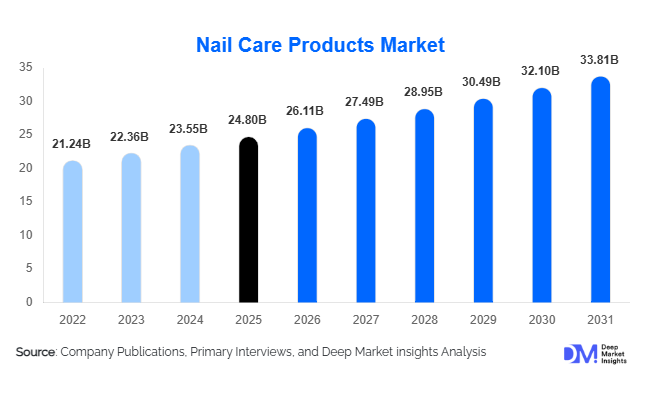
What are the latest trends in the nail care products market?
Rising Demand for Clean and Vegan Nail Products
Consumers are increasingly shifting toward nail care products formulated without harmful chemicals such as formaldehyde, toluene, and dibutyl phthalate. The emergence of “3-free”, “5-free”, and “10-free” nail polish formulations reflects this trend toward safer cosmetic products. Brands are investing in vegan and cruelty-free nail cosmetics that align with environmentally conscious consumer preferences. Many manufacturers are also focusing on sustainable packaging solutions and biodegradable materials to further strengthen their environmental credentials. These developments are particularly prominent in Europe and North America where regulatory frameworks and consumer awareness strongly favor clean beauty products.
Expansion of At-Home Nail Care and DIY Beauty Solutions
Home-based beauty routines have significantly expanded in recent years, driving strong demand for DIY nail care products. Consumers are increasingly purchasing gel polish kits, UV lamps, nail extensions, and press-on nails to achieve salon-like results at home. Social media platforms and beauty influencers are playing a major role in promoting nail art tutorials and product demonstrations. As a result, manufacturers are developing user-friendly nail systems designed for home use, including quick-dry formulas, easy-application nail strips, and customizable press-on nails.
What are the key drivers in the nail care products market?
Growing Global Beauty and Grooming Expenditure
Rising disposable income and growing consumer awareness regarding personal appearance have significantly boosted spending on beauty and personal care products. Nail cosmetics have become an essential component of grooming routines, particularly among younger consumers who actively follow fashion and beauty trends. The increasing popularity of nail art, seasonal color collections, and celebrity-endorsed beauty brands has further accelerated product demand.
Expansion of Professional Nail Salon Industry
The rapid growth of professional nail salons and beauty service providers has played a crucial role in expanding demand for nail care products. Salons require a wide range of products including gel nail systems, acrylic extensions, nail strengthening treatments, and professional-grade tools. As urbanization increases and consumer lifestyles evolve, professional nail services are becoming a routine beauty service in many countries.
What are the restraints for the global market?
Health Concerns Related to Chemical Ingredients
Traditional nail care formulations often contain chemicals that may cause allergic reactions or nail damage when used frequently. Increasing awareness regarding these risks has encouraged some consumers to switch to natural or organic alternatives, creating challenges for conventional product manufacturers.
Fashion-Driven Demand Volatility
The nail cosmetics market is strongly influenced by seasonal fashion trends and consumer preferences. Colors and styles that are popular in one season may quickly become outdated in the next, creating challenges for manufacturers in terms of product lifecycle management and inventory planning.
What are the key opportunities in the nail care products industry?
Growth of Organic and Halal Nail Cosmetics
The demand for organic, vegan, and halal-certified nail products is expanding rapidly, particularly in regions such as Southeast Asia and the Middle East. Consumers in these markets prefer cosmetics that align with religious and ethical standards. Manufacturers that invest in certified halal and natural formulations can tap into a rapidly growing niche segment within the global cosmetics industry.
Emerging Market Expansion
Emerging economies such as India, Brazil, Indonesia, and Vietnam present substantial growth opportunities for nail care product manufacturers. Rising disposable income, growing urban populations, and increasing beauty consciousness are fueling demand for affordable cosmetic products. International brands entering these markets are adopting localized product strategies and competitive pricing models to attract first-time consumers.
Report Scope
| Report Metric | Details |
|---|---|
| Market Size in 2025 | USD 24.8 Billion |
| Market Size in 2026 | USD 26.11 Billion |
| Market Size in 2031 | USD 33.81 Billion |
| CAGR | 5.3% (2026-2031) |
| Base Year for Estimation | 2025 |
| Historical Data | 2022-2024 |
| Forecast Period | 2026-2031 |
| Report Coverage | Revenue Forecast, Competitive Landscape, Supply Chain Disruption, Growth Factors, Environment & Regulatory Landscape and Trends |
| Geographies Covered | North America, Europe, APAC, Middle East and Africa, LATAM |
| Countries Covered | U.S., Canada, U.K., Germany, France, Spain, Italy, Russia, Nordic, Benelux, Rest of Europe, China, Korea, Japan, India, Australia, Singapore, Taiwan, South East Asia, Rest of Asia-Pacific, UAE, Turky, Saudi Arabia, South Africa, Egypt, Nigeria, Rest of MEA, Brazil, Mexico, Argentina, Chile, Colombia, Rest of LATAM |
Explore more data points, trends and opportunities Download Free Sample Report
Product Type Insights
Nail polish continues to dominate the global nail care products market, accounting for approximately 40–42% of total industry revenue. The segment’s leadership is driven by continuous product innovation, frequent seasonal color launches, and strong consumer engagement with beauty and fashion trends. Manufacturers regularly introduce new textures, finishes, and formulations, including matte, holographic, metallic, and breathable nail polishes, to keep pace with evolving consumer preferences. In addition, the rapid adoption of gel nail polish systems has significantly strengthened the growth of this segment. Gel polishes offer long-lasting wear, chip resistance, and a high-gloss finish that appeals to both professional salons and home users, making them one of the fastest-growing product categories within nail cosmetics.
Beyond traditional nail polish, nail treatment products such as strengthening serums, cuticle oils, hydration treatments, and nail growth enhancers are gaining increasing consumer attention. Rising awareness about nail health, nail damage caused by excessive cosmetic use, and the popularity of nail strengthening routines are driving growth in this category. Additionally, artificial nails and press-on nail extensions are becoming increasingly popular among younger consumers who seek quick, fashionable manicure options without visiting professional salons. These products allow consumers to achieve salon-quality results instantly and are widely promoted through social media platforms and influencer-led beauty tutorials. As a result, product innovation, expanding color ranges, and improved durability technologies continue to reinforce nail polish as the leading segment within the global nail care products market.
Application Insights
Based on application, manicure products represent the largest segment of the nail care products market, accounting for nearly 68% of total global demand. The dominance of manicure products is largely attributed to the greater emphasis placed on fingernail aesthetics compared to toenail care. Consumers frequently change nail colors and experiment with new styles for social events, fashion trends, and professional appearances, resulting in higher consumption of manicure-related products such as nail polish, base coats, top coats, and nail art accessories.
The increasing popularity of nail art and decorative nail applications is also contributing significantly to market expansion. Consumers are experimenting with complex nail designs that incorporate embellishments such as rhinestones, stickers, chrome powders, and textured finishes. Social media platforms such as Instagram, TikTok, and YouTube have played a major role in promoting nail art trends, encouraging consumers to explore creative manicure styles. As a result, demand for specialized nail art tools, decorative accessories, and professional nail art kits is growing steadily. Meanwhile, pedicure products maintain stable demand, particularly within professional salon environments where full-service nail care treatments are offered. Pedicure products including foot scrubs, cuticle treatments, and strengthening nail solutions are widely used in spas and beauty clinics. While pedicure services are typically less frequent than manicures, the growth of the global spa and wellness industry is expected to sustain demand for pedicure-related products in the coming years.
Distribution Channel Insights
In terms of distribution channels, offline retail remains the dominant sales channel, accounting for approximately 62% of global nail care product sales. Physical retail outlets such as beauty specialty stores, supermarkets, pharmacies, and department stores continue to attract a large consumer base due to the ability to physically evaluate product quality, color shades, and texture before making a purchase. Beauty specialty stores in particular play a crucial role in promoting premium nail care products and offering expert product recommendations.
However, online retail channels are experiencing the fastest growth within the nail care products market. E-commerce platforms and direct-to-consumer brand websites provide consumers with convenient access to a wider range of nail products, competitive pricing, and frequent promotional discounts. Online channels also enable brands to engage with customers through digital marketing strategies, influencer partnerships, and targeted advertising campaigns. Subscription-based beauty services that deliver curated nail care kits to consumers are also gaining popularity, particularly among younger demographics. As digital shopping behavior continues to evolve, the share of online distribution channels is expected to increase significantly over the forecast period.
End-User Insights
From an end-user perspective, individual consumers represent the largest segment, accounting for nearly 70% of total market demand. The increasing popularity of do-it-yourself beauty routines has encouraged consumers to purchase nail care products for personal use at home. Home manicure kits, gel polish systems, nail treatment solutions, and press-on nails are widely used by consumers seeking affordable alternatives to salon visits. The influence of social media beauty influencers and online tutorials has further accelerated the adoption of DIY nail care practices.
At the same time, professional nail salons remain a critical high-value market segment. Professional salons require a wide range of premium products including gel nail systems, acrylic extensions, UV curing lamps, nail strengthening treatments, and specialized manicure tools. The rapid expansion of organized salon chains and independent nail studios across urban areas has strengthened demand for professional-grade nail care products. In addition, beauty training institutes and cosmetology schools contribute to market demand by purchasing nail care products for educational and professional training purposes. As the beauty services industry continues to expand globally, demand from professional users is expected to grow steadily.
Explore more data points, trends and opportunities Download Free Sample Report
Nail Care Products Market Segmentations
By Product Type
- Nail Polish
- Base Coats & Top Coats
- Nail Treatments
- Cuticle Care Products
- Nail Polish Removers
- Artificial Nails & Extensions
- Nail Care Tools & Accessories
By Application
- Manicure
- Pedicure
- Nail Art & Decoration
By Distribution Channel
- Offline Retail
- Online Retail
By End-User
- Individual Consumers
- Professional Nail Salons & Spas
- Beauty Training Institutes
Regional Insights
Asia-Pacific
Asia-Pacific represents the largest regional market, accounting for approximately 39% of global demand. Countries such as China, Japan, South Korea, and India are key growth drivers within the region. China’s large consumer base, expanding middle-class population, and rapidly growing beauty retail sector are major contributors to product consumption. The country also benefits from strong domestic manufacturing capabilities and widespread availability of both international and local cosmetic brands.
South Korea plays a particularly influential role in the global beauty industry, with the country widely recognized as a leader in cosmetic innovation and nail art trends. Korean beauty brands frequently introduce new formulations and creative nail designs that influence global consumer preferences. Japan represents a mature yet stable market driven by high consumer spending on premium beauty products and strong demand for salon-quality nail treatments. India is emerging as one of the fastest-growing nail care markets globally, supported by rising disposable incomes, rapid urbanization, and increasing participation of women in the workforce. The growing number of beauty salons, expanding e-commerce platforms, and rising popularity of international cosmetic brands are further accelerating regional market growth.
North America
North America accounts for roughly 28% of the global nail care products market, with the United States representing the largest national market in the region. The strong presence of professional nail salons, high consumer spending on personal grooming, and widespread adoption of premium beauty products drive market demand. The United States also has one of the largest salon industries globally, with thousands of nail salons operating across urban and suburban areas.
Another key driver of regional growth is the increasing demand for clean beauty and non-toxic cosmetic formulations. Consumers in the United States and Canada are increasingly seeking nail products that are free from harmful chemicals and are formulated with vegan and cruelty-free ingredients. In addition, the growing influence of social media beauty trends and celebrity-endorsed cosmetic brands continues to support strong product demand across North America.
Europe
Europe accounts for approximately 22% of the global nail care products market, with major markets including Germany, France, the United Kingdom, Italy, and Spain. The region benefits from a well-established cosmetics industry and strong consumer awareness regarding beauty and personal care products. European consumers demonstrate a strong preference for environmentally friendly and ethically sourced cosmetic products, which has driven demand for toxin-free, vegan, and cruelty-free nail care formulations.
Government regulations governing cosmetic safety and ingredient transparency also play an important role in shaping the European nail care market. Strict regulatory standards encourage manufacturers to develop safer and more sustainable formulations, further boosting consumer confidence in premium nail products. The strong presence of luxury cosmetic brands and the growth of beauty specialty retail stores are additional factors supporting regional market expansion.
Latin America
Latin America accounts for approximately 7% of global nail care product demand. Brazil is the largest market in the region and is widely recognized as one of the world’s most beauty-conscious countries. The country has a vibrant beauty culture, high per-capita consumption of cosmetic products, and a rapidly expanding salon industry. Brazilian consumers frequently experiment with nail colors and nail art designs, which contributes to strong demand for nail cosmetics.
Mexico and Argentina are also emerging as important markets within Latin America. Rising urbanization, increasing disposable incomes, and the growing influence of global beauty trends are encouraging consumers to invest more in personal grooming products. The expansion of organized retail chains and the growing popularity of e-commerce platforms are further supporting market growth across the region.
Middle East & Africa
The Middle East and Africa region accounts for approximately 4% of the global nail care products market. Despite its smaller market share, the region is witnessing steady growth driven by rising disposable incomes, expanding urban populations, and increasing consumer interest in premium beauty products. Countries such as the United Arab Emirates, Saudi Arabia, and South Africa are key demand centers within the region. The Middle East, in particular, has a strong luxury beauty market where consumers frequently purchase high-end cosmetic products. The rapid expansion of shopping malls, beauty salons, and luxury retail outlets across Gulf Cooperation Council (GCC) countries is further supporting demand for premium nail care products.
Additionally, the growing popularity of halal-certified cosmetic products and the expansion of beauty retail infrastructure are contributing to the development of the nail care market across the Middle East and Africa. As consumer awareness regarding personal grooming continues to rise, the region is expected to offer significant growth opportunities for international cosmetic brands.
Key Players in the Nail Care Products Market
- L’Oréal SA
- Coty Inc.
- Estée Lauder Companies
- Shiseido Company Limited
- Revlon Inc.
- Orly International
- OPI Products Inc.
- Creative Nail Design (CND)
- KISS Products Inc.
- Essie Cosmetics
- China Glaze
- Deborah Lippmann
- ILNP (I Love Nail Polish)
- Butter London
- Sally Hansen