Music Tours Market Size
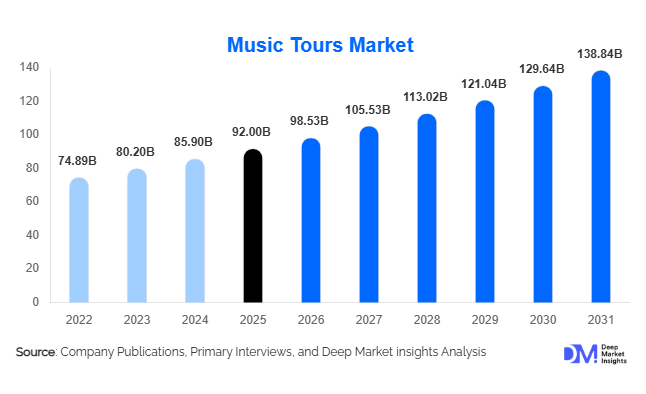
According to Deep Market Insights, the global music tours market size was valued at USD 92 billion in 2025 and is projected to grow from USD 98.53 billion in 2026 to reach USD 138.84 billion by 2031, expanding at a CAGR of 7.1% during the forecast period (2026–2031). The music tours market growth is primarily driven by the resurgence of live entertainment demand, increasing global fan engagement, and the expansion of large-scale concert tours and music festivals worldwide. Rising disposable income, coupled with a shift toward experience-based spending, is further accelerating demand for live music events across both developed and emerging markets.
Key Market Insights
- Global music tours are increasingly becoming multi-revenue ecosystems, integrating ticketing, sponsorships, and merchandise sales.
- Stadiums and large-scale tours dominate revenue generation, driven by global superstar artists and high-capacity venues.
- North America leads the global market, supported by premium ticket pricing and advanced event infrastructure.
- Asia-Pacific is the fastest-growing region, fueled by rising middle-class income and expanding urban entertainment hubs.
- Technology integration, including hybrid concerts, AI-based ticketing, and blockchain systems, is transforming the industry.
- Brand partnerships and VIP experiences are significantly boosting per-customer revenue and profitability.
What are the latest trends in the music tours market?
Hybrid and Digital-Integrated Concert Experiences
The integration of digital technologies into live music tours is reshaping the industry. Hybrid concerts, which combine physical attendance with live streaming, are enabling artists to reach global audiences beyond venue capacity. Platforms offering real-time streaming, virtual reality (VR), and augmented reality (AR) experiences are enhancing fan engagement and opening new monetization channels. Fans can now access exclusive backstage content, multi-angle viewing options, and immersive digital experiences, making concerts more interactive. This trend is particularly appealing to younger audiences and international fans who may not be able to attend live events physically.
Rise of Experiential and Premium Concert Offerings
Music tours are evolving into comprehensive experiential events. VIP packages, backstage access, meet-and-greet opportunities, and exclusive merchandise bundles are becoming mainstream offerings. These premium experiences are significantly increasing revenue per attendee and attracting high-spending consumers. Additionally, artists and promoters are incorporating immersive stage designs, advanced lighting systems, and thematic storytelling into performances, creating unforgettable live experiences. This trend reflects a broader shift toward experiential consumption, where audiences prioritize unique and memorable events over traditional entertainment formats.
What are the key drivers in the music tours market?
Resurgence of Live Entertainment Demand
The global rebound of live events post-pandemic has significantly boosted the music tours market. Consumers are increasingly prioritizing live experiences, leading to record-breaking ticket sales for major tours. This pent-up demand continues to drive strong growth across regions, with sold-out concerts becoming more frequent.
Globalization of Music and Artists
Streaming platforms have enabled artists to build international fanbases, making global tours more viable and profitable. Cross-border collaborations and multilingual music are expanding audience reach, allowing artists to tour in new and emerging markets with strong demand.
Diversification of Revenue Streams
Revenue diversification is a key growth driver, with income generated from merchandise, sponsorships, and VIP experiences complementing ticket sales. Premium offerings such as exclusive access and limited-edition merchandise are driving higher consumer spending and improving profit margins.
What are the restraints for the global market?
High Operational and Logistical Costs
Music tours involve substantial expenses, including transportation, stage setup, security, and staffing. These high operational costs can impact profitability, particularly for mid-tier artists and smaller events, limiting scalability.
Economic Sensitivity and Discretionary Spending
The music tours market is highly dependent on consumer discretionary spending. Economic downturns, inflation, and geopolitical uncertainties can reduce ticket sales, especially in price-sensitive markets, posing a challenge to sustained growth.
What are the key opportunities in the music tours industry?
Expansion into Emerging Markets
Emerging economies in the Asia-Pacific and Latin America present significant growth opportunities. Rising disposable incomes, expanding urban populations, and increasing interest in global music are driving demand for live concerts in countries such as India, Brazil, and Indonesia. Investments in event infrastructure are further supporting this expansion.
Technology Integration and Smart Ticketing
The adoption of advanced technologies such as blockchain-based ticketing and AI-driven pricing models is creating new opportunities. These technologies enhance transparency, reduce fraud, and optimize revenue generation, improving overall market efficiency.
Brand Partnerships and Experiential Marketing
Music tours are increasingly being leveraged as marketing platforms for global brands. Sponsorships, co-branded merchandise, and immersive brand activations are generating additional revenue streams while enhancing audience engagement.
Report Scope
| Report Metric | Details |
|---|---|
| Market Size in 2025 | USD 92 Billion |
| Market Size in 2026 | USD 98.53 Billion |
| Market Size in 2031 | USD 138.84 Billion |
| CAGR | 7.1% (2026-2031) |
| Base Year for Estimation | 2025 |
| Historical Data | 2022-2024 |
| Forecast Period | 2026-2031 |
| Report Coverage | Revenue Forecast, Competitive Landscape, Supply Chain Disruption, Growth Factors, Environment & Regulatory Landscape and Trends |
| Geographies Covered | North America, Europe, APAC, Middle East and Africa, LATAM |
| Countries Covered | U.S., Canada, U.K., Germany, France, Spain, Italy, Russia, Nordic, Benelux, Rest of Europe, China, Korea, Japan, India, Australia, Singapore, Taiwan, South East Asia, Rest of Asia-Pacific, UAE, Turky, Saudi Arabia, South Africa, Egypt, Nigeria, Rest of MEA, Brazil, Mexico, Argentina, Chile, Colombia, Rest of LATAM |
Explore more data points, trends and opportunities Download Free Sample Report
Tour Type Insights
Concert tours continue to dominate the music tours market, accounting for approximately 42% of total revenue. This leadership is primarily driven by the global scalability of single-artist tours, where internationally recognized performers leverage extensive fan bases across multiple continents. The increasing frequency of multi-city and multi-country tours, combined with dynamic pricing strategies and premium ticket tiers, has significantly enhanced revenue potential. Additionally, concert tours benefit from strong sponsorship deals and merchandise sales, further reinforcing their dominance. Festival tours are gaining substantial traction, particularly in Europe and North America, due to their ability to aggregate multiple artists and attract diverse audience segments over short durations. Residency shows offer consistent and predictable revenue streams, especially in established entertainment hubs such as Las Vegas and Dubai, while cultural and heritage music tours are emerging as niche but fast-growing segments, driven by increasing interest in regional identity and traditional music experiences.
Genre Insights
Pop music remains the leading genre, capturing approximately 28% of the global market, largely due to its universal appeal, cross-cultural adaptability, and strong presence on global streaming platforms. The dominance of pop is further reinforced by global superstars capable of selling out stadium tours worldwide. Rock and hip-hop segments follow closely, supported by deeply loyal fanbases and strong touring legacies, particularly in North America and Europe. Hip-hop, in particular, is witnessing rapid international expansion, driven by younger demographics and digital influence. Electronic Dance Music (EDM) tours are among the fastest-growing segments, fueled by festival culture and demand from younger audiences in regions such as Europe and Asia-Pacific. Meanwhile, classical and jazz tours cater to premium, niche audiences, often commanding higher ticket prices and offering curated, high-value experiences in specialized venues.
Venue Size Insights
Stadium tours lead the venue size segment with an estimated 35% market share, driven by their ability to maximize attendance and revenue per event. The increasing number of global mega-tours by top-tier artists has amplified demand for large-capacity venues, enabling economies of scale and higher profitability. Large arenas and outdoor festivals also contribute significantly, particularly in urban centers with established infrastructure. These venues strike a balance between capacity and accessibility, making them ideal for mid- to high-tier artists. Smaller venues, while representing a smaller share, play a critical role in nurturing emerging talent and catering to niche audiences seeking intimate and immersive experiences. The continued investment in venue modernization and smart infrastructure is further enhancing audience experience across all venue categories.
Revenue Stream Insights
Ticket sales remain the cornerstone of the music tours market, contributing approximately 55% of total revenue. Their dominance is driven by high demand for live experiences and the ability to implement tiered pricing models, including general admission, premium seating, and VIP packages. However, ancillary revenue streams are growing at a faster pace. Sponsorships and brand partnerships are becoming increasingly integral, with global brands leveraging music tours for direct consumer engagement. Merchandise sales, particularly exclusive and limited-edition items, contribute significantly to overall profitability. VIP experiences, including backstage access and meet-and-greet opportunities, are driving higher per-capita spending. Additionally, digital streaming and hybrid concert formats are emerging as scalable revenue channels, enabling artists to monetize global audiences beyond physical venue limitations.
Audience Type Insights
The mass market audience segment dominates the market with nearly 70% share, driven by the widespread accessibility and affordability of standard ticket options. This segment benefits from large-scale marketing campaigns and broad genre appeal, ensuring consistent demand across regions. However, the premium and VIP audience segment is becoming increasingly important from a revenue perspective. Although smaller in volume, this segment generates significantly higher revenue per attendee through exclusive experiences, premium seating, and personalized services. The growing willingness of consumers to pay for unique and immersive experiences is further accelerating the expansion of this high-value segment.
Distribution Channel Insights
Direct ticketing platforms account for approximately 48% of total sales, reflecting a strong shift toward digital-first distribution models. Artists and promoters are increasingly adopting direct-to-consumer strategies to retain greater control over pricing, customer data, and brand engagement. Advanced technologies such as mobile ticketing, AI-driven pricing, and blockchain-based systems are enhancing efficiency and transparency in ticket sales. Third-party ticketing agencies continue to play a significant role, particularly for large-scale events and international tours, while travel operators are gaining relevance by offering bundled packages that combine event tickets with accommodation and transportation, especially for destination-based concerts and festivals.
Explore more data points, trends and opportunities Download Free Sample Report
Music Tours Market Segmentations
By Tour Type
- Concert Tours
- Festival Tours
- Residency Shows
- Tribute & Legacy Tours
- Cultural & Heritage Music Tours
- DJ & Electronic Music Tours
By Genre
- Pop
- Rock
- Hip-Hop / Rap
- Electronic Dance Music (EDM)
- Classical & Opera
- Country & Folk
- Jazz & Blues
- Regional / Traditional Music
By Revenue Stream
- Ticket Sales
- Sponsorship & Brand Partnerships
- Merchandise Sales
- Digital Streaming & Hybrid Access
- VIP Packages & Experiences
By Audience Type
- Mass Market Audience
- Premium/VIP Audience
- Corporate/Private Events
- Fan Club/Exclusive Communities
By Distribution Channel
- Direct Ticketing Platforms
- Third-party Ticketing Agencies
- Travel & Tour Operators
- Artist-Owned Platforms
Regional Insights
North America
North America leads the global music tours market with a 38% share in 2025, driven primarily by the United States, which serves as the epicenter of global music production and live entertainment. The region benefits from a well-established ecosystem comprising advanced venue infrastructure, leading event promoters, and high consumer spending capacity. Key growth drivers include premium ticket pricing, strong demand for large-scale stadium tours, and the presence of globally recognized artists. Additionally, technological adoption, such as dynamic pricing and digital ticketing platforms, is highly advanced in this region, further enhancing revenue generation and operational efficiency.
Europe
Europe accounts for approximately 27% of the global market, with major contributions from the United Kingdom, Germany, and France. The region’s growth is driven by its deeply rooted festival culture, which attracts both domestic and international audiences. Government support for arts and culture, along with well-developed transportation networks, facilitates large-scale events across multiple countries. Sustainability initiatives and eco-friendly festivals are also key drivers, as European consumers increasingly prioritize environmentally responsible entertainment experiences. The region’s diverse musical heritage further supports demand across multiple genres, from classical to contemporary music.
Asia-Pacific
Asia-Pacific holds around 20% market share and is the fastest-growing region, with a CAGR exceeding 9%. Key markets include China, Japan, South Korea, and India. Growth in this region is driven by rapid urbanization, rising disposable incomes, and a large युवा population with increasing interest in global music trends. Expanding digital penetration and social media influence are further boosting demand for live music experiences. Governments and private players are investing heavily in entertainment infrastructure, including stadiums and arenas, enabling large-scale international tours. The growing popularity of K-pop and regional music industries is also contributing to increased intra-regional touring activity.
Latin America
Latin America represents approximately 8% of the global market, led by Brazil and Mexico. The region is experiencing steady growth due to increasing demand for international artists and the expansion of middle-class populations. Key growth drivers include rising urbanization, improved access to digital ticketing platforms, and growing enthusiasm for live entertainment among younger audiences. Music festivals and large-scale concerts are becoming more frequent, supported by improving infrastructure and greater investment from global promoters seeking to tap into underserved markets.
Middle East & Africa
The Middle East & Africa region accounts for around 7% of the market, with the UAE and Saudi Arabia emerging as key growth hubs. Significant government investments in entertainment and tourism infrastructure, particularly under initiatives such as Saudi Vision 2031, are driving rapid market expansion. The region is increasingly hosting international artists and large-scale events, attracting both local and international audiences. High disposable incomes in the Gulf countries and a growing focus on diversifying economies beyond oil are further supporting the growth of the music tours market. In Africa, rising urban populations and increasing cultural investments are gradually expanding the regional market base.
Key Players in the Music Tours Market
- Live Nation Entertainment
- AEG Presents
- CTS Eventim
- SM Entertainment
- HYBE Corporation
- Warner Music Group
- Sony Music Entertainment
- Universal Music Group
- Eventbrite
- TEG Group
- Anschutz Corporation
- CJ ENM
- Tencent Music Entertainment
- YG Entertainment
- SJM Concerts