Multifunction Kitchen Sink Market Size
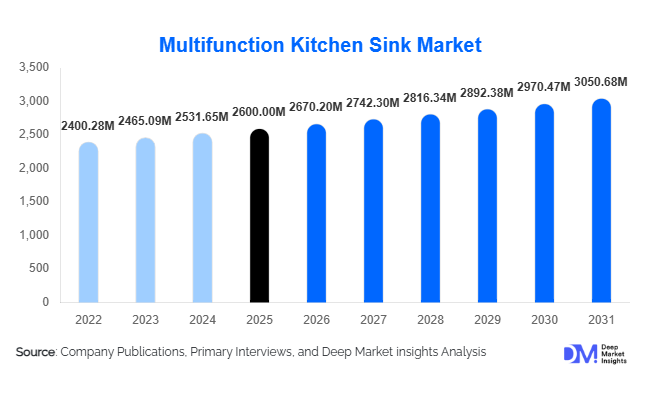
According to Deep Market Insights, the global multifunction kitchen sink market size was valued at USD 2,600 million in 2025 and is projected to grow from USD 2670.20 million in 2026 to reach USD 3050.68 million by 2031, expanding at a CAGR of 2.7% during the forecast period (2026–2031). The multifunction kitchen sink market growth is primarily driven by the rising adoption of modular kitchen designs, increasing home renovation activities, and growing consumer preference for integrated kitchen fixtures that enhance functionality and space efficiency.
Multifunction kitchen sinks combine traditional washing functionality with integrated accessories such as cutting boards, drying racks, colanders, and smart faucet systems, enabling users to perform multiple kitchen tasks within a single workstation. This integration supports modern kitchen layouts where efficiency, convenience, and aesthetic design play a critical role. As urban apartments become more compact, multifunction sinks are increasingly preferred because they maximize workspace without requiring additional countertop area.
In addition, rising disposable incomes and the premiumization of home interiors have encouraged homeowners to invest in high-quality kitchen fixtures made from durable materials such as stainless steel, granite composite, and fireclay. Manufacturers are introducing advanced finishes, nano-coatings, and smart sensor-enabled faucets to improve hygiene, durability, and user convenience. While North America and Europe currently account for a large portion of global demand due to strong remodeling activity, the Asia-Pacific is emerging as a high-growth region driven by rapid urbanization and increasing adoption of modular kitchens in countries such as China and India.
Key Market Insights
- Workstation-style multifunction sinks are becoming increasingly popular, allowing food preparation, washing, and draining to occur in a single integrated workspace.
- Stainless steel remains the dominant material segment, accounting for the majority of installations due to durability, corrosion resistance, and cost efficiency.
- North America holds the largest market share, driven by high home renovation spending and strong demand for premium kitchen fixtures.
- Asia-Pacific is the fastest-growing region, supported by rapid urbanization and increasing modular kitchen adoption.
- Online retail channels are expanding rapidly, enabling consumers to compare designs, materials, and prices across global brands.
- Integration of smart faucets and touchless technology is emerging as a major product innovation trend in the market.
What are the latest trends in the multifunction kitchen sink market?
Workstation Sink Designs: Transforming Kitchen Functionality
Workstation sinks are one of the most significant innovations shaping the multifunction kitchen sink market. These sinks are designed with integrated ledges that support sliding accessories such as cutting boards, drying racks, colanders, and preparation trays. By turning the sink into a multifunctional workspace, these designs reduce countertop clutter and improve kitchen efficiency. This concept is particularly appealing in urban apartments and compact kitchens where space optimization is essential. Manufacturers are introducing customizable workstation systems with interchangeable accessories, allowing homeowners to tailor the sink setup according to their cooking habits and kitchen layout.
The workstation sink trend is also supported by the growing popularity of open kitchen layouts in modern homes. As kitchens become more visible within living spaces, consumers prefer aesthetically pleasing fixtures that combine design and practicality. Premium finishes such as matte black stainless steel, brushed gold fixtures, and nano-coated surfaces are becoming common in high-end workstation sink products.
Smart and Touchless Sink Technologies
Technological integration is gradually transforming kitchen sinks into smart appliances. Multifunction sinks are increasingly being equipped with touchless faucets, digital temperature control systems, and water-saving sensors. These features improve hygiene by reducing physical contact with faucet handles, which is particularly valuable in households focused on sanitation and convenience.
Some manufacturers are also experimenting with IoT-enabled sinks that monitor water consumption, detect leaks, and integrate with smart home ecosystems. Mobile apps can allow users to control water flow or set automatic cleaning cycles. As smart home adoption expands globally, especially in developed markets, these technological enhancements are expected to drive innovation and product differentiation in the multifunction kitchen sink industry.
What are the key drivers in the multifunction kitchen sink market?
Growing Demand for Modular Kitchens
The rising adoption of modular kitchen designs is a key factor driving the multifunction kitchen sink market. Modular kitchens emphasize efficient space utilization, standardized cabinet systems, and integrated appliances. Multifunction sinks fit perfectly within this concept because they combine multiple kitchen tasks into one compact workstation.
Urban housing developments increasingly feature modular kitchens as standard amenities, particularly in newly constructed apartments. Developers and interior designers often select multifunction sinks to enhance the practicality and visual appeal of kitchen spaces. This trend is particularly prominent in emerging markets such as India, China, and Southeast Asia, where rapid urbanization is accelerating residential construction.
Rising Home Renovation and Remodeling Spending
Home renovation activities have increased significantly in recent years as homeowners seek to modernize kitchens and improve property value. Kitchen remodeling projects often involve replacing outdated sinks with more advanced models that provide better functionality and aesthetics.
Consumers are increasingly willing to invest in premium fixtures during renovations, particularly in developed markets such as the United States, Canada, Germany, and the United Kingdom. Multifunction sinks with integrated accessories and durable materials are frequently chosen as centerpiece fixtures in upgraded kitchens, supporting steady demand growth.
What are the restraints for the global market?
Higher Product Costs Compared to Conventional Sinks
Multifunction kitchen sinks typically cost more than traditional single-function sinks due to their complex design, additional accessories, and advanced materials. Premium workstation sinks with integrated accessories and smart faucets can be significantly more expensive than standard models. This price gap can limit adoption among cost-sensitive consumers, particularly in developing markets where basic kitchen fixtures remain the preferred option.
Raw Material Price Volatility
The production of kitchen sinks relies heavily on raw materials such as stainless steel, copper, and engineered stone. Fluctuations in global commodity prices can increase manufacturing costs and reduce profit margins for sink manufacturers. Rising steel prices, in particular, have affected the cost structure of stainless steel sinks, forcing manufacturers to adjust pricing or absorb cost increases. Such volatility can impact market competitiveness and slow growth in price-sensitive regions.
What are the key opportunities in the multifunction kitchen sink industry?
Expansion in Emerging Urban Housing Markets
Rapid urbanization in emerging economies presents a significant opportunity for the multifunction kitchen sink market. Countries such as China, India, Indonesia, and Vietnam are experiencing strong growth in residential construction as urban populations expand. Many new housing developments feature compact kitchens where space-saving fixtures are highly valued.
Multifunction sinks that integrate preparation, washing, and draining functions are well-suited to these compact kitchen environments. Manufacturers targeting these markets with affordable workstation sink models and localized distribution strategies can benefit from the large volume of new residential projects being developed.
Adoption in the Commercial Food Service Industry
The expansion of the global food service industry is creating additional opportunities for multifunction kitchen sink manufacturers. Restaurants, hotels, and institutional kitchens require efficient workspaces that enable quick food preparation and cleaning. Stainless steel workstation sinks with multiple compartments and integrated accessories help improve workflow efficiency in commercial kitchens.
The rapid growth of cloud kitchens and food delivery infrastructure is also driving demand for durable, high-capacity kitchen equipment. Multifunction sinks designed for commercial use can help operators optimize kitchen layouts and meet hygiene standards while minimizing space requirements.
Report Scope
| Report Metric | Details |
|---|---|
| Market Size in 2025 | USD 2600 Million |
| Market Size in 2026 | USD 2670.20 Million |
| Market Size in 2031 | USD 3050.68 Million |
| CAGR | 2.7% (2026-2031) |
| Base Year for Estimation | 2025 |
| Historical Data | 2022-2024 |
| Forecast Period | 2026-2031 |
| Report Coverage | Revenue Forecast, Competitive Landscape, Supply Chain Disruption, Growth Factors, Environment & Regulatory Landscape and Trends |
| Geographies Covered | North America, Europe, APAC, Middle East and Africa, LATAM |
| Countries Covered | U.S., Canada, U.K., Germany, France, Spain, Italy, Russia, Nordic, Benelux, Rest of Europe, China, Korea, Japan, India, Australia, Singapore, Taiwan, South East Asia, Rest of Asia-Pacific, UAE, Turky, Saudi Arabia, South Africa, Egypt, Nigeria, Rest of MEA, Brazil, Mexico, Argentina, Chile, Colombia, Rest of LATAM |
Explore more data points, trends and opportunities Download Free Sample Report
Material Type Insights
Stainless steel remains the dominant material in the multifunction kitchen sink market, accounting for approximately 60% of global demand in 2025. The leading position of stainless steel sinks is primarily driven by their exceptional durability, corrosion resistance, and hygienic properties, which make them suitable for both residential and commercial kitchens. Stainless steel sinks are capable of withstanding high temperatures, heavy cookware, and frequent usage without compromising structural integrity. Additionally, the material is non-porous and easy to clean, making it highly preferred in food preparation environments where hygiene standards are critical.
The increasing adoption of workstation-style multifunction sinks has further strengthened demand for stainless steel variants. These sinks often feature integrated ledges for sliding accessories such as cutting boards, colanders, and drying racks, which require high structural strength and precise engineering, qualities that stainless steel offers. Moreover, manufacturers are introducing advanced surface technologies such as nano-coatings, brushed finishes, and anti-scratch surfaces to improve noise reduction, durability, and aesthetic appeal. These innovations are making stainless steel sinks more attractive in premium residential kitchens as well.
Granite and quartz composite sinks are gaining traction within the premium segment due to their sophisticated appearance, superior scratch resistance, and ability to match modern countertop materials. These sinks are increasingly used in designer kitchens where visual appeal is a major purchase factor. Fireclay and ceramic sinks, particularly farmhouse-style models, remain popular in North America and Europe, where traditional and rustic kitchen designs are widely preferred. However, their higher cost and heavier installation requirements limit their share compared with stainless steel sinks.
Installation Type Insights
Undermount sinks represent the largest installation segment in the multifunction kitchen sink market, accounting for nearly 38% of global market share. The leading position of this segment is driven by the increasing popularity of seamless kitchen countertop designs. Undermount sinks are installed beneath the countertop surface, creating a smooth transition between the sink and the surrounding countertop. This design simplifies cleaning by allowing food particles and liquids to be wiped directly into the sink without obstruction.
The growing adoption of premium countertop materials such as granite, quartz, and solid surface countertops has significantly boosted the demand for undermount sink installations. These countertops are commonly used in modern kitchen remodeling projects and luxury residential developments, making undermount sinks the preferred installation option among interior designers and homeowners. Additionally, undermount sinks enhance the visual appeal of contemporary kitchens by creating a minimalistic and streamlined look. Top-mount or drop-in sinks remain widely used in budget and mid-range housing due to their affordability and easier installation process. These sinks require minimal countertop modification and are commonly installed in older homes and rental properties. Meanwhile, farmhouse or apron-front sinks are gaining popularity in high-end kitchen renovations and luxury home projects. Their distinctive exposed front design offers both aesthetic value and ergonomic benefits, particularly for users who spend extended periods preparing food at the sink.
Bowl Configuration Insights
Single bowl multifunction sinks hold the largest share of the market, accounting for around 52% of total installations. The dominance of single bowl sinks is primarily attributed to their spacious design, which allows users to accommodate large cookware such as stockpots, baking trays, and oversized pans. This configuration is particularly compatible with workstation-style multifunction sinks that incorporate sliding accessories for food preparation and drying tasks. Single bowl sinks are also preferred in compact urban kitchens where maximizing workspace is essential. The larger uninterrupted basin provides flexibility for various kitchen tasks, including washing vegetables, cleaning utensils, and preparing ingredients. As urban housing developments increasingly prioritize compact yet efficient kitchen layouts, single bowl sinks continue to gain popularity among homeowners and developers.
Double bowl sinks remain widely used among households that prefer separating washing and rinsing activities into two compartments. This configuration is common in traditional kitchen setups where multitasking during food preparation is required. Multi-compartment sinks are predominantly used in commercial kitchens and institutional food service environments, where multiple washing and preparation stations are necessary to maintain operational efficiency and hygiene standards.
Distribution Channel Insights
Offline retail channels dominate the multifunction kitchen sink market with approximately 70% market share. Home improvement retailers, kitchen showrooms, and specialty hardware stores remain the preferred purchasing platforms for consumers because sinks are considered durable fixtures that require careful evaluation before purchase. Buyers typically prefer to physically inspect the material quality, finish, size, and accessory compatibility before making a purchase decision. In addition, kitchen sinks are often purchased as part of larger renovation or construction projects, where contractors, architects, and interior designers influence product selection through offline showrooms and distributor networks. Many premium sink manufacturers also maintain strong partnerships with building contractors and kitchen cabinet suppliers, further strengthening offline sales channels.
Despite the dominance of offline retail, online distribution channels are expanding rapidly. E-commerce platforms allow consumers to compare a wide range of sink models, materials, and price points across global brands. Online channels are particularly popular for mid-range products and replacement sinks, where consumers prioritize convenience and competitive pricing. Digital marketing strategies, virtual product visualization tools, and customer review systems are increasingly influencing purchasing decisions in this category.
End-Use Insights
The residential sector accounts for nearly 75–78% of global multifunction kitchen sink demand, making it the largest end-use segment in the market. Growth in this segment is driven by increasing residential construction, rising disposable income, and strong demand for modern kitchen remodeling projects. Homeowners are increasingly investing in multifunction kitchen fixtures that combine efficiency, design appeal, and space optimization. Multifunction sinks have become particularly popular in modular kitchens, which are widely adopted in urban apartments and luxury residential developments. The trend toward open-plan kitchens and integrated living spaces has further increased the importance of visually appealing and multifunctional kitchen fixtures. Homeowners are prioritizing sinks that complement modern kitchen interiors while also providing practical features such as integrated accessories and smart faucet systems.
The commercial segment, which includes restaurants, hotels, catering facilities, and institutional kitchens, represents approximately 22–25% of the market. Growth in the food service industry and the rapid expansion of cloud kitchens are driving demand for durable stainless steel workstation sinks that improve operational efficiency. Commercial kitchens require sinks capable of handling heavy workloads while maintaining strict hygiene standards, making multifunction stainless steel sinks an ideal solution for these environments.
Explore more data points, trends and opportunities Download Free Sample Report
Multifunction Kitchen Sink Market Segmentations
By Material Type
- Stainless Steel
- Granite / Quartz Composite
- Fireclay / Ceramic
- Cast Iron (Enamel Coated)
- Copper
By Installation Type
- Top Mount / Drop-in Sinks
- Undermount Sinks
- Farmhouse / Apron Front Sinks
- Integrated Countertop Sinks
- Flush Mount Sinks
By Bowl Configuration
- Single Bowl Multifunction Sinks
- Double Bowl Multifunction Sinks
- Multi-Compartment Sinks
By Distribution Channel
- Online Retail
- Home Improvement Stores
- Kitchen & Bath Specialty Stores
- Wholesale Distributors
- Construction & Contractor Sales Channels
By End-Use
- Residential Housing
- Commercial Kitchens
- Hospitality & Food Service
- Institutional Kitchens (Hospitals, Schools)
Regional Insights
North America
North America accounts for approximately 34% of the global multifunction kitchen sink market, making it the largest regional market. The United States dominates regional demand due to strong consumer spending on home improvement and kitchen remodeling projects. Homeowners frequently upgrade kitchen fixtures as part of property value enhancement initiatives, which drives consistent demand for premium sink products.
Several factors support market growth in North America, including the increasing popularity of open-concept kitchens, high adoption of modular cabinetry, and strong demand for smart home technologies. Consumers in the region are also highly receptive to innovative products such as workstation sinks, touchless faucets, and integrated kitchen accessories. In addition, a well-established distribution network of home improvement retailers and kitchen showrooms contributes to market expansion.
Europe
Europe holds approximately 28% of global market share, with key markets including Germany, the United Kingdom, France, and Italy. European consumers place significant emphasis on design aesthetics, material quality, and sustainability, which encourages the adoption of premium sink materials such as granite composite, fireclay, and ceramic. The region is home to several globally recognized kitchen fixture manufacturers, which drives continuous product innovation and design development. Demand is further supported by strong renovation activity in older residential properties across Western Europe. Additionally, increasing consumer interest in eco-friendly kitchen products and water-efficient fixtures is influencing sink design and material selection across the region.
Asia-Pacific
Asia-Pacific represents about 30% of global market demand and is the fastest-growing regional market. China is the largest market within the region due to its massive residential construction sector and strong manufacturing ecosystem for kitchen fixtures. The country also serves as a major global exporter of stainless steel kitchen sinks. India, Indonesia, Vietnam, and other Southeast Asian countries are experiencing rapid market growth due to rising middle-class incomes, urbanization, and increasing adoption of modular kitchens. Government housing initiatives and expanding urban infrastructure are also contributing to higher demand for modern kitchen fixtures. In addition, growing awareness of international interior design trends is encouraging consumers to upgrade from basic sinks to multifunction workstation models.
Latin America
Latin America accounts for roughly 4–5% of global demand, with Brazil and Mexico representing the largest markets in the region. Urban housing development and improving living standards are gradually increasing the adoption of modern kitchen infrastructure. As disposable incomes rise and middle-class populations expand, consumers are investing more in home improvement and kitchen upgrades. The growing presence of international kitchen fixture brands in the region, combined with expanding retail infrastructure and e-commerce platforms, is also supporting market development. While traditional sink models remain dominant, multifunction sinks are increasingly being introduced in new residential construction projects and premium housing developments.
Middle East & Africa
The Middle East and Africa represent approximately 5–6% of the global multifunction kitchen sink market. Demand is strongest in the United Arab Emirates and Saudi Arabia, where large-scale residential developments and luxury housing projects drive the adoption of high-end kitchen fixtures.
Rapid urbanization, population growth, and major real estate investments in Gulf Cooperation Council (GCC) countries are key drivers of regional market growth. High consumer spending power and preference for premium home interiors also encourage the adoption of multifunction sinks with advanced design features. In Africa, gradual urban development and the expansion of modern retail infrastructure are creating new opportunities for sink manufacturers targeting emerging markets.
Key Players in the Multifunction Kitchen Sink Market
- Franke Group
- Kohler Co.
- BLANCO GmbH
- Elkay Manufacturing Company
- Moen Incorporated
- Teka Group
- Duravit AG
- Hafele Group
- JOMOO Group
- Roca Sanitario
- Kraus USA
- Foster S.p.A.
- Alveus (Kovinoplastika Lož)
- Reginox
- American Standard Brands