Mouth Spray Market Size
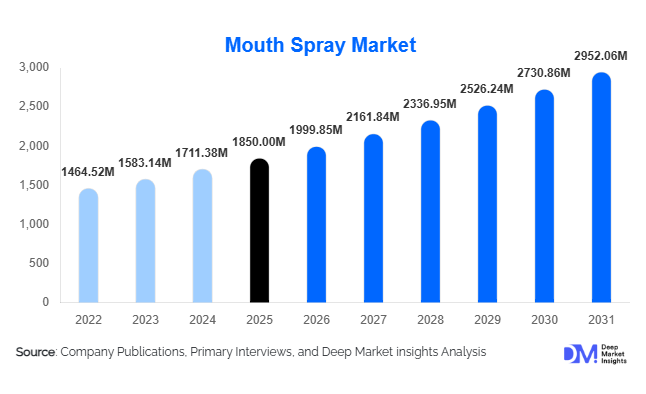
According to Deep Market Insights, the global mouth spray market size was valued at USD 1,850 million in 2025 and is projected to grow from USD 1,999.85 million in 2026 to reach USD 2,952.06 million by 2031, expanding at a CAGR of 8.1% during the forecast period (2026–2031). The market growth is primarily driven by increasing awareness of oral hygiene, rising demand for convenient and portable personal care products, and the growing prevalence of oral health conditions such as dry mouth and bad breath. The shift toward alcohol-free, herbal, and multifunctional formulations is further enhancing consumer adoption, while e-commerce expansion is improving accessibility and product visibility globally.
Key Market Insights
- Mouth sprays are gaining popularity as a portable alternative to traditional oral care products, particularly among urban and working populations.
- Alcohol-free and herbal formulations are witnessing strong demand, driven by increasing consumer preference for gentle and natural products.
- North America dominates the market, supported by high awareness, premium product adoption, and strong retail infrastructure.
- Asia-Pacific is the fastest-growing region, fueled by rising disposable incomes and expanding oral care awareness in countries like China and India.
- E-commerce platforms are transforming distribution, enabling direct-to-consumer sales and broader product reach.
- Technological advancements in spray mechanisms and long-lasting formulations are enhancing product performance and differentiation.
What are the latest trends in the mouth spray market?
Shift Toward Natural and Herbal Formulations
Consumers are increasingly gravitating toward mouth sprays made from natural ingredients such as essential oils, herbal extracts, and plant-based compounds. This trend is driven by concerns over chemical exposure and alcohol content in conventional formulations. Manufacturers are responding by introducing clean-label products with claims such as “alcohol-free,” “organic,” and “chemical-free.” Ayurvedic and herbal brands, particularly in Asia, are gaining traction, while global players are expanding their natural product portfolios. This shift is also aligned with sustainability trends, as brands incorporate eco-friendly packaging and ethically sourced ingredients.
Growth of Multifunctional Oral Sprays
Mouth sprays are evolving beyond simple breath fresheners into multifunctional products offering benefits such as antibacterial protection, whitening, and dry mouth relief. These value-added features are appealing to consumers seeking comprehensive oral care in a single product. Innovations in formulation technology are enabling longer-lasting effects and targeted therapeutic benefits. Medicated sprays designed for conditions like xerostomia are gaining traction, particularly among elderly populations and patients undergoing medical treatments, further diversifying the product landscape.
What are the key drivers in the mouth spray market?
Increasing Oral Hygiene Awareness
Rising awareness of oral health and hygiene is a key driver of the mouth spray market. Consumers are becoming more conscious of maintaining fresh breath and preventing oral health issues, leading to increased adoption of convenient oral care solutions. Public health campaigns and dental care initiatives are further reinforcing this trend, particularly in emerging markets where awareness is growing rapidly.
Demand for Convenience and Portability
The fast-paced lifestyles of modern consumers are driving demand for compact and easy-to-use products. Mouth sprays offer instant freshness and can be conveniently carried in pockets or handbags, making them ideal for on-the-go use. This convenience factor is particularly appealing to working professionals, travelers, and younger consumers, contributing significantly to market growth.
What are the restraints for the global market?
Competition from Alternative Products
The availability of alternative oral care products such as chewing gums, mouthwashes, and lozenges poses a significant challenge to the mouth spray market. These substitutes often offer similar benefits at competitive prices, limiting market penetration, especially in price-sensitive regions.
Regulatory and Formulation Challenges
Stringent regulations governing oral care products, particularly those with therapeutic claims, can delay product approvals and increase compliance costs. Manufacturers must adhere to varying standards across regions, which can complicate global expansion and innovation efforts.
What are the key opportunities in the mouth spray industry?
Expansion in Emerging Markets
Emerging economies in Asia-Pacific, Latin America, and Africa present significant growth opportunities due to rising disposable incomes, urbanization, and increasing awareness of personal hygiene. Companies can leverage localized marketing strategies, affordable pricing, and regional distribution networks to capture untapped demand. India and Southeast Asia, in particular, are expected to drive substantial growth due to their large consumer base and improving healthcare awareness.
Development of Therapeutic and Medicated Sprays
The growing prevalence of oral health conditions such as dry mouth, gum disease, and infections is creating demand for medicated mouth sprays. Products with clinically proven benefits, including antimicrobial and moisturizing properties, are gaining traction among healthcare professionals and consumers. This segment offers high growth potential and premium pricing opportunities for manufacturers.
Report Scope
| Report Metric | Details |
|---|---|
| Market Size in 2025 | USD 1850 Million |
| Market Size in 2026 | USD 1999.85 Million |
| Market Size in 2031 | USD 2952.06 Million |
| CAGR | 8.1% (2026-2031) |
| Base Year for Estimation | 2025 |
| Historical Data | 2022-2024 |
| Forecast Period | 2026-2031 |
| Report Coverage | Revenue Forecast, Competitive Landscape, Supply Chain Disruption, Growth Factors, Environment & Regulatory Landscape and Trends |
| Geographies Covered | North America, Europe, APAC, Middle East and Africa, LATAM |
| Countries Covered | U.S., Canada, U.K., Germany, France, Spain, Italy, Russia, Nordic, Benelux, Rest of Europe, China, Korea, Japan, India, Australia, Singapore, Taiwan, South East Asia, Rest of Asia-Pacific, UAE, Turky, Saudi Arabia, South Africa, Egypt, Nigeria, Rest of MEA, Brazil, Mexico, Argentina, Chile, Colombia, Rest of LATAM |
Explore more data points, trends and opportunities Download Free Sample Report
Product Type Insights
Breath-freshening sprays dominate the market, accounting for approximately 42% of the global market share in 2025. Their leadership is primarily driven by high-frequency usage, low price points, and immediate effectiveness, making them a staple in daily personal hygiene routines. The increasing emphasis on social confidence, workplace interactions, and on-the-go freshness solutions has significantly boosted demand for this segment globally. Additionally, strong visibility across retail shelves and convenience stores further reinforces their market penetration.
Medicated oral sprays are emerging as the fastest-growing segment, supported by rising incidences of oral health conditions such as xerostomia (dry mouth), gum inflammation, and bacterial infections. Increasing recommendations from dental professionals and healthcare practitioners are further accelerating adoption. Meanwhile, herbal and natural sprays are witnessing robust growth due to the global shift toward clean-label, chemical-free, and sustainable products. Consumers, particularly in Asia-Pacific and Europe, are increasingly opting for plant-based formulations, driving innovation and premiumization within this segment.
Formulation Insights
Alcohol-free formulations lead the market with around 48% share, driven by growing consumer awareness regarding the potential irritation and dryness caused by alcohol-based products. This segment is particularly favored among sensitive users, including children, elderly consumers, and individuals with pre-existing oral conditions. The shift toward safer, daily-use oral care solutions has significantly strengthened this segment’s dominance.
Essential oil-based formulations are experiencing accelerated growth, fueled by increasing demand for natural antimicrobial and therapeutic benefits. Ingredients such as peppermint, clove, and eucalyptus are gaining popularity due to their dual functionality of freshening breath and providing oral health benefits. Fluoride-enriched and chemical-based formulations continue to maintain steady demand, particularly in therapeutic and dental care applications, where efficacy and clinically proven benefits remain key purchasing factors.
Distribution Channel Insights
Pharmacies and drugstores dominate distribution, accounting for approximately 38% of total sales, largely due to consumer trust in these outlets for oral care and medicated products. The presence of trained pharmacists and the availability of clinically recommended products make this channel particularly important for therapeutic mouth sprays. Additionally, strong partnerships between manufacturers and pharmacy chains enhance product visibility and credibility.
Online retail is the fastest-growing distribution channel, driven by increasing internet penetration, convenience, and access to a broader range of domestic and international brands. The rise of direct-to-consumer (D2C) models and subscription-based purchasing is further accelerating online sales. Supermarkets and convenience stores also play a significant role, especially in driving impulse purchases of breath-freshening sprays due to high footfall and strategic product placement near checkout counters.
Application Insights
Daily oral hygiene applications account for nearly 50% of the market, reflecting the integration of mouth sprays into routine personal care practices. The growing emphasis on preventive healthcare and hygiene maintenance is a key driver for this segment. Consumers are increasingly using mouth sprays as a complementary product alongside toothpaste and mouthwash. Cosmetic applications, including breath freshening and teeth whitening, also hold a significant share, driven by increasing consumer focus on appearance and social confidence. Therapeutic applications are witnessing rapid growth due to the rising prevalence of oral diseases, aging populations, and increased healthcare awareness. Smoking cessation applications, although niche, are expanding steadily with the growing adoption of nicotine mouth sprays as alternatives to traditional cessation products such as gums and patches.
End-Use Insights
The personal care and oral hygiene industry remains the primary end-use segment, supported by a global market size exceeding USD 50 billion and consistent annual growth. Increasing consumer spending on grooming and hygiene products is directly influencing demand for mouth sprays. The healthcare and pharmaceutical sector is the fastest-growing end-use segment, driven by rising demand for medicated sprays addressing specific oral health conditions.
Emerging applications in smoking cessation, dental clinics, and post-treatment oral care are further expanding the market scope. Dental professionals are increasingly recommending mouth sprays as adjunct therapies, particularly for patients with dry mouth or post-surgical oral care needs. Additionally, export-driven demand from manufacturing hubs such as India and China is strengthening global supply chains, enabling cost-efficient production and wider international distribution.
Explore more data points, trends and opportunities Download Free Sample Report
Mouth Spray Market Segmentations
By Product Type
- Breath Freshening Sprays
- Medicated Oral Sprays
- Whitening Mouth Sprays
- Herbal/Natural Mouth Sprays
- Nicotine Mouth Sprays
By Formulation
- Alcohol-Based
- Alcohol-Free
- Fluoride-Enriched
- Essential Oil-Based
- Chemical-Based
By Application
- Daily Oral Hygiene
- Therapeutic Use
- Cosmetic Use
- Smoking Cessation
By Distribution Channel
- Pharmacies & Drugstores
- Supermarkets/Hypermarkets
- Convenience Stores
- Online Retail
- Dental Clinics
By Consumer Type
- Adults
- Children
- Geriatric Population
Regional Insights
North America
North America holds the largest share of the mouth spray market, accounting for approximately 32% of global demand in 2025. The United States dominates the region due to high consumer awareness, advanced oral healthcare infrastructure, and strong purchasing power. Growth in this region is driven by premium product adoption, increasing demand for multifunctional sprays, and a strong presence of leading oral care brands. Additionally, the rising prevalence of dry mouth conditions linked to lifestyle factors and medication use is fueling demand for medicated sprays. High penetration of e-commerce and well-established retail networks further support sustained market expansion.
Europe
Europe accounts for around 28% of the market, with Germany, the UK, and France leading demand. Regional growth is primarily driven by stringent regulatory standards promoting safe and effective formulations, as well as strong consumer preference for natural and alcohol-free products. Increasing adoption of sustainable and eco-friendly personal care products is also influencing market dynamics. Additionally, aging populations across Western Europe are contributing to higher demand for therapeutic oral care solutions, particularly medicated mouth sprays.
Asia-Pacific
Asia-Pacific holds approximately 25% market share and is the fastest-growing region, with a CAGR exceeding 10%. China and India are key contributors, driven by rapid urbanization, rising disposable incomes, and increasing awareness of personal hygiene. Government-led healthcare awareness initiatives and expanding middle-class populations are further boosting demand. The region also benefits from strong manufacturing capabilities, enabling cost-effective production and export opportunities. The rapid growth of e-commerce platforms and digital marketing is significantly enhancing product accessibility and consumer reach.
Latin America
Latin America accounts for about 7% of the global market, led by Brazil and Mexico. Growth in this region is supported by improving consumer awareness of oral hygiene, expanding retail infrastructure, and increasing availability of affordable oral care products. Rising urbanization and growing middle-class populations are also contributing to higher adoption rates. Additionally, the expansion of pharmacy chains and supermarkets is improving product accessibility across both urban and semi-urban areas.
Middle East & Africa
The Middle East & Africa region holds approximately 8% market share, with growth driven by improving healthcare infrastructure, rising disposable incomes, and increasing personal care spending. Countries such as the UAE and Saudi Arabia are leading demand due to their high-income populations and strong preference for premium imported products. In Africa, growing awareness of oral hygiene and gradual improvements in retail distribution networks are supporting market growth. Government initiatives aimed at improving healthcare access are also contributing to increased adoption of oral care products, including mouth sprays.
Key Players in the Mouth Spray Market
- Procter & Gamble
- Johnson & Johnson
- GlaxoSmithKline
- Colgate-Palmolive
- Unilever
- Sunstar Group
- Church & Dwight
- Lion Corporation
- Amway
- Himalaya Wellness
- Dabur
- Dr. Fresh
- TheraBreath
- Prestige Consumer Healthcare
- Perrigo Company