Mosquito Killer Machine Market Size
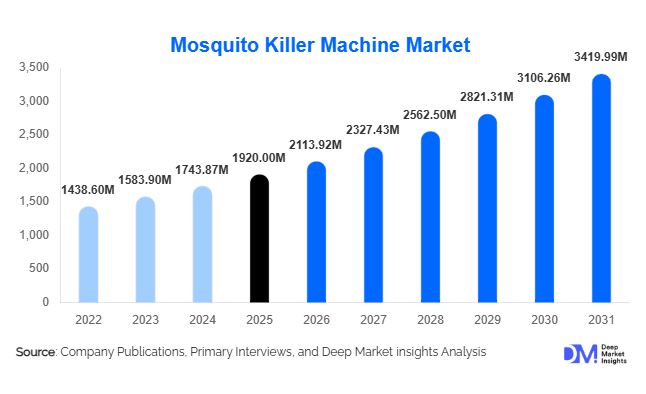
According to Deep Market Insights, the global mosquito killer machine market size was valued at USD 1,920 million in 2025 and is projected to grow from USD 2,113.92 million in 2026 to reach USD 3,419.99 million by 2031, expanding at a CAGR of 10.1% during the forecast period (2026–2031). The mosquito killer machine market growth is primarily driven by increasing concerns over mosquito-borne diseases, growing consumer preference for chemical-free pest control solutions, and technological advancements in UV-based and airflow suction trapping systems.
Mosquito killer machines are widely used in residential homes, hospitality establishments, healthcare facilities, and outdoor recreational areas to control mosquito populations without relying on chemical repellents. These devices employ technologies such as ultraviolet light attraction, electric grids, CO₂ simulation, and photocatalytic attractants to capture and eliminate mosquitoes efficiently.
Rising global temperatures and urbanization are contributing to the expansion of mosquito habitats, increasing the need for reliable and environmentally friendly mosquito control solutions. Governments across tropical regions are also promoting non-toxic mosquito control systems as part of public health initiatives aimed at reducing diseases such as dengue, malaria, chikungunya, and Zika virus infections.
Key Market Insights
- Electric grid mosquito killers remain the most widely adopted product category, accounting for a significant share of global residential demand due to their affordability and ease of use.
- Asia-Pacific dominates the global mosquito killer machine market, driven by high mosquito prevalence and strong demand from countries such as China, India, and Southeast Asia.
- Residential households represent the largest end-use segment, contributing more than 60% of total global market demand.
- Online retail platforms are rapidly expanding market accessibility, enabling manufacturers to reach global consumers directly.
- Technological innovations such as smart sensors, IoT-enabled traps, and energy-efficient UV LEDs are transforming product capabilities and improving mosquito capture efficiency.
- The hospitality and tourism industries are emerging as key commercial adopters, particularly in tropical tourist destinations where mosquito control is essential for guest comfort.
What are the latest trends in the mosquito killer machine market?
Smart and IoT-Enabled Mosquito Control Devices
Technological integration is emerging as a major trend in the mosquito killer machine market. Manufacturers are increasingly introducing smart mosquito traps equipped with sensors, automation features, and mobile connectivity that allow users to monitor and control devices remotely. These systems can detect mosquito activity patterns, adjust operating schedules automatically, and optimize trapping efficiency. IoT-enabled mosquito control devices are particularly attractive for smart homes, hospitality establishments, and commercial facilities seeking automated pest management solutions. As smart home adoption continues to expand globally, connected mosquito control devices are expected to gain significant market traction.
Solar-Powered and Energy-Efficient Mosquito Traps
Another prominent trend in the market is the development of solar-powered mosquito killer machines designed for outdoor environments such as gardens, parks, and recreational areas. These devices reduce dependence on grid electricity and enable continuous mosquito control in remote locations. Energy-efficient LED UV lighting systems are also being widely adopted, providing improved mosquito attraction while lowering energy consumption. The increasing emphasis on sustainable consumer electronics is encouraging manufacturers to develop eco-friendly mosquito control devices that minimize environmental impact while maintaining high performance.
What are the key drivers in the mosquito killer machine market?
Rising Prevalence of Mosquito-Borne Diseases
The increasing global incidence of mosquito-borne diseases is one of the most significant drivers of market growth. Diseases such as malaria, dengue fever, chikungunya, and Zika virus infections affect millions of people annually, particularly in tropical and subtropical regions. Governments and health organizations are encouraging preventive measures to reduce mosquito exposure, including the use of electric mosquito killer machines. Growing awareness of the health risks associated with mosquito bites is prompting households and institutions to invest in effective mosquito control technologies.
Growing Preference for Chemical-Free Pest Control
Consumers are increasingly seeking safer alternatives to traditional mosquito control products such as sprays, coils, and vaporizers, which often contain chemicals that may cause respiratory irritation or environmental damage. Electric mosquito killer machines offer a non-toxic solution by eliminating mosquitoes through physical trapping mechanisms rather than chemical repellents. This shift toward eco-friendly pest control solutions is driving strong demand across residential and commercial sectors.
What are the restraints for the global market?
Availability of Low-Cost Traditional Mosquito Control Methods
In many developing regions, traditional mosquito control products such as coils, sprays, and chemical vaporizers remain widely used due to their lower cost. These alternatives are often significantly cheaper than electric mosquito killer machines, which can limit market penetration among price-sensitive consumers. As a result, manufacturers must balance affordability with technological innovation to expand adoption in emerging markets.
Reduced Efficiency in Large Outdoor Environments
Although mosquito killer machines perform effectively in controlled indoor environments, their efficiency may decline in large outdoor spaces where wind and environmental factors disperse attractants. Achieving effective mosquito control in expansive outdoor areas often requires multiple devices or supplementary pest control measures, increasing installation costs and potentially limiting adoption in certain commercial applications.
What are the key opportunities in the mosquito killer machine industry?
Expansion in Hospitality and Outdoor Recreation Infrastructure
The hospitality industry is emerging as a major growth opportunity for mosquito killer machine manufacturers. Hotels, resorts, outdoor restaurants, and recreational parks increasingly rely on mosquito control systems to enhance guest comfort and safety. Tourist destinations located in tropical climates face persistent mosquito infestations, making reliable mosquito control essential for maintaining customer satisfaction. Large-area mosquito trapping systems capable of covering extensive outdoor environments are expected to witness strong demand from hospitality operators.
Government Vector Control Programs
Government-led mosquito control initiatives present another significant opportunity for the market. Public health agencies across countries such as India, Brazil, Indonesia, and Thailand are implementing integrated mosquito control programs aimed at reducing disease transmission. These programs include installing mosquito traps in public parks, transportation hubs, and residential complexes. As climate change expands mosquito habitats, governments are expected to increase investments in vector control infrastructure, creating new opportunities for manufacturers of large-scale mosquito trapping systems.
Report Scope
| Report Metric | Details |
|---|---|
| Market Size in 2025 | USD 1920 Million |
| Market Size in 2026 | USD 2113.92 Million |
| Market Size in 2031 | USD 3419.99 Million |
| CAGR | 10.1% (2026-2031) |
| Base Year for Estimation | 2025 |
| Historical Data | 2022-2024 |
| Forecast Period | 2026-2031 |
| Report Coverage | Revenue Forecast, Competitive Landscape, Supply Chain Disruption, Growth Factors, Environment & Regulatory Landscape and Trends |
| Geographies Covered | North America, Europe, APAC, Middle East and Africa, LATAM |
| Countries Covered | U.S., Canada, U.K., Germany, France, Spain, Italy, Russia, Nordic, Benelux, Rest of Europe, China, Korea, Japan, India, Australia, Singapore, Taiwan, South East Asia, Rest of Asia-Pacific, UAE, Turky, Saudi Arabia, South Africa, Egypt, Nigeria, Rest of MEA, Brazil, Mexico, Argentina, Chile, Colombia, Rest of LATAM |
Explore more data points, trends and opportunities Download Free Sample Report
Product Type Insights
Electric grid mosquito killers dominate the global market, accounting for approximately 34% of total market demand in 2025. These devices are widely adopted due to their affordability, simple operation, and immediate mosquito elimination capability. UV light mosquito traps and airflow suction mosquito traps are also gaining popularity, particularly in residential and hospitality environments where silent operation is preferred. Photocatalytic mosquito traps are increasingly used in premium indoor environments due to their ability to simulate human breath and attract mosquitoes more effectively. Hybrid mosquito control devices that combine UV lighting with airflow suction technology are emerging as a high-performance segment, particularly in advanced residential and commercial applications.
Application Insights
The residential sector represents the largest application segment for mosquito killer machines, contributing nearly 62% of total global market demand. Households across tropical regions rely heavily on mosquito control devices to protect against disease transmission and improve indoor comfort. The hospitality industry is one of the fastest-growing application segments, driven by the need for mosquito-free outdoor dining areas, resort environments, and recreational facilities. Healthcare facilities are also increasingly adopting mosquito killer machines to maintain hygienic environments and reduce the risk of mosquito-borne infections. Industrial facilities, warehouses, and livestock farms are emerging as additional application areas where mosquito control is essential for worker safety and operational efficiency.
Distribution Channel Insights
Online retail channels have become a dominant distribution pathway for mosquito killer machines, accounting for approximately 44% of global sales. E-commerce platforms enable consumers to compare product features, read reviews, and access a wide range of mosquito control devices from global manufacturers. Offline retail channels, including supermarkets, electronics stores, and hardware outlets, remain important for reaching consumers who prefer in-store product demonstrations. Direct institutional procurement is also gaining traction, particularly among hospitality chains, healthcare institutions, and municipal authorities implementing mosquito control initiatives.
End-Use Industry Insights
Residential households remain the primary end-use sector for mosquito killer machines due to widespread consumer awareness of mosquito-borne diseases and increasing demand for chemical-free pest control solutions. The hospitality industry is rapidly expanding its adoption of mosquito control devices to ensure comfortable guest experiences in outdoor environments. Restaurants and cafés with outdoor seating areas are also investing in mosquito traps to maintain hygienic dining spaces. Healthcare facilities are adopting mosquito control devices as part of infection prevention strategies, particularly in regions prone to malaria and dengue outbreaks. Agricultural farms and livestock operations are emerging as niche users of mosquito control systems to protect animals and improve farm productivity.
Explore more data points, trends and opportunities Download Free Sample Report
Mosquito Killer Machine Market Segmentations
By Product Type
- Electric Grid Mosquito Killers
- UV Light Mosquito Traps
- Photocatalytic Mosquito Killers
- Airflow Suction Mosquito Traps
- Sticky Trap Mosquito Killers
- CO₂ Attractant Mosquito Traps
- Solar-Powered Mosquito Killers
- Hybrid Mosquito Control Devices
By Power Source
- Plug-in Electric Devices
- Battery-Powered Devices
- Rechargeable Devices (USB Powered)
- Solar-Powered Devices
- Hybrid Power Devices
By Coverage Area
- Small Coverage Devices (<50 m²)
- Medium Coverage Devices (50–200 m²)
- Large Coverage Devices (200–1000 m²)
- Industrial / Municipal Systems (>1000 m²)
By Distribution Channel
- Online Retail
- Supermarkets and Hypermarkets
- Electronics and Appliance Stores
- Hardware and Home Improvement Stores
- Institutional / B2B Procurement
By End-Use Industry
- Residential Households
- Hospitality Industry
- Food Service Industry
- Healthcare Facilities
- Industrial Facilities and Warehouses
- Agriculture and Livestock Farms
- Public Infrastructure
Regional Insights
North America
North America accounts for approximately 22% of the global mosquito killer machine market. The United States represents the largest market in the region, driven by strong consumer demand for chemical-free pest control devices and widespread use of mosquito traps in suburban households and outdoor recreational areas. Growing interest in eco-friendly consumer appliances and increasing awareness about mosquito-borne diseases are further supporting market growth.
Europe
Europe represents nearly 18% of the global market, with strong demand in Germany, the United Kingdom, France, Italy, and Spain. European consumers are increasingly adopting environmentally friendly pest control solutions due to strict regulations on chemical insecticides. The region also benefits from strong retail distribution networks and high consumer purchasing power.
Asia-Pacific
Asia-Pacific dominates the global mosquito killer machine market with approximately 46% market share in 2025. Countries such as China, India, Indonesia, Thailand, and Vietnam experience high mosquito prevalence and frequent disease outbreaks, driving strong demand for mosquito control devices. China serves as a major manufacturing hub for mosquito killer machines, while India represents one of the fastest-growing consumer markets due to large population size and rising health awareness.
Latin America
Latin America accounts for roughly 6% of the global market, led by Brazil and Mexico. The region experiences recurring dengue outbreaks, prompting increased adoption of mosquito control technologies in residential and public infrastructure environments.
Middle East & Africa
The Middle East and Africa region holds approximately 8% of global market demand. Tourism-driven economies such as the UAE and Saudi Arabia are increasingly deploying mosquito control devices in hotels, resorts, and public parks. In Africa, high mosquito prevalence and government vector control programs are encouraging adoption of mosquito trapping systems.