Mini Hair Straightener Market Size
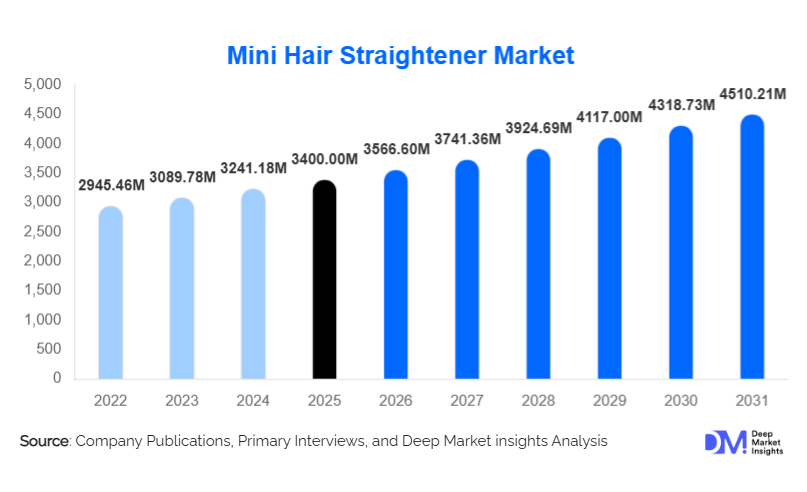
According to Deep Market Insights, the global mini hair straightener market size was valued at USD 3400 million in 2025 and is projected to grow from USD 3566.6 million in 2026 to reach USD 4510.21 million by 2031, expanding at a CAGR of 4.9% during the forecast period (2026–2031). The mini hair straightener market growth is primarily driven by rising demand for portable grooming solutions, increasing travel frequency, growing beauty consciousness among younger consumers, and rapid innovation in cordless and heat-protection technologies.
Key Market Insights
- Portable and travel-friendly styling tools are witnessing strong adoption, driven by urban lifestyles and frequent travel.
- Cordless mini hair straighteners are gaining momentum, supported by advancements in lithium-ion battery efficiency and fast charging.
- Online retail dominates global sales, fueled by direct-to-consumer strategies, influencer marketing, and global e-commerce penetration.
- Asia-Pacific is the fastest-growing region, driven by rising disposable incomes and expanding beauty awareness in China and India.
- Mid-range priced products (USD 20–50) account for the largest revenue share, balancing affordability with performance.
- Professional salons are increasingly adopting premium mini straighteners for precision styling and touch-up applications.
What are the latest trends in the mini hair straightener market?
Rise of Cordless and Smart Styling Devices
The mini hair straightener market is experiencing a significant shift toward cordless and smart devices. Consumers increasingly prefer rechargeable straighteners that offer portability without compromising performance. Manufacturers are integrating smart temperature sensors, automatic shut-off features, and USB-C fast charging to improve safety and convenience. These innovations appeal strongly to frequent travelers, professionals, and younger consumers who value flexibility and modern design.
Premiumization and Hair Protection Technologies
Another major trend is the premiumization of mini hair straighteners. Consumers are willing to pay higher prices for devices that reduce heat damage and improve hair health. Ceramic, titanium, and tourmaline hybrid plates, ionic technology, and uniform heat distribution systems are becoming standard features in premium models. Sustainability-focused packaging and energy-efficient designs are also gaining importance, particularly in developed markets.
What are the key drivers in the mini hair straightener market?
Growing Demand for On-the-Go Grooming Solutions
Increasing travel frequency, busy urban lifestyles, and the need for quick grooming solutions are major drivers of the mini hair straightener market. Compact designs that fit easily into handbags and luggage make mini straighteners a preferred choice for consumers seeking convenience and portability.
Influence of Social Media and Beauty Trends
Social media platforms such as Instagram, TikTok, and YouTube have amplified hairstyling trends, encouraging frequent touch-ups and experimentation. Influencer endorsements and tutorial-driven content have significantly increased awareness and adoption of mini hair straighteners, particularly among Gen Z and millennials.
What are the restraints for the global market?
Intense Price Competition
The presence of numerous low-cost manufacturers, particularly in Asia, has intensified price competition. This puts pressure on profit margins for established brands and makes differentiation through technology and branding essential.
Performance Limitations Perception
Some consumers still perceive mini hair straighteners as less effective than full-sized models, particularly for thick or long hair. Overcoming this perception requires continuous product innovation and consumer education.
What are the key opportunities in the mini hair straightener industry?
Expansion in Emerging Markets
Emerging economies across Asia-Pacific, Latin America, and the Middle East present strong growth opportunities. Rising disposable incomes, urbanization, and increasing beauty awareness are expanding the consumer base for affordable and mid-range mini hair straighteners.
Technology Integration and Sustainability
Opportunities exist in integrating advanced technologies such as smart heat control, sustainable materials, and energy-efficient designs. Brands focusing on eco-friendly manufacturing and recyclable packaging can gain competitive advantage as sustainability becomes a key purchase criterion.
Report Scope
| Report Metric | Details |
|---|---|
| Market Size in 2025 | USD 3400 Million |
| Market Size in 2026 | USD 3566.6 Million |
| Market Size in 2031 | USD 4510.21 Million |
| CAGR | 4.9% (2026-2031) |
| Base Year for Estimation | 2025 |
| Historical Data | 2022-2024 |
| Forecast Period | 2026-2031 |
| Report Coverage | Revenue Forecast, Competitive Landscape, Supply Chain Disruption, Growth Factors, Environment & Regulatory Landscape and Trends |
| Geographies Covered | North America, Europe, APAC, Middle East and Africa, LATAM |
| Countries Covered | U.S., Canada, U.K., Germany, France, Spain, Italy, Russia, Nordic, Benelux, Rest of Europe, China, Korea, Japan, India, Australia, Singapore, Taiwan, South East Asia, Rest of Asia-Pacific, UAE, Turky, Saudi Arabia, South Africa, Egypt, Nigeria, Rest of MEA, Brazil, Mexico, Argentina, Chile, Colombia, Rest of LATAM |
Explore more data points, trends and opportunities Download Free Sample Report
Product Type Insights
Corded mini hair straighteners dominate the market, accounting for nearly 62% of the 2025 market share, due to consistent power output and affordability. Cordless models are the fastest-growing segment, supported by improvements in battery performance and portability. Ceramic plate straighteners lead by material type, contributing approximately 48% of global revenue, owing to even heat distribution and cost efficiency.
Application Insights
Personal and home use remains the largest application segment, representing around 55% of total demand, driven by daily grooming needs and social media influence. Travel applications are growing rapidly, particularly among urban consumers, while professional salon use is expanding at a faster CAGR due to premium product adoption.
Distribution Channel Insights
Online retail channels account for approximately 58% of global sales, driven by brand websites and e-commerce marketplaces. Offline channels, including specialty beauty stores and salon distributors, remain important for premium and professional-grade products.
End-User Insights
Individual consumers dominate the market in volume terms, while professional salons contribute higher per-unit revenue. The professional segment is growing at an estimated 9% CAGR, supported by increasing demand for precision styling tools and premium grooming standards.
Explore more data points, trends and opportunities Download Free Sample Report
Mini Hair Straightener Market Segmentations
By Product Type
- Corded Mini Hair Straighteners
- Cordless (Battery-Operated) Mini Hair Straighteners
By Plate Material
- Ceramic Plate Mini Straighteners
- Titanium Plate Mini Straighteners
- Tourmaline-Coated Mini Straighteners
- Hybrid Plate (Ceramic + Titanium/Tourmaline)
By Application
- Personal/Home Use
- Travel & Portable Styling
- Professional Salon Use
By Distribution Channel
- Online Retail
- Specialty Beauty Stores
- Hypermarkets & Supermarkets
- Professional Salon Distributors
By Price Range
- Low (Below USD 20)
- Mid-Range (USD 20–50)
- Premium (Above USD 50)
Regional Insights
North America
North America holds approximately 28% of the global market share in 2025, led by the U.S. High consumer spending on personal care appliances and strong adoption of premium products support regional growth.
Europe
Europe accounts for nearly 24% of global demand, with strong adoption across Germany, the U.K., and France. Sustainability and premium hair care trends are key growth drivers.
Asia-Pacific
Asia-Pacific is the fastest-growing region, with a CAGR exceeding 9.5%. China, India, Japan, and South Korea are major contributors, driven by rising disposable incomes and expanding beauty consciousness.
Latin America
Latin America represents around 9% of the global market, led by Brazil and Mexico. Growth is supported by increasing urbanization and rising adoption of affordable grooming devices.
Middle East & Africa
The Middle East & Africa region contributes approximately 7% of global demand, with the UAE and Saudi Arabia showing rapid adoption due to high grooming standards and premium product demand.