Metal Trophies Market Size
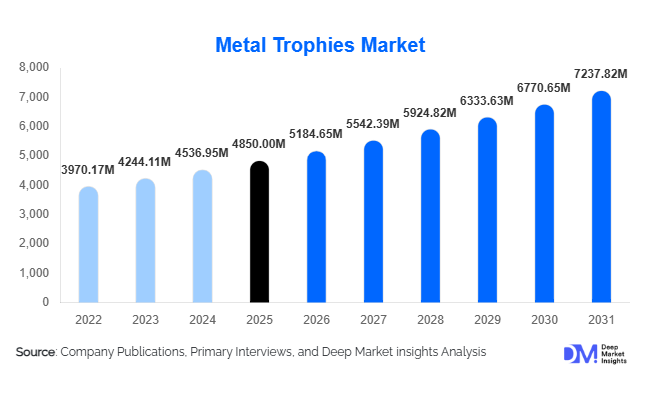
According to Deep Market Insights, the global metal trophies market size was valued at USD 4,850 million in 2025 and is projected to grow from USD 5,184.65 million in 2026 to reach USD 7,237.82 million by 2031, expanding at a CAGR of 6.9% during the forecast period (2026–2031). The metal trophies market growth is primarily driven by the increasing number of global sporting events, rising adoption of corporate recognition programs, and growing demand for customized and premium awards across institutions. The market is further supported by advancements in manufacturing technologies such as CNC machining and 3D metal printing, which enable high-quality, intricate, and personalized trophy designs.
Key Market Insights
- Customization is a key growth driver, with semi-customized and bespoke trophies gaining strong traction across corporate and entertainment sectors.
- Sports and athletics dominate demand, accounting for the largest share due to increasing participation in organized competitions globally.
- North America leads the global market, driven by corporate recognition culture and established sports leagues.
- Asia-Pacific is the fastest-growing region, fueled by rising sports infrastructure investments and educational competitions.
- Mid-range trophies dominate sales, balancing affordability and quality for large-scale events.
- Technological advancements such as laser engraving and 3D printing are transforming product design and production efficiency.
What are the latest trends in the metal trophies market?
Rising Demand for Customization and Personalization
The demand for customized metal trophies is increasing significantly across corporate, sports, and entertainment sectors. Organizations are prioritizing unique designs that reflect brand identity, event themes, and individual achievements. Semi-customized trophies with engraved logos and names dominate the market, while fully bespoke designs are gaining traction in high-profile global events. This trend is supported by advancements in digital design tools and precision manufacturing technologies, enabling cost-effective customization even at smaller volumes.
Adoption of Advanced Manufacturing Technologies
The integration of CNC machining, laser engraving, and 3D metal printing is transforming the production landscape. These technologies enable manufacturers to produce intricate designs with higher precision and reduced lead times. 3D printing, in particular, is gaining attention for prototyping and limited-edition trophies, allowing greater design flexibility. Automation is also improving scalability, making it easier to meet large-volume demands from sports leagues and educational institutions.
What are the key drivers in the metal trophies market?
Expansion of Global Sports and Esports Industries
The rapid growth of professional sports leagues, grassroots tournaments, and esports competitions is significantly driving demand for metal trophies. Increasing participation levels and sponsorship investments are leading to higher volumes of awards being distributed globally. Even local and regional events are adopting high-quality trophies to enhance prestige and engagement.
Growing Corporate Recognition Programs
Organizations are increasingly implementing structured employee recognition programs to boost morale and retention. Metal trophies are widely used as tangible symbols of achievement in corporate environments. The expansion of multinational companies and remote work cultures has further increased demand for standardized and customized awards across regions.
What are the restraints for the global market?
Volatility in Raw Material Prices
Fluctuations in the prices of metals such as aluminum, brass, and stainless steel pose a significant challenge for manufacturers. These variations directly impact production costs and profit margins, making pricing strategies more complex in competitive markets.
Competition from Alternative Materials
Materials such as acrylic, resin, and composites are emerging as cost-effective alternatives to metal trophies. These substitutes are particularly attractive for budget-conscious events, limiting the growth potential of metal trophies in price-sensitive segments.
What are the key opportunities in the metal trophies industry?
Premium and Luxury Trophy Segment Expansion
The demand for high-end and luxury trophies is increasing in global sporting events, entertainment awards, and corporate ceremonies. These trophies often feature premium materials, intricate craftsmanship, and unique designs, allowing manufacturers to achieve higher margins and differentiate their offerings.
Emerging Market Growth
Countries in the Asia-Pacific, Latin America, and Africa present significant growth opportunities due to rising investments in sports infrastructure and educational programs. Increasing participation in competitions and government initiatives promoting talent development is driving demand for affordable and durable metal trophies.
Report Scope
| Report Metric | Details |
|---|---|
| Market Size in 2025 | USD 4850 Million |
| Market Size in 2026 | USD 5184.65 Million |
| Market Size in 2031 | USD 7237.82 Million |
| CAGR | 6.9% (2026-2031) |
| Base Year for Estimation | 2025 |
| Historical Data | 2022-2024 |
| Forecast Period | 2026-2031 |
| Report Coverage | Revenue Forecast, Competitive Landscape, Supply Chain Disruption, Growth Factors, Environment & Regulatory Landscape and Trends |
| Geographies Covered | North America, Europe, APAC, Middle East and Africa, LATAM |
| Countries Covered | U.S., Canada, U.K., Germany, France, Spain, Italy, Russia, Nordic, Benelux, Rest of Europe, China, Korea, Japan, India, Australia, Singapore, Taiwan, South East Asia, Rest of Asia-Pacific, UAE, Turky, Saudi Arabia, South Africa, Egypt, Nigeria, Rest of MEA, Brazil, Mexico, Argentina, Chile, Colombia, Rest of LATAM |
Explore more data points, trends and opportunities Download Free Sample Report
Product Type Insights
Cups and chalices continue to dominate the metal trophies market, accounting for approximately 29% of the global share in 2025. This leadership position is primarily driven by their deep-rooted association with traditional sporting events, international championships, and institutional ceremonies where symbolic value and legacy play a critical role. Their standardized designs allow for scalable production while still enabling moderate customization through engraving and finishing, making them highly preferred across both premium and mid-range segments. Additionally, their visual prominence and perceived prestige ensure continued demand from global tournaments and national-level competitions.
Figurine-based and custom sculpted trophies are witnessing strong growth, particularly in corporate and entertainment sectors where branding and uniqueness are key differentiators. These trophies allow organizations to reflect specific themes, achievements, or brand identities, making them increasingly popular for high-value events. Meanwhile, metal medals remain a crucial segment, especially in large-scale sporting events, due to their cost efficiency, ease of mass production, and logistical convenience. The growing scale of marathons, school competitions, and amateur leagues is further reinforcing demand for medals globally.
Application Insights
Sports and athletics represent the largest application segment, contributing approximately 44% of the total market share in 2025. The dominance of this segment is driven by the continuous expansion of organized sports, rising participation in amateur and professional tournaments, and increasing sponsorship investments globally. The emergence of new formats such as esports tournaments and community-level competitions has further amplified demand for trophies across various tiers.
Corporate awards form the second-largest segment, supported by the growing emphasis on employee recognition and performance incentives. Companies are increasingly investing in structured reward systems, where metal trophies serve as tangible symbols of achievement and organizational culture. The education sector is also a significant contributor, with rising participation in academic competitions, extracurricular activities, and inter-school events driving consistent demand. Additionally, the entertainment and media industry is emerging as a high-growth segment, fueled by global award ceremonies, streaming platforms, and influencer-driven events that require visually distinctive and premium trophies.
Distribution Channel Insights
Direct B2B sales dominate the distribution landscape, accounting for approximately 37% of the global market. This segment leads due to bulk procurement by corporations, sports federations, educational institutions, and government bodies. The ability to negotiate pricing, ensure consistent quality, and customize orders at scale makes direct procurement the preferred channel for large buyers. Long-term supplier relationships and contract-based manufacturing further strengthen this segment’s position.
Specialty trophy retailers continue to play a vital role, particularly in regional and local markets where personalized service and quick turnaround times are valued. However, the most notable shift is toward e-commerce platforms, which are rapidly gaining traction. Online channels offer extensive product catalogs, real-time customization tools, competitive pricing, and global delivery capabilities. This digital transformation is enabling smaller organizations and individual buyers to access high-quality metal trophies, thereby expanding the overall market reach.
End-Use Industry Insights
The sports industry remains the largest end-use segment, supported by a global market exceeding USD 600 billion and continuous investments in leagues, tournaments, and grassroots programs. The increasing professionalization of sports, along with government-backed initiatives to promote physical activity, is sustaining long-term demand for metal trophies.
Corporate demand is growing steadily, driven by rising spending on employee engagement, recognition programs, and corporate events. Organizations are increasingly viewing awards as a strategic tool to enhance productivity and retention. The education sector is expanding rapidly in emerging markets, where governments and private institutions are promoting competitive learning environments through academic and extracurricular competitions.
The entertainment industry, including film, television, music, and digital content platforms, is among the fastest-growing end-use segments. The rise of global award shows, influencer recognition events, and streaming platform ceremonies is creating demand for premium and customized trophies. Additionally, export-driven demand from manufacturing hubs such as China and India continues to supply cost-effective products to global markets, ensuring steady supply chain dynamics.
Explore more data points, trends and opportunities Download Free Sample Report
Metal Trophies Market Segmentations
By Material Type
- Aluminum Trophies
- Stainless Steel Trophies
- Brass Trophies
- Bronze Trophies
- Zinc Alloy Trophies
- Precious Metal-Plated Trophies
By Product Type
- Cups & Chalices
- Figurine-Based Trophies
- Custom Sculpted Trophies
- Medals
- Corporate Awards
By Application
- Sports & Athletics
- Corporate Awards
- Educational Institutions
- Entertainment & Media
- Government & Military Recognition
By Distribution Channel
- Direct B2B Sales
- Specialty Trophy Retailers
- E-commerce Platforms
- Event Management Companies
Regional Insights
North America
North America holds approximately 32% of the global market share, with the United States being the largest contributor. The region’s dominance is driven by a well-established sports ecosystem, including professional leagues such as the NFL, NBA, and MLB, which generate consistent demand for high-quality trophies. Additionally, the strong corporate culture of employee recognition significantly boosts demand for customized awards. High disposable income levels and a preference for premium and luxury trophies further support market growth. The presence of leading manufacturers and advanced production technologies also enhances regional competitiveness.
Europe
Europe accounts for around 27% of the global market, with key countries including Germany, the UK, and France. The region’s growth is driven by its rich tradition of sports, cultural events, and academic competitions. European consumers and organizations show a strong preference for high-quality craftsmanship and premium materials, which drives demand for luxury metal trophies. Additionally, stringent environmental regulations are encouraging the adoption of sustainable manufacturing practices, including the use of recycled metals. The region also benefits from a strong presence of global sporting events such as football leagues and international tournaments.
Asia-Pacific
Asia-Pacific is the fastest-growing region, with a CAGR exceeding 8%. Countries such as China, India, and Japan are key contributors to this growth. The expansion of sports infrastructure, government initiatives promoting physical education, and increasing participation in academic competitions are major drivers. China’s position as a global manufacturing hub enables large-scale production and export of cost-effective metal trophies, while India is witnessing rapid demand growth due to rising investments in school and collegiate competitions. The growing middle-class population and increasing corporate presence are also fueling demand for recognition programs across the region.
Latin America
Latin America demonstrates moderate growth, led by Brazil and Mexico. The region’s demand is primarily driven by the popularity of football and other regional sports tournaments. Government initiatives to promote youth sports and community engagement are supporting the expansion of local competitions. Additionally, increasing corporate presence in urban centers is contributing to demand for employee recognition awards. However, economic fluctuations and budget constraints in certain countries may limit the adoption of premium trophies, keeping the market largely price-sensitive.
Middle East & Africa
The Middle East and Africa region is emerging as a significant growth hub. Countries such as the UAE and Saudi Arabia are investing heavily in international sporting events, including global tournaments and exhibition matches, which drive demand for high-end and customized trophies. Government-led diversification strategies and investments in tourism and entertainment infrastructure are further boosting market growth. In Africa, a strong sports culture and increasing participation in regional competitions are supporting demand, particularly for cost-effective metal trophies. The region also benefits from rising corporate activity and educational initiatives, which are gradually expanding the scope of the market.
Key Players in the Metal Trophies Market
- Crown Awards
- MTM Recognition
- Awards.com
- PDU CAT
- Trophy Depot
- American Trophy & Award Company
- EFX Creative
- St Regis Group
- Recognition Express
- Awards and Fine Gifts
- Thomas Lyte
- Metalcraft Inc.
- HME Brass
- Wendell August Forge