Men’s Wallet Market Size
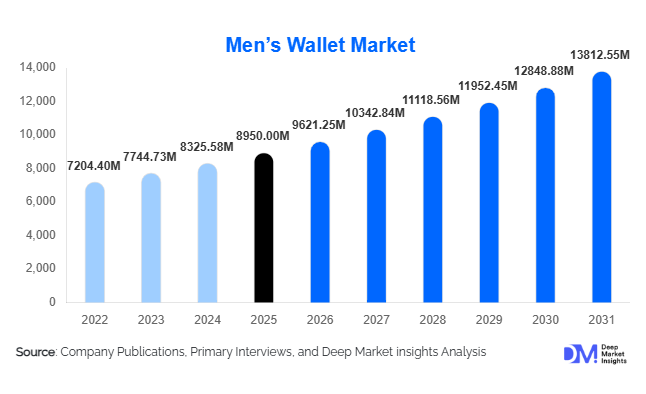
According to Deep Market Insights, the global men’s wallet market size was valued at USD 8,950 million in 2025 and is projected to grow from USD 9,621.25 million in 2026 to reach USD 13,812.55 million by 2031, expanding at a CAGR of 7.5% during the forecast period (2026–2031). The men’s wallet market growth is primarily driven by increasing consumer focus on personal accessories as style statements, rising disposable incomes, and the growing adoption of premium and functional wallet designs. Additionally, the integration of RFID-blocking and smart wallet technologies is enhancing product value, while the expansion of e-commerce platforms is significantly improving accessibility and global reach.
Key Market Insights
- Premiumization trends are reshaping consumer demand, with increasing preference for high-quality leather and branded wallets.
- Smart wallets with RFID-blocking and tracking features are gaining traction, particularly in developed markets.
- Asia-Pacific dominates the global market, driven by a large population base and rising middle-class consumption.
- Online retail channels are expanding rapidly, contributing significantly to global sales growth.
- Sustainable and vegan materials are emerging as key differentiators, especially among younger consumers.
- Corporate gifting and seasonal demand cycles continue to support consistent market growth.
What are the latest trends in the men’s wallet market?
Shift Toward Minimalist and Slim Wallet Designs
Consumers are increasingly favoring compact, minimalist wallet designs that align with modern lifestyles. Slim wallets and cardholders are replacing traditional bulky formats, particularly among urban professionals and younger demographics. This trend is driven by reduced cash usage and a growing reliance on cards and digital payments. Manufacturers are responding by designing wallets that offer efficient storage while maintaining sleek aesthetics. The trend also aligns with portability preferences, as consumers seek accessories that fit seamlessly into daily routines without adding bulk.
Adoption of Smart and RFID-Enabled Wallets
Technological integration is transforming the men’s wallet market. RFID-blocking wallets have become increasingly popular due to rising concerns over digital theft and data security. Additionally, smart wallets equipped with Bluetooth tracking, GPS functionality, and mobile app integration are gaining momentum. These features allow users to track lost wallets, enhancing convenience and security. The growing adoption of such technologies is particularly prominent in North America and Europe, where consumers are more inclined toward tech-enabled lifestyle products.
What are the key drivers in the men’s wallet market?
Rising Demand for Fashion Accessories
Wallets are increasingly viewed as fashion accessories rather than just functional items. This shift has led to higher demand for premium and luxury products, particularly in urban markets. Consumers are willing to invest in branded wallets that reflect personal style and status, driving growth in the premium and luxury segments.
Expansion of E-commerce and Direct-to-Consumer Channels
The rapid growth of online retail has significantly boosted the men’s wallet market. E-commerce platforms enable brands to reach a global audience while offering a wide range of products at competitive prices. Direct-to-consumer strategies have also allowed brands to enhance customer engagement, offer customization, and improve profit margins.
Growing Awareness of Security Features
With the rise in digital payments, concerns about data theft have increased. This has driven demand for RFID-blocking wallets, which protect users from unauthorized scanning of credit cards. The emphasis on security is encouraging innovation and product differentiation within the market.
What are the restraints for the global market?
Declining Cash Usage and Digital Wallet Adoption
The increasing adoption of digital payment methods is reducing the reliance on physical wallets. Mobile wallets and contactless payment systems are becoming more prevalent, particularly among younger consumers, which may limit long-term demand growth.
Fluctuating Raw Material Prices
Volatility in leather prices and supply chain disruptions pose challenges for manufacturers. Rising costs of raw materials can impact pricing strategies and profit margins, especially in the mid-range segment where price sensitivity is high.
What are the key opportunities in the men’s wallet industry?
Growth of Smart Wallet Technology
The integration of technology into wallets presents a significant growth opportunity. Smart wallets with tracking capabilities, biometric security, and app connectivity are attracting tech-savvy consumers. This segment remains underpenetrated in emerging markets, offering substantial growth potential for manufacturers.
Expansion of Sustainable and Vegan Materials
Increasing environmental awareness is driving demand for eco-friendly wallets made from vegan leather, recycled materials, and cork. Brands that adopt sustainable practices and materials are likely to gain a competitive advantage, particularly among younger consumers who prioritize ethical consumption.
Report Scope
| Report Metric | Details |
|---|---|
| Market Size in 2025 | USD 8950 Million |
| Market Size in 2026 | USD 9621.25 Million |
| Market Size in 2031 | USD 13812.55 Million |
| CAGR | 7.5% (2026-2031) |
| Base Year for Estimation | 2025 |
| Historical Data | 2022-2024 |
| Forecast Period | 2026-2031 |
| Report Coverage | Revenue Forecast, Competitive Landscape, Supply Chain Disruption, Growth Factors, Environment & Regulatory Landscape and Trends |
| Geographies Covered | North America, Europe, APAC, Middle East and Africa, LATAM |
| Countries Covered | U.S., Canada, U.K., Germany, France, Spain, Italy, Russia, Nordic, Benelux, Rest of Europe, China, Korea, Japan, India, Australia, Singapore, Taiwan, South East Asia, Rest of Asia-Pacific, UAE, Turky, Saudi Arabia, South Africa, Egypt, Nigeria, Rest of MEA, Brazil, Mexico, Argentina, Chile, Colombia, Rest of LATAM |
Explore more data points, trends and opportunities Download Free Sample Report
Product Type Insights
Bi-fold wallets continue to dominate the men’s wallet market, accounting for approximately 38% of the global share in 2025. The leadership of this segment is primarily driven by its optimal balance between functionality, storage capacity, and compact design, making it suitable for a wide range of consumers across both developed and emerging markets. Bi-fold wallets are widely accepted as a standard format, supported by their compatibility with traditional cash usage as well as modern card storage needs. Additionally, their strong presence across all price segments, from economy to luxury, further reinforces their dominance.
Cardholders are emerging as the fastest-growing segment, fueled by the global shift toward cashless transactions and minimalist lifestyles. Increasing adoption among younger consumers and urban professionals is accelerating demand. Travel wallets and zip-around wallets cater to niche but steadily growing segments, particularly frequent travelers seeking enhanced organization and security features. Meanwhile, smart wallets, although currently a smaller share, are witnessing rapid growth due to rising demand for RFID protection, Bluetooth tracking, and tech-enabled convenience, particularly in North America and Europe.
Material Insights
Genuine leather remains the leading material segment, holding around 55% of the market share in 2025. This dominance is driven by its superior durability, premium aesthetics, and long-standing association with luxury and craftsmanship. Leather wallets are particularly favored in premium and luxury segments, where brand value and product longevity play a critical role in purchasing decisions. Additionally, established supply chains and strong consumer trust in leather products continue to sustain its leadership globally.
However, alternative materials are gaining traction. Synthetic leather and fabric-based wallets are increasingly popular due to their affordability and growing alignment with sustainability trends. These materials are particularly востребованы in price-sensitive and environmentally conscious segments. Metal wallets, especially aluminum and titanium variants, are gaining momentum within the smart wallet category due to their durability, sleek design, and enhanced protection features. The shift toward sustainable and innovative materials is expected to gradually reshape the material landscape over the forecast period.
Price Range Insights
The mid-range segment dominates the market, accounting for approximately 42% of the total share in 2025. This segment’s leadership is driven by its ability to offer a balance between affordability and perceived quality, making it highly attractive to a broad consumer base. Mid-range wallets often combine decent material quality, brand recognition, and functional features, positioning them as the preferred choice for middle-income consumers globally.
Premium and luxury segments are experiencing steady growth, supported by increasing disposable incomes, urbanization, and rising brand consciousness. Consumers in developed regions and affluent urban centers are increasingly willing to invest in high-end wallets as status symbols and lifestyle accessories. On the other hand, economy wallets continue to maintain strong demand in emerging markets, where affordability remains a key purchasing factor. The coexistence of these segments highlights a diversified pricing structure driven by varying consumer preferences and income levels.
Distribution Channel Insights
While offline retail channels such as department stores, specialty outlets, and brand stores continue to play a significant role, online channels have emerged as a key growth driver, accounting for nearly 36% of total sales in 2025. The rapid expansion of e-commerce is driven by increasing internet penetration, smartphone adoption, and consumer preference for convenience and variety.
The dominance of online channels is further supported by competitive pricing, availability of global brands, and access to customer reviews, which enhance purchase confidence. Direct-to-consumer (D2C) strategies adopted by brands are also strengthening online sales by enabling personalized offerings and improved customer engagement. Meanwhile, offline channels remain important for premium and luxury purchases, where tactile experience and brand interaction influence buying decisions.
End-Use Insights
Mass-market consumers represent the largest end-use segment, accounting for around 60% of total demand in 2025. The dominance of this segment is driven by high-volume consumption in emerging economies, where wallets are considered essential everyday accessories. Affordable pricing, wide availability, and frequent replacement cycles contribute to sustained demand in this segment.
The professional segment is growing steadily, supported by increasing demand for premium, functional, and aesthetically appealing wallets among working individuals. Features such as RFID protection, organized compartments, and sleek designs are particularly valued in this segment. The luxury consumer segment, although smaller in volume, contributes significantly to revenue due to high product margins. This segment is driven by brand prestige, exclusivity, and demand for high-quality craftsmanship, particularly in developed markets and high-income regions.
Explore more data points, trends and opportunities Download Free Sample Report
Men’s Wallet Market Segmentations
By Product Type
- Bi-Fold Wallets
- Tri-Fold Wallets
- Cardholders
- Money Clips
- Travel & Passport Wallets
- Zip-Around Wallets
- Smart Wallets
By Material Type
- Genuine Leather
- Synthetic Leather
- Fabric-Based
- Metal
- Sustainable Materials
By Price Range
- Economy
- Mid-Range
- Premium
- Luxury
By Distribution Channel
- Online Retail
- Department Stores
- Specialty Stores
- Brand Outlets
By End-Use
- Mass Market Consumers
- Professional/Corporate Users
- Luxury Consumers
Regional Insights
Asia-Pacific
Asia-Pacific dominates the men’s wallet market with approximately 42% market share in 2025, making it the largest regional contributor. China leads the region with around 18% share, supported by its strong manufacturing base, cost competitiveness, and large domestic consumer market. India is the fastest-growing market in the region, with a CAGR of nearly 9%, driven by rapid urbanization, rising disposable incomes, and expanding retail and e-commerce infrastructure. Japan contributes significantly through demand for premium and high-quality wallets, supported by strong consumer preference for craftsmanship and branded products. Regional growth is further fueled by increasing middle-class populations, rising fashion consciousness, and strong export-oriented manufacturing capabilities.
North America
North America accounts for around 25% of the global market, with the United States contributing nearly 20%. The region’s growth is driven by high consumer purchasing power, strong demand for premium and luxury accessories, and early adoption of technologically advanced products such as RFID and smart wallets. The presence of leading global brands and well-established retail infrastructure further supports market expansion. Additionally, increasing consumer preference for branded and personalized products, along with a strong gifting culture, continues to drive demand in this region.
Europe
Europe holds approximately 20% market share, led by Germany, France, and Italy. Italy remains a key hub for luxury leather wallet production, benefiting from its heritage in leather craftsmanship and strong export capabilities. Regional growth is driven by high demand for premium and sustainable products, with consumers increasingly favoring eco-friendly materials and ethically sourced leather. The presence of globally recognized luxury brands and strong fashion influence also contributes to steady demand. Additionally, stringent environmental regulations are encouraging innovation in sustainable materials, further shaping market dynamics.
Latin America
Latin America accounts for about 7% of the global market, with Brazil and Mexico as the primary contributors. Market growth in this region is driven by expanding middle-class populations, increasing urbanization, and growing exposure to international fashion trends. Rising retail penetration and improving e-commerce infrastructure are also supporting demand. Additionally, the affordability of mid-range and economy wallets aligns well with the purchasing power of consumers in this region, making it a key growth driver.
Middle East & Africa
The Middle East & Africa region contributes around 6% of global demand, with the UAE leading in luxury wallet consumption due to its high-income population and strong preference for premium brands. Growth in the Middle East is driven by increasing tourism, luxury retail expansion, and rising disposable incomes. In Africa, countries such as South Africa are witnessing steady growth supported by expanding retail networks and improving economic conditions. Additionally, increasing urbanization and rising consumer awareness of branded products are contributing to gradual market expansion across the region.
Key Players in the Men’s Wallet Market
- Louis Vuitton
- Gucci
- Prada
- Hermès
- Fossil Group
- Montblanc
- Tommy Hilfiger
- Calvin Klein
- Tumi
- Coach
- Bellroy
- Ekster
- Secrid
- Samsonite
- Timberland