Men’s Suits Market Size
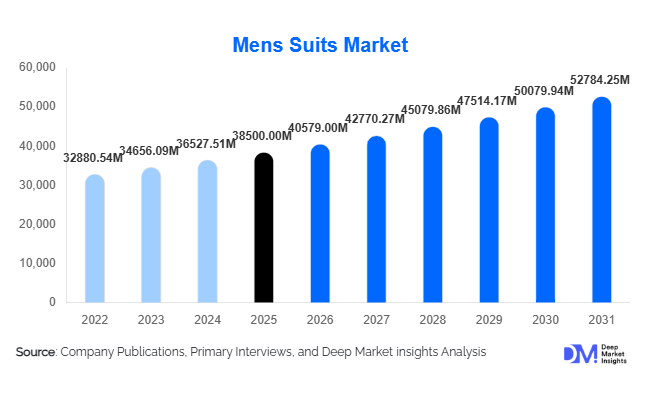
According to Deep Market Insights, the global men’s suits market size was valued at USD 38,500 million in 2025 and is projected to grow from USD 40,579.00 million in 2026 to reach USD 52,784.25 million by 2031, expanding at a CAGR of 5.4% during the forecast period (2026–2031). The market growth is primarily driven by the resurgence of formal events, increasing participation in corporate employment across emerging economies, and rising demand for premium and occasion-based menswear. Additionally, evolving fashion trends toward versatile and semi-formal suits, combined with the expansion of e-commerce and digital tailoring solutions, are reshaping consumer purchasing behavior and supporting sustained market expansion globally.
Key Market Insights
- Asia-Pacific dominates the global market, driven by strong demand from China and India due to urbanization and rising disposable incomes.
- Mid-range suits account for the largest share, offering a balance between affordability and quality, particularly in emerging markets.
- Wedding and occasion wear is the fastest-growing segment, supported by increasing spending on social events globally.
- Offline retail remains dominant, as consumers prefer in-store trials and customization services.
- Slim-fit suits are leading fashion trends, especially among younger consumers seeking modern aesthetics.
- Digital transformation in tailoring, including AI-based sizing and virtual try-ons, is enhancing customer experience and boosting online sales.
What are the latest trends in the men’s suits market?
Shift Toward Casual and Hybrid Suits
The market is witnessing a transition from traditional formal suits to hybrid designs that combine comfort with style. Consumers are increasingly opting for unstructured blazers, lightweight fabrics, and stretch materials that allow suits to be worn in both professional and social settings. This shift is largely influenced by evolving workplace norms and the rise of business-casual dress codes. Brands are responding by introducing versatile collections that cater to multiple occasions, reducing the dependency on strictly formal attire while expanding overall suit usage.
Rise of Digital Tailoring and Customization
Technology is playing a critical role in transforming the men’s suits market. Digital measurement tools, AI-powered size recommendations, and virtual fitting rooms are improving online purchasing confidence. Made-to-measure and bespoke suits are becoming more accessible through online platforms, allowing brands to reduce inventory while offering personalized products. This trend is particularly appealing to younger, tech-savvy consumers who value convenience and customization.
What are the key drivers in the men’s suits market?
Growth in Formal and Social Events
The revival of weddings, corporate events, and social gatherings has significantly boosted demand for men’s suits. Occasion wear, particularly tuxedos and premium suits, is witnessing strong growth as consumers invest more in appearance and personal style for key events. This trend is especially prominent in regions with a strong cultural emphasis on ceremonies and celebrations.
Rising Middle-Class Income in Emerging Markets
Increasing disposable income and expanding middle-class populations in countries such as India, China, and Southeast Asia are driving market growth. As more individuals enter formal employment sectors, demand for business attire, including suits, continues to rise. This demographic shift is creating substantial opportunities for mid-range and affordable premium suit segments.
What are the restraints for the global market?
Casualization of Workplace Attire
The growing adoption of business-casual and remote work environments, particularly in North America and Europe, has reduced the frequency of suit usage in daily professional settings. This shift has led to a decline in demand for traditional business suits, impacting overall market growth.
Price Sensitivity and Fast Fashion Competition
The presence of low-cost alternatives and fast fashion brands has intensified price competition. Consumers in price-sensitive markets often opt for cheaper substitutes, which can impact margins for premium and mid-tier brands.
What are the key opportunities in the men’s suits industry?
Expansion in Emerging Economies
Emerging markets in Asia-Pacific, Africa, and Latin America present significant growth opportunities due to rising urbanization and increasing formal employment. Local manufacturing capabilities combined with international brand expansion can help companies tap into these high-growth regions.
Premiumization and Occasion Wear Growth
The increasing demand for luxury and premium suits for weddings and special occasions offers strong growth potential. Consumers are willing to invest in high-quality fabrics, bespoke tailoring, and designer brands, particularly in regions with a strong cultural emphasis on celebrations.
Report Scope
| Report Metric | Details |
|---|---|
| Market Size in 2025 | USD 38500 Million |
| Market Size in 2026 | USD 40579 Million |
| Market Size in 2031 | USD 52784.25 Million |
| CAGR | 5.4% (2026-2031) |
| Base Year for Estimation | 2025 |
| Historical Data | 2022-2024 |
| Forecast Period | 2026-2031 |
| Report Coverage | Revenue Forecast, Competitive Landscape, Supply Chain Disruption, Growth Factors, Environment & Regulatory Landscape and Trends |
| Geographies Covered | North America, Europe, APAC, Middle East and Africa, LATAM |
| Countries Covered | U.S., Canada, U.K., Germany, France, Spain, Italy, Russia, Nordic, Benelux, Rest of Europe, China, Korea, Japan, India, Australia, Singapore, Taiwan, South East Asia, Rest of Asia-Pacific, UAE, Turky, Saudi Arabia, South Africa, Egypt, Nigeria, Rest of MEA, Brazil, Mexico, Argentina, Chile, Colombia, Rest of LATAM |
Explore more data points, trends and opportunities Download Free Sample Report
Product Type Insights
Two-piece suits dominate the global men’s suits market, accounting for approximately 48% of total revenue in 2025. The segment’s leadership is primarily driven by its versatility, cost-effectiveness, and adaptability across both formal and semi-formal occasions. Two-piece suits are widely preferred in corporate environments as well as social settings, making them a staple wardrobe essential across regions. Additionally, their relatively lower price compared to three-piece suits enhances accessibility in emerging markets, further strengthening their volume dominance. The segment has also benefited from evolving design innovations such as stretch fabrics, lightweight materials, and wrinkle-resistant finishes, which improve comfort and usability.
Three-piece suits and tuxedos, while smaller in share, are experiencing steady growth driven by occasion-based demand, particularly weddings, black-tie events, and premium social gatherings. This segment is gaining traction in regions with strong cultural emphasis on ceremonial dressing, such as South Asia and the Middle East. Meanwhile, casual and unstructured suits are witnessing increasing adoption due to the global shift toward relaxed dress codes. These suits, often made with linen, cotton, and blended fabrics, cater to consumers seeking comfort without compromising on style, making them particularly popular among younger demographics and in warmer climates.
Application Insights
Corporate and business wear remains the largest application segment, contributing approximately 44% of the global market in 2025. This dominance is supported by sustained demand from industries such as finance, legal services, consulting, and corporate management, where formal attire continues to be a professional requirement. Emerging economies are further strengthening this segment, as increasing white-collar employment drives the adoption of business suits. However, the wedding and occasion wear segment is the fastest growing, with growth rates exceeding the overall market average. This trend is driven by rising global spending on weddings, increasing preference for premium attire, and the influence of social media on fashion trends. Consumers are increasingly investing in high-quality, customized suits for once-in-a-lifetime events, particularly in countries like India, China, and the Middle East.
Uniform applications in sectors such as hospitality, aviation, and luxury retail provide stable and recurring demand, ensuring consistent market contribution. At the same time, casual and social wear applications are expanding rapidly as suits evolve into lifestyle products rather than purely formal attire. This shift is supported by changing consumer preferences toward multi-functional clothing that can be worn across different occasions.
Distribution Channel Insights
Offline retail channels continue to dominate the market, accounting for approximately 62% of total sales in 2025. The leading position of this segment is primarily driven by the need for physical trials, personalized fittings, and alterations, which are critical factors influencing suit purchases. Tailoring shops, brand-exclusive outlets, and department stores play a vital role in delivering customized experiences, particularly in premium and luxury segments.
However, online retail is emerging as the fastest-growing channel, supported by increasing digital penetration and advancements in virtual fitting technologies, AI-based size recommendations, and seamless return policies. Consumers are increasingly adopting online platforms due to convenience, wider product selection, and competitive pricing. Direct-to-consumer (D2C) models are also gaining traction, allowing brands to improve margins while offering personalized experiences. The integration of omnichannel strategies, such as online ordering with in-store fitting, is further bridging the gap between digital and physical retail.
Fit Type Insights
Slim-fit suits lead the market with an estimated 39% share in 2025, driven by changing fashion preferences and the influence of younger consumers. This segment benefits from strong demand among millennials and Gen Z consumers who prefer modern, tailored silhouettes that align with contemporary fashion trends. Slim-fit designs are widely promoted by global fashion brands and influencers, further accelerating adoption. Regular and classic fits continue to maintain steady demand, particularly among older demographics and professionals who prioritize comfort and traditional styling. These segments remain relevant in conservative industries and regions where formal dress codes are more rigid.
Meanwhile, tailored and custom-fit suits are gaining significant traction in the premium and luxury segments. The growth of this category is driven by increasing demand for personalization, superior fit, and exclusivity. Technological advancements in digital tailoring and made-to-measure services are further enabling scalability in this segment, making customized suits more accessible to a broader consumer base.
Explore more data points, trends and opportunities Download Free Sample Report
Mens Suits Market Segmentations
By Product Type
- Two-Piece Suits
- Three-Piece Suits
- Tuxedos / Dinner Suits
- Casual / Unstructured Suits
- Business Formal Suits
By Application
- Corporate / Business Wear
- Wedding & Occasion Wear
- Casual / Social Wear
- Uniforms
By Distribution Channel
- Offline Retail
- Online Retail
By Fit Type
- Slim Fit
- Regular Fit
- Classic Fit
- Tailored / Custom Fit
By Fabric Type
- Wool
- Cotton
- Linen
- Polyester / Synthetic
- Blended Fabrics
Regional Insights
North America
North America accounts for approximately 26% of the global men’s suits market, with the United States being the dominant contributor. While the region faces structural challenges due to the casualization of workplace attire and remote working trends, growth is sustained by strong demand in premium, luxury, and occasion wear segments. High disposable income levels, a well-established retail infrastructure, and strong brand presence support market stability. Additionally, increasing spending on weddings, corporate events, and social gatherings continues to drive demand. The adoption of sustainable and high-quality fabrics is also influencing purchasing decisions among environmentally conscious consumers.
Europe
Europe holds approximately 24% of the global market share, driven by key countries such as Italy, the UK, Germany, and France. The region’s growth is supported by its strong heritage in tailoring and luxury fashion, with Italy serving as a global hub for premium suit manufacturing. Demand in Europe is largely driven by high fashion awareness, preference for premium quality, and increasing adoption of sustainable materials. The UK and Germany contribute significantly to business wear demand, while Southern Europe shows strong consumption of luxury and occasion wear. Additionally, the region benefits from a mature retail ecosystem and strong export capabilities.
Asia-Pacific
Asia-Pacific dominates the global market with approximately 38% share in 2025, making it the largest and fastest-growing region. China leads with nearly 18% of global demand, driven by rapid urbanization, an expanding middle-class population, and strong domestic manufacturing capabilities. India is the fastest-growing market, supported by rising disposable incomes, increasing formal employment, and a strong cultural emphasis on weddings and celebrations. Southeast Asian countries such as Indonesia and Vietnam are also emerging as key growth markets due to expanding retail infrastructure and rising consumer spending. The region’s growth is further accelerated by cost-efficient production, export-driven manufacturing, and increasing penetration of international brands.
Latin America
Latin America accounts for approximately 6% of the global market, with Brazil and Mexico as the primary contributors. Growth in this region is driven by increasing urbanization, expansion of the middle class, and rising adoption of formal wear in professional settings. While price sensitivity remains a challenge, demand for mid-range suits is increasing steadily. The region is also witnessing gradual growth in occasion wear, supported by cultural events and social gatherings. Improvements in retail infrastructure and e-commerce penetration are further supporting market expansion.
Middle East & Africa
The Middle East & Africa region is experiencing steady growth, driven by strong demand in countries such as the UAE, Saudi Arabia, and South Africa. The market is primarily supported by high disposable incomes, luxury consumption patterns, and cultural preferences for formal and traditional attire. The Middle East, in particular, is a significant market for premium and luxury suits due to its affluent consumer base and high spending on weddings and formal events. In Africa, increasing urbanization and the growth of formal employment sectors are gradually driving demand. Additionally, government initiatives aimed at boosting the retail and tourism sectors are indirectly supporting market growth in this region.
Key Players in the Men’s Suits Market
- Hugo Boss
- Armani
- Ralph Lauren
- Zegna
- Burberry
- Brooks Brothers
- Inditex (Zara)
- H&M
- PVH Corp.
- Kiton
- Canali
- Brioni
- Tom Ford
- Ermenegildo Zegna Group
- Marks & Spencer