Men’s Luxury Bag Market Size
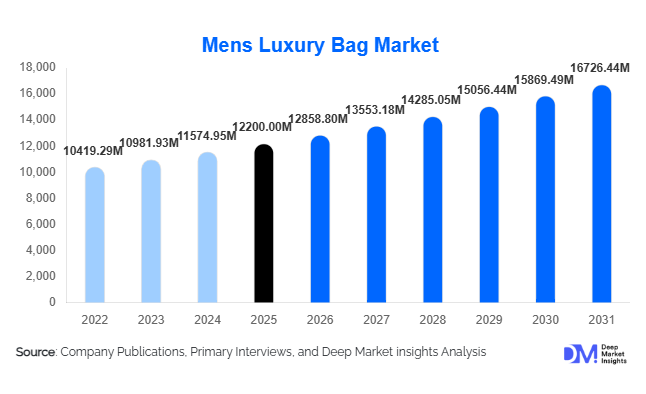
According to Deep Market Insights, the global men’s luxury bag market size was valued at USD 12,200 million in 2025 and is projected to grow from USD 12,858.80 million in 2026 to reach USD 16,726.44 million by 2031, expanding at a CAGR of 5.4% during the forecast period (2026–2031). The men’s luxury bag market growth is primarily driven by the increasing acceptance of luxury fashion accessories among male consumers, the expansion of global luxury retail networks, and rising disposable income among affluent professionals and high-net-worth individuals.
Luxury fashion houses have significantly expanded their men’s product portfolios, offering bags that combine premium craftsmanship, modern design, and practical functionality. From leather briefcases and messenger bags to travel duffels and fashion-forward crossbody bags, brands are increasingly targeting male consumers who seek both utility and status-driven fashion accessories.
The market is also benefiting from digital transformation in luxury retail. Online flagship stores, personalized shopping experiences, and social media-driven fashion trends are encouraging younger demographics to adopt luxury accessories earlier in their purchasing journey. Additionally, emerging markets such as China, India, and the Middle East are becoming major growth engines due to rising urban affluence and aspirational luxury consumption.
Key Market Insights
- Luxury leather bags remain the dominant product category, accounting for more than half of global demand due to their craftsmanship, durability, and heritage appeal.
- Flagship luxury boutiques continue to dominate distribution, as high-value purchases often rely on personalized in-store experiences and brand storytelling.
- Europe leads the global market, supported by strong luxury fashion heritage and the presence of major luxury manufacturing hubs in Italy and France.
- Asia-Pacific is the fastest-growing region, driven by rising affluent populations and increasing luxury fashion adoption among younger consumers.
- Corporate professionals represent the largest end-use consumer group, driving demand for premium briefcases, laptop bags, and business travel accessories.
- Technological innovations such as blockchain authentication and AI-driven personalization are improving product transparency, customer engagement, and brand loyalty.
What are the latest trends in the men’s luxury bag market?
Sustainable Materials and Ethical Luxury Production
Sustainability is becoming an increasingly influential factor in the luxury accessories market. Consumers are demanding transparency in sourcing and environmentally responsible production processes. Luxury brands are responding by incorporating eco-friendly materials such as recycled nylon, vegan leather alternatives, and ethically sourced hides into their collections. Additionally, brands are implementing traceability systems and sustainable manufacturing processes to reduce environmental impact. The emergence of circular luxury models, including resale platforms and refurbishment services for luxury bags, is also gaining traction. These initiatives help extend product lifecycles and appeal to environmentally conscious consumers who value both luxury and sustainability.
Rise of Functional Luxury Bags
The modern luxury consumer increasingly values practicality alongside aesthetics. As a result, brands are designing multifunctional bags that integrate laptop compartments, device chargers, and ergonomic carrying features. Business professionals and frequent travelers are particularly drawn to bags that combine luxury craftsmanship with practical functionality. Hybrid designs that transition from office use to travel are gaining popularity, reflecting changes in workplace culture and increased global mobility among professionals.
What are the key drivers in the men’s luxury bag market?
Growing Male Luxury Fashion Consumption
The perception of men’s fashion accessories has evolved significantly over the past decade. Bags are no longer viewed solely as functional items but as fashion statements that reflect personal style and professional status. Influencers, celebrities, and social media platforms have played a major role in shaping consumer attitudes, encouraging men to experiment with luxury accessories such as crossbody bags, designer backpacks, and statement travel bags. This cultural shift has expanded the customer base for luxury bag manufacturers.
Expansion of Global Luxury Retail Networks
Luxury brands are expanding their presence in emerging markets through flagship boutiques and luxury shopping malls. Cities such as Shanghai, Dubai, Mumbai, and Singapore are becoming major hubs for luxury retail expansion. Governments in several countries are investing heavily in tourism and retail infrastructure, further supporting the growth of luxury shopping destinations. These developments are increasing accessibility to luxury products and boosting international demand.
What are the restraints for the global market?
High Product Pricing
Luxury bags often carry premium price tags ranging from several hundred to several thousand dollars. While this exclusivity strengthens brand prestige, it also restricts accessibility for middle-income consumers. Economic fluctuations and inflationary pressures can therefore influence purchasing decisions and slow demand during uncertain economic conditions.
Counterfeit Luxury Goods
The proliferation of counterfeit luxury goods remains a significant challenge for market participants. Fake products sold through unauthorized channels damage brand reputation and erode sales of genuine luxury products. To address this issue, brands are increasingly adopting digital authentication technologies, including blockchain-based verification systems and smart tags embedded in luxury products.
What are the key opportunities in the men’s luxury bag industry?
Emerging Market Luxury Demand
Rapid economic growth in emerging markets is creating new opportunities for luxury bag manufacturers. Countries such as China, India, and the United Arab Emirates are witnessing rapid growth in affluent consumers and aspirational luxury buyers. Urbanization, increasing disposable income, and expanding retail infrastructure are encouraging luxury brands to establish a stronger presence in these markets. New flagship stores, localized product collections, and digital marketing strategies are helping brands capture this expanding consumer base.
Technology-Enabled Luxury Retail
Digital technologies are transforming the luxury retail experience. Artificial intelligence, augmented reality, and advanced data analytics are enabling brands to offer personalized shopping experiences. Virtual product previews, customized bag designs, and limited-edition online releases are attracting younger consumers. Luxury brands are also using blockchain technology to ensure product authenticity and improve supply chain transparency, further strengthening consumer trust.
Report Scope
| Report Metric | Details |
|---|---|
| Market Size in 2025 | USD 12200 Million |
| Market Size in 2026 | USD 12858.80 Million |
| Market Size in 2031 | USD 16726.44 Million |
| CAGR | 5.4% (2026-2031) |
| Base Year for Estimation | 2025 |
| Historical Data | 2022-2024 |
| Forecast Period | 2026-2031 |
| Report Coverage | Revenue Forecast, Competitive Landscape, Supply Chain Disruption, Growth Factors, Environment & Regulatory Landscape and Trends |
| Geographies Covered | North America, Europe, APAC, Middle East and Africa, LATAM |
| Countries Covered | U.S., Canada, U.K., Germany, France, Spain, Italy, Russia, Nordic, Benelux, Rest of Europe, China, Korea, Japan, India, Australia, Singapore, Taiwan, South East Asia, Rest of Asia-Pacific, UAE, Turky, Saudi Arabia, South Africa, Egypt, Nigeria, Rest of MEA, Brazil, Mexico, Argentina, Chile, Colombia, Rest of LATAM |
Explore more data points, trends and opportunities Download Free Sample Report
Product Type Insights
Briefcases dominate the men’s luxury bag market, accounting for approximately 26% of global demand in 2025. These bags are widely used by corporate professionals who value premium craftsmanship and durability for everyday work use. Messenger bags and luxury backpacks are also experiencing strong demand due to their versatility and contemporary styling. Travel duffel bags and weekenders are gaining traction among frequent travelers and luxury lifestyle consumers who prioritize premium travel accessories. Crossbody bags and belt bags, often influenced by streetwear fashion trends, are rapidly gaining popularity among younger consumers seeking compact and fashionable luxury accessories.
Application Insights
Business and professional use represents the largest application segment in the market, accounting for nearly one-third of global demand. Corporate professionals often invest in premium briefcases, laptop bags, and document carriers that complement professional attire and reflect status. Travel-related applications represent the fastest-growing segment as global tourism and business travel continue to expand. Luxury travel bags, garment carriers, and weekenders are particularly popular among frequent travelers. Fashion-focused applications are also increasing among younger consumers who view luxury bags as statement accessories rather than purely functional items.
Distribution Channel Insights
Brand-owned flagship stores remain the primary distribution channel in the men’s luxury bag market. These stores provide personalized shopping experiences, product customization services, and direct engagement with luxury consumers. Multi-brand luxury retail stores and department stores also play a significant role in expanding brand reach. Online channels are rapidly growing, with luxury brands investing heavily in digital commerce platforms. Direct-to-consumer websites, luxury e-commerce platforms, and influencer-driven social media marketing are reshaping the way consumers discover and purchase luxury bags.
Age Group Insights
Millennials represent the largest consumer group in the men’s luxury bag market, accounting for a significant share of purchases due to their strong interest in fashion and lifestyle accessories. This demographic often values premium design and brand identity while remaining highly influenced by digital marketing and social media trends. Gen Z consumers are emerging as the fastest-growing customer segment, particularly for compact and fashion-forward bag designs such as crossbody bags and belt bags. Older demographics, including Gen X and high-net-worth individuals over 50 years old, continue to drive demand for classic leather briefcases and premium travel bags.
Explore more data points, trends and opportunities Download Free Sample Report
Mens Luxury Bag Market Segmentations
By Product Type
- Briefcases
- Messenger Bags
- Backpacks
- Travel Duffel Bags & Weekenders
- Crossbody Bags
- Belt Bags
- Tote Bags
- Garment Bags
By Material Type
- Genuine Leather
- Exotic Leather (Crocodile, Ostrich, etc.)
- Premium Synthetic Leather
- Nylon and Fabric Luxury Bags
- Sustainable and Recycled Materials
By Application
- Business and Professional Use
- Travel and Tourism
- Fashion and Lifestyle
- Sports and Leisure
By Distribution Channel
- Brand-Owned Flagship Stores
- Luxury Department Stores
- Multi-Brand Luxury Retailers
- Online Luxury E-Commerce Platforms
- Brand Direct-to-Consumer Websites
By End User
- Corporate Professionals
- High-Net-Worth Individuals
- Fashion Enthusiasts
- Frequent Travelers
- Students and Young Professionals
Regional Insights
North America
North America accounts for approximately 28% of the global men’s luxury bag market. The United States represents the largest market in the region, driven by high disposable incomes, a robust luxury retail infrastructure, and widespread adoption of premium fashion accessories. Major cities such as New York, Los Angeles, and Miami serve as important luxury consumption hubs. Corporate professionals and high-net-worth individuals are key consumers driving demand for premium briefcases, travel bags, and designer backpacks.
Europe
Europe holds the largest share of the global market at nearly 38%. The region benefits from its deep-rooted luxury fashion heritage and strong manufacturing base in countries such as Italy and France. European luxury houses dominate the global luxury accessories industry, and their established brand reputation continues to drive global demand. Tourism also plays a major role in luxury retail sales across cities such as Paris, Milan, and London.
Asia-Pacific
Asia-Pacific is the fastest-growing region in the market, driven by rising affluent populations and expanding luxury retail networks. China represents the largest market in the region due to its rapidly growing middle class and strong appetite for luxury fashion products. Japan and South Korea also maintain strong demand for premium accessories. India is emerging as a promising market as luxury awareness increases among urban consumers.
Latin America
Latin America represents a smaller but steadily growing market for men’s luxury bags. Brazil and Mexico lead regional demand due to increasing urban wealth and expanding luxury retail infrastructure. Luxury brands are gradually expanding their presence in the region through flagship stores and online sales channels.
Middle East & Africa
The Middle East is a key luxury consumption region supported by high disposable incomes and strong tourism flows. The United Arab Emirates, particularly Dubai, has become a global luxury shopping destination attracting consumers from around the world. Saudi Arabia and Qatar are also emerging as important markets due to economic diversification initiatives and increasing luxury spending among affluent consumers.
Key Players in the Men’s Luxury Bag Market
- Louis Vuitton
- Gucci
- Hermès
- Prada
- Chanel
- Burberry
- Bottega Veneta
- Saint Laurent
- Dior
- Fendi
- Coach
- Salvatore Ferragamo
- Montblanc
- Bally
- Valextra