Men’s Golf Hats Market Size
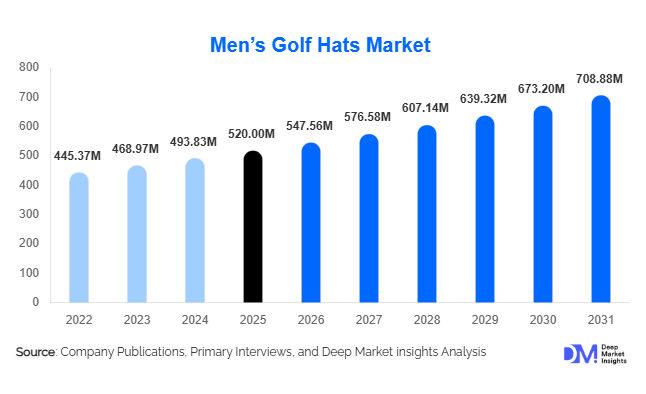
According to Deep Market Insights, the global men’s golf hats market size was valued at USD 520 million in 2025 and is projected to grow from USD 547.56 million in 2026 to reach USD 708.88 million by 2031, expanding at a CAGR of 5.3% during the forecast period (2026–2031). The men’s golf hats market growth is primarily driven by increasing participation in golf, rising awareness regarding sun protection, and the growing influence of athleisure fashion trends. The integration of performance fabrics, moisture-wicking technologies, and premium branding has further elevated the role of golf hats from basic accessories to essential performance gear.
Key Market Insights
- Baseball caps dominate the product segment, accounting for nearly 48% share due to their versatility and strong brand visibility.
- North America leads the global market, contributing approximately 38% of total demand, driven by high golf participation in the U.S.
- Asia-Pacific is the fastest-growing region, expanding at over 6.8% CAGR due to rising golf infrastructure and middle-class participation.
- Amateur golfers represent over 70% of total demand, making them the primary consumer base globally.
- Online retail channels are rapidly expanding, capturing around 38% market share through e-commerce growth.
- Performance fabrics and UV protection technologies are becoming key differentiators among premium brands.
What are the latest trends in the men’s golf hats market?
Shift Toward Performance-Driven Headwear
Manufacturers are increasingly focusing on performance-enhancing features such as moisture-wicking fabrics, UV protection, antimicrobial properties, and lightweight breathable materials. These innovations are aligned with growing consumer demand for comfort and functionality during long hours on the golf course. Performance fabrics, particularly polyester blends, are gaining traction as they improve durability and sweat management. Additionally, ergonomic designs and adjustable fittings are being introduced to enhance user comfort. This trend is particularly strong among premium brands, which are leveraging advanced textile technologies to differentiate their offerings and justify higher price points.
Rising Influence of Athleisure and Lifestyle Fashion
Men’s golf hats are increasingly being adopted beyond the golf course as part of casual and athleisure wear. Influenced by celebrity endorsements and collaborations with lifestyle brands, golf hats are evolving into fashion statements. Consumers are seeking stylish designs that can be worn in everyday settings, leading to increased demand for premium and branded products. Social media and influencer marketing are playing a crucial role in shaping purchasing decisions, particularly among younger demographics. This crossover appeal is expanding the addressable market and driving consistent demand across seasons.
What are the key drivers in the men’s golf hats market?
Growing Global Participation in Golf
The increasing popularity of golf as both a recreational and professional sport is a major growth driver. Countries such as the United States, Japan, South Korea, and China are witnessing rising participation rates supported by expanding golf infrastructure and tourism. Corporate networking and leisure activities are also contributing to higher engagement levels, directly boosting demand for golf accessories, including hats. This trend is expected to sustain long-term market growth.
Rising Awareness of Sun Protection
With growing awareness about the harmful effects of UV exposure, golfers are prioritizing protective gear such as hats with UV-blocking capabilities. Wide-brim hats and performance caps with UPF ratings are increasingly preferred, especially in regions with high sun exposure. This health-driven demand is encouraging manufacturers to innovate and integrate protective features into their product lines.
What are the restraints for the global market?
Seasonal Demand Fluctuations
The men’s golf hats market is influenced by the seasonal nature of golf, particularly in regions with colder climates where outdoor activity declines during winter months. This leads to uneven demand cycles and impacts overall sales consistency for manufacturers and retailers.
Intense Price Competition and Counterfeit Products
The presence of low-cost alternatives and counterfeit products, especially in online marketplaces, poses a significant challenge for established brands. Price-sensitive consumers often opt for cheaper options, impacting profit margins and brand positioning in the market.
What are the key opportunities in the men’s golf hats industry?
Premiumization and Customization Trends
There is a growing opportunity for brands to offer premium and customized golf hats, including personalized embroidery, club branding, and tailored fits. Consumers in developed markets are increasingly willing to pay higher prices for exclusive and high-quality products. This trend not only enhances customer engagement but also improves profit margins for manufacturers.
Expansion in Emerging Markets
Emerging economies in the Asia-Pacific, particularly China and India, present significant growth opportunities. Increasing disposable incomes, expanding golf infrastructure, and rising interest in recreational sports are driving demand for golf accessories. Companies that tailor products to local preferences and climatic conditions can tap into these high-growth markets effectively.
Report Scope
| Report Metric | Details |
|---|---|
| Market Size in 2025 | USD 520 Million |
| Market Size in 2026 | USD 547.56 Million |
| Market Size in 2031 | USD 708.88 Million |
| CAGR | 5.3% (2026-2031) |
| Base Year for Estimation | 2025 |
| Historical Data | 2022-2024 |
| Forecast Period | 2026-2031 |
| Report Coverage | Revenue Forecast, Competitive Landscape, Supply Chain Disruption, Growth Factors, Environment & Regulatory Landscape and Trends |
| Geographies Covered | North America, Europe, APAC, Middle East and Africa, LATAM |
| Countries Covered | U.S., Canada, U.K., Germany, France, Spain, Italy, Russia, Nordic, Benelux, Rest of Europe, China, Korea, Japan, India, Australia, Singapore, Taiwan, South East Asia, Rest of Asia-Pacific, UAE, Turky, Saudi Arabia, South Africa, Egypt, Nigeria, Rest of MEA, Brazil, Mexico, Argentina, Chile, Colombia, Rest of LATAM |
Explore more data points, trends and opportunities Download Free Sample Report
Product Type Insights
Baseball caps continue to dominate the men’s golf hats market, accounting for approximately 48% of total revenue in 2025. Their leadership is primarily driven by their versatility, lightweight construction, and universal acceptance across both professional and amateur golfers. Additionally, baseball caps offer a strong platform for branding and sponsorship visibility, making them the preferred choice among leading sportswear companies and professional athletes. The ability to integrate performance features such as moisture-wicking linings, adjustable closures, and UV-resistant fabrics further strengthens their dominance. Visors and bucket hats are gaining traction, particularly in warmer climates where enhanced airflow and sun protection are critical purchasing factors. Wide-brim hats, though niche, are witnessing increasing adoption among older and health-conscious golfers due to their superior UV coverage. Meanwhile, beanies maintain a steady but smaller share, driven by demand in colder regions, ensuring year-round market continuity and seasonal diversification.
Material Type Insights
Polyester-based hats lead the material segment with around 42% market share, primarily due to their durability, cost efficiency, and superior moisture-wicking capabilities. Polyester’s ability to retain shape, resist shrinkage, and support advanced fabric treatments makes it the preferred material for performance-oriented golf hats. Cotton remains relevant, particularly in the mid-range segment, driven by its natural comfort and breathability, appealing to casual and recreational users. Blended fabrics are increasingly gaining importance as they combine the benefits of multiple materials, offering a balance between comfort, flexibility, and performance. The premium segment is witnessing a shift toward advanced performance fabrics with features such as UV protection, antimicrobial coatings, and temperature regulation. These innovations are not only enhancing user experience but also enabling brands to differentiate their offerings and command higher price points in a competitive market.
Distribution Channel Insights
Online retail channels account for approximately 38% of total market share, emerging as the leading distribution channel due to the rapid expansion of e-commerce and direct-to-consumer (D2C) strategies adopted by major brands. The convenience of product comparison, availability of a wide range of styles, and increasing penetration of digital payment systems are key drivers supporting online sales growth. Additionally, personalized marketing, influencer collaborations, and targeted promotions are further accelerating online adoption. Offline retail continues to play a vital role, particularly in premium and performance segments, where consumers prefer physical product trials and brand experiences. Specialty sports stores and golf pro shops remain critical touchpoints for professional and serious amateur golfers. Department stores contribute significantly to mid-range product sales, while brand-owned outlets are increasingly focusing on experiential retail, offering customization services and interactive shopping environments to enhance customer engagement and loyalty.
End-User Insights
Amateur and recreational golfers dominate the market, contributing over 70% of total demand in 2025. This segment’s leadership is driven by the large global base of casual players, increasing accessibility of golf as a leisure activity, and the growing influence of athleisure trends that extend usage beyond the golf course. Amateur players tend to purchase golf hats not only for performance but also for style and everyday wear, significantly expanding market demand. Professional golfers, while representing a smaller share, play a crucial role in shaping market dynamics through endorsements, sponsorships, and product collaborations. Their influence drives brand visibility and accelerates adoption of premium and technologically advanced products. This dual demand structure—volume-driven by amateurs and value-driven by professionals—creates a balanced growth trajectory for the market.
Explore more data points, trends and opportunities Download Free Sample Report
Men’s Golf Hats Market Segmentations
By Product Type
- Baseball Caps
- Visors
- Bucket Hats
- Wide-Brim Hats
- Beanies
By Material Type
- Polyester
- Cotton
- Nylon
- Blended Fabrics
- Performance Fabrics
By Distribution Channel
- Online Retail
- Specialty Sports Stores
- Golf Pro Shops
- Department Stores
- Brand-Owned Outlets
By End-User
- Professional Golfers
- Amateur & Recreational Golfers
Regional Insights
North America
North America remains the largest market, accounting for approximately 38% of global demand in 2025, with the United States leading regional consumption. Growth in this region is driven by a well-established golf culture, high participation rates, and strong purchasing power. The presence of leading global brands and extensive distribution networks further strengthens market penetration. Additionally, increasing awareness of sun protection and the popularity of branded sportswear contribute to sustained demand. Canada complements regional growth through rising recreational golf participation and increasing consumer spending on sports accessories, particularly in urban centers.
Europe
Europe holds around 27% market share, with key markets including the United Kingdom, Germany, and France. The region’s growth is driven by strong golf tourism, established golf traditions, and increasing participation in recreational sports. The UK continues to lead due to its historical association with golf and a high number of golf courses. Germany and France are witnessing steady growth fueled by corporate engagement and tourism-driven demand. Additionally, the rising popularity of sustainable and performance-oriented sportswear is influencing purchasing decisions, supporting the adoption of premium golf hats across the region.
Asia-Pacific
Asia-Pacific is the fastest-growing region, with a CAGR exceeding 6.8%. Growth is primarily driven by expanding golf infrastructure, rising disposable incomes, and increasing middle-class participation. China is experiencing rapid market expansion due to government-backed sports development and urbanization. Japan and South Korea represent mature markets with high participation rates and strong demand for premium products. India is emerging as a high-potential market, supported by growing interest in golf among urban professionals and increasing investments in sports infrastructure. Additionally, the influence of international tournaments and social media is boosting awareness and adoption across the region.
Latin America
Latin America represents a smaller but gradually growing market, led by Brazil and Mexico. Growth in this region is driven by increasing urbanization, rising disposable incomes, and growing interest in recreational sports. While golf remains a niche sport, expanding middle-class populations and exposure to global sports trends are supporting incremental demand. Additionally, tourism and the development of golf resorts are contributing to market expansion, although infrastructure limitations continue to pose challenges.
Middle East & Africa
The Middle East & Africa region is witnessing moderate growth, supported by golf tourism, luxury lifestyle trends, and increasing investments in sports infrastructure. The UAE is a key market, driven by high-income consumers, international tournaments, and world-class golf facilities. South Africa contributes significantly to Africa, supported by a strong golfing tradition and growing domestic participation. Additionally, government initiatives promoting tourism and sports development are creating new growth opportunities. The region’s warm climate further drives demand for functional golf hats with UV protection, reinforcing steady market expansion.
Key Players in the Men’s Golf Hats Market
- Nike
- Adidas
- Puma
- Under Armour
- Callaway Golf
- TaylorMade
- Titleist (Acushnet)
- New Era Cap Company
- TravisMathew
- PXG (Parsons Xtreme Golf)
- Mizuno
- FootJoy
- Lululemon
- Columbia Sportswear
- Decathlon