Men’s Coats & Jackets Market Size
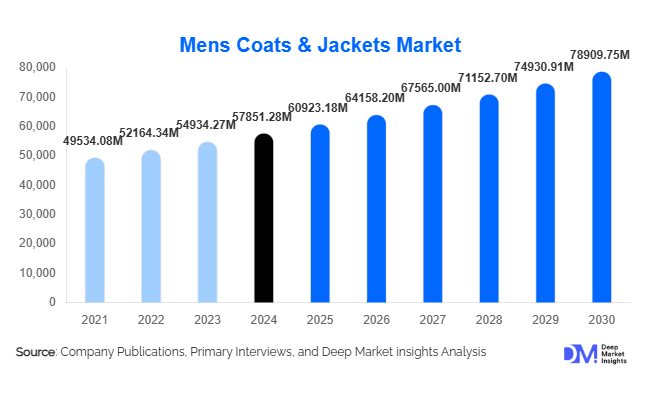
According to Deep Market Insights, the global men’s coats & jackets market size was valued at USD 57,851.28 million in 2025 and is projected to grow from USD 60,923.18 million in 2026 to reach USD 78,909.75 million by 2031, expanding at a CAGR of 5.31% during the forecast period (2026–2031). The market growth is primarily driven by climate variability, increasing fashion consciousness among male consumers, rising participation in outdoor and travel activities, and the rapid premiumization of men’s apparel across both developed and emerging economies.
Key Market Insights
- Winter jackets remain the dominant product category, accounting for the largest revenue share due to higher average selling prices and sustained demand in colder regions.
- Synthetic and blended materials lead material adoption, supported by durability, cost efficiency, and rising use of recycled fibers.
- Asia-Pacific represents the largest and fastest-growing regional market, driven by China, India, Japan, and South Korea.
- Mid-premium price positioning dominates, reflecting consumer preference for quality and brand value without luxury-level pricing.
- Offline retail still leads sales, but online and direct-to-consumer channels are expanding at a faster pace.
- Sustainability and functional innovation, including lightweight insulation and weather-adaptive fabrics, are reshaping product development strategies.
Men’s Coats & Jackets Market latest trends
Rising Demand for Sustainable and Recycled Outerwear
Sustainability has emerged as a defining trend in the men’s coats & jackets market. Brands are increasingly incorporating recycled polyester, organic cotton, and bio-based insulation materials to address regulatory pressures and evolving consumer preferences. Environmentally conscious consumers are willing to pay premium prices for jackets that offer transparency in sourcing and reduced environmental impact. As a result, sustainable jackets are growing faster than the overall market and are becoming a key differentiator for global apparel brands.
Functional-Fashion Convergence
The line between fashion and performance outerwear is increasingly blurred. Modern men’s jackets are designed to serve both aesthetic and functional purposes, featuring waterproof membranes, thermal regulation, and lightweight construction while maintaining fashionable silhouettes. This convergence is expanding year-round usage beyond seasonal wear, particularly in urban markets, and is driving higher repeat purchases.
Men’s Coats & Jackets Market key drivers
Climate Variability and Extended Cold Seasons
Unpredictable weather patterns and prolonged cold periods in North America and Europe are driving sustained demand for versatile and high-performance jackets. Consumers increasingly invest in multi-season outerwear that provides insulation, wind resistance, and durability, supporting higher average selling prices and stable replacement demand.
Premiumization of Men’s Apparel
Men’s fashion has undergone rapid evolution, with jackets becoming a central wardrobe investment. Premium and mid-premium brands are benefiting from strong brand loyalty, frequent product refresh cycles, and growing acceptance of higher price points. Designer collaborations and limited-edition collections further strengthen this trend.
Men’s Coats & Jackets Market restraints
Raw Material Price Volatility
Fluctuations in the prices of synthetic fibers, leather, and wool pose challenges for manufacturers. Rising input and logistics costs can compress margins, particularly for mass-market brands with limited pricing flexibility.
Seasonality and Inventory Risks
The market remains highly seasonal, with demand closely tied to weather conditions. Poor demand forecasting can lead to excess inventory, heavy discounting, and margin erosion, particularly in mature markets.
Men’s Coats & Jackets Market key opportunities
Growth in Emerging Markets
Rapid urbanization, rising disposable incomes, and Western fashion influence in Asia-Pacific and the Middle East present significant growth opportunities. Countries such as India and China are witnessing rising demand for branded outerwear, particularly in mid-premium price segments.
Technology-Integrated Outerwear
Innovation in smart and performance-enhancing fabrics, including temperature-regulating materials and lightweight synthetic insulation, offers strong differentiation potential. Premium smart jackets, though niche, are growing at nearly double the market CAGR.
Report Scope
| Report Metric | Details |
|---|---|
| Market Size in 2025 | USD 57851.28 Million |
| Market Size in 2026 | USD 60923.18 Million |
| Market Size in 2031 | USD 78909.75 Million |
| CAGR | 5.31% (2026-2031) |
| Base Year for Estimation | 2025 |
| Historical Data | 2022-2024 |
| Forecast Period | 2026-2031 |
| Report Coverage | Revenue Forecast, Competitive Landscape, Supply Chain Disruption, Growth Factors, Environment & Regulatory Landscape and Trends |
| Geographies Covered | North America, Europe, APAC, Middle East and Africa, LATAM |
| Countries Covered | U.S., Canada, U.K., Germany, France, Spain, Italy, Russia, Nordic, Benelux, Rest of Europe, China, Korea, Japan, India, Australia, Singapore, Taiwan, South East Asia, Rest of Asia-Pacific, UAE, Turky, Saudi Arabia, South Africa, Egypt, Nigeria, Rest of MEA, Brazil, Mexico, Argentina, Chile, Colombia, Rest of LATAM |
Explore more data points, trends and opportunities Download Free Sample Report
Product Type Insights
Winter jackets account for approximately 38% of the global men’s coats & jackets market, making them the leading product category by revenue. This dominance is driven by their higher insulation requirements, premium material usage, and elevated average selling prices compared to other jacket types. Demand remains structurally strong across North America, Europe, and colder parts of Asia-Pacific, where extended winter seasons and extreme weather conditions necessitate durable, thermally efficient outerwear. Additionally, the growing preference for multi-functional winter jackets, combining warmth, water resistance, and fashion appeal, has further strengthened this segment’s leadership.
Lightweight jackets, including bombers, windcheaters, and transitional jackets, are gaining significant traction due to their year-round usability and versatility. These jackets benefit from increasing urbanization, changing workwear norms, and higher demand for casual layering pieces suitable for mild climates and indoor-outdoor transitions. Fashion and lifestyle jackets, such as leather and denim, remain particularly popular in metropolitan and fashion-driven markets, supported by brand-led styling, celebrity influence, and seasonal refresh cycles. Meanwhile, functional rain jackets and shell jackets are expanding steadily, driven by rising outdoor recreation, travel activity, and demand for weather-protective apparel in both developed and emerging markets.
Material Insights
Synthetic materials dominate the men’s coats & jackets market with nearly 45% market share, primarily due to their cost efficiency, durability, lightweight properties, and adaptability to advanced performance features such as waterproofing, wind resistance, and thermal insulation. Polyester and nylon-based fabrics are widely used across mass-market and mid-premium segments, enabling manufacturers to achieve scale while maintaining consistent quality. The ease of integrating recycled synthetic fibers has further reinforced this segment’s leadership amid growing sustainability mandates.
Natural materials such as wool and leather continue to hold relevance in premium, luxury, and formal outerwear categories, where craftsmanship, aesthetics, and heritage branding play a critical role in purchasing decisions. These materials are particularly prominent in European and North American markets. Blended fabrics are increasingly preferred as they offer a balance between comfort, performance, and cost efficiency, allowing brands to optimize margins while meeting consumer expectations. Sustainable and recycled materials represent the fastest-growing material category, supported by regulatory pressure, eco-conscious consumers, and brand commitments to carbon reduction and circular fashion models.
Distribution Channel Insights
Offline retail channels account for approximately 58% of total market sales, driven by consumer preference for physical fit assessment, tactile evaluation of materials, and immediate product availability. Brand-exclusive stores, department stores, and specialty apparel retailers remain particularly important for premium and luxury jackets, where in-store experience and personalized service influence purchasing decisions.
However, online retail is the fastest-growing distribution channel, supported by rapid improvements in logistics, digital payment infrastructure, and advanced sizing and return solutions. Brand-owned e-commerce platforms are gaining prominence as companies prioritize direct-to-consumer (D2C) strategies to improve margins, enhance customer data ownership, and strengthen brand loyalty. Marketplaces continue to drive volume in price-sensitive segments, while omnichannel strategies, such as click-and-collect and in-store returns for online purchases, are increasingly blurring the boundaries between physical and digital retail.
End-Use Insights
Casual and daily wear represents the largest end-use segment, accounting for nearly 47% of global demand. This dominance reflects the growing integration of jackets into everyday wardrobes, particularly lightweight and mid-weight styles suited for work, travel, and leisure. The shift toward relaxed dress codes and urban lifestyles has further accelerated demand for versatile outerwear.
Outdoor and sportswear is the fastest-growing end-use segment, expanding at over 7% CAGR, driven by increasing participation in outdoor activities such as hiking, skiing, and adventure tourism. Rising health awareness and fitness trends are also contributing to this growth. Industrial and workwear demand is steadily increasing, particularly in colder regions, as stricter occupational safety regulations mandate protective and insulated outerwear for workers in construction, logistics, and energy sectors.
Explore more data points, trends and opportunities Download Free Sample Report
Mens Coats & Jackets Market Segmentations
By Product Type
- Winter Jackets
- Lightweight Jackets
- Coats
- Functional & Performance Jackets
- Fashion & Lifestyle Jackets
By Material Type
- Synthetic Materials
- Natural Materials
- Blended Fabrics
- Sustainable & Recycled Materials
By Distribution Channel
- Offline Retail
- Online Retail
By End Use
- Casual & Daily Wear
- Outdoor & Sportswear
- Formal & Office Wear
- Industrial & Workwear
- Travel & Tourism
Regional Insights
Asia-Pacific
Asia-Pacific leads the global men’s coats & jackets market with approximately 31% share, supported by large population bases, rising disposable incomes, and expanding urban middle-class consumers. China dominates regional demand and global manufacturing, benefiting from a mature supply chain, large domestic consumption, and strong export activity. India is the fastest-growing country in the region, driven by rapid urbanization, western fashion influence, growth of organized retail, and increasing adoption of branded apparel. Japan and South Korea contribute significantly to premium and functional jacket demand, supported by fashion-conscious consumers and colder seasonal climates.
North America
North America accounts for around 28% of the global market value, led by the United States. Demand is driven by harsh and prolonged winters, high disposable incomes, and strong penetration of premium and performance-oriented brands. Outdoor recreation culture, including skiing, hiking, and winter sports, significantly supports sales of insulated and technical jackets. Canada also contributes meaningfully due to extreme cold conditions and high per-capita spending on winter apparel.
Europe
Europe holds nearly 24% market share, with Germany, the UK, France, and Italy leading consumption. Growth in the region is driven by strong fashion orientation, emphasis on quality craftsmanship, and increasing demand for sustainable apparel. Northern and Western Europe sustain robust winter jacket demand due to cold climates, while Southern Europe supports lightweight and fashion-focused outerwear. Regulatory focus on sustainability further accelerates the adoption of recycled and eco-friendly materials.
Latin America
Latin America represents about 8% of the global market, led by Brazil and Mexico. Growth is supported by expanding urban populations, changing lifestyle preferences, and increasing exposure to global fashion trends. While demand is skewed toward lightweight jackets due to milder climates, premium and fashion-oriented segments are gradually expanding in metropolitan areas.
Middle East & Africa
The Middle East & Africa region shows moderate but steady growth. In the Middle East, premium fashion demand in countries such as the UAE and Saudi Arabia drives sales of luxury and lifestyle jackets, particularly for travel and seasonal use. In Africa, colder-climate regions such as South Africa contribute to functional and winter jacket demand, while urbanization and retail development support gradual market expansion across key cities.
Leading Companies in the Men’s Coats & Jackets Industry
- Nike
- Adidas
- The North Face
- Columbia Sportswear
- Patagonia
- Ralph Lauren
- H&M
- Zara
- Uniqlo
- Levi Strauss & Co.
- Hugo Boss
- Canada Goose
- Burberry
- Moncler
- Puma