Men Footwear Market Size
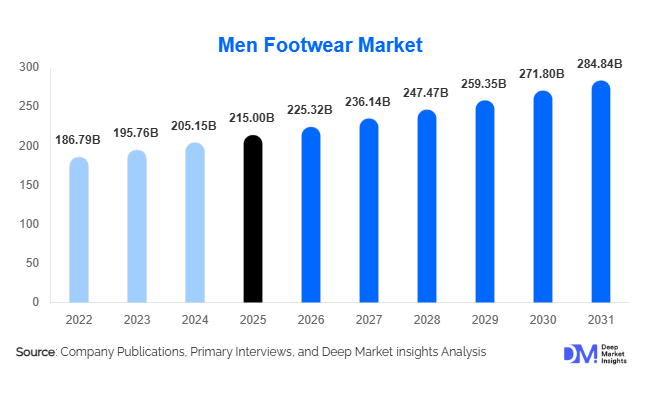
According to Deep Market Insights, the global men footwear market size was valued at USD 215 billion in 2025 and is projected to grow from USD 225.32 billion in 2026 to reach USD 284.84 billion by 2031, expanding at a CAGR of 4.8% during the forecast period (2026–2031). The men footwear market growth is primarily driven by rising urbanization, increasing disposable income, and the growing influence of fashion and athleisure trends across global consumer segments. The market continues to benefit from expanding e-commerce penetration, product innovation in materials and comfort technologies, and increasing brand consciousness among consumers.
Key Market Insights
- Sports and athleisure footwear are driving category expansion, with increasing demand for versatile, performance-oriented shoes suitable for daily wear.
- Asia-Pacific dominates the global market, supported by strong manufacturing capabilities and rising consumer demand in China and India.
- Mid-range footwear holds the largest share, balancing affordability with quality for mass-market consumers.
- Online retail is the fastest-growing distribution channel, fueled by convenience, wider product selection, and digital engagement.
- Sustainability is reshaping product innovation, with growing demand for eco-friendly materials and ethical production practices.
- Technological advancements, including lightweight materials and ergonomic designs, are enhancing product differentiation.
What are the latest trends in the men footwear market?
Rise of Athleisure and Casualization
The growing popularity of athleisure has blurred the lines between sportswear and casual footwear, making sneakers and performance shoes a staple in everyday wardrobes. Consumers increasingly prefer footwear that offers both style and functionality, leading to higher demand for hybrid designs. This trend is particularly strong among younger demographics, who prioritize comfort and versatility. As a result, brands are launching multi-purpose footwear collections that cater to both fitness and lifestyle needs, contributing significantly to overall market growth.
Sustainable and Eco-Friendly Footwear
Sustainability is becoming a central theme in the men footwear market, with brands investing in recycled materials, biodegradable components, and low-carbon manufacturing processes. Consumers are showing increased willingness to pay a premium for environmentally responsible products. Companies are also adopting circular economy models, including take-back programs and recyclable packaging, to align with regulatory requirements and consumer expectations. This trend is expected to gain further momentum as environmental awareness continues to rise globally.
What are the key drivers in the men footwear market?
Increasing Disposable Income and Urbanization
Rising income levels, particularly in emerging economies, are enabling consumers to spend more on branded and premium footwear. Urban lifestyles demand diverse footwear options for work, travel, and leisure, driving consistent demand across multiple product categories. The expansion of retail infrastructure and e-commerce platforms further supports accessibility and consumption.
Growing Influence of Fashion and Branding
Fashion trends and brand visibility play a crucial role in shaping consumer preferences. Social media, influencer marketing, and celebrity endorsements have accelerated product adoption and increased brand loyalty. Footwear is increasingly viewed as a fashion statement, encouraging frequent purchases and boosting market growth.
What are the restraints for the global market?
Volatility in Raw Material Prices
Fluctuations in the prices of key raw materials such as leather, rubber, and synthetic polymers can significantly impact production costs and profit margins. This creates challenges for manufacturers in maintaining competitive pricing while ensuring product quality.
Intense Market Competition
The presence of numerous global and regional players leads to aggressive pricing strategies and high competitive intensity. Smaller brands often struggle to compete with established players in terms of scale, branding, and innovation, which can limit market entry and expansion opportunities.
What are the key opportunities in the men footwear industry?
Expansion of Digital and Direct-to-Consumer Channels
The rapid growth of e-commerce presents significant opportunities for brands to reach a wider audience and improve margins through direct sales. Advanced technologies such as AI-driven personalization and virtual try-ons are enhancing the online shopping experience, increasing conversion rates and customer engagement.
Sustainable Product Innovation
The shift toward eco-friendly footwear offers opportunities for differentiation and premium pricing. Companies investing in sustainable materials and ethical production processes can capture environmentally conscious consumers and strengthen brand positioning in the global market.
Report Scope
| Report Metric | Details |
|---|---|
| Market Size in 2025 | USD 215 Billion |
| Market Size in 2026 | USD 225.32 Billion |
| Market Size in 2031 | USD 284.84 Billion |
| CAGR | 4.8% (2026-2031) |
| Base Year for Estimation | 2025 |
| Historical Data | 2022-2024 |
| Forecast Period | 2026-2031 |
| Report Coverage | Revenue Forecast, Competitive Landscape, Supply Chain Disruption, Growth Factors, Environment & Regulatory Landscape and Trends |
| Geographies Covered | North America, Europe, APAC, Middle East and Africa, LATAM |
| Countries Covered | U.S., Canada, U.K., Germany, France, Spain, Italy, Russia, Nordic, Benelux, Rest of Europe, China, Korea, Japan, India, Australia, Singapore, Taiwan, South East Asia, Rest of Asia-Pacific, UAE, Turky, Saudi Arabia, South Africa, Egypt, Nigeria, Rest of MEA, Brazil, Mexico, Argentina, Chile, Colombia, Rest of LATAM |
Explore more data points, trends and opportunities Download Free Sample Report
Product Type Insights
Sports and performance footwear dominate the market, accounting for approximately 32% of the total market share in 2025. The leadership of this segment is primarily driven by the global surge in fitness awareness, rising participation in sports and recreational activities, and the continued expansion of the athleisure trend. Consumers increasingly prefer footwear that delivers both performance and everyday usability, leading to strong demand for running shoes, training footwear, and hybrid sneakers. Technological advancements such as enhanced cushioning systems, lightweight materials, and ergonomic designs further strengthen this segment’s dominance. Casual footwear follows as a significant contributor, supported by evolving workplace norms favoring relaxed dress codes and the growing need for comfort-centric daily wear. Formal footwear maintains a stable share due to consistent demand from corporate and occasion-based usage, particularly in developed markets. Meanwhile, boots and sandals serve niche and seasonal requirements, with demand influenced by climatic conditions and regional preferences. Continuous product innovation, rapid design cycles, and brand-driven differentiation remain critical growth drivers across all product categories.
Material Type Insights
Synthetic materials lead the market with around 38% share, primarily due to their cost efficiency, scalability in production, and versatility across multiple footwear categories. The dominance of this segment is further reinforced by advancements in polymer technologies, which enable improved durability, flexibility, and water resistance while maintaining affordability for mass-market consumers. Leather footwear continues to hold a strong position, particularly in premium and formal segments, where durability, aesthetics, and brand perception play a key role in consumer purchasing decisions. Textile-based footwear is gaining momentum, especially in sports and casual categories, driven by demand for breathable, lightweight, and flexible designs suitable for all-day wear. Additionally, sustainable materials are emerging as a high-growth segment, supported by increasing environmental awareness, stricter regulatory frameworks, and brand commitments toward carbon neutrality. The shift toward recycled and bio-based materials is expected to further accelerate innovation and reshape material sourcing strategies across the industry.
Distribution Channel Insights
Offline retail continues to dominate the market with nearly 60% market share, largely due to consumer preference for physical product trials, fit assurance, and immediate purchase gratification. Specialty stores, brand outlets, and multi-brand retail chains play a crucial role in maintaining this dominance by offering personalized customer experiences and extensive product displays. However, the online channel is the fastest-growing segment, driven by increasing internet penetration, smartphone adoption, and the convenience of home delivery. E-commerce platforms and brand-owned websites are leveraging advanced technologies such as AI-driven recommendations, virtual try-ons, and dynamic pricing to enhance customer engagement and conversion rates. The integration of omnichannel strategies, such as click-and-collect services and seamless inventory management, is enabling brands to bridge the gap between online and offline experiences. This hybrid approach is expected to redefine retail dynamics and significantly influence future growth patterns.
End-Use Insights
Daily wear footwear accounts for approximately 40% of the market, making it the leading end-use segment due to its universal applicability and high replacement frequency. The segment’s dominance is driven by the growing demand for versatile, comfortable footwear suitable for multiple settings, including work, travel, and leisure. The sports and fitness segment is the fastest-growing, supported by increasing health consciousness, rising gym memberships, and the global popularity of fitness activities such as running and outdoor sports. This segment is also benefiting from product innovations tailored to performance enhancement and injury prevention. Work and industrial footwear is expanding steadily, driven by stricter occupational safety regulations and increasing infrastructure and construction activities worldwide. Demand in this segment is particularly strong in emerging economies, where industrialization and workforce expansion are accelerating the need for protective footwear solutions.
Explore more data points, trends and opportunities Download Free Sample Report
Men Footwear Market Segmentations
By Product Type
- Formal Shoes
- Casual Shoes
- Sports & Performance Footwear
- Boots
- Sandals & Slippers
By Material Type
- Leather Footwear
- Synthetic Footwear
- Textile Footwear
- Rubber-based Footwear
- Sustainable/Eco-friendly Materials
By Distribution Channel
- Online Retail
- Offline Retail
Regional Insights
Asia-Pacific
Asia-Pacific leads the global market with around 38% share in 2025, driven by a combination of strong manufacturing capabilities and rapidly growing consumer demand. China remains the largest producer and consumer, benefiting from well-established supply chains, large-scale production capacity, and export-oriented growth. India is emerging as one of the fastest-growing markets, supported by rising disposable incomes, urbanization, and increasing penetration of organized retail and e-commerce platforms. Southeast Asia, including Vietnam and Indonesia, is gaining prominence as a manufacturing hub due to competitive labor costs and favorable government policies. Key growth drivers in this region include population growth, expanding middle-class demographics, and strong domestic consumption, along with government initiatives promoting local manufacturing.
North America
North America accounts for approximately 22% of the market, with the United States being the dominant contributor. The region’s growth is driven by high consumer purchasing power, strong brand loyalty, and significant demand for premium and performance-oriented footwear. The popularity of sports and fitness activities, coupled with the influence of athleisure trends, continues to boost demand for innovative and high-quality products. Additionally, the region benefits from advanced retail infrastructure, widespread adoption of e-commerce, and continuous product innovation by leading global brands. Sustainability trends and demand for eco-friendly products are also shaping purchasing behavior in this market.
Europe
Europe holds nearly 20% share, with Germany, the UK, and France leading demand. The region is characterized by a strong preference for premium, high-quality, and sustainably produced footwear. Growth in Europe is driven by increasing environmental awareness, stringent regulatory standards, and a well-established fashion industry that influences global trends. Consumers in this region are highly brand-conscious and willing to pay a premium for comfort, durability, and ethical production practices. Additionally, the rise of sustainable fashion and circular economy initiatives is encouraging manufacturers to adopt eco-friendly materials and processes, further driving market growth.
Latin America
Latin America represents about 10% share, with Brazil and Mexico as key markets. The region’s growth is supported by improving economic conditions, expanding middle-class populations, and increasing urbanization. Rising consumer awareness of global fashion trends and growing demand for affordable yet stylish footwear are key drivers in this region. Additionally, the expansion of retail infrastructure and e-commerce platforms is enhancing product accessibility. Seasonal demand patterns and climate conditions also play a role in shaping product preferences, particularly for casual and sports footwear.
Middle East & Africa
The Middle East & Africa region accounts for roughly 10% share, with growth driven by rapid urbanization, retail sector expansion, and increasing consumer spending. The UAE and Saudi Arabia are key markets in the Middle East, characterized by high demand for premium and luxury footwear due to strong purchasing power and brand affinity. In Africa, countries such as South Africa are witnessing steady growth driven by expanding retail networks and rising urban populations. Key growth drivers in this region include infrastructure development, increasing penetration of international brands, and a growing young population with evolving fashion preferences. The expansion of shopping malls and digital retail platforms is further supporting market growth across the region.
Key Players in the Men Footwear Market
- Nike
- Adidas
- Puma
- Skechers
- New Balance
- Bata
- Under Armour
- ASICS
- VF Corporation
- Wolverine World Wide
- ECCO
- Clarks
- Geox
- Deckers Brands
- Anta Sports