Mannequins Market Size
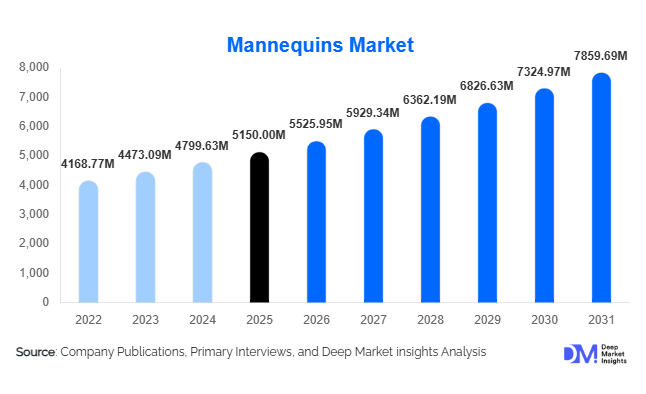
According to Deep Market Insights, the global mannequins market size was valued at USD 5,150 million in 2025 and is projected to grow from USD 5,525.95 million in 2026 to reach USD 7,859.69 million by 2031, expanding at a CAGR of 7.3% during the forecast period (2026–2031). The mannequin market growth is primarily driven by the expansion of global retail infrastructure, increasing investments in visual merchandising, and the rising need for high-quality product presentation across both physical and digital retail channels.
Key Market Insights
- Visual merchandising is becoming central to retail strategy, with mannequins playing a key role in enhancing in-store customer engagement and brand storytelling.
- Sustainable and eco-friendly mannequins are gaining traction, driven by regulatory pressure and retailer commitments toward reducing environmental impact.
- Asia-Pacific dominates the global market, supported by large-scale manufacturing capabilities and the rapid expansion of organized retail.
- North America leads in premium and smart mannequin adoption, with retailers investing in technologically advanced display solutions.
- E-commerce content creation is emerging as a major demand driver, with mannequins widely used in photography studios and digital merchandising.
- Technological integration, including AR-enabled and sensor-based mannequins, is transforming the traditional display landscape.
What are the latest trends in the mannequins market?
Shift Toward Sustainable and Recyclable Materials
One of the most prominent trends in the mannequins market is the transition toward eco-friendly materials. Manufacturers are increasingly adopting recycled plastics, biodegradable composites, and modular designs to align with global sustainability goals. Retailers, particularly in Europe and North America, are prioritizing environmentally responsible store fixtures, making sustainability a key differentiator in procurement decisions. This shift is also influencing product design, with lightweight, reusable mannequins gaining popularity. Companies are investing in circular production models, allowing mannequins to be refurbished and reused, thereby reducing waste and lifecycle costs.
Rise of Smart and Interactive Mannequins
Technological innovation is reshaping the mannequins industry, with the introduction of smart mannequins integrated with augmented reality (AR), sensors, and digital interfaces. These mannequins enable interactive customer experiences, such as virtual outfit visualization and real-time product information display. Retailers are leveraging these technologies to bridge the gap between physical and online shopping, creating immersive store environments. The adoption of AI-driven analytics within mannequins is also emerging, enabling retailers to track customer interactions and optimize store layouts. This trend is particularly strong in premium retail segments and flagship stores.
What are the key drivers in the mannequins market?
Expansion of Organized Retail and Fashion Industry
The rapid expansion of organized retail, particularly in emerging economies, is a major driver of the mannequins market. The global fashion industry continues to grow, with increasing demand for fast fashion and frequent product launches. Retailers rely heavily on mannequins to showcase new collections and enhance store aesthetics, making them an essential component of visual merchandising strategies. The proliferation of shopping malls, branded outlets, and specialty stores further supports sustained demand.
Growth of Omnichannel and E-commerce Retailing
The rise of e-commerce has not diminished the relevance of mannequins; instead, it has expanded their applications. Mannequins are widely used in studio photography and digital catalog creation, ensuring consistent product presentation across online platforms. As brands adopt omnichannel strategies, the demand for mannequins in both physical stores and digital environments continues to increase. This dual utility strengthens the market’s growth trajectory.
What are the restraints for the global market?
High Cost of Premium and Customized Mannequins
Advanced mannequins made from high-quality materials such as fiberglass and silicone, along with customized designs, can be expensive. This limits adoption among small and medium-sized retailers, particularly in price-sensitive markets. High initial investment and maintenance costs can act as a barrier to widespread usage.
Emergence of Virtual Modeling Technologies
The increasing adoption of virtual models and digital avatars in online retail poses a potential threat to physical mannequins. As virtual try-on technologies become more sophisticated, some retailers may shift budgets toward digital solutions, reducing demand for traditional mannequins over the long term.
What are the key opportunities in the mannequins industry?
Integration of AR and AI Technologies
The integration of augmented reality and artificial intelligence into mannequins presents a significant opportunity for market players. Smart mannequins capable of delivering interactive experiences can enhance customer engagement and increase conversion rates. Retailers are increasingly investing in such solutions to differentiate their stores and improve the shopping experience.
Expansion in Emerging Retail Markets
Emerging economies in Asia, Latin America, and Africa offer substantial growth opportunities due to rapid urbanization and rising disposable incomes. The expansion of organized retail and international fashion brands in these regions is driving demand for mannequins. Localized production and cost-effective designs can help companies capture these markets effectively.
Report Scope
| Report Metric | Details |
|---|---|
| Market Size in 2025 | USD 5150 Million |
| Market Size in 2026 | USD 5525.95 Million |
| Market Size in 2031 | USD 7859.69 Million |
| CAGR | 7.3% (2026-2031) |
| Base Year for Estimation | 2025 |
| Historical Data | 2022-2024 |
| Forecast Period | 2026-2031 |
| Report Coverage | Revenue Forecast, Competitive Landscape, Supply Chain Disruption, Growth Factors, Environment & Regulatory Landscape and Trends |
| Geographies Covered | North America, Europe, APAC, Middle East and Africa, LATAM |
| Countries Covered | U.S., Canada, U.K., Germany, France, Spain, Italy, Russia, Nordic, Benelux, Rest of Europe, China, Korea, Japan, India, Australia, Singapore, Taiwan, South East Asia, Rest of Asia-Pacific, UAE, Turky, Saudi Arabia, South Africa, Egypt, Nigeria, Rest of MEA, Brazil, Mexico, Argentina, Chile, Colombia, Rest of LATAM |
Explore more data points, trends and opportunities Download Free Sample Report
Product Type Insights
Full-body mannequins dominate the global mannequins market, accounting for approximately 48% of the market share in 2025. Their leadership is driven by their ability to provide complete outfit visualization, enabling retailers to present full apparel looks in a highly realistic and engaging manner. This significantly enhances customer purchase intent in physical retail stores, particularly in fast fashion and premium apparel segments where styling plays a crucial role in sales conversion. Partial mannequins, including torso, upper-body, and lower-body variants, are widely used for focused merchandising of accessories, tops, bottoms, and category-specific displays. Their cost-effectiveness and flexibility make them a preferred choice for mid-range retailers and departmental stores that frequently update product displays.
Specialty mannequins, such as plus-size, child, sports, and adaptive mannequins, are gaining strong traction due to the global shift toward inclusivity and body diversity in fashion marketing. This segment is being driven by evolving consumer expectations and brand commitments to represent diverse demographics, particularly in North America and Europe. Flexible and inflatable mannequins are emerging as a cost-efficient and highly portable alternative, particularly for pop-up stores, exhibitions, and short-term retail activations. Their adoption is rising in e-commerce studios and event-based merchandising environments where mobility and quick setup are essential.
Application Insights
Apparel retail remains the dominant application segment, contributing nearly 55% of the global market share in 2025. The segment’s leadership is driven by continuous retail expansion, frequent product launches, and the critical role mannequins play in influencing in-store consumer behavior through visual storytelling and styling presentation. E-commerce and digital merchandising represent the fastest-growing application segment, supported by the surge in online fashion retail and demand for high-quality product imagery. Brands are increasingly investing in studio photography setups using mannequins to ensure consistency across digital catalogs and social commerce platforms.
Fashion institutes and training centers utilize mannequins for design education, garment fitting practice, and visualization training, ensuring steady institutional demand. Healthcare applications are also expanding, particularly in nursing and medical simulation training, where mannequins are used for procedural practice and anatomy learning. Museums and exhibitions contribute niche but stable demand, using mannequins for historical representation, cultural storytelling, and interactive displays in curated environments.
Distribution Channel Insights
Direct B2B sales dominate the mannequins market, accounting for approximately 60% of total revenue. This dominance is driven by large-scale procurement from retail chains, fashion brands, and department stores that require customized, bulk orders directly from manufacturers. Direct engagement allows for product personalization, cost optimization, and long-term supplier relationships.
Retail and wholesale suppliers serve small and medium-sized enterprises by offering standardized mannequin solutions at competitive pricing. These channels remain essential in fragmented retail markets where customization needs are limited. Online distribution channels are gaining strong momentum, driven by digital procurement trends, wider product availability, and price transparency. Small retailers, independent fashion boutiques, and emerging e-commerce sellers increasingly rely on online platforms for quick sourcing and diversified product selection.
End-Use Industry Insights
The apparel retail industry is the largest end-use segment, valued at over USD 2,800 million in 2025. Its dominance is driven by global fashion expansion, rapid product turnover, and increasing investments in store aesthetics and visual merchandising strategies across both luxury and fast fashion brands. The e-commerce sector is the fastest-growing end-use industry, registering a CAGR of over 9%. Growth is fueled by the rising importance of digital storefronts, influencer-driven marketing, and the need for consistent product presentation across online platforms. Mannequins play a crucial role in improving conversion rates through high-quality visual content creation.
Healthcare and medical training represent emerging niche applications, where mannequins are increasingly used for simulation-based learning and procedural training in nursing and emergency care. Museums and cultural institutions continue to provide steady demand, particularly for historical exhibits and interactive displays. Export-driven demand remains a key structural factor in the industry, with Asia-Pacific manufacturers supplying cost-effective mannequins to North America and Europe, supporting global supply chain efficiency and pricing competitiveness.
Explore more data points, trends and opportunities Download Free Sample Report
Mannequins Market Segmentations
By Product Type
- Full-Body Mannequins
- Partial Mannequins
- Specialty Mannequins
- Flexible/Posable Mannequins
- Inflatable/Portable Mannequins
By Material
- Fiberglass Mannequins
- Plastic Mannequins
- Silicone/Wax Mannequins
- Metal Frame Mannequins
- Eco-friendly & Recyclable Mannequins
By Application
- Apparel Retail & Fashion Stores
- E-commerce & Digital Product Photography
- Fashion Design Institutes
- Healthcare & Medical Training
- Museums & Exhibitions
- Sports & Fitness Merchandising
By Distribution Channel
- Direct B2B Sales
- Retail & Wholesale Distributors
- Online E-commerce Platforms
Regional Insights
Asia-Pacific
Asia-Pacific leads the global mannequins market with approximately 38% market share in 2025, driven by strong manufacturing ecosystems, expanding retail infrastructure, and rapid urbanization. China dominates both production and domestic consumption due to its large-scale manufacturing base and export capabilities. India is emerging as a high-growth market supported by increasing organized retail penetration, rising disposable incomes, and expansion of shopping malls in Tier 1 and Tier 2 cities. Southeast Asian countries such as Indonesia, Vietnam, and Thailand are also witnessing rising demand due to growing fashion retail chains. low-cost manufacturing advantage, rapid retail expansion, rising fashion consumption, and strong export-oriented production networks.
North America
North America holds around 25% of the global market share, led primarily by the United States. The region is characterized by strong adoption of premium, realistic, and technologically advanced mannequins, particularly in flagship retail stores and luxury fashion outlets. High consumer spending power and emphasis on immersive shopping experiences further strengthen demand. premium retail expansion, adoption of smart mannequins, strong presence of global fashion brands, and advanced visual merchandising practices.
Europe
Europe accounts for approximately 22% of the market, with key demand centers in Germany, France, Italy, and the United Kingdom. The region is heavily influenced by sustainability regulations, pushing demand for eco-friendly and recyclable mannequins. Europe also leads in luxury retail presentation and design innovation. sustainability mandates, luxury retail dominance, high fashion consciousness, and strong adoption of premium store aesthetics.
Latin America
Latin America is an emerging market led by Brazil and Mexico. Growth is supported by increasing investment in shopping malls, retail modernization, and the expansion of international fashion brands. However, the market remains price-sensitive, with demand focused on cost-effective mannequin solutions. retail infrastructure development, rising urban consumer base, and expansion of organized fashion retail chains.
Middle East & Africa
The Middle East & Africa region is witnessing steady growth, particularly in the UAE, Saudi Arabia, and South Africa. The UAE and Saudi Arabia are driving demand through luxury retail expansion, tourism-led retail spending, and large-scale commercial developments. South Africa remains a key hub for regional retail infrastructure and fashion distribution. luxury retail expansion, tourism-driven retail growth, rising mall development projects, and increasing fashion consumption among urban populations.
Key Players in the Mannequins Market
- ABC Mannequins
- Bonaveri
- Hans Boodt Mannequins
- Genesis Display
- Window France
- Cofrad Mannequins
- La Rosa Mannequins
- Global Display Projects
- Retailment
- Noa Brands
- Siegel & Stockman
- Proportion London
- Almax
- Goldsmith Inc.
- Manex USA