Male Grooming Products Market Size
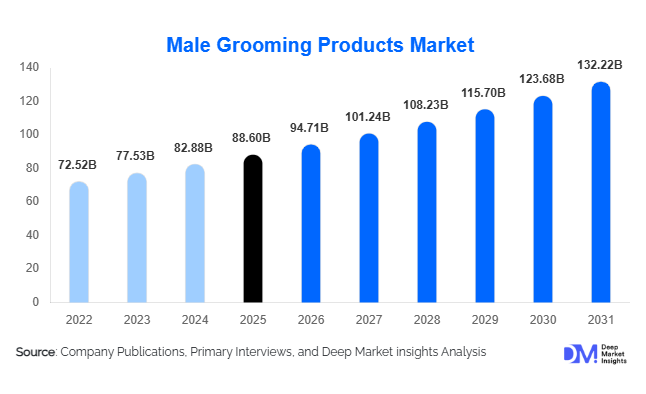
According to Deep Market Insights, the global male grooming products market size was valued at USD 88.6 billion in 2025 and is projected to grow from USD 94.71 billion in 2026 to reach USD 132.22 billion by 2031, expanding at a CAGR of 6.9% during the forecast period (2026–2031). The male grooming products market growth is primarily driven by increasing awareness regarding personal grooming and skincare among men, rising disposable income across emerging economies, growing adoption of premium grooming products, and the rapid expansion of e-commerce and digital retail channels. The market is also benefiting from evolving consumer preferences toward clean-label formulations, personalized skincare solutions, and technologically advanced grooming appliances.
Key Market Insights
- Men’s skincare products are rapidly outperforming traditional shaving categories, driven by increasing demand for anti-aging, hydration, acne treatment, and sun protection products.
- Premium and luxury grooming products continue to expand globally, supported by rising disposable income, celebrity influence, and growing interest in self-care routines among younger consumers.
- Asia-Pacific dominates the global market, led by strong demand growth across China, India, South Korea, and Japan.
- E-commerce has emerged as the leading distribution channel, supported by subscription-based grooming services, influencer marketing, and social commerce platforms.
- Natural, vegan, and cruelty-free grooming formulations are gaining strong traction, particularly among millennials and Generation Z consumers.
- AI-powered personalization and smart grooming technologies, including skin diagnostics and precision grooming devices, are reshaping product innovation and customer engagement.
Male Grooming Products Market Trends
Premium Skincare Adoption Among Male Consumers
The male grooming products market is witnessing a strong transition toward premium skincare products as consumers increasingly prioritize skin health, anti-aging, and wellness-focused grooming routines. Men are expanding beyond traditional shaving products and adopting advanced skincare regimens involving cleansers, serums, moisturizers, exfoliators, and sunscreens. Social media influence, celebrity endorsements, and growing awareness regarding dermatological care are accelerating adoption of premium skincare solutions globally. Product innovation involving active ingredients such as retinol, niacinamide, hyaluronic acid, and vitamin C is driving higher consumer spending across developed and emerging markets. Korean beauty trends and clinically tested formulations are further supporting market expansion, especially among younger consumers seeking high-performance grooming products.
Rise of Sustainable and Clean-Label Grooming Products
Sustainability has emerged as a defining trend within the male grooming products market as consumers increasingly prefer natural, organic, vegan, and cruelty-free formulations. Grooming companies are investing heavily in recyclable packaging, refillable containers, biodegradable materials, and ethically sourced ingredients to align with changing consumer preferences and tightening environmental regulations. Clean-label products free from sulfates, parabens, synthetic fragrances, and alcohol-based ingredients are witnessing strong demand growth globally. Premium consumers are also willing to pay higher prices for environmentally responsible grooming products. Major global brands are integrating carbon reduction initiatives, water-efficient manufacturing processes, and sustainable supply chain strategies to strengthen brand positioning and long-term customer loyalty.
Male Grooming Products Market Drivers
Growing Acceptance of Male Grooming and Self-Care
The increasing social acceptance of grooming and self-care among male consumers remains one of the primary growth drivers for the global market. Men across all age groups are increasingly investing in skincare, beard care, hairstyling, fragrances, and wellness products as part of daily self-care routines. Influencer culture, digital content, and celebrity endorsements have normalized discussions surrounding male beauty and appearance enhancement. Younger demographics, particularly millennials and Generation Z consumers, are actively adopting advanced grooming routines focused on aesthetics, confidence, and wellness. This evolving consumer behavior has substantially expanded the addressable market while increasing consumption frequency across multiple grooming categories.
Rapid Expansion of Premiumization Across Emerging Economies
Rising disposable income and middle-class expansion across emerging economies such as China, India, Indonesia, Vietnam, and Brazil are significantly boosting demand for premium male grooming products. Consumers are increasingly transitioning from mass-market products toward specialized formulations offering enhanced performance, convenience, and luxury appeal. Premium electric grooming devices, luxury fragrances, dermatologically tested skincare products, and organic grooming solutions are experiencing strong demand growth. International companies are also localizing product portfolios to cater to region-specific skin and haircare requirements, further strengthening market penetration across high-growth economies.
Male Grooming Products Market Restraints
Intense Market Competition and Pricing Pressure
The male grooming products market remains highly competitive and fragmented due to the rapid emergence of direct-to-consumer brands, private-label manufacturers, and digital-native grooming startups. Lower barriers to entry across e-commerce channels have intensified competition within multiple product categories. Established global players increasingly face pressure from niche brands offering personalized, sustainable, and highly specialized grooming solutions. Aggressive discounting strategies across online retail platforms and supermarkets are also impacting operating margins, particularly within mass-market product categories.
Regulatory Compliance and Ingredient Safety Concerns
Increasing regulatory scrutiny regarding ingredient transparency, sustainability standards, product safety, and cosmetic testing continues to create challenges for manufacturers. Consumers are becoming more aware of the potential long-term effects associated with sulfates, parabens, synthetic fragrances, and alcohol-based formulations. Regulatory agencies across Europe and North America are implementing stricter requirements regarding labeling, environmental compliance, and product testing standards. Rising compliance costs associated with sustainable packaging, ingredient certifications, and quality assurance processes may increase operational expenses for market participants during the forecast period.
Male Grooming Products Market Opportunities
Expansion of Personalized and AI-Driven Grooming Solutions
Personalized grooming products and AI-enabled skincare diagnostics represent a major opportunity for manufacturers and technology-focused entrants. Companies are increasingly leveraging artificial intelligence, skin analysis tools, and consumer behavior analytics to offer customized skincare formulations and subscription-based grooming kits. Personalized recommendations improve customer engagement, retention, and premium product adoption. Smart grooming devices and connected wellness ecosystems are also emerging as important differentiators for technologically advanced grooming brands targeting digitally engaged consumers. The integration of virtual consultations and AI-powered product matching is expected to significantly strengthen direct-to-consumer business models globally.
Growth of Sustainable and Wellness-Oriented Grooming Categories
The growing popularity of sustainability-focused consumer behavior is creating substantial opportunities for natural, vegan, and clean-label grooming brands. Consumers increasingly prioritize environmentally responsible packaging, cruelty-free ingredients, and ethical sourcing practices while making purchasing decisions. Wellness-oriented grooming products integrating aromatherapy, skin nourishment, stress relief, and preventive skincare are also witnessing rising demand globally. Brands capable of integrating sustainability, wellness, and premium positioning are expected to gain long-term competitive advantages, particularly across Europe and North America where environmental awareness remains high.
Report Scope
| Report Metric | Details |
|---|---|
| Market Size in 2025 | USD 88.6 Billion |
| Market Size in 2026 | USD 94.71 Billion |
| Market Size in 2031 | USD 132.22 Billion |
| CAGR | 6.9% (2026-2031) |
| Base Year for Estimation | 2025 |
| Historical Data | 2022-2024 |
| Forecast Period | 2026-2031 |
| Report Coverage | Revenue Forecast, Competitive Landscape, Supply Chain Disruption, Growth Factors, Environment & Regulatory Landscape and Trends |
| Geographies Covered | North America, Europe, APAC, Middle East and Africa, LATAM |
| Countries Covered | U.S., Canada, U.K., Germany, France, Spain, Italy, Russia, Nordic, Benelux, Rest of Europe, China, Korea, Japan, India, Australia, Singapore, Taiwan, South East Asia, Rest of Asia-Pacific, UAE, Turky, Saudi Arabia, South Africa, Egypt, Nigeria, Rest of MEA, Brazil, Mexico, Argentina, Chile, Colombia, Rest of LATAM |
Explore more data points, trends and opportunities Download Free Sample Report
Product Type Insights
Men’s skincare products dominate the global male grooming products market, accounting for approximately 24% of overall market revenue in 2025. Rising awareness regarding anti-aging, acne prevention, hydration, and UV protection has significantly expanded demand across both developed and emerging economies. Beard care products are witnessing rapid growth due to evolving fashion trends and increasing preference for premium beard oils, balms, and grooming kits among younger consumers. Shaving products continue to maintain substantial market demand, although traditional razor categories are gradually being replaced by electric trimmers and multifunctional grooming devices. Haircare products, including anti-hair fall treatments, scalp-care solutions, and styling products, are also experiencing strong adoption due to increasing concerns regarding hair health and appearance enhancement.
Distribution Channel Insights
E-commerce platforms represent the leading distribution channel within the male grooming products market, contributing nearly 28% of global sales in 2025. Online retail channels continue to benefit from smartphone penetration, influencer-driven product promotion, digital marketing campaigns, and subscription-based grooming services. Consumers increasingly rely on social media recommendations, online tutorials, and product reviews while making grooming purchases. Supermarkets and hypermarkets continue to dominate mass-market product distribution due to wide accessibility and competitive pricing. Specialty grooming stores and premium retail chains remain important for luxury skincare, fragrances, and professional grooming products, while brand-owned direct-to-consumer websites increasingly support personalization and higher-margin sales.
Consumer Age Group Insights
Millennials account for the largest share of the global male grooming products market, representing nearly 42% of total demand in 2025. This demographic demonstrates high spending on appearance enhancement, wellness, and premium grooming products while remaining highly engaged with digital commerce and social media trends. Generation Z consumers are driving demand for sustainable, vegan, and influencer-promoted grooming products, particularly across skincare and beard care categories. Generation X consumers continue to support premium anti-aging and haircare segments, while older demographics increasingly adopt wellness-oriented and dermatologically tested grooming formulations focused on comfort and skin sensitivity.
Category Insights
Premium grooming products dominate market growth, accounting for approximately 37% of total market revenue in 2025. Consumers are increasingly willing to pay premium prices for clinically tested formulations, luxury fragrances, technologically advanced grooming appliances, and high-performance skincare products. Mass-market products continue to maintain strong sales volumes due to affordability and extensive retail accessibility. Organic and natural grooming products are rapidly expanding across developed economies, supported by rising awareness regarding ingredient safety and environmental sustainability. Luxury and prestige grooming categories are particularly strong across North America, Europe, the UAE, and East Asian premium beauty markets.
End-Use Insights
Individual consumers represent the dominant end-use segment within the male grooming products market, accounting for nearly 74% of global demand in 2025. Increasing awareness regarding personal appearance, professional image consciousness, and evolving self-care habits continue to support strong consumer demand across skincare, haircare, and fragrance categories. Professional grooming salons and barbershops are emerging as one of the fastest-growing end-use segments due to rising demand for premium grooming services and personalized styling experiences. Hospitality and wellness sectors are also integrating premium male grooming products into luxury customer experiences across hotels, spas, airlines, and fitness centers.
Explore more data points, trends and opportunities Download Free Sample Report
Male Grooming Products Market Segmentations
By Product Type
- Beard Care Products
- Shaving Products
- Men’s Skin Care Products
- Men’s Hair Care Products
- Bath & Body Care Products
- Fragrances
- Oral Care Products
- Nutraceutical & Wellness Grooming Products
By Category
- Mass Market Products
- Premium Products
- Luxury & Prestige Grooming Products
- Organic & Natural Products
- Vegan & Cruelty-Free Products
By Distribution Channel
- Supermarkets & Hypermarkets
- Convenience Stores
- Pharmacies & Drug Stores
- Specialty Grooming Stores
- Department Stores
- E-commerce Platforms
- Brand-Owned Online Stores
- Subscription & Direct-to-Consumer Platforms
- Salons & Barbershops
By Consumer Age Group
- Generation Z
- Millennials
- Generation X
- Baby Boomers
By End Use
- Individual Consumers
- Professional Grooming Salons & Barbershops
- Hospitality & Wellness Sector
- Corporate Grooming Programs
Regional Insights
North America
North America accounted for approximately 31% of the global male grooming products market in 2025. The United States remains the dominant regional market due to strong consumer spending on premium skincare, beard care, and luxury fragrance products. High e-commerce penetration, advanced product innovation, and strong adoption of subscription-based grooming services continue to support market growth across the region. Canada is witnessing rising demand for natural and sustainable grooming products, while Mexico benefits from increasing urbanization and middle-class expansion.
Europe
Europe remains a major market for premium skincare, fragrances, and sustainable grooming formulations. Germany, the United Kingdom, France, and Italy represent key regional markets supported by high consumer awareness regarding ingredient safety, product quality, and environmental sustainability. European consumers demonstrate strong preference for vegan, cruelty-free, and organic grooming products, driving innovation in clean-label formulations and eco-friendly packaging solutions.
Asia-Pacific
Asia-Pacific dominates the global male grooming products market, contributing nearly 36% of global revenue in 2025 while also representing the fastest-growing regional market. China leads regional demand due to rising disposable income, premiumization, and social media-driven grooming trends. India is emerging as one of the fastest-growing country-level markets globally due to increasing youth population, rising urbanization, and expanding awareness regarding personal care. South Korea and Japan continue to serve as innovation hubs for advanced skincare technologies and premium grooming formulations.
Latin America
Latin America continues to demonstrate stable growth led primarily by Brazil and Mexico. Brazil remains one of the world’s largest fragrance and personal care markets, supported by strong consumer spending on appearance and beauty products. E-commerce adoption and premium grooming product penetration are steadily increasing across urban centers within the region.
Middle East & Africa
The Middle East & Africa region is witnessing rising demand for premium fragrances, beard care products, and luxury grooming kits. The UAE and Saudi Arabia remain key premium markets supported by high disposable income levels and strong cultural emphasis on personal grooming. South Africa continues to emerge as an important regional market due to expanding retail infrastructure and rising urban consumer demand for international grooming brands.
Key Players in the Male Grooming Products Market
- Procter & Gamble
- Unilever
- L’Oréal Group
- Beiersdorf AG
- Edgewell Personal Care
- Colgate-Palmolive Company
- The Estée Lauder Companies
- Shiseido Company
- Philips
- Panasonic Corporation
- Coty Inc.
- Kao Corporation
- Natura & Co.
- Reckitt Benckiser Group
- Johnson & Johnson