Male Aesthetics Market Size
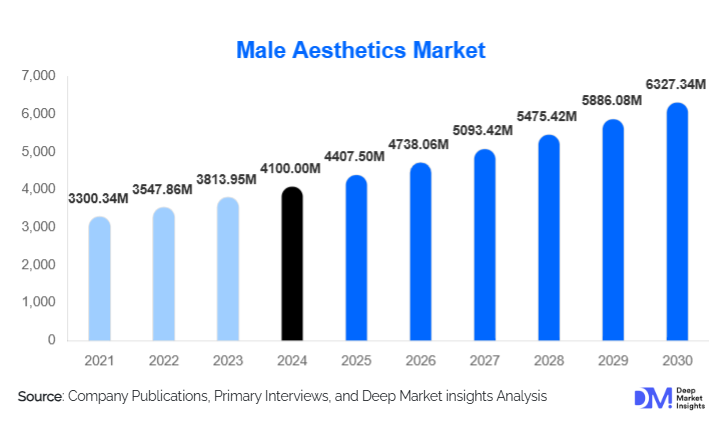
According to Deep Market Insights, the global male aesthetics market size was valued at USD 4,100.00 million in 2025 and is projected to grow from USD 4,407.50 million in 2026 to reach USD 6,327.54 million by 2031, expanding at a CAGR of 7.5% during the forecast period (2026–2031). The male aesthetics market growth is primarily driven by increasing social acceptance of cosmetic procedures among men, rising disposable incomes, advancements in minimally invasive aesthetic technologies, and growing demand for facial rejuvenation, hair restoration, and body contouring treatments.
Key Market Insights
- Minimally invasive procedures dominate the market, supported by strong demand for injectables such as botulinum toxin and dermal fillers among men aged 30–50.
- Hair restoration and facial aesthetics remain the most sought-after indications, reflecting rising concerns over aging, hair loss, and professional appearance.
- North America leads the global market, driven by high procedure awareness, advanced clinical infrastructure, and premium pricing models.
- Asia-Pacific is the fastest-growing region, supported by medical tourism, expanding middle-class populations, and cultural shifts toward male grooming.
- Medical spas are emerging as high-growth service providers, offering bundled, affordable, and discreet aesthetic treatments.
- Technological innovation, including AI-based facial mapping, advanced laser platforms, and regenerative therapies, is reshaping treatment personalization and outcomes.
Male Aesthetics Market Trends
Rapid Adoption of Minimally Invasive and Non-Invasive Treatments
Men increasingly prefer aesthetic procedures that offer natural-looking results with minimal downtime. Injectable treatments, laser-based skin rejuvenation, and non-surgical body contouring are gaining traction due to convenience and repeat usability. These procedures align well with busy professional lifestyles and are often marketed as maintenance solutions rather than cosmetic alterations, further increasing acceptance among male consumers.
Male-Specific Product Innovation and Branding
The market is witnessing a shift toward male-specific injectables, skincare formulations, and energy-based devices designed for thicker skin, stronger facial musculature, and hair-bearing areas. Companies are investing in gender-focused branding, discreet clinical environments, and outcome-driven messaging that emphasizes confidence, performance, and aging well rather than cosmetic enhancement.
Male Aesthetics Market Drivers
Changing Social Perceptions and Lifestyle Aspirations
Modern masculinity increasingly embraces self-care and appearance enhancement. Social media exposure, professional competitiveness, and longer working lives are encouraging men to invest in facial aesthetics, hair restoration, and body sculpting. This cultural shift has significantly expanded the addressable male consumer base across age groups.
Technological Advancements in Aesthetic Medicine
Innovations in injectables, laser platforms, and regenerative medicine, such as PRP therapy, have improved safety, precision, and outcomes. These advancements reduce treatment risks and downtime, enabling wider adoption and repeat procedures, thereby driving recurring revenues for clinics and device manufacturers.
Male Aesthetics Market Restraints
High Cost of Procedures and Limited Insurance Coverage
Most male aesthetic procedures are elective and not covered by insurance, making affordability a key barrier in price-sensitive regions. Premium devices and branded injectables further increase treatment costs, limiting penetration beyond urban and high-income demographics.
Regulatory and Safety Challenges
Stringent regulatory requirements for injectables and devices can delay product launches and increase compliance costs. Inconsistent practitioner standards and unregulated clinics in certain regions also pose safety concerns, potentially impacting consumer trust.
Male Aesthetics Market Opportunities
Medical Tourism and Emerging Market Expansion
Countries such as South Korea, Turkey, India, Thailand, Brazil, and Mexico are becoming global hubs for male aesthetic procedures, particularly hair transplantation and body contouring. Competitive pricing, skilled practitioners, and supportive government policies make these regions attractive for both patients and market entrants.
AI-Driven Personalization and Digital Engagement
The integration of AI, 3D facial analysis, and predictive modeling enables highly personalized treatment planning and outcome simulation. Companies leveraging digital diagnostics, tele-consultations, and smart aesthetic devices can enhance patient satisfaction and command premium pricing.
Report Scope
| Report Metric | Details |
|---|---|
| Market Size in 2025 | USD 4100 Million |
| Market Size in 2026 | USD 4407.50 Million |
| Market Size in 2031 | USD 6327.34 Million |
| CAGR | 7.5% (2026-2031) |
| Base Year for Estimation | 2025 |
| Historical Data | 2022-2024 |
| Forecast Period | 2026-2031 |
| Report Coverage | Revenue Forecast, Competitive Landscape, Supply Chain Disruption, Growth Factors, Environment & Regulatory Landscape and Trends |
| Geographies Covered | North America, Europe, APAC, Middle East and Africa, LATAM |
| Countries Covered | U.S., Canada, U.K., Germany, France, Spain, Italy, Russia, Nordic, Benelux, Rest of Europe, China, Korea, Japan, India, Australia, Singapore, Taiwan, South East Asia, Rest of Asia-Pacific, UAE, Turky, Saudi Arabia, South Africa, Egypt, Nigeria, Rest of MEA, Brazil, Mexico, Argentina, Chile, Colombia, Rest of LATAM |
Explore more data points, trends and opportunities Download Free Sample Report
Product Type Insights
Injectables account for the largest share of the male aesthetics market, contributing approximately 38% of total revenue in 2025, driven by high repeat usage and relatively lower treatment costs. Energy-based aesthetic devices represent around 27% of the market, supported by growing demand for laser hair removal, skin tightening, and body contouring. Surgical aesthetic equipment holds nearly 20% share, led by hair transplantation systems and gynecomastia surgery tools. Male-specific cosmeceuticals and medical-grade skincare products account for about 15%, driven by daily maintenance regimens and post-procedure care.
Application Insights
Facial aesthetics dominate application demand, accounting for nearly 40% of market revenue, as men seek solutions for wrinkles, jawline definition, and skin texture improvement. Hair restoration and removal applications contribute around 28%, supported by the rising prevalence of male pattern baldness. Body contouring and fat reduction represent approximately 20%, while skin rejuvenation and anti-aging therapies account for the remaining share, reflecting increasing preventive aesthetics adoption among younger men.
Service Provider Insights
Dermatology clinics lead the market with nearly 45% share due to specialization in injectables and skin treatments. Medical spas are the fastest-growing service providers, expanding at over 13% CAGR, driven by affordability, bundled offerings, and convenience. Hospitals and surgical centers dominate complex procedures such as hair transplantation and gynecomastia surgery, particularly in medical tourism-driven markets.
Age Group Insights
Men aged 31–45 years represent the largest consumer segment, driven by high disposable income and a strong focus on professional appearance. The 46–60 age group contributes significantly to anti-aging and hair restoration demand. The 18–30 segment is growing rapidly, driven by laser hair removal, acne treatments, and preventive skincare. Men above 60 years represent a smaller but premium segment, favoring surgical and corrective procedures.
Explore more data points, trends and opportunities Download Free Sample Report
Male Aesthetics Market Segmentations
By Procedure Type
- Minimally Invasive Procedures
- Non-Invasive Energy-Based Procedures
- Surgical Aesthetic Procedures
By Product Category
- Injectables
- Energy-Based Devices
- Surgical Equipment
- Cosmeceuticals & Medical-Grade Skincare
By Indication
- Facial Aesthetics
- Body Contouring & Fat Reduction
- Hair Restoration & Removal
- Skin Rejuvenation & Anti-Aging
By Age Group
- 18–30 Years
- 31–45 Years
- 46–60 Years
- Above 60 Years
By Service Provider
- Dermatology Clinics
- Medical Spas & Aesthetic Centers
- Hospitals & Surgical Centers
Regional Insights
North America
North America accounts for approximately 36% of the global male aesthetics market in 2025. The United States dominates regional demand, driven by high awareness, premium pricing, and widespread adoption of minimally invasive procedures. Strong presence of leading aesthetic brands and advanced clinical infrastructure supports sustained growth.
Europe
Europe holds nearly 26% market share, led by Germany, the U.K., France, and Italy. Demand is supported by aging male populations, growing acceptance of cosmetic treatments, and strong regulatory standards that enhance consumer confidence.
Asia-Pacific
Asia-Pacific accounts for around 22% of global revenue and is the fastest-growing region, with a CAGR exceeding 14%. South Korea, China, India, and Japan lead demand, driven by medical tourism, expanding middle-class income, and strong cultural emphasis on grooming.
Latin America
Latin America contributes approximately 9% of the market, with Brazil and Mexico as key demand centers. Growth is driven by aesthetic tourism, cost-competitive procedures, and rising domestic awareness.
Middle East & Africa
The region accounts for about 7% of global demand, led by Turkey and the UAE. High-income populations, growing medical tourism, and expanding private clinic infrastructure support market expansion.
Key Players in the Male Aesthetics Market
- AbbVie (Allergan Aesthetics)
- Galderma
- Merz Pharma
- Lumenis
- Cynosure
- Cutera
- Solta Medical
- Alma Lasers
- Revance Therapeutics
- Evolus
- Bausch Health
- Sinclair Pharma
- Candela Medical
- Fotona
- Hugel