Makeup Remover Market Size
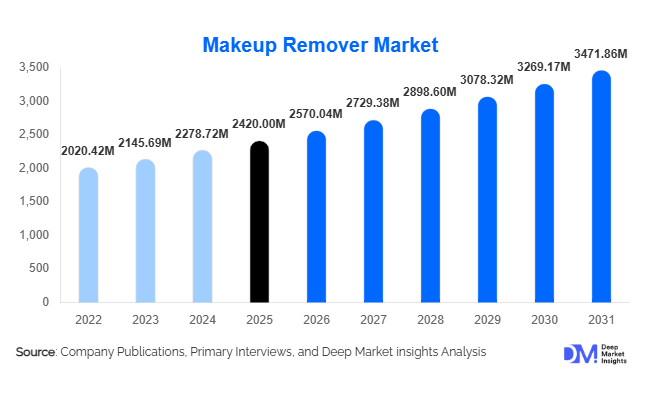
According to Deep Market Insights, the global makeup remover market size was valued at USD 2,420 million in 2025 and is projected to grow from USD 2570.04 million in 2026 to reach USD 3471.86 million by 2031, expanding at a CAGR of 6.2% during the forecast period (2026–2031). The makeup remover market growth is primarily driven by increasing cosmetics consumption, growing awareness about skincare routines, and the expansion of multifunctional skincare formulations designed to cleanse, hydrate, and nourish the skin.
Makeup removers have become an essential component of modern skincare routines as consumers increasingly recognize the importance of effective cleansing to maintain healthy skin. With the growing popularity of long-wear and waterproof cosmetics, demand for specialized makeup removal products such as micellar water, cleansing oils, and dual-phase removers is rising globally. Additionally, the rapid growth of e-commerce beauty platforms and the emergence of clean beauty trends are driving product innovation and market expansion. Companies are investing in sustainable packaging, botanical ingredients, and dermatologically tested formulations to meet evolving consumer expectations.
Key Market Insights
- Liquid-based makeup removers, particularly micellar water, dominate the market due to their gentle cleansing properties and compatibility with multiple skin types.
- Natural and organic formulations are rapidly gaining popularity, driven by consumer demand for chemical-free skincare products and transparent ingredient labeling.
- North America accounts for the largest share of the global market, supported by high consumer spending on skincare and strong presence of global beauty brands.
- The Asia-Pacific region is the fastest-growing market, driven by increasing cosmetics usage and the growing popularity of multi-step skincare routines.
- Online retail channels are expanding rapidly, allowing global beauty brands and emerging niche players to reach consumers directly.
- Sustainability trends, including biodegradable wipes and reusable makeup removal pads, are shaping future product innovation.
What are the latest trends in the makeup remover market?
Rise of Clean Beauty and Organic Formulations
One of the most prominent trends in the makeup remover market is the increasing demand for clean and natural skincare products. Consumers are becoming more aware of potentially harmful ingredients such as parabens, sulfates, and artificial fragrances. As a result, many skincare brands are reformulating products using botanical extracts, essential oils, and plant-derived cleansing agents. Organic makeup removers, which contain ingredients such as aloe vera, coconut oil, green tea, and chamomile, are gaining traction among health-conscious consumers. Brands are also focusing on cruelty-free and vegan certifications to strengthen their appeal among ethically conscious buyers. This trend is particularly strong in North America and Europe, where consumers prioritize ingredient transparency and sustainability.
Technology-Enhanced Skincare Formulations
Advancements in cosmetic science are transforming the formulations of makeup removers. Micellar technology, oil-to-foam cleansers, and bi-phase removers are increasingly used to dissolve stubborn and waterproof makeup effectively without damaging the skin barrier. Many modern makeup removers are designed as multifunctional products that combine cleansing with moisturizing, anti-aging, and skin-repair benefits. Ingredients such as hyaluronic acid, vitamin complexes, and probiotics are being integrated into formulations to enhance skin hydration and improve overall skin health. Additionally, reusable makeup remover tools such as microfiber cloths and washable pads are gaining popularity as sustainable alternatives to disposable wipes.
What are the key drivers in the makeup remover market?
Growing Global Cosmetics Consumption
The rapid growth of the global cosmetics industry is one of the primary drivers of the makeup remover market. Increasing use of foundation, waterproof mascara, and long-lasting lip products has created the need for effective cleansing solutions. Consumers are adopting comprehensive skincare routines that emphasize proper makeup removal to prevent clogged pores, skin irritation, and premature aging. Rising disposable income and the influence of social media beauty trends are also encouraging consumers to invest in specialized skincare products, including makeup removers.
Increasing Awareness of Skincare and Dermatological Health
Dermatologists and skincare experts often emphasize the importance of thoroughly removing makeup before going to sleep to maintain healthy skin. Educational campaigns by beauty brands, skincare influencers, and dermatology associations have significantly increased consumer awareness regarding the benefits of proper makeup removal. This growing awareness has resulted in higher product adoption rates, particularly among younger consumers who actively follow skincare routines promoted on digital platforms.
What are the restraints for the global market?
Environmental Concerns Related to Disposable Wipes
Disposable makeup remover wipes have faced increasing scrutiny due to their environmental impact. Many conventional wipes contain synthetic fibers that are not biodegradable and contribute to plastic pollution. Growing consumer awareness regarding sustainability and stricter environmental regulations in several regions may reduce demand for traditional wipes. Manufacturers are responding by introducing biodegradable and compostable alternatives, but the transition toward sustainable solutions may increase production costs.
Price Sensitivity in Emerging Markets
While demand for premium skincare products is rising globally, price sensitivity remains a challenge in several developing economies. Many consumers in emerging markets still rely on traditional cleansing products such as soap or face wash instead of specialized makeup removers. Premium formulations that incorporate advanced ingredients or organic certifications can be relatively expensive, which limits their adoption among price-conscious consumers. Manufacturers must strike a balance between affordability and innovation to expand their customer base in these regions.
What are the key opportunities in the makeup remover industry?
Expansion of E-Commerce and Direct-to-Consumer Channels
The rapid expansion of online retail platforms is creating significant growth opportunities for makeup remover brands. E-commerce marketplaces, brand websites, and social media shopping platforms allow companies to reach a global consumer base without relying solely on traditional retail channels. Digital marketing strategies, influencer collaborations, and personalized skincare recommendations are enabling brands to build strong customer engagement. The rise of subscription models for skincare products also encourages repeat purchases, creating stable revenue streams for manufacturers.
Innovation in Multifunctional Skincare Products
Consumers increasingly prefer skincare products that deliver multiple benefits in a single formulation. Makeup removers that combine cleansing with moisturizing, soothing, and anti-aging properties are gaining popularity. Manufacturers are integrating advanced ingredients such as ceramides, antioxidants, and botanical extracts to enhance product functionality. This trend is encouraging companies to invest in research and development to create innovative skincare solutions that differentiate their products in a competitive market.
Report Scope
| Report Metric | Details |
|---|---|
| Market Size in 2025 | USD 2420 Million |
| Market Size in 2026 | USD 2570.04 Million |
| Market Size in 2031 | USD 3471.86 Million |
| CAGR | 6.2% (2026-2031) |
| Base Year for Estimation | 2025 |
| Historical Data | 2022-2024 |
| Forecast Period | 2026-2031 |
| Report Coverage | Revenue Forecast, Competitive Landscape, Supply Chain Disruption, Growth Factors, Environment & Regulatory Landscape and Trends |
| Geographies Covered | North America, Europe, APAC, Middle East and Africa, LATAM |
| Countries Covered | U.S., Canada, U.K., Germany, France, Spain, Italy, Russia, Nordic, Benelux, Rest of Europe, China, Korea, Japan, India, Australia, Singapore, Taiwan, South East Asia, Rest of Asia-Pacific, UAE, Turky, Saudi Arabia, South Africa, Egypt, Nigeria, Rest of MEA, Brazil, Mexico, Argentina, Chile, Colombia, Rest of LATAM |
Explore more data points, trends and opportunities Download Free Sample Report
Product Type Insights
Liquid makeup removers represent the largest product category in the global makeup remover market, accounting for nearly 38% of total market share. The dominance of this segment is largely driven by the widespread adoption of micellar water and cleansing liquids, which are recognized for their ability to effectively remove makeup, dirt, and excess oil while remaining gentle on the skin. These formulations use micelle molecules that attract and lift impurities without requiring harsh rubbing, making them particularly suitable for daily skincare routines and sensitive skin types. Increasing consumer preference for lightweight, non-greasy cleansing solutions has further strengthened the growth of liquid makeup removers. Additionally, dermatologists frequently recommend micellar water as a gentle cleansing option, which has helped increase its acceptance across both premium and mass-market skincare segments.
Oil-based makeup removers and cleansing balms are also experiencing steady demand, particularly among consumers who regularly use waterproof or long-lasting cosmetics. These formulations dissolve stubborn makeup pigments and oil-based cosmetic products more effectively than traditional cleansers, making them popular among professional makeup artists and beauty enthusiasts. Cream and lotion removers continue to maintain a stable presence in the market, especially among consumers with dry or sensitive skin, as these products provide additional hydration and nourishment while cleansing. Meanwhile, makeup remover wipes remain widely used due to their convenience, portability, and travel-friendly format. However, increasing environmental concerns regarding disposable wipes are encouraging manufacturers to develop biodegradable and compostable alternatives. Reusable makeup removal cloths and microfiber pads are emerging as sustainable solutions, particularly among environmentally conscious consumers seeking eco-friendly skincare products.
Application Insights
Face makeup removers account for the largest share of global demand, representing approximately 65% of the makeup remover market. This segment’s leadership is primarily driven by the extensive use of facial cosmetics, including foundation, primer, concealer, sunscreen, and contouring products. These cosmetic formulations often require specialized cleansing solutions that can effectively remove pigments, oils, and long-wear ingredients without irritating the skin. As skincare routines become more sophisticated worldwide, consumers increasingly recognize the importance of thorough facial cleansing to maintain healthy skin and prevent clogged pores, acne, and premature aging.
Eye makeup removers represent another significant segment due to the growing popularity of waterproof mascaras, eyeliners, and long-lasting eye shadows. The delicate skin around the eyes requires specially formulated removers that can dissolve stubborn makeup while minimizing irritation. Consequently, many brands offer dual-phase eye makeup removers that combine oil and water layers to gently remove waterproof cosmetics. Lip makeup removers are also gaining traction as long-wear and matte lip products become increasingly popular among consumers. These products require targeted removal solutions to prevent excessive rubbing, which can cause lip dryness or irritation. Multi-purpose makeup removers designed for the entire face are gaining popularity due to their convenience and cost efficiency, particularly among consumers seeking simplified skincare routines that reduce the number of products required for daily cleansing.
Distribution Channel Insights
Offline retail channels continue to dominate the global makeup remover market, accounting for approximately 63% of total sales. Supermarkets, pharmacies, and beauty specialty stores remain the primary points of purchase for skincare products, as consumers often prefer evaluating product textures, fragrances, packaging, and ingredient lists before making a purchase. Pharmacies and dermatology-focused retailers are particularly important distribution channels for dermatologically tested and sensitive-skin formulations. Additionally, beauty specialty stores often offer personalized consultations and product demonstrations, further encouraging consumer purchases.
However, online retail channels are emerging as the fastest-growing distribution segment due to the rapid expansion of global e-commerce platforms and digital beauty marketplaces. Online platforms allow consumers to easily compare prices, read product reviews, and access a wide range of international skincare brands that may not be available in local stores. Direct-to-consumer websites operated by beauty brands are also gaining traction, enabling companies to establish stronger relationships with customers and offer exclusive product launches or subscription-based skincare programs. Social media marketing and influencer endorsements play a significant role in driving online sales, particularly among younger consumers who rely on digital platforms for skincare recommendations and product discovery.
Consumer Demographic Insights
Women represent the largest consumer demographic in the makeup remover market, accounting for the majority of product consumption due to higher usage of cosmetic products in daily grooming routines. The increasing popularity of beauty tutorials, social media makeup trends, and personalized skincare regimens has significantly increased the frequency of makeup remover usage among female consumers worldwide. Premium skincare brands have also developed specialized formulations targeting different skin types and cosmetic routines, further expanding the product range available to female consumers.
However, the male grooming segment is emerging as a growing market opportunity as more men adopt skincare routines and grooming products. Increasing awareness regarding skin health, combined with the influence of social media and celebrity endorsements, is encouraging male consumers to invest in skincare products, including makeup removers designed to remove sunscreen, tinted moisturizers, and grooming products. Professional makeup artists and beauty salons also represent a significant consumer segment, as they frequently use specialized makeup removers during bridal makeup sessions, fashion shows, film productions, and professional photo shoots. Additionally, rising skincare awareness among younger consumers particularly millennials and Generation Z is contributing significantly to market growth, as these demographics actively follow multi-step skincare routines that emphasize proper cleansing and makeup removal.
Explore more data points, trends and opportunities Download Free Sample Report
Makeup Remover Market Segmentations
By Product Type
- Liquid Makeup Removers
- Oil-Based Makeup Removers
- Cream and Lotion Makeup Removers
- Gel and Foam Makeup Removers
- Makeup Remover Wipes
- Reusable Makeup Remover Cloths and Pads
By Application
- Face Makeup Removers
- Eye Makeup Removers
- Lip Makeup Removers
- Multi-Purpose Makeup Removers
By Distribution Channel
- Online Retail
- Supermarkets and Hypermarkets
- Pharmacies and Drugstores
- Beauty Specialty Stores
- Department Stores
By Consumer Demographic
- Women Consumers
- Male Grooming Segment
- Professional Makeup Artists and Beauty Salons
Regional Insights
North America
North America accounts for approximately 34% of the global makeup remover market, making it the largest regional market. The United States represents the dominant country within the region due to high consumer spending on cosmetics and skincare products. A strong presence of leading global beauty brands, well-established retail infrastructure, and widespread adoption of premium skincare routines continue to support market growth. Increasing consumer awareness regarding skin health and dermatological care has significantly boosted demand for gentle and effective cleansing products. Additionally, the region has witnessed strong growth in organic and clean beauty trends, prompting companies to introduce formulations that are free from harmful chemicals and suitable for sensitive skin. The rapid expansion of e-commerce beauty platforms and direct-to-consumer skincare brands is also driving growth in North America by making innovative products more accessible to consumers.
Europe
Europe holds approximately 29% of the global makeup remover market share. Countries such as France, Germany, and the United Kingdom represent the major markets in the region due to high consumer awareness regarding skincare and beauty routines. France plays a particularly important role in the global cosmetics industry and is widely recognized for pioneering micellar water technology, which has become one of the most popular makeup removal solutions worldwide. European consumers also demonstrate a strong preference for environmentally friendly and sustainable beauty products, which has encouraged companies to develop biodegradable wipes, refillable packaging, and formulations with natural ingredients. Strict cosmetic regulations within the European Union also promote product safety and quality, further strengthening consumer confidence in skincare products.
Asia-Pacific
Asia-Pacific is the fastest-growing regional market for makeup removers, driven by rapidly expanding cosmetics consumption and rising disposable incomes across emerging economies. Major markets, such as China, Japan, South Korea, and India, are experiencing significant growth due to a strong beauty culture and the increasing adoption of multi-step skincare routines. South Korea and Japan, in particular, are global leaders in skincare innovation, having popularized comprehensive cleansing routines that include specialized makeup removal products. The rapid expansion of e-commerce platforms and digital beauty influencers across the Asia-Pacific is also driving consumer awareness and product adoption. Additionally, the rising middle-class population and growing urbanization in countries such as China and India are contributing to increasing demand for premium and mid-range skincare products.
Latin America
Latin America accounts for roughly 7% of the global makeup remover market. Brazil and Mexico are the largest markets in the region due to strong beauty culture and high consumer interest in cosmetics and personal care products. Brazil, in particular, is one of the world’s largest beauty and personal care markets, supported by a large consumer base and a vibrant cosmetics industry. Rising urbanization, expanding middle-class populations, and the increasing availability of international beauty brands through retail chains and online platforms are supporting regional market growth. Additionally, growing demand for skincare products among younger consumers is encouraging manufacturers to introduce affordable makeup remover solutions tailored to emerging markets.
Middle East & Africa
The Middle East and Africa region represents approximately 5% of global makeup remover demand. Countries such as the United Arab Emirates and Saudi Arabia are key markets due to high spending on luxury cosmetics and premium skincare products. Fashion trends, social media influencers, and the popularity of international luxury beauty brands strongly influence the region’s beauty industry. The increasing development of retail outlets, including shopping malls and specialized beauty stores, has improved product accessibility in major urban centers. Additionally, rising disposable incomes and growing interest in personal grooming among younger consumers are supporting the gradual expansion of the makeup remover market across the region.
Key Players in the Makeup Remover Market
- L'Oréal Group
- Estée Lauder Companies
- Unilever
- Procter & Gamble
- Shiseido Company
- Johnson & Johnson
- Natura & Co
- Coty Inc.
- LVMH
- Beiersdorf
- Revlon
- Avon Products
- Amorepacific Corporation
- Kao Corporation
- Chanel