Makeup Foundation Market Size
According to Deep Market Insights, the global makeup foundation market size was valued at USD 36,500 million in 2025 and is projected to grow from USD 38,836.00 million in 2026 to reach USD 52,959.35 million by 2031, expanding at a CAGR of 6.4% during the forecast period (2026–2031). The makeup foundation market growth is primarily driven by increasing consumer focus on personal grooming, rising influence of social media beauty trends, and the growing demand for multifunctional cosmetic products that combine skincare and makeup benefits.
Key Market Insights
- Hybrid makeup-skincare formulations are gaining traction, with consumers preferring foundations infused with SPF, hydration, and anti-ageing benefits.
- Inclusive shade ranges and diversity-focused product development are becoming industry standards, driving brand loyalty and market expansion.
- Asia-Pacific dominates the global demand, supported by rapid urbanisation and rising disposable incomes in countries like China and India.
- Online retail is the fastest-growing distribution channel, fueled by AI-based shade matching and virtual try-on tools.
- Mid-range products lead the market, offering a balance between affordability and quality for mass consumers.
- Sustainability trends, including vegan formulations and eco-friendly packaging, are reshaping product innovation strategies.
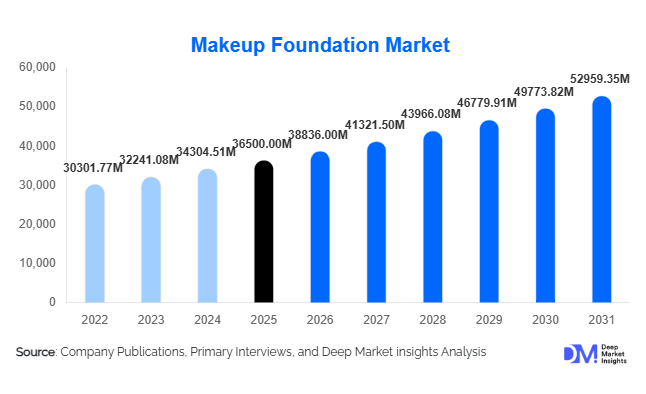
What are the latest trends in the makeup foundation market?
Rise of Skincare-Infused Foundations
The integration of skincare benefits into foundation products is a defining trend in the market. Consumers increasingly seek products that offer hydration, sun protection, and anti-ageing properties alongside coverage. Serum-based foundations enriched with ingredients such as hyaluronic acid, niacinamide, and antioxidants are gaining popularity. This trend is particularly strong among urban consumers who prefer minimalistic beauty routines, driving demand for multifunctional products that simplify daily use while improving skin health.
Digitalisation and AI-Based Personalisation
Technology is transforming the way consumers purchase foundation products. AI-powered tools for shade matching, augmented reality (AR) virtual try-ons, and personalised recommendations are enhancing online shopping experiences. These innovations reduce product returns and increase customer satisfaction. Brands are investing heavily in digital platforms to offer customised solutions, enabling them to capture younger, tech-savvy audiences and expand their direct-to-consumer presence globally.
What are the key drivers in the makeup foundation market?
Influence of Social Media and Beauty Content
Social media platforms such as Instagram, YouTube, and TikTok have become powerful drivers of consumer demand. Beauty influencers and makeup tutorials significantly impact purchasing decisions, accelerating product awareness and adoption. Viral trends and product reviews contribute to rapid sales growth, particularly among millennials and Gen Z consumers.
Growing Demand for Inclusive Beauty Products
The increasing emphasis on diversity and inclusivity is driving brands to expand their shade ranges and cater to a wider spectrum of skin tones. Companies that offer extensive shade options are gaining a competitive advantage and capturing underserved markets. This shift has become a critical growth driver, particularly in multicultural regions.
What are the restraints for the global market?
Rising Raw Material and Packaging Costs
The increasing cost of high-quality ingredients and sustainable packaging solutions is impacting profit margins. Natural and organic formulations often require premium inputs, making it challenging for manufacturers to maintain competitive pricing while ensuring product quality.
Regulatory and Skin Sensitivity Concerns
Stringent regulations regarding cosmetic ingredients and growing consumer awareness about skin safety are creating challenges for manufacturers. Compliance with varying regional standards increases R&D costs and delays product launches, while concerns about skin sensitivity influence consumer purchasing decisions.
What are the key opportunities in the makeup foundation industry?
Expansion in Emerging Markets
Emerging economies in the Asia-Pacific, Latin America, and the Middle East present significant growth opportunities. Rising disposable incomes, increasing urbanization, and growing exposure to global beauty trends are driving demand. Localisation strategies, including region-specific shades and climate-adapted formulations, can help brands penetrate these markets effectively.
AI-Driven Personalisation and Direct-to-Consumer Channels
The adoption of AI and data analytics enables brands to provide personalised product recommendations and enhance customer engagement. Direct-to-consumer (DTC) channels allow companies to build stronger relationships with consumers, improve margins, and gather valuable insights for product development.
Report Scope
| Report Metric | Details |
|---|---|
| Market Size in 2025 | USD 36500 Million |
| Market Size in 2026 | USD 38836.00 Million |
| Market Size in 2031 | USD 52959.35 Million |
| CAGR | 6.4% (2026-2031) |
| Base Year for Estimation | 2025 |
| Historical Data | 2022-2024 |
| Forecast Period | 2026-2031 |
| Report Coverage | Revenue Forecast, Competitive Landscape, Supply Chain Disruption, Growth Factors, Environment & Regulatory Landscape and Trends |
| Geographies Covered | North America, Europe, APAC, Middle East and Africa, LATAM |
| Countries Covered | U.S., Canada, U.K., Germany, France, Spain, Italy, Russia, Nordic, Benelux, Rest of Europe, China, Korea, Japan, India, Australia, Singapore, Taiwan, South East Asia, Rest of Asia-Pacific, UAE, Turky, Saudi Arabia, South Africa, Egypt, Nigeria, Rest of MEA, Brazil, Mexico, Argentina, Chile, Colombia, Rest of LATAM |
Explore more data points, trends and opportunities Download Free Sample Report
Product Type Insights
Liquid foundation continues to dominate the global makeup foundation market, accounting for approximately 48% of the total market share in 2025. Its leadership position is primarily driven by its versatility across different skin types, ease of blending, and availability in a wide range of finishes and coverage levels. Liquid formulations are also at the forefront of innovation, particularly with the integration of skincare ingredients such as hyaluronic acid, SPF, and anti-ageing compounds. This multifunctionality aligns with the growing consumer preference for hybrid beauty products, especially in urban markets where time-efficient routines are valued. Additionally, the ability of liquid foundations to cater to both premium and mass segments further strengthens their dominance. Cream and powder foundations maintain steady demand, particularly among consumers seeking hydration and oil control, respectively. Meanwhile, stick and serum-based foundations are gaining traction in niche segments due to portability and the rising popularity of skincare-infused cosmetics, especially within premium and travel-friendly product categories.
Application Insights
Medium coverage foundations lead the application segment, capturing around 42% of the global market share, as they provide an optimal balance between natural aesthetics and effective skin correction. This segment’s growth is driven by the increasing consumer preference for a “no-makeup” makeup look, particularly among millennials and Gen Z consumers. Matte finish foundations account for approximately 35% share, with strong demand in regions characterised by hot and humid climates, where oil control and long-lasting wear are essential. The segment is further supported by consumers with oily and combination skin types. Meanwhile, dewy and natural finishes are witnessing accelerated growth, fueled by trends emphasising radiant, healthy-looking skin. These finishes are particularly popular in developed markets and among younger demographics. The increasing demand for customizable coverage and finish combinations is encouraging brands to develop adaptable formulations, including buildable coverage and multi-finish products, thereby expanding the application landscape.
Distribution Channel Insights
Offline retail channels remain dominant, contributing nearly 60% of total market sales in 2025, largely due to the importance of physical product testing, shade matching, and personalised consultation in foundation purchases. Speciality beauty stores and department stores play a critical role in influencing consumer decisions through expert assistance and experiential retail environments. However, online distribution channels are the fastest-growing segment, driven by increasing internet penetration, smartphone usage, and advancements in digital technologies. E-commerce platforms and brand-owned websites are leveraging AI-powered shade matching, augmented reality (AR) try-on tools, and influencer-driven marketing to enhance customer engagement and conversion rates. The rapid adoption of omnichannel strategies—where brands integrate online and offline experiences—is further accelerating growth. Consumers increasingly prefer a seamless shopping journey, such as researching online and purchasing in-store or vice versa, which is reshaping distribution dynamics globally.
End-Use Insights
Individual consumers dominate the end-use segment, accounting for over 75% of total market demand, driven by daily usage patterns and growing awareness of personal grooming and aesthetics. The segment’s growth is supported by increasing participation of women in the workforce, rising disposable incomes, and the influence of social media beauty trends. Professional makeup artists and salons represent a steadily growing segment, benefiting from rising demand in the wedding, fashion, and entertainment industries. This segment is particularly significant in emerging markets, where professional beauty services are expanding rapidly. The film and media industry, while relatively niche, contributes to high-value demand for premium and specialised foundation products that offer long-lasting performance under intense lighting conditions. Additionally, the emergence of men’s grooming as a growing category is opening new avenues for market expansion, with increasing acceptance of cosmetic usage among male consumers, particularly in urban and developed regions.
Explore more data points, trends and opportunities Download Free Sample Report
Makeup Foundation Market Segmentations
By Product Type
- Liquid Foundation
- Cream Foundation
- Powder Foundation
- Stick Foundation
- Serum/Hybrid Foundation
By Application
- Sheer Coverage
- Medium Coverage
- Full Coverage
- Matte Finish
- Dewy/Natural Finish
By Distribution Channel
- Online Retail
- Supermarkets/Hypermarkets
- Specialty Beauty Stores
- Department Stores
- Brand-Owned Stores
By End-Use
- Individual Consumers
- Professional Makeup Artists & Salons
- Film & Media Industry
Regional Insights
Asia-Pacific
Asia-Pacific leads the global makeup foundation market, accounting for approximately 34% of total market share in 2025, and remains the fastest-growing region. Growth is primarily driven by large population bases, rapid urbanisation, and rising disposable incomes in key countries such as China, India, Japan, and South Korea. China dominates regional demand due to its strong e-commerce ecosystem and digital-first consumer behaviour, while India is experiencing robust growth with a CAGR exceeding 8%, supported by a young demographic profile and increasing beauty consciousness. South Korea and Japan contribute significantly through innovation in skincare-infused cosmetics and advanced formulations. Additionally, the strong influence of K-beauty trends, increasing adoption of international brands, and government support for domestic cosmetic manufacturing are key drivers accelerating regional growth.
North America
North America holds around 28% of the global market share, with the United States contributing nearly 22%. The region’s growth is driven by high consumer spending power, strong brand presence, and continuous innovation in premium and clean beauty products. The widespread adoption of digital technologies, including AI-based personalisation and online retail platforms, further supports market expansion. Additionally, increasing consumer demand for inclusive shade ranges and sustainable products is encouraging brands to invest in R&D and product diversification. The presence of leading global cosmetic companies and a well-established retail infrastructure also contributes to the region’s sustained dominance.
Europe
Europe accounts for approximately 22% of the global market, with major contributions from France, Germany, and the United Kingdom. The region is characterised by a strong preference for premium, organic, and sustainable cosmetic products, driven by high consumer awareness and stringent regulatory standards. Growth is supported by the presence of established luxury cosmetic brands and increasing demand for eco-friendly and cruelty-free formulations. Additionally, the rising popularity of minimalist beauty routines and high-quality skincare-infused foundations is driving innovation. Strong export capabilities, particularly from France, further reinforce Europe’s position in the global market.
Latin America
Latin America represents about 8% of the global market, with Brazil and Mexico leading regional demand. Growth is driven by expanding middle-class populations, increasing urbanisation, and rising beauty awareness among consumers. The region shows a strong preference for mid-range products that balance affordability and quality. Additionally, the growing influence of social media and beauty influencers is shaping consumer preferences and driving product adoption. Local manufacturing capabilities and increasing availability of international brands are further supporting market growth in the region.
Middle East & Africa
The Middle East and Africa region is emerging as a promising growth market, supported by increasing urbanisation, rising disposable incomes, and a strong preference for premium and luxury cosmetics in countries such as the UAE and Saudi Arabia. The region’s hot climate drives demand for long-lasting, high-performance foundations, particularly matte and full-coverage formulations. Additionally, the growing presence of international beauty brands, the expansion of modern retail infrastructure, and increasing participation of women in the workforce are key growth drivers. In Africa, improving economic conditions and rising consumer awareness are gradually boosting demand, particularly in urban centres.