Luxury Tourism Market Size
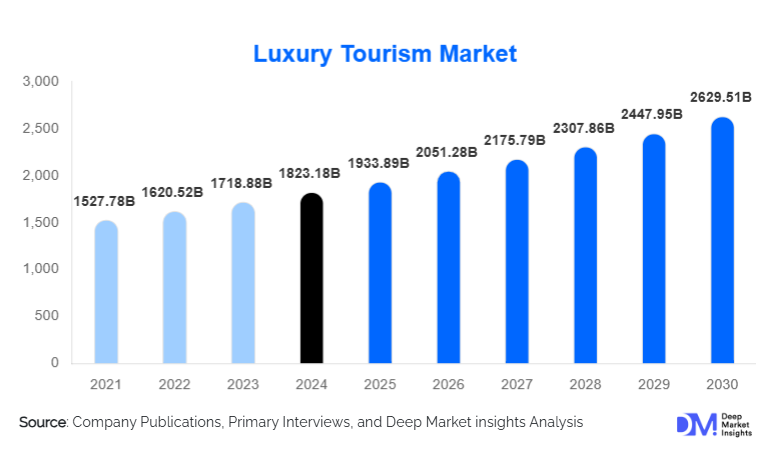
According to Deep Market Insights, the global luxury tourism market size was valued at USD 1,823.18 billion in 2025 and is projected to grow from USD 1,933.89 billion in 2026 to reach USD 2,629.51 billion by 2031, expanding at a CAGR of 6.07% during the forecast period (2026–2031). The luxury tourism market growth is primarily driven by rising global wealth, increasing demand for personalized and experiential travel, and the expansion of luxury travel services, including high-end accommodations, bespoke cultural experiences, and private transport offerings tailored for affluent travelers.
Key Market Insights
- Luxury tourism increasingly emphasizes personalized and immersive experiences, catering to high-net-worth individuals and affluent millennials seeking bespoke itineraries and exclusive offerings.
- Urban luxury destinations dominate, with major cities offering high-end hotels, fine dining, cultural experiences, and premium shopping, contributing to consistent revenue streams.
- North America holds the largest market share, led by the U.S. and Canada due to high disposable incomes anda mature luxury travel infrastructure.
- Asia-Pacific is the fastest-growing region, driven by rising domestic wealth in China, India, and Thailand and increasing outbound travel demand for premium experiences.
- Europe remains a strong market for cultural and heritage luxury tourism, supported by historic cities, high service standards, and a strong interest in sustainable travel.
- Technology integration, including AI-powered personalization, virtual reality previews, and digital concierge services, is transforming traveler engagement and service delivery in luxury tourism.
Luxury Tourism Market Trends
Experiential and Sustainable Tourism
Luxury tourism operators are increasingly focusing on eco-conscious and experiential travel. High-end resorts and travel services are integrating sustainability into operations through renewable energy, waste reduction, and community engagement initiatives. Travelers are drawn to cultural immersion, wellness-focused programs, and adventure-based experiences that go beyond conventional sightseeing. Sustainable luxury tourism initiatives, such as carbon offset programs and local community involvement, not only improve brand perception but also align with affluent travelers’ environmental and social values.
Technology-Enhanced Travel Experiences
Emerging technologies are enhancing both pre-travel and on-ground luxury experiences. AI-driven itinerary customization, virtual reality previews of destinations, and digital concierge services allow affluent travelers to plan seamless and highly personalized journeys. Mobile apps offer real-time updates, personalized recommendations, and immersive content. Blockchain-enabled bookings and loyalty platforms are also gaining traction, ensuring security, transparency, and convenience for high-net-worth clients. Technology adoption is particularly appealing to younger luxury travelers seeking interactive and efficient services.
Luxury Tourism Market Drivers
Rising Global Wealth
The increasing population of high-net-worth and ultra-high-net-worth individuals worldwide is a key growth driver. Affluent travelers prioritize exclusivity, bespoke services, and unique experiences, resulting in higher spending on premium accommodations, private jets, yachts, and curated tours. Emerging wealth hubs in Asia-Pacific and the Middle East are accelerating international luxury travel, further fueling market growth.
Shift Toward Experiential Travel
Travelers are moving away from conventional sightseeing toward immersive experiences, including cultural, gastronomic, wellness, and adventure-based itineraries. Demand for bespoke tours, eco-luxury resorts, and adventure travel has expanded the scope of luxury tourism offerings. This trend encourages operators to differentiate through curated experiences and high-quality services.
Digitalization and Convenience
Technology has simplified access to luxury travel services, enabling travelers to plan and book complex itineraries with ease. AI-powered trip planners, VR previews, and mobile apps offering real-time service updates enhance convenience and satisfaction. Digital platforms also facilitate direct engagement with luxury operators, reducing intermediaries and increasing personalized offerings.
Luxury Tourism Market Restraints
High Operational Costs
Delivering premium, bespoke services entails significant investments in infrastructure, staff training, and technology. High operational costs may restrict profitability for smaller players and limit market entry, posing challenges to broader expansion.
Vulnerability to Economic and Geopolitical Fluctuations
Luxury tourism demand can be impacted by economic downturns, political instability, or global crises, such as pandemics. Travel restrictions, visa complexities, and fluctuating exchange rates may temporarily suppress demand, particularly for international luxury travel segments.
Luxury Tourism Market Opportunities
Emerging Regional Markets
Emerging economies in the Asia-Pacific, the Middle East, and Latin America present significant growth opportunities. Rising disposable incomes, improved infrastructure, and government initiatives promoting tourism enable luxury operators to tap into previously underserved markets. Customized experiences tailored to local preferences and culture-driven itineraries are key to capturing this segment.
Integration of Technology for Personalization
Luxury operators can leverage AI, virtual reality, and digital concierge platforms to deliver highly personalized experiences. This enhances customer satisfaction and loyalty, while also providing operational efficiencies. Travel companies that invest in technology-driven services can differentiate themselves and capture the premium market effectively.
Experiential and Sustainable Offerings
Eco-luxury and wellness-focused travel are growing rapidly. Travelers are increasingly seeking sustainable, socially responsible, and immersive experiences. Operators incorporating sustainability certifications, wellness retreats, adventure tourism, and community-based activities can capture high-margin opportunities and align with evolving consumer preferences.
Report Scope
| Report Metric | Details |
|---|---|
| Market Size in 2025 | USD 1823.18 Billion |
| Market Size in 2026 | USD 1933.89 Billion |
| Market Size in 2031 | USD 2629.51 Billion |
| CAGR | 6.07% (2026-2031) |
| Base Year for Estimation | 2025 |
| Historical Data | 2022-2024 |
| Forecast Period | 2026-2031 |
| Report Coverage | Revenue Forecast, Competitive Landscape, Supply Chain Disruption, Growth Factors, Environment & Regulatory Landscape and Trends |
| Geographies Covered | North America, Europe, APAC, Middle East and Africa, LATAM |
| Countries Covered | U.S., Canada, U.K., Germany, France, Spain, Italy, Russia, Nordic, Benelux, Rest of Europe, China, Korea, Japan, India, Australia, Singapore, Taiwan, South East Asia, Rest of Asia-Pacific, UAE, Turky, Saudi Arabia, South Africa, Egypt, Nigeria, Rest of MEA, Brazil, Mexico, Argentina, Chile, Colombia, Rest of LATAM |
Explore more data points, trends and opportunities Download Free Sample Report
Service Type Insights
Luxury accommodation, including five-star hotels, resorts, and private villas, dominates the market with around 45% share of the 2025 market revenue. These offerings attract consistently high-spending travelers seeking exclusivity, comfort, and premium service. Luxury transport, including private jets, yachts, and first-class flights, contributes significantly to overall revenue, catering to international travelers. Curated tours and experiences, focusing on adventure, wellness, and culture, are rapidly expanding, especially in emerging markets where experiential tourism is on the rise.
Application Insights
Urban luxury destinations lead global demand, driven by high-end hotels, cultural experiences, and shopping. Beach and island resorts attract affluent travelers seeking relaxation and wellness programs, while adventure and nature destinations, including safaris and eco-lodges, are growing due to demand for immersive experiences. Cultural and heritage destinations benefit from historical attractions and bespoke guided tours, creating high-value niche offerings.
Distribution Channel Insights
Direct bookings through operator websites, online travel agencies, and digital concierge platforms dominate the luxury tourism market. Specialist luxury travel agencies remain critical for high-net-worth clients seeking curated experiences. Social media marketing, influencer collaborations, and subscription-based travel clubs are emerging as effective channels to engage affluent and experience-driven travelers. Personalized service and real-time booking transparency are key differentiators in this segment.
Traveler Type Insights
High-net-worth individuals represent the largest segment, accounting for approximately 55% of global luxury tourism spending. Ultra-high-net-worth travelers seek private and ultra-exclusive experiences. Affluent millennials are increasingly driving demand for experiential and adventure-focused luxury tourism, leveraging digital platforms for booking and planning. Couples and honeymooners prioritize privacy and high-value experiences, while families are seeking child-friendly luxury accommodations and multi-generational travel options.
Age Group Insights
Travelers aged 31–50 dominate the market due to high disposable income and preference for experience-driven travel. The 18–30 segment is driving growth in adventure and wellness tourism, particularly via digital engagement. Older demographics, aged 51–65, focus on premium and guided travel, while the 65+ segment represents a niche for high-value, comfort-focused luxury travel, including wellness and medical tourism.
Explore more data points, trends and opportunities Download Free Sample Report
Luxury Tourism Market Segmentations
By Service Type
- Luxury Accommodation
- Luxury Transport
- Curated Tours & Experiences
By Application
- Urban Luxury Tourism
- Beach & Island Resorts
- Adventure & Nature Tourism
- Cultural & Heritage Tourism
By Distribution Channel
- Direct Bookings
- Luxury Travel Agencies
- Online Travel Agencies (OTAs)
- Subscription/Membership-Based Travel Clubs
By Traveler Type
- High-Net-Worth Individuals
- Ultra-High-Net-Worth Travelers
- Affluent Millennials
- Couples & Honeymooners
- Families & Multi-Generational Travelers
Regional Insights
North America
North America accounts for the largest market share (35% in 2025), led by the U.S. and Canada. High disposable incomes, mature luxury infrastructure, and strong outbound travel trends support demand. Customized urban and experiential luxury packages are particularly popular.
Europe
Europe holds 30% market share, led by France, Italy, and the U.K., driven by cultural and heritage tourism. Demand is increasing for sustainable and experiential travel options, particularly among younger, eco-conscious travelers.
Asia-Pacific
Asia-Pacific is the fastest-growing region (8.5% CAGR), led by China, India, Thailand, and Japan. Rising affluence, digital travel adoption, and outbound travel demand are key growth drivers. Luxury wellness resorts and adventure packages are particularly in demand.
Latin America
Brazil, Mexico, and Argentina are emerging markets for luxury tourism. Outbound travel to North America, Europe, and Asia-Pacific is growing, with a focus on experiential and family-friendly luxury packages.
Middle East & Africa
Home to both travelers and premium destinations, the Middle East (UAE, Saudi Arabia, Qatar) is driving luxury outbound tourism. Africa, particularly South Africa, Kenya, and Morocco, remains central for inbound luxury tourism due to established high-end resorts, safari experiences, and cultural tourism.
Key Players in the Luxury Tourism Market
- Marriott International
- Hilton Worldwide
- Accor
- Four Seasons Hotels
- Aman Resorts
- Hyatt Hotels
- Ritz-Carlton
- Mandarin Oriental
- Belmond
- Rosewood Hotels
- Shangri-La Hotels
- Kempinski Hotels
- Banyan Tree Hotels & Resorts
- Taj Hotels
- Relais & Châteaux