Luxury Rugs Market Size
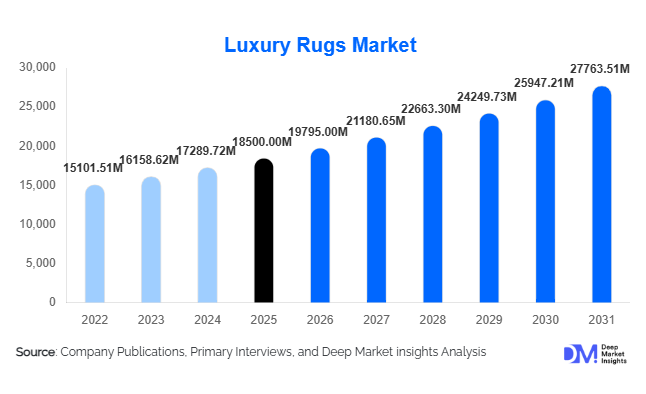
According to Deep Market Insights, the global luxury rugs market size was valued at USD 18,500 million in 2025 and is projected to grow from USD 19,795.00 million in 2026 to reach USD 27,763.51 million by 2031, expanding at a CAGR of 7.0% during the forecast period (2026–2031). The luxury rugs market growth is primarily driven by rising disposable incomes, increasing investments in luxury housing, and growing consumer preference for premium interior décor solutions that combine aesthetics with craftsmanship.
Key Market Insights
- Luxury rugs are increasingly viewed as statement décor and collectible assets, with demand shifting from functional usage to aesthetic and investment-driven purchases.
- Customization and designer collaborations are gaining prominence, enabling premium pricing and differentiation in a competitive market.
- North America dominates the global market, driven by strong home décor spending and a mature luxury housing sector.
- Asia-Pacific is the fastest-growing region, supported by rising affluent populations in China and India.
- Sustainability trends are reshaping product development, with growing demand for eco-friendly materials such as organic wool and natural dyes.
- E-commerce expansion is transforming distribution channels, enabling global access to high-end rugs and direct-to-consumer sales.
What are the latest trends in the luxury rugs market?
Sustainable and Ethically Sourced Rugs
The luxury rugs market is witnessing a strong shift toward sustainability, with consumers prioritizing eco-friendly materials and ethical sourcing practices. Manufacturers are increasingly adopting organic wool, recycled fibers, and natural dyes to align with environmental standards. Certifications related to fair trade and sustainable production are becoming key differentiators, particularly in North America and Europe. Additionally, brands are investing in transparent supply chains and artisan welfare programs, which enhance brand value and appeal to environmentally conscious consumers. This trend is expected to drive premiumization while ensuring long-term sustainability of the industry.
Digital Customization and E-commerce Growth
Technology is playing a transformative role in the luxury rugs market, particularly through digital customization tools and online platforms. Consumers can now design rugs based on size, color, and patterns using virtual visualization software. E-commerce platforms are offering augmented reality (AR) tools that allow customers to visualize rugs within their living spaces before purchase. This shift is expanding market reach beyond traditional retail stores and attracting younger, tech-savvy consumers. Direct-to-consumer models are also improving margins for manufacturers while reducing dependency on intermediaries.
What are the key drivers in the luxury rugs market?
Growth in Luxury Real Estate and Interior Design
The expansion of luxury residential and commercial real estate is a major driver of the luxury rugs market. High-end apartments, villas, and hospitality projects increasingly incorporate premium rugs as essential design elements. Interior designers and architects play a critical role in influencing purchasing decisions, often sourcing customized rugs for large-scale projects. The continuous refurbishment cycles in luxury hotels and resorts further contribute to sustained demand, making real estate development a key growth catalyst.
Rising Disposable Income and Lifestyle Upgradation
Increasing global wealth, particularly in emerging economies, is enabling consumers to spend more on premium home décor. The growing population of high-net-worth individuals (HNWIs) is driving demand for exclusive and high-value rugs, including hand-knotted and silk variants. Urbanization and changing lifestyles are also encouraging consumers to invest in aesthetically appealing interiors, further boosting market growth. This trend is particularly strong in the Asia-Pacific and the Middle East.
What are the restraints for the global market?
High Product Costs Limiting Mass Adoption
Luxury rugs, especially hand-knotted and silk variants, are highly expensive due to labor-intensive production processes and premium raw materials. This restricts market accessibility to affluent consumers and limits penetration in price-sensitive regions. The high cost also reduces replacement frequency, impacting overall sales volumes.
Volatility in Raw Material Prices
Fluctuations in the prices of wool, silk, and dyes significantly impact production costs and profit margins. Supply chain disruptions and dependency on specific regions for raw materials further exacerbate price volatility. Manufacturers must adopt strategic sourcing and inventory management practices to mitigate these risks.
What are the key opportunities in the luxury rugs industry?
Expansion in Emerging Luxury Housing Markets
Rapid urbanization and rising affluence in emerging economies such as India, China, and the UAE are creating significant opportunities for luxury rug manufacturers. Developers are increasingly incorporating premium interior décor elements into residential projects, driving bulk procurement of luxury rugs. This trend is expected to expand market penetration beyond traditional Western markets and create new revenue streams for manufacturers.
Customization and Designer Collaborations
The growing demand for personalized interiors is driving the adoption of customized luxury rugs. Manufacturers are offering bespoke solutions tailored to individual preferences, enabling premium pricing and stronger customer engagement. Collaborations with renowned designers and luxury brands are further enhancing market visibility and positioning, creating opportunities for differentiation and innovation.
Report Scope
| Report Metric | Details |
|---|---|
| Market Size in 2025 | USD 18500 Million |
| Market Size in 2026 | USD 19795 Million |
| Market Size in 2031 | USD 27763.51 Million |
| CAGR | 7.0% (2026-2031) |
| Base Year for Estimation | 2025 |
| Historical Data | 2022-2024 |
| Forecast Period | 2026-2031 |
| Report Coverage | Revenue Forecast, Competitive Landscape, Supply Chain Disruption, Growth Factors, Environment & Regulatory Landscape and Trends |
| Geographies Covered | North America, Europe, APAC, Middle East and Africa, LATAM |
| Countries Covered | U.S., Canada, U.K., Germany, France, Spain, Italy, Russia, Nordic, Benelux, Rest of Europe, China, Korea, Japan, India, Australia, Singapore, Taiwan, South East Asia, Rest of Asia-Pacific, UAE, Turky, Saudi Arabia, South Africa, Egypt, Nigeria, Rest of MEA, Brazil, Mexico, Argentina, Chile, Colombia, Rest of LATAM |
Explore more data points, trends and opportunities Download Free Sample Report
Product Type Insights
Hand-knotted rugs continue to dominate the luxury rugs market, accounting for approximately 38% of the global market share in 2025. The leadership of this segment is primarily driven by its superior craftsmanship, exclusivity, and long-term value retention. These rugs are often handcrafted over several months or years, making them unique pieces that appeal strongly to collectors, high-net-worth individuals, and luxury hospitality buyers. Additionally, their durability and ability to appreciate over time position them not just as décor items but also as investment assets. Growing consumer inclination toward heritage products and artisanal craftsmanship, particularly in North America and Europe, further reinforces demand. While hand-knotted rugs lead in value, hand-tufted and machine-made luxury rugs are gaining traction due to shorter production cycles and relatively lower price points, catering to the expanding “affordable luxury” segment. Flat-weave rugs, including kilims and dhurries, are also witnessing steady demand growth, especially in contemporary interiors, due to their lightweight structure, versatility, and alignment with minimalistic design trends.
Application Insights
The residential segment remains the dominant application area, contributing nearly 65% of total demand in 2025. This dominance is driven by increasing global spending on home décor, rising homeownership rates, and a growing preference for personalized interior spaces. Consumers are increasingly viewing luxury rugs as focal design elements that enhance aesthetic appeal and reflect personal style. The surge in home renovation activities, particularly post-pandemic, has further accelerated demand. Meanwhile, the commercial segment—especially hospitality and corporate spaces—is emerging as the fastest-growing application area. The expansion of luxury hotels, resorts, and premium office spaces is fueling demand for high-quality rugs that enhance ambiance and brand perception. Frequent refurbishment cycles in hospitality properties create recurring demand, while corporate offices are increasingly incorporating luxury interiors to improve employee experience and client impressions.
Distribution Channel Insights
Specialty retail stores continue to lead the luxury rugs market with approximately 35% market share, driven by the consumer preference for tactile evaluation and physical inspection before making high-value purchases. The ability to assess texture, craftsmanship, and color accuracy in person remains a critical factor influencing buying decisions. However, online platforms are rapidly emerging as the fastest-growing distribution channel, supported by advancements in digital technologies such as augmented reality (AR) visualization tools, virtual showrooms, and AI-driven recommendations. These innovations allow customers to visualize rugs within their living spaces, significantly improving purchase confidence. Additionally, interior designers and architects play a pivotal role in procurement, particularly for large-scale residential and commercial projects. Their influence is growing as consumers increasingly rely on professional expertise for curated and cohesive interior solutions.
End-Use Insights
The luxury housing segment accounts for nearly 48% of the total market share, making it the largest end-use category. This dominance is driven by rising global investments in high-end residential real estate and the increasing demand for premium interior furnishings. Luxury homeowners are prioritizing unique, high-quality décor elements, with rugs serving as essential components of interior design. The hospitality sector is the fastest-growing end-use segment, expanding at a CAGR of over 8%, fueled by global tourism growth and the continuous expansion of luxury hotel chains and boutique resorts. Hotels frequently upgrade interiors to maintain competitive positioning, creating consistent demand for luxury rugs. Additionally, corporate offices and retail spaces are increasingly adopting premium rugs to enhance brand image, customer experience, and workplace aesthetics, contributing to overall market expansion.
Explore more data points, trends and opportunities Download Free Sample Report
Luxury Rugs Market Segmentations
By Product Type
- Hand-Knotted Rugs
- Hand-Tufted Rugs
- Flat-Weave Rugs
- Machine-Made Luxury Rugs
By Material
- Wool-Based Rugs
- Silk Rugs
- Cotton Rugs
- Synthetic Fiber Rugs
- Blended Material Rugs
By Application
- Residential
- Commercial
By Distribution Channel
- Specialty Retail Stores
- Luxury Home Décor Boutiques
- Online/E-commerce Platforms
- Interior Designers & Architects
By End-Use
- Luxury Housing
- Hospitality
- Corporate Offices
- Retail & Public Infrastructure
Regional Insights
North America
North America remains the largest market, accounting for approximately 35% of global demand in 2025, with the United States leading consumption. The region’s dominance is driven by high disposable incomes, a well-established luxury housing sector, and strong consumer spending on home renovation and interior design. The growing trend of home personalization and the influence of interior designers significantly boost demand for premium rugs. Additionally, the presence of leading market players and widespread adoption of e-commerce platforms further strengthen regional growth. Canada also contributes steadily, supported by increasing investments in upscale residential developments and rising consumer interest in sustainable home décor products.
Europe
Europe holds around 28% of the global market share, with key demand centers including Germany, the United Kingdom, France, and Italy. The region’s growth is strongly influenced by a deep-rooted appreciation for heritage, craftsmanship, and traditional weaving techniques. European consumers exhibit a high preference for handmade and ethically sourced rugs, driving demand for premium and sustainable products. Stringent environmental regulations and increasing awareness of eco-friendly materials further accelerate the adoption of organic and natural fiber rugs. Additionally, the presence of established luxury interior design markets and high renovation activity in historic properties contributes significantly to market expansion.
Asia-Pacific
Asia-Pacific is the fastest-growing region, expanding at a CAGR of approximately 8.5%. China and India are the primary growth engines, driven by rapid urbanization, rising disposable incomes, and a growing population of affluent consumers. The expansion of luxury residential and commercial real estate projects in major metropolitan areas is significantly boosting demand for premium rugs. India plays a dual role as both a major consumer and a leading manufacturing hub, exporting high-quality hand-knotted rugs globally. Additionally, increasing influence of Western interior design trends and the rapid growth of e-commerce platforms are further accelerating market penetration across the region.
Latin America
Latin America is experiencing moderate growth, led by Brazil and Mexico. The region’s expansion is driven by increasing urbanization, a growing middle-class population, and rising awareness of premium home décor products. Demand is particularly strong in metropolitan areas where luxury residential developments are increasing. However, economic volatility, currency fluctuations, and relatively lower disposable incomes compared to developed regions pose challenges to sustained growth. Despite these constraints, improving retail infrastructure and the gradual expansion of online sales channels are expected to support future market development.
Middle East & Africa
The Middle East and Africa region is witnessing steady growth, with the UAE and Saudi Arabia leading demand. The region’s growth is primarily driven by substantial investments in luxury real estate, large-scale hospitality projects, and government initiatives aimed at diversifying economies through tourism. Mega projects and high-end infrastructure developments are creating strong demand for premium interior furnishings, including luxury rugs. Additionally, the cultural significance of rugs in Middle Eastern households sustains consistent baseline demand. Africa, particularly countries like South Africa, is also contributing to market growth through expanding tourism and hospitality sectors. The combination of cultural affinity and economic development makes the region a key contributor to the global luxury rugs market.
Key Players in the Luxury Rugs Market
- Mohawk Industries
- Shaw Industries
- Tarkett
- Interface Inc.
- Oriental Weavers
- Jaipur Rugs
- Nourison
- The Rug Company
- Tai Ping Carpets
- Stark Carpet
- ABC Carpet & Home
- Kaleen
- Obeetee
- Masland Carpets
- Milliken & Company