Luxury Menswear Market Size
According to Deep Market Insights, the global luxury menswear market size was valued at USD 72.5 billion in 2025 and is projected to grow from USD 77.43 billion in 2026 to reach USD 107.59 billion by 2031, expanding at a CAGR of 6.8% during the forecast period (2026–2031). The luxury menswear market growth is primarily driven by rising global affluence, increasing fashion consciousness among male consumers, and the expansion of digital luxury retail channels. The market has evolved significantly beyond traditional formalwear, incorporating casual, athleisure, and occasion-based luxury apparel, reflecting changing lifestyle and workplace dynamics. Additionally, growing demand for sustainable and ethically produced clothing is reshaping product development and brand positioning across global markets.
Key Market Insights
- Luxury menswear is expanding beyond formal attire, with casualwear and athleisure gaining strong traction among younger consumers.
- Asia-Pacific is emerging as a key demand hub, driven by rising disposable incomes and aspirational luxury consumption in China and India.
- Mono-brand retail stores dominate distribution, offering personalized and immersive brand experiences.
- Digital transformation is accelerating market growth, with e-commerce and direct-to-consumer channels expanding rapidly.
- Sustainability is becoming a major differentiator, with brands investing in eco-friendly materials and ethical supply chains.
- Luxury weddings and events are driving demand, particularly in emerging markets with strong cultural spending patterns.
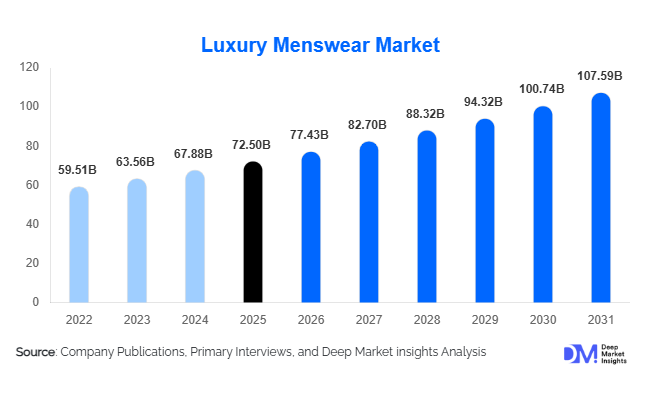
What are the latest trends in the luxury menswear market?
Casualization of Luxury Fashion
The luxury menswear market is witnessing a significant shift toward casual and hybrid styles, driven by evolving workplace norms and lifestyle changes. Consumers are increasingly opting for premium t-shirts, knitwear, and designer athleisure over traditional formalwear. This trend is particularly prominent among millennials and Gen Z consumers who prioritize comfort without compromising on brand value. Luxury brands are responding by expanding their casualwear collections and introducing versatile designs suitable for both work and leisure. Collaborations between luxury houses and streetwear labels have further accelerated this shift, blurring the lines between high fashion and everyday wear.
Digitalization and Omnichannel Retail Growth
Technology is transforming how luxury menswear is marketed and sold. E-commerce platforms, brand-owned websites, and luxury marketplaces are becoming critical sales channels. Brands are leveraging AI-driven personalization, virtual try-ons, and digital showrooms to enhance customer engagement. Omnichannel strategies that integrate physical boutiques with digital platforms are enabling seamless shopping experiences. Social media and influencer marketing are also playing a crucial role in shaping consumer preferences and driving brand visibility, particularly among younger audiences.
What are the key drivers in the luxury menswear market?
Rising Global Affluence and Premiumization
The increasing number of high-net-worth individuals and upper-middle-class consumers globally is a major driver of the luxury menswear market. Emerging economies, particularly in Asia-Pacific and the Middle East, are witnessing rapid growth in disposable incomes, enabling greater spending on premium apparel. Consumers are increasingly viewing luxury clothing as a status symbol and a form of self-expression, driving demand across multiple product categories.
Changing Male Consumer Behavior
Men are becoming more fashion-conscious and willing to invest in premium apparel. The influence of social media, celebrity endorsements, and global fashion trends has significantly altered purchasing behavior. Additionally, the growing acceptance of diverse dress codes in professional environments has expanded the scope of luxury menswear beyond traditional suits and formal attire.
What are the restraints for the global market?
High Product Pricing and Limited Accessibility
The premium pricing of luxury menswear products remains a key barrier to widespread adoption. High costs associated with quality materials, craftsmanship, and brand value restrict the market primarily to affluent consumers. Economic uncertainties and inflationary pressures can further impact discretionary spending, limiting growth potential.
Counterfeit Products and Brand Dilution
The proliferation of counterfeit luxury goods, particularly in emerging markets, poses a significant challenge to market growth. Fake products not only reduce revenue for genuine brands but also undermine brand equity and consumer trust. Companies are increasingly investing in authentication technologies and legal measures to combat this issue.
What are the key opportunities in the luxury menswear industry?
Expansion in Emerging Markets
Emerging economies such as China, India, and the UAE present significant growth opportunities for luxury menswear brands. Rapid urbanization, increasing disposable incomes, and growing exposure to global fashion trends are driving demand in these regions. Localized product offerings and culturally relevant designs can help brands capture a larger share of these markets.
Sustainable and Ethical Fashion
Sustainability is becoming a critical factor influencing consumer decisions in the luxury segment. Brands that adopt eco-friendly materials, ethical sourcing practices, and transparent supply chains can differentiate themselves and attract environmentally conscious consumers. Circular fashion models, including resale and rental platforms, are also gaining traction as new revenue streams.
Report Scope
| Report Metric | Details |
|---|---|
| Market Size in 2025 | USD 72.5 Billion |
| Market Size in 2026 | USD 77.43 Billion |
| Market Size in 2031 | USD 107.59 Billion |
| CAGR | 6.8% (2026-2031) |
| Base Year for Estimation | 2025 |
| Historical Data | 2022-2024 |
| Forecast Period | 2026-2031 |
| Report Coverage | Revenue Forecast, Competitive Landscape, Supply Chain Disruption, Growth Factors, Environment & Regulatory Landscape and Trends |
| Geographies Covered | North America, Europe, APAC, Middle East and Africa, LATAM |
| Countries Covered | U.S., Canada, U.K., Germany, France, Spain, Italy, Russia, Nordic, Benelux, Rest of Europe, China, Korea, Japan, India, Australia, Singapore, Taiwan, South East Asia, Rest of Asia-Pacific, UAE, Turky, Saudi Arabia, South Africa, Egypt, Nigeria, Rest of MEA, Brazil, Mexico, Argentina, Chile, Colombia, Rest of LATAM |
Explore more data points, trends and opportunities Download Free Sample Report
Product Type Insights
Formal wear continues to lead the luxury menswear market, accounting for approximately 32% of the global market share in 2025. This dominance is primarily driven by sustained demand for tailored suits, bespoke garments, and premium business attire among corporate professionals, high-net-worth individuals, and occasion-based buyers. The segment benefits from high margins and strong brand heritage, particularly in Europe, where craftsmanship and tailoring traditions remain deeply rooted. Additionally, the resurgence of in-person corporate engagements and global business travel has reinforced demand for formalwear.
However, casual wear is the fastest-evolving segment, fueled by changing workplace norms, hybrid work models, and increasing preference for comfort-driven luxury. Premium polos, denim, and knitwear are gaining traction among younger consumers. Outerwear, including luxury coats and jackets, performs strongly in colder regions such as Europe and North America, driven by seasonal demand and high product value. Meanwhile, athleisure is emerging as a high-growth category, supported by lifestyle shifts toward wellness and active living. Ethnic and traditional wear remains highly relevant in Asia-Pacific and the Middle East, where cultural events and weddings drive consistent demand, making it a key regional growth lever.
Application Insights
Business and professional wear remains the dominant application segment, contributing approximately 30% of total market demand. This leadership is driven by continued demand from corporate sectors such as finance, consulting, and legal services, where formal dressing remains integral. The segment also benefits from repeat purchases and brand loyalty, particularly among affluent professionals.
Occasion-based wear is one of the fastest-growing applications, especially in Asia-Pacific and the Middle East, where weddings and social events involve high expenditure on luxury attire. This segment is witnessing strong growth due to cultural significance and increasing disposable incomes. Casual lifestyle wear is expanding rapidly as consumers seek versatile, everyday luxury clothing that aligns with modern lifestyles. Additionally, travel and resort wear is gaining momentum, supported by the recovery of global tourism and the expansion of luxury hospitality, driving demand for lightweight, seasonal, and destination-specific apparel.
Distribution Channel Insights
Mono-brand stores dominate the luxury menswear market, accounting for approximately 35% of total sales in 2025. Their leadership is driven by the ability to offer immersive brand experiences, personalized services, and exclusive product lines, which are critical in the luxury segment. Flagship stores in major fashion capitals such as Paris, Milan, and New York continue to serve as key revenue drivers and brand-building platforms.
Multi-brand luxury retailers play a complementary role by offering curated selections and enabling cross-brand comparisons for consumers. However, e-commerce is the fastest-growing distribution channel, driven by increasing digital adoption, convenience, and the growing influence of online luxury marketplaces. Brand-owned websites and luxury e-retail platforms are investing heavily in AI-driven personalization, seamless logistics, and virtual shopping experiences. Duty-free and travel retail channels also contribute significantly, particularly in regions with high tourist inflows such as the Middle East and Europe, where international travelers drive premium purchases.
Consumer Demographics Insights
The 31–50 age group dominates the luxury menswear market, accounting for approximately 40% of total demand in 2025. This segment leads due to higher disposable incomes, established careers, and strong brand affinity, making them the core customer base for luxury brands. Their purchasing behavior is characterized by a preference for quality, exclusivity, and long-term value.
The 18–30 segment is the fastest-growing demographic, driven by increasing exposure to global fashion trends through social media and a rising inclination toward casual and athleisure luxury products. This group is also more receptive to digital shopping channels and influencer-driven marketing. Consumers aged 50 and above represent a stable and high-value segment, with a preference for classic, heritage-driven styles and premium craftsmanship. While high-net-worth individuals remain the primary consumers, the aspirational upper-middle-income segment is expanding rapidly, supported by accessible luxury offerings and entry-level product lines.
Explore more data points, trends and opportunities Download Free Sample Report
Luxury Menswear Market Segmentations
By Product Type
- Formal Wear
- Casual Wear
- Outerwear
- Athleisure & Loungewear
- Ethnic & Traditional Wear
By Application
- Business & Professional Wear
- Occasion Wear
- Casual Lifestyle Wear
- Travel & Resort Wear
By Distribution Channel
- Mono-brand Stores
- Multi-brand Luxury Retailers
- Online Retail
- Duty-Free & Travel Retail
By Consumer Demographics
- 18–30 Years
- 31–50 Years
- 50+ Years
- High-Net-Worth Individuals
- Aspirational Upper-Middle-Income Consumers
Regional Insights
North America
North America accounts for approximately 22% of the global luxury menswear market, with the United States serving as the primary growth engine. The region’s demand is driven by high disposable incomes, a mature retail ecosystem, and strong brand penetration. A key growth driver is the increasing shift toward casual luxury and premium athleisure, reflecting evolving workplace norms and lifestyle preferences. Additionally, the rapid adoption of e-commerce and omnichannel retail strategies has enhanced accessibility and customer engagement. Canada contributes to regional growth through rising urban affluence and increasing adoption of premium fashion, particularly in metropolitan areas.
Europe
Europe leads the global market with a share of approximately 34% in 2025, driven by countries such as Italy, France, and the United Kingdom. The region’s dominance is underpinned by its strong luxury fashion heritage, skilled craftsmanship, and presence of leading global brands. Tourism plays a crucial role, with international travelers contributing significantly to luxury retail sales. Additionally, Europe benefits from a well-established supply chain and manufacturing base for premium textiles and garments. The growing emphasis on sustainability and ethical fashion is also driving innovation and consumer demand across the region.
Asia-Pacific
Asia-Pacific holds nearly 30% of the global market and is the fastest-growing region. China dominates regional demand, driven by a rapidly expanding middle class, increasing brand consciousness, and strong digital luxury adoption. A major growth driver is the rise of aspirational consumers and the expansion of online luxury retail ecosystems. India is emerging as a high-growth market, supported by rising disposable incomes, urbanization, and increasing demand for luxury attire in weddings and social events. Japan and South Korea represent mature markets with steady demand, characterized by high brand loyalty and preference for premium quality products.
Latin America
Latin America accounts for approximately 6% of the global market, with Brazil and Mexico as key contributors. Growth in this region is driven by rising urbanization and increasing exposure to global fashion trends. However, economic volatility and currency fluctuations pose challenges to consistent market expansion. Despite these constraints, the growing affluent population in major cities is supporting demand for luxury menswear, particularly in premium retail outlets and shopping malls.
Middle East & Africa
The Middle East & Africa region is experiencing the fastest growth, with a projected CAGR exceeding 8% during the forecast period. Countries such as the UAE and Saudi Arabia are leading demand, driven by high per capita income, luxury-oriented lifestyles, and a strong preference for premium and designer apparel. The region also benefits from robust tourism and a thriving duty-free retail sector. Cultural factors, including high spending on weddings and traditional attire, further support market growth. Additionally, government initiatives aimed at diversifying economies and promoting retail and tourism sectors are creating favorable conditions for luxury menswear expansion.