Luxury Invitation Market Size
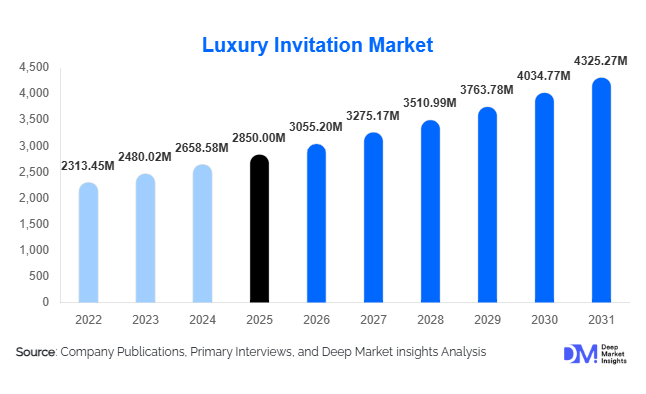
According to Deep Market Insights, the global luxury invitation market size was valued at USD 2,850 million in 2025 and is projected to grow from USD 3,055.20 million in 2026 to reach USD 4,325.27 million by 2031, expanding at a CAGR of 7.2% during the forecast period (2026–2031). The luxury invitation market growth is primarily driven by rising demand for personalized premium event experiences, increasing global wedding expenditure, and the growing importance of visual aesthetics in social and corporate events. The integration of advanced printing techniques, premium materials such as acrylic and velvet, and the emergence of digital luxury invitations are further shaping market expansion globally.
Key Market Insights
- Wedding invitations dominate the market, accounting for over 55% of global demand due to high spending on elaborate ceremonies.
- Fully customized invitations are gaining strong traction, driven by consumer preference for exclusivity and personalization.
- Asia-Pacific leads the market, supported by large-scale weddings and cultural emphasis on luxury celebrations.
- Digital luxury invitations are the fastest-growing segment, driven by tech-savvy consumers and convenience factors.
- Eco-friendly luxury invitations are emerging, reflecting increasing sustainability awareness among consumers.
- Corporate demand is rising rapidly, with premium invitations being used for branding and high-profile events.
What are the latest trends in the luxury invitation market?
Rise of Digital and Interactive Invitations
The luxury invitation market is witnessing a shift toward digital formats, including animated video invitations, QR-enabled interactive designs, and augmented reality-based experiences. These digital invitations combine convenience with high-end aesthetics, appealing to younger consumers and corporate clients. Event hosts are increasingly integrating multimedia storytelling, enabling recipients to engage with event details dynamically. This trend is particularly strong in urban markets where digital adoption is high and environmental concerns are influencing purchasing decisions.
Sustainable and Eco-Friendly Materials
Sustainability has become a key trend in the luxury invitation market, with rising demand for recycled paper, seed paper, and biodegradable materials. Consumers are seeking environmentally responsible options without compromising on luxury appeal. Manufacturers are responding by innovating with organic inks, reusable materials, and minimalistic packaging. This trend is especially prominent in Europe and North America, where regulatory pressures and consumer awareness are higher.
What are the key drivers in the luxury invitation market?
Growth of the Global Wedding Industry
The expansion of the global wedding industry is a major driver of the luxury invitation market. Countries like India and China host millions of weddings annually, many of which involve significant spending on premium invitations. Destination weddings and themed events further amplify demand for customized luxury invitations, contributing to higher market growth.
Increasing Demand for Personalization
Consumers are increasingly prioritizing unique and personalized invitations that reflect their identity and event theme. Fully customized invitations, incorporating bespoke designs, materials, and printing techniques, are becoming the preferred choice. This trend has increased the average selling price and boosted profit margins for manufacturers.
What are the restraints for the global market?
High Cost of Premium Invitations
Luxury invitations often involve expensive materials and intricate production processes, resulting in high costs. This limits their adoption among price-sensitive consumers and restricts market growth in lower-income segments.
Shift Toward Digital Alternatives
The increasing adoption of digital invitations poses a challenge to traditional luxury invitation manufacturers. While digital formats offer convenience and cost savings, they can reduce demand for physical invitations, impacting revenue growth in certain segments.
What are the key opportunities in the luxury invitation industry?
Expansion in Emerging Markets
Emerging economies such as India, Indonesia, and the UAE present significant growth opportunities due to rising disposable incomes and increasing expenditure on weddings and events. Localized designs and culturally relevant offerings can help companies capture market share in these regions.
Integration of Advanced Technologies
The adoption of augmented reality, blockchain-based invitations, and digital customization platforms offers new growth avenues. Companies investing in technology-driven solutions can enhance customer engagement and differentiate their offerings in a competitive market.
Report Scope
| Report Metric | Details |
|---|---|
| Market Size in 2025 | USD 2850 Million |
| Market Size in 2026 | USD 3055.20 Million |
| Market Size in 2031 | USD 4325.27 Million |
| CAGR | 7.2% (2026-2031) |
| Base Year for Estimation | 2025 |
| Historical Data | 2022-2024 |
| Forecast Period | 2026-2031 |
| Report Coverage | Revenue Forecast, Competitive Landscape, Supply Chain Disruption, Growth Factors, Environment & Regulatory Landscape and Trends |
| Geographies Covered | North America, Europe, APAC, Middle East and Africa, LATAM |
| Countries Covered | U.S., Canada, U.K., Germany, France, Spain, Italy, Russia, Nordic, Benelux, Rest of Europe, China, Korea, Japan, India, Australia, Singapore, Taiwan, South East Asia, Rest of Asia-Pacific, UAE, Turky, Saudi Arabia, South Africa, Egypt, Nigeria, Rest of MEA, Brazil, Mexico, Argentina, Chile, Colombia, Rest of LATAM |
Explore more data points, trends and opportunities Download Free Sample Report
Product Type Insights
Wedding invitations dominate the luxury invitation market, accounting for approximately 58% of the total market share in 2025. This segment’s leadership is primarily driven by the global expansion of the wedding industry, particularly in high-spending regions such as Asia-Pacific and the Middle East, where invitations are considered a symbol of status and the first impression of the event. These invitations typically incorporate premium materials such as handmade paper, velvet, acrylic, and metal, along with advanced techniques like foil stamping, embossing, and laser cutting. Increasing demand for destination weddings and themed ceremonies has further accelerated customization, significantly raising average order values.
Corporate invitations are gaining momentum, particularly for product launches, investor meetings, and executive networking events, as companies increasingly use premium invitations as part of brand positioning and experiential marketing strategies. Meanwhile, social event invitations such as birthdays, anniversaries, and private gatherings continue to provide steady demand, supported by rising urbanization and lifestyle upgrades. Digital luxury invitations are emerging as the fastest-growing category, driven by increasing smartphone penetration, demand for convenience, and integration of multimedia elements such as video, animation, and QR-based interactivity.
Application Insights
Personal events, particularly weddings and anniversaries, represent the largest application segment, driven by high emotional value, cultural importance, and significant discretionary spending. This segment continues to expand due to increasing consumer inclination toward unique, personalized experiences and visually appealing event branding. The willingness of consumers to invest in premium invitations as a reflection of social status and event theme is a key growth driver.
Corporate applications are expanding rapidly and are among the fastest-growing segments, with companies increasingly leveraging luxury invitations as strategic branding tools for high-profile events, product launches, and VIP gatherings. The rise of experiential marketing and corporate hospitality has further strengthened this segment. Social gatherings such as private parties, milestone celebrations, and baby showers are also contributing to market growth, particularly in urban centers. Additionally, niche applications such as NFT-based invitations and blockchain-enabled access passes are beginning to emerge in technologically advanced markets, offering exclusivity, traceability, and enhanced guest engagement.
Distribution Channel Insights
Offline channels, including boutique stores, luxury stationery outlets, and wedding planners, dominate the luxury invitation market with over 55% share, as consumers prefer tactile evaluation of materials, finishes, and craftsmanship before making high-value purchases. The personalized consultation offered by these channels, especially for weddings and large events, remains a critical driver of their dominance.
However, online platforms are growing at a significantly faster pace, supported by the increasing adoption of digital tools, convenience, and broader product accessibility. E-commerce platforms and direct-to-consumer brand websites are integrating advanced customization features such as real-time previews, AI-based design recommendations, and interactive templates. This shift is particularly strong among younger consumers and in urban markets, where digital adoption is high. Hybrid models, where customers explore designs online and finalize purchases offline, are also emerging as a key trend, bridging the gap between convenience and experiential buying.
End-User Insights
Individual consumers account for the largest share of the market, contributing around 62% of total demand, primarily driven by weddings and personal celebrations. The dominance of this segment is fueled by emotional spending behavior, increasing disposable income, and the growing importance of social media aesthetics in event planning.
Corporate clients represent the fastest-growing segment, driven by increasing investments in premium branding, client engagement, and exclusive event experiences. Companies are using luxury invitations to enhance brand perception and create memorable impressions among stakeholders. Event management companies and wedding planners are also playing a crucial role as intermediaries, influencing purchasing decisions and driving bulk demand. Their expertise in design selection, vendor coordination, and theme alignment makes them key contributors to market expansion.
Explore more data points, trends and opportunities Download Free Sample Report
Luxury Invitation Market Segmentations
By Product Type
- Wedding Invitations
- Corporate Invitations
- Social Event Invitations
- Digital Luxury Invitations
By Application
- Personal Events
- Corporate Events
- Social Gatherings
- Emerging Applications
By Distribution Channel
- Online Platforms
- Boutique Stores
- Wedding Planners/Event Agencies
- Luxury Stationery Stores
By End-User
- Individual Consumers
- Corporate Clients
- Event Management Companies
- Wedding Planners
Regional Insights
North America
North America holds approximately 25% of the global luxury invitation market share, with the United States being the dominant contributor. Growth in this region is driven by high disposable incomes, a strong culture of personalized celebrations, and the widespread adoption of premium lifestyle products. The region also benefits from a well-established corporate sector that frequently invests in high-end event branding. Additionally, advanced digital infrastructure supports the rapid adoption of digital luxury invitations. The increasing demand for eco-friendly and sustainable products, driven by environmentally conscious consumers and regulatory frameworks, is further shaping market growth in North America.
Europe
Europe accounts for around 20% of the market, with countries such as the UK, France, Germany, and Italy leading demand. The region’s growth is primarily driven by strong design heritage, emphasis on craftsmanship, and increasing demand for sustainable luxury products. European consumers prefer high-quality materials, minimalist aesthetics, and eco-conscious production methods. Regulatory pressures promoting sustainability and the adoption of recycled materials are also key drivers. Additionally, the growing trend of intimate and themed events is supporting demand for customized luxury invitations across the region.
Asia-Pacific
Asia-Pacific dominates the global market with nearly 38% share in 2025, led by India and China. India alone contributes around 18% of global demand, driven by a high volume of weddings, strong cultural emphasis on elaborate invitations, and increasing spending on luxury celebrations. China is witnessing rising demand due to urbanization and growing middle-class affluence. The region is also the fastest-growing, with a CAGR exceeding 8%, supported by rising disposable incomes, expansion of the wedding industry, and increasing influence of social media trends. Additionally, the presence of cost-effective manufacturing hubs and export capabilities further strengthens Asia-Pacific’s dominance in the global market.
Latin America
Latin America contributes approximately 7% of the global market, with Brazil and Mexico being the key contributors. Market growth in this region is driven by increasing urbanization, rising middle-class income levels, and growing adoption of premium lifestyle products. Cultural emphasis on celebrations and family events also supports demand for luxury invitations. However, price sensitivity remains a challenge, leading to higher demand for affordable luxury options. The gradual expansion of digital platforms is expected to further accelerate growth in the region.
Middle East & Africa
The Middle East & Africa region holds around 10% of the market, with the UAE and Saudi Arabia leading demand. Growth in this region is driven by high disposable incomes, strong preference for luxury and opulence, and the cultural significance of grand weddings and events. Invitations in this region often feature ultra-premium materials such as gold foiling, metal inserts, and elaborate packaging. Government initiatives promoting tourism and luxury events, particularly in the UAE, are also contributing to market growth. In Africa, the market is gradually expanding, supported by increasing urbanization and the development of event management industries.
Key Players in the Luxury Invitation Market
- American Greetings Corporation
- Hallmark Cards Inc.
- Minted LLC
- Shutterfly Inc.
- Papier Ltd.
- Rifle Paper Co.
- Crane & Co.
- Smythson of Bond Street
- Wedding Paper Divas
- Basic Invite
- Artifact Uprising
- Vistaprint (Cimpress Plc)
- Ellie Ellie Ltd.
- Paper Source Inc.
- The Knot Worldwide Inc.