Luxury Hats Market Size
According to Deep Market Insights, the global luxury hats market size was valued at USD 1,850 million in 2025 and is projected to grow from USD 1,962.85 million in 2026 to reach USD 2,639.15 million by 2031, expanding at a CAGR of 6.1% during the forecast period (2026–2031). The luxury hats market growth is primarily driven by increasing global demand for premium fashion accessories, rising disposable incomes among affluent consumers, and the resurgence of heritage fashion trends supported by celebrity influence and social media.
Key Market Insights
- Luxury hats are increasingly positioned as statement fashion accessories, moving beyond functional use to become integral elements of premium styling.
- Europe dominates the global market, supported by strong heritage craftsmanship and the presence of leading luxury fashion houses.
- Asia-Pacific is the fastest-growing region, driven by rising high-net-worth individuals and increasing adoption of Western luxury fashion.
- Offline retail remains dominant, as consumers prefer personalized fittings and in-store luxury experiences.
- Sustainability trends are influencing purchasing decisions, with demand rising for ethically sourced materials and eco-friendly production processes.
- Digital transformation and customization technologies, including AI-based personalization and virtual try-ons, are reshaping customer engagement.
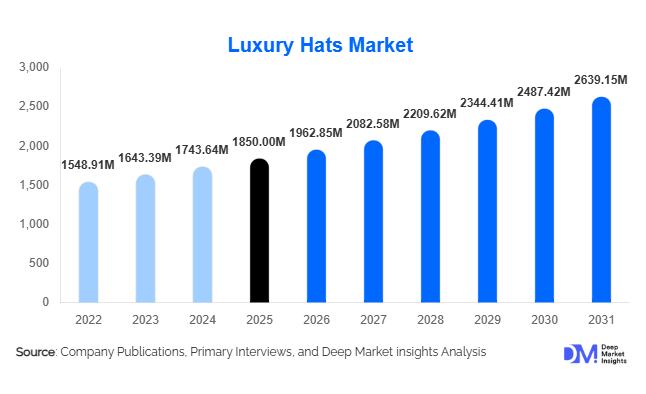
What are the latest trends in the luxury hats market?
Rise of Sustainable and Ethical Luxury Hats
Sustainability has become a central trend in the luxury hats market, with consumers increasingly demanding transparency in sourcing and production. Brands are adopting organic fibers, cruelty-free felt alternatives, and recycled textiles to align with environmentally conscious buyers. Ethical production practices, including fair wages and artisanal craftsmanship, are being emphasized as differentiators. Luxury brands are also introducing limited collections using eco-certified materials and incorporating traceability into their supply chains. This shift is particularly prominent among younger consumers, who value sustainability alongside brand prestige, driving long-term transformation in the market.
Digital Customization and Direct-to-Consumer Expansion
Technological innovation is transforming how luxury hats are designed and sold. AI-powered customization platforms enable customers to personalize size, material, color, and embellishments, enhancing the perceived value of products. Virtual try-on technologies allow consumers to visualize products before purchase, reducing return rates and improving satisfaction. Additionally, brands are increasingly adopting direct-to-consumer (D2C) strategies through e-commerce platforms, enabling better control over pricing, branding, and customer relationships. Social media integration and influencer collaborations are further accelerating online sales, particularly among younger demographics seeking unique and personalized fashion statements.
What are the key drivers in the luxury hats market?
Growing Global Luxury Consumption
The expansion of high-net-worth populations and increasing disposable incomes are driving demand for premium fashion accessories, including luxury hats. Consumers are willing to invest in high-quality, artisanal products that reflect exclusivity and status. This trend is particularly strong in emerging markets such as China, India, and the Middle East, where luxury consumption is rapidly growing.
Influence of Fashion Trends and Celebrity Culture
Luxury hats have regained popularity due to strong influence from fashion weeks, celebrity endorsements, and cultural events. Social media platforms amplify these trends, making hats a key styling element. High-profile events such as weddings, horse racing, and fashion shows have contributed to renewed interest in statement headwear.
Expansion of Occasion-Based Fashion
The growing importance of events and experiential fashion has increased demand for luxury hats. Occasions such as weddings, cultural festivals, and luxury travel experiences require distinctive accessories, driving incremental sales and expanding the market beyond traditional use cases.
What are the restraints for the global market?
Limited Purchase Frequency
Luxury hats are not frequently purchased compared to other apparel items, which limits volume growth. Consumers typically buy hats for specific occasions, resulting in lower repeat purchase rates and making the market reliant on new customer acquisition.
High Production Costs and Material Volatility
The use of premium materials such as wool, leather, and straw, combined with artisanal craftsmanship, leads to high production costs. Fluctuations in raw material prices can impact profit margins, while the reliance on skilled labor limits scalability and increases operational complexity.
What are the key opportunities in the luxury hats industry?
Expansion into Emerging Luxury Markets
Emerging economies in the Asia-Pacific and the Middle East present significant growth opportunities. Rising disposable incomes and increasing luxury awareness are driving demand for premium accessories. Brands that localize designs to suit cultural preferences can capture a larger share of these markets.
Sustainable Product Innovation
The growing demand for eco-friendly products offers opportunities for brands to innovate with sustainable materials and processes. Companies investing in ethical sourcing, biodegradable materials, and transparent supply chains can differentiate themselves and attract environmentally conscious consumers.
Technology-Driven Personalization
Advancements in digital technologies enable brands to offer customized products at scale. AI-driven personalization, virtual fitting tools, and made-to-order manufacturing enhance customer experience and support premium pricing strategies, creating new revenue streams.
Report Scope
| Report Metric | Details |
|---|---|
| Market Size in 2025 | USD 1850 Million |
| Market Size in 2026 | USD 1962.85 Million |
| Market Size in 2031 | USD 2639.15 Million |
| CAGR | 6.1% (2026-2031) |
| Base Year for Estimation | 2025 |
| Historical Data | 2022-2024 |
| Forecast Period | 2026-2031 |
| Report Coverage | Revenue Forecast, Competitive Landscape, Supply Chain Disruption, Growth Factors, Environment & Regulatory Landscape and Trends |
| Geographies Covered | North America, Europe, APAC, Middle East and Africa, LATAM |
| Countries Covered | U.S., Canada, U.K., Germany, France, Spain, Italy, Russia, Nordic, Benelux, Rest of Europe, China, Korea, Japan, India, Australia, Singapore, Taiwan, South East Asia, Rest of Asia-Pacific, UAE, Turky, Saudi Arabia, South Africa, Egypt, Nigeria, Rest of MEA, Brazil, Mexico, Argentina, Chile, Colombia, Rest of LATAM |
Explore more data points, trends and opportunities Download Free Sample Report
Product Type Insights
Formal hats, including fedoras, top hats, and cloche hats, dominate the luxury hats market with approximately 32% share in 2025, primarily driven by their enduring association with heritage fashion and premium brand identity. The segment’s leadership is reinforced by strong demand from formal events, luxury social gatherings, and high-fashion occasions where structured headwear is considered a symbol of sophistication. Additionally, luxury fashion houses continue to reintroduce classic silhouettes in modern designs, sustaining global appeal across both mature and emerging markets.
Casual luxury hats, such as Panama hats and wide-brim styles, are witnessing robust growth, particularly among younger and fashion-forward consumers. This growth is driven by increasing adoption of relaxed luxury aesthetics, resort wear trends, and social media influence, where versatile styling is prioritized. Seasonal hats, including summer straw hats and winter wool variants, maintain stable demand due to climate-driven consumption patterns, especially in regions with pronounced seasonal variations. Designer and couture hats, although niche, represent a high-margin segment characterized by bespoke craftsmanship and exclusivity. This segment is driven by ultra-high-net-worth individuals and fashion collectors, with demand concentrated around runway fashion, celebrity endorsements, and limited-edition releases.
Material Insights
Natural premium materials such as wool felt and fur felt account for nearly 38% of the global market, making them the leading segment due to their superior durability, comfort, and premium tactile experience. The dominance of this segment is further supported by strong consumer perception of authenticity and craftsmanship, particularly in Europe and North America, where heritage manufacturing plays a key role. Luxury fabric-based materials, including silk, velvet, and cashmere, are extensively used in high-fashion and couture hats. These materials cater to consumers seeking aesthetic differentiation and exclusivity, especially in designer collections and event-specific headwear.
Sustainable materials are emerging as the fastest-growing segment, driven by increasing environmental awareness and regulatory pressure on ethical sourcing. The adoption of organic fibers, recycled textiles, and cruelty-free alternatives is gaining momentum, particularly among younger consumers and in regions with strong sustainability mandates. This shift is expected to significantly influence material innovation and supply chain strategies over the forecast period.
Distribution Channel Insights
Offline retail channels dominate the luxury hats market, accounting for approximately 60% of total sales in 2025. The leadership of this segment is driven by the importance of experiential retail in the luxury sector, where consumers prioritize personalized services, product trials, and brand immersion. High-end boutiques, department stores, and specialty hat retailers play a critical role in delivering tailored customer experiences, including custom fittings and styling consultations.
However, online retail is emerging as the fastest-growing channel, supported by the rapid expansion of luxury e-commerce platforms and direct-to-consumer strategies. Growth in this segment is driven by increasing digital adoption, global accessibility, and the integration of advanced technologies such as virtual try-ons and AI-driven recommendations. Brands are leveraging digital channels to reach younger consumers and expand their geographic footprint, particularly in emerging markets where physical retail presence is limited.
End-Use Insights
Fashion and lifestyle applications dominate the market, accounting for approximately 50% of total demand in 2025. The leadership of this segment is driven by the increasing integration of hats into everyday fashion, supported by evolving consumer preferences for statement accessories and premium styling. The influence of social media, fashion influencers, and global fashion trends has further accelerated adoption across diverse consumer segments. Events and ceremonies represent the fastest-growing end-use segment, driven by rising demand for luxury accessories in weddings, horse racing events, and cultural festivals. This segment benefits from the growing trend of occasion-based fashion, where consumers invest in distinctive and high-quality accessories for specific events.
Travel and leisure applications are also expanding, particularly within the luxury tourism sector, where hats serve both functional and aesthetic purposes. Additionally, cultural and traditional uses continue to sustain demand in regions such as Europe and parts of Asia, where headwear holds historical and cultural significance, contributing to long-term market stability.
Explore more data points, trends and opportunities Download Free Sample Report
Luxury Hats Market Segmentations
By Product Type
- Formal Hats
- Casual Luxury Hats
- Seasonal Hats
- Designer & Couture Hats
By Material
- Natural Premium Materials
- Luxury Fabrics
- Sustainable Materials
By Distribution Channel
- Offline Retail
- Online Retail
By End-Use
- Fashion & Lifestyle
- Events & Ceremonies
- Travel & Leisure
- Cultural & Traditional Use
Regional Insights
Europe
Europe leads the global luxury hats market with approximately 38% share in 2025, driven by key countries such as the UK, Italy, and France. The region’s dominance is underpinned by its strong heritage in hat-making craftsmanship, the presence of globally renowned luxury fashion houses, and deep-rooted cultural traditions associated with headwear. Events such as horse racing, royal ceremonies, and fashion weeks significantly contribute to sustained demand.
Growth in Europe is further driven by high consumer preference for artisanal and handcrafted products, as well as strong tourism inflows that boost luxury retail sales. Additionally, sustainability regulations and consumer awareness are encouraging brands to innovate in eco-friendly materials, further strengthening the region’s leadership position.
North America
North America accounts for approximately 28% of the global market, with the United States serving as the primary demand hub. The region’s growth is driven by high disposable incomes, strong luxury consumption patterns, and the influence of celebrity culture and entertainment industries. Luxury hats are increasingly adopted as fashion statements, supported by widespread media exposure and social media trends.
Another key driver is the region’s advanced retail infrastructure, including both premium offline stores and highly developed e-commerce platforms. The rapid adoption of digital technologies and direct-to-consumer models is further accelerating market expansion, particularly among younger consumers.
Asia-Pacific
Asia-Pacific is the fastest-growing region, with a projected CAGR exceeding 7.5% during the forecast period. China dominates the regional market, accounting for nearly 40% of Asia-Pacific demand, followed by Japan and South Korea. Growth is driven by rising disposable incomes, rapid urbanization, and increasing exposure to global luxury fashion trends. The expansion of the affluent middle class and the growing number of high-net-worth individuals are key drivers of demand. Additionally, the influence of digital platforms, celebrity endorsements, and cross-border e-commerce is accelerating adoption. India is emerging as a high-potential market, supported by increasing luxury awareness, evolving fashion preferences, and government initiatives promoting domestic manufacturing.
Latin America
Latin America represents a smaller share of the global market but is experiencing steady growth, led by Brazil and Mexico. The region’s growth is driven by increasing urbanization, rising disposable incomes among affluent consumers, and greater exposure to global fashion trends through digital channels. Demand is primarily concentrated in urban centers, where consumers are more inclined toward premium and branded products. The expansion of luxury retail infrastructure and the growing influence of international fashion brands are expected to support continued market growth in the region.
Middle East & Africa
The Middle East & Africa region shows strong growth potential, particularly in the UAE and Saudi Arabia, where high purchasing power and a strong preference for luxury goods drive demand. The region benefits from a high concentration of affluent consumers and a well-established luxury retail ecosystem, including premium malls and designer boutiques. Growth is further supported by increasing tourism, which drives sales of luxury accessories, and government initiatives aimed at diversifying economies through retail and tourism development. In Africa, demand remains relatively limited but is gradually increasing in key markets such as South Africa, supported by rising urbanization and growing exposure to global luxury brands.