Luxury Baby Clothing Market Size
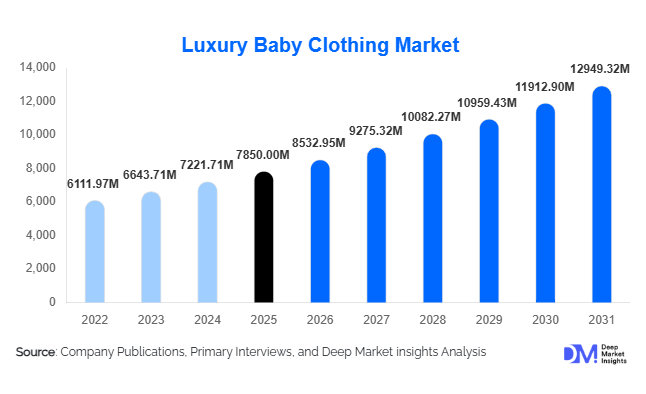
According to Deep Market Insights, the global luxury baby clothing market size was valued at USD 7,850 million in 2025 and is projected to grow from USD 8,532.95 million in 2026 to reach USD 12,949.32 million by 2031, expanding at a CAGR of 8.7% during the forecast period (2026–2031). The luxury baby clothing market is experiencing growth primarily driven by increasing premiumization in baby products, rising disposable incomes among millennial parents, and a growing demand for sustainable and high-quality infant apparel.
Key Market Insights
- Luxury baby apparel dominates the market, accounting for over 60% of total demand due to its everyday usage and higher purchase frequency.
- Organic and sustainable fabrics are becoming mainstream, with organic cotton emerging as the leading material segment.
- Europe leads the global market, supported by heritage luxury brands and strong export capabilities.
- Asia-Pacific is the fastest-growing region, driven by rising affluent populations in China and India.
- E-commerce platforms are transforming distribution, contributing to over 40% of global sales.
- Customization and personalization trends are reshaping consumer preferences, particularly in premium gifting segments.
What are the latest trends in the luxury baby clothing market?
Sustainable and Organic Clothing Gaining Momentum
The shift toward sustainability is one of the most prominent trends in the luxury baby clothing market. Consumers are increasingly prioritizing organic, chemical-free fabrics such as organic cotton and bamboo due to concerns over infant skin sensitivity and environmental impact. Brands are responding by introducing certified sustainable collections, emphasizing transparency in sourcing and manufacturing. Eco-labeling, biodegradable packaging, and carbon-neutral production processes are becoming standard among premium players. This trend is particularly strong in Europe and North America, where regulatory frameworks and consumer awareness are driving adoption. Luxury brands are also integrating ethical labor practices and fair-trade certifications, reinforcing brand trust and long-term loyalty among environmentally conscious parents.
Digital-First and Direct-to-Consumer Expansion
The rapid expansion of e-commerce and direct-to-consumer (DTC) models is reshaping how luxury baby clothing is marketed and sold. Online platforms now account for a significant share of global sales, enabling brands to reach a wider audience without relying heavily on traditional retail channels. Advanced technologies such as AI-driven recommendations, virtual try-ons, and personalized shopping experiences are enhancing customer engagement. Social media platforms and influencer marketing are also playing a critical role in driving brand visibility and aspirational buying behavior. This digital shift is particularly impactful in emerging markets, where physical luxury retail infrastructure is still developing but online penetration is high.
What are the key drivers in the luxury baby clothing market?
Rising Affluent Parenting and Premium Spending Behavior
The increasing number of high-income households globally is a major driver of the luxury baby clothing market. Millennial and Gen Z parents are more inclined to invest in premium products that ensure quality, comfort, and brand value for their children. This demographic prioritizes aesthetics and lifestyle branding, often influenced by social media and celebrity endorsements. The willingness to spend on luxury baby apparel is particularly high in urban centers, where dual-income households have greater purchasing power.
Growing Focus on Safety, Comfort, and Quality
Parents are increasingly prioritizing safety and comfort in baby clothing, driving demand for high-quality materials and superior craftsmanship. Luxury baby clothing brands differentiate themselves by offering hypoallergenic fabrics, seamless stitching, and ergonomic designs that enhance comfort. Regulatory standards in developed markets further encourage the adoption of high-quality materials, reinforcing consumer confidence in premium products.
What are the restraints for the global market?
High Cost and Limited Product Lifecycle
Luxury baby clothing products are relatively expensive, and their usage is limited due to rapid growth in infants and toddlers. This reduces repeat purchase frequency for certain categories, particularly in price-sensitive markets. While affluent consumers are less affected, this remains a key barrier to broader market penetration.
Counterfeit Products and Brand Dilution
The proliferation of counterfeit luxury baby clothing, especially through online channels, poses a significant challenge for established brands. These products often mimic high-end designs at lower prices, undermining brand value and eroding consumer trust. Addressing this issue requires robust supply chain monitoring and digital authentication technologies.
What are the key opportunities in the luxury baby clothing industry?
Expansion in Emerging Luxury Markets
Emerging economies such as China, India, and the UAE present significant growth opportunities due to rising disposable incomes and increasing brand consciousness. These markets are witnessing a surge in affluent consumers who are willing to invest in premium baby products. Localization strategies, including culturally relevant designs and targeted marketing campaigns, can help brands capture this growing demand.
Personalization and Customization Offerings
Customization is becoming a key differentiator in the luxury baby clothing market. Personalized products such as monogrammed outfits, made-to-order designs, and curated gift sets are gaining popularity, particularly in the gifting segment. This trend not only enhances customer experience but also allows brands to command higher margins and build stronger emotional connections with consumers.
Report Scope
| Report Metric | Details |
|---|---|
| Market Size in 2025 | USD 7850 Million |
| Market Size in 2026 | USD 8532.95 Million |
| Market Size in 2031 | USD 12949.32 Million |
| CAGR | 8.7% (2026-2031) |
| Base Year for Estimation | 2025 |
| Historical Data | 2022-2024 |
| Forecast Period | 2026-2031 |
| Report Coverage | Revenue Forecast, Competitive Landscape, Supply Chain Disruption, Growth Factors, Environment & Regulatory Landscape and Trends |
| Geographies Covered | North America, Europe, APAC, Middle East and Africa, LATAM |
| Countries Covered | U.S., Canada, U.K., Germany, France, Spain, Italy, Russia, Nordic, Benelux, Rest of Europe, China, Korea, Japan, India, Australia, Singapore, Taiwan, South East Asia, Rest of Asia-Pacific, UAE, Turky, Saudi Arabia, South Africa, Egypt, Nigeria, Rest of MEA, Brazil, Mexico, Argentina, Chile, Colombia, Rest of LATAM |
Explore more data points, trends and opportunities Download Free Sample Report
Product Type Insights
Luxury baby apparel dominates the market, accounting for approximately 62% of total revenue in 2025, making it the leading segment globally. This dominance is primarily driven by high purchase frequency and essential usage patterns, as products such as bodysuits, sleepwear, tops, and outerwear are required daily. Infants and toddlers outgrow clothing rapidly, leading to recurring purchases, which significantly boost volume demand compared to other segments. Additionally, parents increasingly prefer premium-quality fabrics for everyday wear, particularly organic and hypoallergenic materials, further strengthening this segment’s growth.
Luxury occasion wear, although smaller in volume, is a high-margin segment, driven by demand for special events such as christenings, birthdays, and family celebrations. This segment benefits from premium pricing due to intricate designs, superior craftsmanship, and limited-edition collections. Meanwhile, accessories such as hats, socks, bibs, and booties play a complementary role, contributing to cross-selling opportunities and increasing average order value. The overall growth of the product type segment is therefore anchored by the strong and consistent demand for everyday luxury apparel, supported by premiumization trends and increasing consumer awareness regarding baby comfort and safety.
Application Insights
Everyday wear remains the primary application for luxury baby clothing, accounting for the majority of consumption globally. This segment is driven by rising adoption among affluent households that increasingly view luxury baby clothing as a necessity rather than an occasional indulgence. Parents are prioritizing quality, durability, and comfort, leading to a shift from mass-market products to premium alternatives even for daily use. The gifting segment is one of the fastest-growing applications, supported by cultural practices such as baby showers, birthdays, and festive occasions. In regions like Asia-Pacific and the Middle East, premium baby clothing is widely perceived as a status symbol, significantly boosting demand for luxury gifting products. The growth of curated gift sets and personalized offerings is further accelerating this segment.
Institutional applications, including premium hospitals and maternity clinics, are emerging as a high-potential niche segment. These institutions are increasingly offering branded newborn kits and luxury baby essentials as part of their service differentiation strategies. The expansion of premium healthcare infrastructure and focus on enhanced patient experience are expected to drive further demand in this segment over the coming years.
Distribution Channel Insights
E-commerce platforms lead the distribution landscape, accounting for approximately 41% of global sales in 2025. The segment’s leadership is driven by convenience, global accessibility, and wider product assortment, allowing consumers to access international luxury brands without geographical constraints. The integration of AI-driven recommendations, personalized shopping experiences, and influencer-led marketing has further accelerated online sales. Brand-owned retail stores and luxury department stores continue to play a crucial role, particularly in developed markets, by offering premium in-store experiences and strengthening brand positioning. These channels are essential for high-value purchases where tactile experience and brand engagement are critical. Specialty baby boutiques cater to niche consumers seeking curated and exclusive collections, often focusing on artisanal and sustainable products.
The growing adoption of omnichannel retail strategies is a key driver across all distribution channels, enabling seamless integration between online and offline platforms. This approach enhances customer experience, improves brand loyalty, and increases overall conversion rates.
End-User Insights
Individual consumers, primarily parents, represent the largest end-user segment, accounting for nearly 70% of total demand in 2025. This segment’s dominance is driven by increasing awareness of product quality, safety, and comfort, along with a growing willingness among parents to invest in premium products for their children. The influence of social media and parenting communities has further reinforced the preference for branded and high-quality baby clothing. The gifting segment is expanding at a faster pace, supported by rising disposable incomes and evolving cultural practices. Luxury baby clothing is increasingly being purchased as a premium gift, particularly in emerging markets where gifting holds strong cultural significance.
Institutional buyers, including hospitals and maternity clinics, are gradually emerging as a new demand segment. Their growth is driven by premiumization in healthcare services, where providers aim to enhance patient experience through curated offerings. The diversification of end-user segments is contributing to broader market expansion and creating new revenue streams for manufacturers.
Explore more data points, trends and opportunities Download Free Sample Report
Luxury Baby Clothing Market Segmentations
By Product Type
- Luxury Baby Apparel
- Luxury Baby Accessories
- Luxury Occasion Wear
By Application
- Everyday Wear
- Gifting
- Institutional Use
By Distribution Channel
- E-commerce Platforms
- Brand-Owned Retail Stores
- Luxury Department Stores
- Specialty Baby Boutiques
By Material Type
- Organic Cotton
- Cashmere
- Silk
- Wool
- Blended Premium Fabrics
By End-User
- Individual Consumers
- Gifting Buyers
- Institutional Buyers
Regional Insights
North America
North America accounts for approximately 28% of the global market, with the United States being the dominant contributor. Regional growth is driven by high disposable incomes, strong brand consciousness, and early adoption of premium lifestyle products. The presence of a well-established luxury retail ecosystem and high penetration of e-commerce platforms further supports market expansion. Additionally, increasing demand for organic and sustainable baby clothing is a key driver, as consumers in this region prioritize safety and environmental responsibility. The influence of social media and celebrity parenting trends also plays a significant role in shaping purchasing behavior.
Europe
Europe holds the largest market share at around 32% in 2025, led by countries such as France, Italy, and the UK. The region’s dominance is driven by its strong heritage in luxury fashion and presence of globally recognized brands. Europe is also a major exporter of luxury baby clothing, supplying high-end products to international markets. Growth is further supported by stringent quality standards and increasing demand for sustainable textiles, particularly organic and ethically produced fabrics. Government regulations promoting eco-friendly manufacturing and high consumer awareness regarding sustainability continue to strengthen the regional market.
Asia-Pacific
Asia-Pacific is the fastest-growing region, with a CAGR exceeding 10%, driven by rapid economic development and rising affluent populations. China leads the region, contributing approximately 15% of global demand, followed by India and Japan. Growth drivers include increasing urbanization, expanding middle-class wealth, and growing exposure to global luxury brands. Additionally, strong cultural emphasis on gifting and rising birth rates among high-income households are fueling demand. The rapid expansion of e-commerce platforms and digital payment systems is further accelerating market penetration in this region.
Latin America
Latin America contributes around 5% of the global market, with Brazil and Mexico as key contributors. Regional growth is supported by increasing urbanization, gradual rise in disposable incomes, and expanding retail infrastructure. While economic volatility poses challenges, the growing influence of global fashion trends and increasing penetration of online retail channels are driving demand for luxury baby clothing. The region is also witnessing rising adoption of premium products among affluent consumers, particularly in metropolitan areas.
Middle East & Africa
The Middle East & Africa region holds approximately 7% of the market, with the UAE and Saudi Arabia leading demand. Growth in this region is primarily driven by high per capita income, a strong culture of luxury consumption, and significant spending on gifting. Luxury baby clothing is often purchased for special occasions and social events, reinforcing demand for premium products. Additionally, the expansion of luxury retail infrastructure, including malls and flagship stores, is supporting market growth. Increasing tourism and the presence of expatriate populations are also contributing to the rising demand for global luxury brands in this region.
Key Players in the Luxury Baby Clothing Market
- Burberry
- Gucci
- Ralph Lauren
- Dolce & Gabbana
- Armani
- Moncler
- Fendi
- Bonpoint
- Jacadi
- Il Gufo
- Stella McCartney Kids
- Versace
- Moschino
- Baby Dior
- Tartine et Chocolat