Luggage Market Size
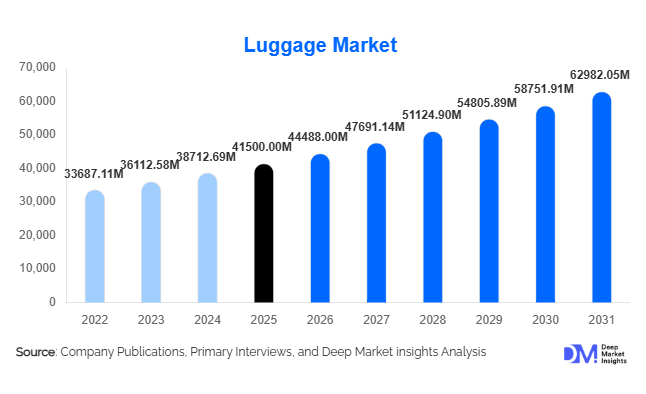
According to Deep Market Insights, the global luggage market size was valued at USD 41,500 million in 2025 and is projected to grow from USD 44,488.00 million in 2026 to reach USD 62,982.05 million by 2031, expanding at a CAGR of 7.2% during the forecast period (2026–2031). The market growth is primarily driven by increasing global travel activity, rising disposable incomes, and the growing preference for durable, lightweight, and premium luggage products. The expansion of low-cost airlines and short-haul travel has further accelerated demand for carry-on and compact luggage, while e-commerce platforms continue to improve accessibility and product visibility globally.
Key Market Insights
- Travel suitcases dominate the market, accounting for nearly 38% share due to universal demand across leisure and business travel segments.
- Hard-shell luggage is gaining strong traction, driven by consumer preference for durability and impact resistance.
- Asia-Pacific leads the global market, supported by rising middle-class travel demand and strong manufacturing capabilities.
- Online retail is the fastest-growing distribution channel, fueled by convenience, price comparison, and expanding digital penetration.
- Smart luggage adoption is increasing, particularly among tech-savvy travelers seeking integrated charging and tracking features.
- Sustainability is emerging as a key purchasing factor, with demand rising for eco-friendly and recycled-material luggage products.
What are the latest trends in the luggage market?
Shift Toward Smart and Connected Luggage
The integration of technology into luggage products is becoming a defining trend in the market. Smart luggage equipped with features such as GPS tracking, USB charging ports, and biometric locks is gaining popularity among frequent travelers. These innovations are particularly appealing to business travelers and digital nomads who require connectivity and security while traveling. Manufacturers are increasingly investing in R&D to enhance product functionality while complying with airline safety regulations regarding lithium-ion batteries. Mobile app integration and remote locking systems are also emerging, enabling users to track and manage their luggage in real time. As travel becomes more digitized, smart luggage is expected to transition from a niche segment to a mainstream offering.
Growing Demand for Sustainable and Eco-Friendly Products
Sustainability is rapidly becoming a central focus in the luggage market. Consumers are showing increased preference for products made from recycled plastics, biodegradable materials, and vegan leather alternatives. Leading manufacturers are incorporating sustainable design principles, including modular construction for easy repair and longer product life cycles. Regulatory pressures in regions such as Europe are also encouraging the adoption of environmentally responsible production practices. Brands that emphasize sustainability are gaining competitive advantage by aligning with environmentally conscious consumers and enhancing brand loyalty.
What are the key drivers in the luggage market?
Growth in Global Tourism and Air Travel
The resurgence of international and domestic travel is a primary driver of luggage demand. Increasing airline connectivity, expansion of low-cost carriers, and rising tourism investments by governments are contributing to higher travel frequency. Leisure travel, in particular, has seen significant growth, leading to increased purchases of both carry-on and check-in luggage. Frequent travelers often invest in multiple luggage types, further boosting market demand.
Rising Disposable Income and Premiumization
Increasing disposable income, particularly in emerging economies, is driving demand for premium and branded luggage products. Consumers are increasingly viewing luggage as a lifestyle accessory rather than a utility product. This shift is encouraging purchases of higher-quality, aesthetically appealing, and durable luggage. Premium brands are capitalizing on this trend by offering innovative designs and superior materials, resulting in higher profit margins and brand differentiation.
What are the restraints for the global market?
Volatility in Raw Material Prices
Fluctuations in the prices of raw materials such as polycarbonate, aluminum, and textiles present a significant challenge for manufacturers. Rising input costs can compress profit margins, especially in price-sensitive segments. Companies are increasingly focusing on supply chain optimization and material innovation to mitigate these risks.
Regulatory Constraints on Smart Luggage
Airline regulations regarding lithium-ion batteries in smart luggage have created barriers to adoption. Compliance with safety standards requires design modifications and increases production costs. These regulatory challenges may slow down the growth of the smart luggage segment in the near term.
What are the key opportunities in the luggage industry?
Expansion in Emerging Markets
Emerging economies such as India, Indonesia, and Vietnam present significant growth opportunities due to rising disposable incomes and increasing travel frequency. Government initiatives to promote tourism and improve infrastructure are further supporting market expansion. Companies can leverage localized product offerings and competitive pricing strategies to capture these high-growth markets.
Technological Innovation and Product Differentiation
The adoption of smart technologies in luggage provides opportunities for product differentiation and premium pricing. Innovations such as GPS tracking, anti-theft features, and integrated charging systems are attracting tech-savvy consumers. Strategic partnerships with technology firms can further enhance product capabilities and accelerate adoption.
Report Scope
| Report Metric | Details |
|---|---|
| Market Size in 2025 | USD 41500 Million |
| Market Size in 2026 | USD 44488 Million |
| Market Size in 2031 | USD 62982.05 Million |
| CAGR | 7.2% (2026-2031) |
| Base Year for Estimation | 2025 |
| Historical Data | 2022-2024 |
| Forecast Period | 2026-2031 |
| Report Coverage | Revenue Forecast, Competitive Landscape, Supply Chain Disruption, Growth Factors, Environment & Regulatory Landscape and Trends |
| Geographies Covered | North America, Europe, APAC, Middle East and Africa, LATAM |
| Countries Covered | U.S., Canada, U.K., Germany, France, Spain, Italy, Russia, Nordic, Benelux, Rest of Europe, China, Korea, Japan, India, Australia, Singapore, Taiwan, South East Asia, Rest of Asia-Pacific, UAE, Turky, Saudi Arabia, South Africa, Egypt, Nigeria, Rest of MEA, Brazil, Mexico, Argentina, Chile, Colombia, Rest of LATAM |
Explore more data points, trends and opportunities Download Free Sample Report
Product Type Insights
Travel suitcases continue to dominate the global luggage market, accounting for approximately 38% of the total market share in 2025. Their universal appeal across leisure, business, and student travel segments is supported by ongoing innovations in lightweight and impact-resistant materials such as polycarbonate and aluminum, which enhance durability without compromising portability. The rising trend of frequent air travel, including short-haul and budget airline usage, further reinforces the demand for wheeled suitcases and carry-on formats. Backpacks and travel bags are gaining traction, particularly among younger travelers and adventure enthusiasts. This growth is fueled by the rising popularity of experiential travel, trekking, camping, and other outdoor activities, where portability, flexibility, and functional design are critical factors. Smart luggage solutions with integrated GPS, USB charging, and biometric locks are slowly expanding within premium segments, catering to tech-savvy consumers who value convenience and security during travel.
Application Insights
Leisure travel remains the largest application segment, contributing around 46% of total luggage demand globally. The surge in outbound tourism, combined with increasing preferences for short vacations and weekend getaways, is driving consistent growth. Consumers are investing in durable, stylish luggage to accommodate frequent travel and lifestyle-oriented purchases. Business travel is steadily recovering post-pandemic, leading to heightened demand for premium and compact luggage options that cater to corporate travelers seeking convenience and professional aesthetics. Additionally, the student travel segment is emerging as a notable growth area, particularly with the expansion of international education. Students increasingly prefer versatile backpacks and mid-sized travel bags that are functional for both academic and leisure purposes.
Distribution Channel Insights
Offline retail channels currently dominate the global market with approximately 60% share, reflecting consumer preference for physical inspection, brand reassurance, and immediate product availability. Specialty stores, brand outlets, and hypermarkets continue to attract the majority of buyers. However, online retail is the fastest-growing distribution segment, driven by convenience, competitive pricing, and wider product selection. E-commerce platforms, including direct-to-consumer websites and major online marketplaces, have enabled brands to reach global customers more effectively while collecting valuable consumer behavior data. The growth of digital channels is also supported by innovative marketing strategies such as AR-based product previews, personalized recommendations, and easy return/exchange policies, which enhance customer confidence in online purchases.
End-User Insights
Leisure travelers represent the largest end-user segment, accounting for almost half of the demand in 2025. This segment is driven by increasing domestic and international tourism, rising disposable incomes, and lifestyle-oriented purchasing habits. Business travelers form a significant segment, particularly in developed markets like North America and Europe, where demand for premium, compact, and professional-grade luggage is high. Adventure and outdoor travelers constitute the fastest-growing segment, propelled by rising interest in trekking, camping, hiking, and other experiential travel activities. The growth of eco-tourism, wellness travel, and adventure expeditions has amplified the need for specialized backpacks, rugged luggage, and versatile travel bags that cater to functional, durability, and portability requirements.
Explore more data points, trends and opportunities Download Free Sample Report
Luggage Market Segmentations
By Product Type
- Travel Suitcases
- Backpacks
- Travel Bags
- Smart Luggage
- Duffel Bags & Holdalls
- Carry-on Bags
By Application
- Leisure Travel
- Business Travel
- Student Travel
- Adventure & Outdoor Travel
By Distribution Channel
- Offline Retail
- Online Retail
- Department Stores
- Travel & Airport Retail Outlets
By End-User
- Leisure Travelers
- Business Travelers
- Students
- Adventure & Outdoor Enthusiasts
Regional Insights
Asia-Pacific
Asia-Pacific is the largest regional market, accounting for approximately 40% of the global luggage market in 2025. China dominates the region, contributing over 20% of global demand due to its dual role as a major manufacturing hub and a large domestic consumer market. Factors driving growth include increasing disposable incomes, rising outbound tourism, urbanization, and the proliferation of low-cost airlines, making air travel more accessible. India is the fastest-growing country in the region, with a CAGR of around 9%, fueled by expanding middle-class populations, increasing air travel, and growing interest in domestic and international vacations. Japan, Indonesia, and Southeast Asian countries also contribute significantly, with demand supported by rising tourism, strong e-commerce penetration, and a preference for premium luggage products among affluent consumers.
North America
North America holds around 25% of the global market share, led by the United States. Key drivers include high travel frequency, rising disposable income, a strong preference for premium and branded luggage, and growing business and leisure travel activities. The U.S. and Canada are major importers of luggage, further supporting market growth. Additional growth is fueled by the increasing adoption of smart luggage and lifestyle-oriented products among tech-savvy and frequent travelers. Regional tourism infrastructure, high air connectivity, and luxury travel trends contribute to sustained demand for premium and innovative luggage solutions.
Europe
Europe accounts for approximately 20% of the global luggage market, with Germany, France, and the UK as the largest contributors. The region’s growth is supported by increasing tourism, high consumer purchasing power, and sustainability-driven product demand. Eco-conscious consumers are favoring luggage made from recycled and biodegradable materials, prompting manufacturers to adopt greener production practices. Additional growth drivers include well-established retail infrastructure, high demand for premium and smart luggage, and strong e-commerce penetration. Sustainability-focused policies and growing interest in experiential travel further accelerate market expansion in this region.
Middle East & Africa
The Middle East and Africa are experiencing steady growth, driven by tourism hubs such as the UAE, Saudi Arabia, and South Africa. High-income populations, increasing international travel, and investments in airport and tourism infrastructure support market expansion. In Africa, the rise of domestic and intra-African travel is stimulating demand for mid-range and premium luggage. Luxury tourism, business travel, and the growing adoption of e-commerce for luggage purchases are key growth drivers. Additionally, the increasing popularity of adventure and outdoor travel experiences is contributing to demand for specialized luggage products in the region.
Latin America
Latin America, led by Brazil and Mexico, shows moderate growth due to economic variability. Drivers include increasing outbound travel among middle- and upper-class consumers, expanding tourism infrastructure, and growing awareness of premium and durable luggage products. E-commerce growth and the modernization of retail channels are also supporting market expansion. Adventure tourism, weekend getaways, and international education travel are emerging as additional factors influencing demand in this region.
Key Players in the Luggage Market
- Samsonite International
- VIP Industries
- Delsey
- American Tourister
- Briggs & Riley
- Rimowa
- Tumi Holdings
- Travelpro
- Antler
- IT Luggage
- Skyway
- Victorinox
- Safari Industries
- Ace Co. Ltd.
- Eagle Creek