Loudspeaker Market Size
According to Deep Market Insights, the global loudspeaker market size was valued at USD 42,500 million in 2025 and is projected to grow from USD 45,687.50 million in 2026 to reach USD 65,590.31 million by 2031, expanding at a CAGR of 7.5% during the forecast period (2026–2031). The loudspeaker market growth is primarily driven by rising demand for wireless and smart audio devices, increasing consumption of digital entertainment, and the rapid integration of advanced audio systems across residential, automotive, and commercial applications.
Key Market Insights
- Wireless and portable loudspeakers dominate the market, driven by consumer preference for convenience, mobility, and seamless connectivity with smartphones and streaming platforms.
- Smart speakers are rapidly gaining traction, supported by the expansion of IoT ecosystems and increasing adoption of voice assistants in households globally.
- Asia-Pacific leads the global market, benefiting from strong manufacturing capabilities and rising consumer electronics demand in China and India.
- Automotive audio systems are among the fastest-growing segments, fueled by EV adoption and premium in-car entertainment demand.
- Online retail channels are reshaping distribution, enabling wider product access, competitive pricing, and faster consumer adoption.
- Technological innovation, including AI-based sound optimization, Dolby Atmos integration, and multi-room audio systems, is transforming the user experience.
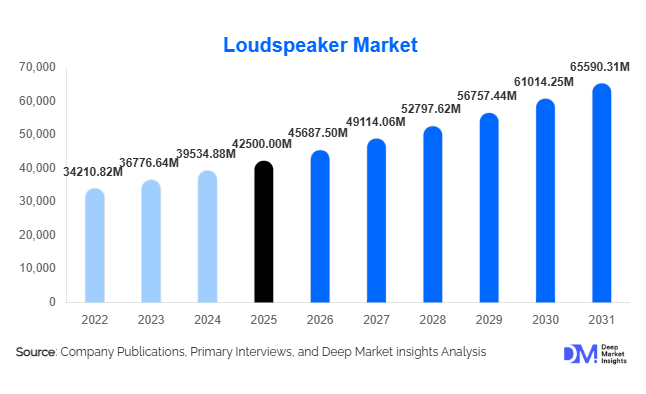
What are the latest trends in the loudspeaker market?
Smart and Connected Audio Ecosystems Expanding
The loudspeaker market is increasingly moving toward smart and interconnected ecosystems. Smart speakers integrated with voice assistants and home automation platforms are becoming central to modern households. Consumers are adopting multi-room audio systems that allow synchronized playback across devices, enhancing convenience and user experience. Integration with streaming platforms, smart TVs, and home security systems is further strengthening the role of loudspeakers as control hubs within connected environments. Manufacturers are focusing on AI-driven personalization, enabling adaptive sound profiles and contextual responses, which significantly enhance product differentiation and consumer engagement.
Shift Toward Compact, High-Performance Audio Solutions
There is a growing trend toward compact yet high-performance loudspeakers that deliver premium sound quality without occupying large physical space. Soundbars and portable Bluetooth speakers are gaining popularity due to their sleek designs and advanced acoustic engineering. Consumers increasingly prioritize aesthetics and minimalistic setups, particularly in urban living environments. This trend is also driving innovation in materials, speaker design, and energy efficiency. Companies are leveraging digital signal processing (DSP) and advanced driver technologies to deliver immersive audio experiences from smaller devices, catering to both mass-market and premium segments.
What are the key drivers in the loudspeaker market?
Growth in Digital Entertainment and Streaming
The surge in streaming platforms, gaming, and home entertainment consumption has significantly increased demand for high-quality audio output devices. Consumers are investing in soundbars, home theater systems, and wireless speakers to enhance their viewing and listening experiences. The rise of OTT platforms and high-definition content is directly influencing the adoption of advanced loudspeaker systems globally.
Proliferation of Wireless Technologies
The rapid adoption of Bluetooth, Wi-Fi, and other wireless technologies has transformed the loudspeaker market. Wireless speakers offer ease of use, portability, and compatibility with multiple devices, making them highly attractive to consumers. Continuous improvements in connectivity stability, battery life, and sound quality are further accelerating market growth.
Resurgence of Live Events and Professional Audio Demand
The recovery of live events, concerts, and corporate gatherings has boosted demand for professional audio equipment, including line array systems and high-power speakers. Event organizers and venues are investing in advanced sound systems to deliver immersive experiences, contributing to the expansion of the professional audio segment.
What are the restraints for the global market?
Intense Price Competition in Mass Market Segments
The presence of numerous regional and low-cost manufacturers, particularly in Asia, has intensified price competition. This limits profit margins for established brands and creates challenges in maintaining premium positioning in mid- and low-range segments.
Rapid Technological Obsolescence
Frequent advancements in audio technology, connectivity standards, and smart features result in shorter product lifecycles. Companies must continuously invest in R&D to remain competitive, increasing operational costs and creating barriers for smaller players.
What are the key opportunities in the loudspeaker industry?
Expansion of Smart Home Ecosystems
The growing adoption of smart homes presents a major opportunity for loudspeaker manufacturers. Smart speakers are evolving into central hubs for home automation, controlling lighting, security, and entertainment systems. Emerging markets offer untapped potential, particularly where smart home penetration is still in early stages.
Integration with Electric Vehicles and Automotive Systems
The shift toward electric vehicles is creating new opportunities for advanced in-car audio systems. EVs provide a quieter cabin environment, increasing the importance of high-quality sound systems. Partnerships between automakers and audio brands are expected to drive innovation and long-term growth in this segment.
Public Infrastructure and Smart City Projects
Government investments in smart cities, transportation hubs, and public safety systems are generating demand for loudspeakers in public announcement and emergency communication systems. Durable and weather-resistant speakers are particularly востребованы in large-scale infrastructure projects.
Report Scope
| Report Metric | Details |
|---|---|
| Market Size in 2025 | USD 42500 Million |
| Market Size in 2026 | USD 45687.50 Million |
| Market Size in 2031 | USD 65590.31 Million |
| CAGR | 7.5% (2026-2031) |
| Base Year for Estimation | 2025 |
| Historical Data | 2022-2024 |
| Forecast Period | 2026-2031 |
| Report Coverage | Revenue Forecast, Competitive Landscape, Supply Chain Disruption, Growth Factors, Environment & Regulatory Landscape and Trends |
| Geographies Covered | North America, Europe, APAC, Middle East and Africa, LATAM |
| Countries Covered | U.S., Canada, U.K., Germany, France, Spain, Italy, Russia, Nordic, Benelux, Rest of Europe, China, Korea, Japan, India, Australia, Singapore, Taiwan, South East Asia, Rest of Asia-Pacific, UAE, Turky, Saudi Arabia, South Africa, Egypt, Nigeria, Rest of MEA, Brazil, Mexico, Argentina, Chile, Colombia, Rest of LATAM |
Explore more data points, trends and opportunities Download Free Sample Report
Product Type Insights
Portable and Bluetooth speakers continue to dominate the global loudspeaker market, accounting for approximately 28% of the total market share in 2025. Their leadership is primarily driven by the rapid proliferation of smartphones, increasing consumption of streaming content, and consumer preference for compact, wireless, and cost-effective audio solutions. The convenience of portability, long battery life, and seamless connectivity via Bluetooth and Wi-Fi have made these devices highly attractive across both developed and emerging markets. Additionally, continuous product innovation in waterproofing, rugged designs, and enhanced bass performance has expanded their use cases, including outdoor and travel applications.
Soundbars are emerging as one of the fastest-growing product categories, supported by the expansion of home entertainment ecosystems and increasing adoption of smart TVs. Consumers are increasingly opting for soundbars as a space-efficient alternative to traditional home theater systems, particularly in urban households with limited space. Meanwhile, smart speakers are witnessing strong growth due to rising integration with voice assistants and smart home platforms, positioning them as central control hubs within connected environments. Professional audio systems, including line arrays and high-power speakers, remain essential in large venues, concerts, and commercial settings. Although their volume share is lower, they contribute significantly to revenue due to higher pricing and customization requirements, driven by the resurgence of live events and large-scale entertainment infrastructure.
Application Insights
Consumer audio applications lead the loudspeaker market, accounting for nearly 50% of the global market share. This dominance is driven by increasing consumer spending on home entertainment systems, personal audio devices, and gaming setups. The growing popularity of OTT platforms, music streaming services, and immersive audio formats such as surround sound and Dolby Atmos has significantly boosted demand within this segment. Additionally, the shift toward remote work and home-based entertainment has further accelerated adoption.
Professional audio applications are experiencing steady growth, supported by the recovery and expansion of live events, concerts, corporate functions, and broadcasting activities. The need for high-quality sound reinforcement systems in large venues continues to drive demand for advanced loudspeaker solutions. Automotive audio is among the fastest-growing application segments, driven by the premiumization of vehicles and increasing integration of advanced infotainment systems. Automakers are collaborating with leading audio brands to deliver enhanced in-cabin sound experiences, particularly in electric vehicles, where quieter cabins amplify the importance of high-fidelity audio systems.
Distribution Channel Insights
Online retail channels account for approximately 35% of total loudspeaker sales, reflecting the rapid digitalization of consumer purchasing behavior. The growth of e-commerce platforms has enabled consumers to access a wide variety of products, compare specifications and prices, and benefit from discounts and doorstep delivery. The increasing penetration of smartphones and internet connectivity, particularly in emerging economies, has further strengthened the dominance of online channels.
Offline retail channels, including specialty electronics stores and large-format retail outlets, continue to play a critical role, especially in the premium segment. High-end audio products often require in-store demonstrations and personalized consultations, which drive consumer preference for physical stores. Additionally, direct B2B sales channels remain significant for professional audio systems and large-scale commercial installations, where customized solutions and long-term contracts are key purchasing drivers.
End-Use Industry Insights
The residential segment dominates the loudspeaker market, accounting for approximately 45% of total market share in 2025, and is valued at over USD 19,000 million. This leadership is driven by the rapid adoption of smart home technologies, increasing consumer investment in home entertainment systems, and rising disposable incomes globally. Consumers are increasingly integrating multiple audio devices within their homes, including smart speakers, soundbars, and multi-room audio systems, creating sustained demand in this segment.
The automotive sector is the fastest-growing end-use industry, supported by the global shift toward electric vehicles and the growing importance of in-car infotainment systems. Automotive manufacturers are increasingly integrating premium branded audio systems as a key differentiator, driving demand for high-performance loudspeakers. The commercial segment, including retail, hospitality, and corporate environments, is also expanding as businesses invest in enhanced customer experiences and ambiance. Additionally, public infrastructure projects such as airports, railway stations, and smart cities are generating demand for robust public announcement and emergency communication systems, further supporting market growth.
Explore more data points, trends and opportunities Download Free Sample Report
Loudspeaker Market Segmentations
By Product Type
- Passive Loudspeakers
- Active (Powered) Loudspeakers
- Subwoofers
- Soundbars
- Line Array Systems
- Portable/Bluetooth Speakers
- Smart Speakers
By Application
- Consumer Audio
- Professional Audio
- Automotive Audio
- Commercial Installations
By Distribution Channel
- Online Retail
- Specialty Electronics Stores
- Supermarkets/Hypermarkets
- Direct B2B Sales
Regional Insights
Asia-Pacific
Asia-Pacific dominates the global loudspeaker market, accounting for approximately 38% of the total market share in 2025. The region’s leadership is driven by a combination of strong manufacturing capabilities, cost-efficient production, and rising domestic demand. China serves as the global manufacturing hub, exporting large volumes of loudspeakers worldwide, while also maintaining strong domestic consumption due to its expanding middle class and high digital adoption. India is emerging as one of the fastest-growing markets, supported by increasing disposable income, rapid urbanization, and expanding internet penetration, which is fueling demand for wireless and smart speakers. Japan contributes significantly through technological innovation and demand for premium, high-quality audio systems. Additionally, the presence of major electronics manufacturers and government initiatives supporting domestic production are key drivers of regional growth.
North America
North America accounts for approximately 25% of the global loudspeaker market, with the United States being the primary contributor. The region’s growth is driven by high consumer purchasing power, early adoption of advanced technologies, and strong demand for premium and smart audio products. The widespread adoption of smart home ecosystems, coupled with high penetration of streaming services and gaming, is significantly boosting demand for high-performance loudspeakers. Additionally, the presence of leading global audio brands and continuous innovation in wireless and AI-enabled audio technologies further strengthen the market in this region. The resurgence of live events and entertainment activities also contributes to the growth of the professional audio segment.
Europe
Europe holds around 22% of the global market share, with key markets including Germany, the United Kingdom, and France. The region is characterized by strong demand for high-quality and premium audio systems, driven by consumer preference for superior sound performance and design aesthetics. Sustainability and energy efficiency are major factors influencing product development and purchasing decisions in Europe. The region also benefits from a well-established automotive industry, which supports demand for advanced in-car audio systems. Additionally, increasing investments in entertainment infrastructure and cultural events are driving growth in the professional audio segment.
Middle East & Africa
The Middle East & Africa region is experiencing steady growth in the loudspeaker market, driven by large-scale infrastructure development and increasing tourism investments. Countries such as the UAE and Saudi Arabia are investing heavily in smart cities, entertainment hubs, and public infrastructure projects, creating strong demand for commercial and public announcement systems. The expansion of retail and hospitality sectors is also contributing to market growth, as businesses focus on enhancing customer experiences through advanced audio solutions. Furthermore, rising disposable income and increasing adoption of consumer electronics are supporting growth in residential applications across key urban centers.
Latin America
Latin America represents a moderately growing market, led by Brazil and Mexico. The region’s growth is driven by increasing urbanization, rising middle-class population, and growing adoption of consumer electronics. Demand for affordable and mid-range loudspeakers is particularly strong, as consumers seek value-driven products. The expansion of e-commerce platforms is improving product accessibility and driving sales across the region. Additionally, the gradual recovery of the entertainment and events industry is supporting demand for professional audio systems. Government initiatives to improve digital infrastructure and connectivity are also contributing to the steady growth of the loudspeaker market in Latin America.
Key Players in the Loudspeaker Market
- Samsung Electronics
- Sony Corporation
- LG Electronics
- Bose Corporation
- Harman International
- Panasonic Corporation
- Pioneer Corporation
- Yamaha Corporation
- Sonos Inc.
- Bang & Olufsen
- Vizio Inc.
- Klipsch Audio Technologies
- Sennheiser Electronic
- Bowers & Wilkins
- Alpine Electronics