Lolita Clothing Market Size
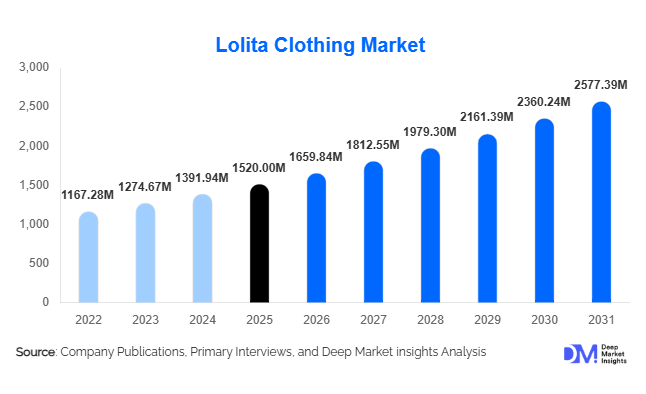
According to Deep Market Insights, the global Lolita Clothing Market was valued at USD 1,520 million in 2025 and is projected to grow from USD 1,659.84 million in 2026 to reach USD 2,577.39 million by 2031, expanding at a CAGR of 9.2% during the forecast period (2026–2031). The market growth is primarily driven by the increasing global popularity of Japanese subculture fashion, rising adoption of niche and personalized clothing, and the growing influence of social media and online fashion communities on consumer purchasing behaviors.
Key Market Insights
- Lolita fashion is increasingly driven by niche communities and online platforms, allowing consumers worldwide to access unique, high-quality garments and accessories beyond traditional retail hubs.
- Premium and mid-range Lolita clothing segments are expanding, balancing affordability with craftsmanship, enabling wider adoption while maintaining exclusivity for collectors and enthusiasts.
- Asia-Pacific dominates the global market, particularly Japan and China, which are major centers for production and cultural adoption of Lolita fashion.
- North America is a key growth region, led by cosplay culture, conventions, and the influence of Japanese pop culture on younger demographics.
- Europe is experiencing strong growth in sustainable and alternative fashion adoption, particularly in the UK, Germany, and France, boosting demand for Sweet and Classic Lolita styles.
- Technological adoption, including direct-to-consumer e-commerce platforms, virtual fashion showcases, and social media marketing, is reshaping global engagement and enabling international brand reach.
What are the latest trends in the Lolita Clothing Market?
Digital Community-Driven Growth
Online communities, influencer-led marketing, and e-commerce platforms are central to the growth of Lolita fashion. Enthusiast forums, Instagram styling pages, and TikTok communities allow consumers to share outfit inspirations, styling tips, and reviews, creating viral trends and global brand recognition. Limited edition releases, pre-orders, and direct engagement through social media have transformed the marketing model, making online visibility critical for both established and emerging brands. Interactive features such as virtual try-ons, online customizations, and social media contests further enhance community engagement while lowering geographical barriers for international adoption.
Sustainability and Ethical Fashion Adoption
There is a rising emphasis on eco-conscious Lolita clothing, including the use of ethically sourced fabrics, slow fashion production techniques, and durable garment design. Consumers increasingly value transparent supply chains and environmental responsibility, which align naturally with the high-quality, collectible nature of Lolita garments. Brands implementing eco-friendly practices and offering long-lasting clothing are able to justify premium pricing while appealing to environmentally conscious consumers. This trend also includes biodegradable packaging, natural dyes, and limited-edition handcrafts to reduce waste.
What are the key drivers in the Lolita Clothing Market?
Global Popularity of Japanese Pop Culture
The spread of anime, manga, cosplay, and Japanese-themed conventions has played a critical role in promoting Lolita fashion worldwide. International events attract both casual enthusiasts and hardcore collectors, driving demand for authentic and high-quality Lolita apparel. Social media amplification further accelerates adoption, with viral cosplay and styling content generating awareness and aspirational appeal among diverse audiences.
Rising Interest in Personalized and Niche Fashion
Consumers are increasingly seeking identity-driven clothing experiences. Lolita fashion, with its intricate detailing and distinctive aesthetic, aligns well with these preferences. Customizable garments, made-to-order pieces, and limited-edition designs allow individuals to express personal style, fostering loyalty and repeat purchases. This shift away from fast fashion encourages long-term engagement with the market, particularly in premium and mid-range segments.
Influence of Social Media and Online Retail
Platforms like Instagram, TikTok, and e-commerce marketplaces are amplifying market reach, enabling both small and large brands to showcase collections globally. Online retail accounts for approximately 72% of the market share, highlighting the significance of digital channels in driving sales. Brands leverage influencer collaborations, live-streamed fashion shows, and virtual styling sessions to engage communities and enhance brand recognition.
What are the restraints for the global market?
High Price Points of Premium Garments
Authentic Lolita clothing, particularly from established Japanese brands, is often expensive due to intricate designs and high-quality materials. These high costs restrict accessibility for price-sensitive consumers and limit penetration in emerging regions, posing a significant challenge for market expansion.
Limited Physical Retail Infrastructure
Unlike mainstream fashion, Lolita clothing is primarily sold through online channels or specialized boutiques. Limited offline availability reduces consumer exposure to garments for first-time buyers, which can hinder adoption and growth in regions where e-commerce penetration is lower or customers prefer in-person experiences.
What are the key opportunities in the Lolita Clothing Market?
Direct-to-Consumer E-Commerce Expansion
Expanding DTC sales channels enables brands to engage consumers globally without relying on intermediaries. This model allows for personalized experiences, pre-order collections, and limited-edition offerings, reducing overhead costs while boosting margins. Emerging markets in Southeast Asia and Latin America present untapped opportunities for online expansion.
Integration of Sustainable Fashion Practices
Eco-conscious practices in Lolita clothing, including sustainable fabrics, slow fashion principles, and transparent sourcing, offer opportunities to differentiate products and capture premium segments. Brands adopting ethical production not only appeal to environmentally aware consumers but also reinforce the collectible and durable nature of Lolita apparel.
Lifestyle and Experiential Diversification
Lolita fashion extends beyond clothing, offering potential in themed cafes, cosplay events, and cultural festivals. Collaborations with entertainment franchises, gaming, and anime studios can enhance brand visibility and cross-industry demand. Inclusive and gender-neutral collections further broaden the consumer base and create new market segments.
Report Scope
| Report Metric | Details |
|---|---|
| Market Size in 2025 | USD 1520 Million |
| Market Size in 2026 | USD 1659.84 Million |
| Market Size in 2031 | USD 2577.39 Million |
| CAGR | 9.2% (2026-2031) |
| Base Year for Estimation | 2025 |
| Historical Data | 2022-2024 |
| Forecast Period | 2026-2031 |
| Report Coverage | Revenue Forecast, Competitive Landscape, Supply Chain Disruption, Growth Factors, Environment & Regulatory Landscape and Trends |
| Geographies Covered | North America, Europe, APAC, Middle East and Africa, LATAM |
| Countries Covered | U.S., Canada, U.K., Germany, France, Spain, Italy, Russia, Nordic, Benelux, Rest of Europe, China, Korea, Japan, India, Australia, Singapore, Taiwan, South East Asia, Rest of Asia-Pacific, UAE, Turky, Saudi Arabia, South Africa, Egypt, Nigeria, Rest of MEA, Brazil, Mexico, Argentina, Chile, Colombia, Rest of LATAM |
Explore more data points, trends and opportunities Download Free Sample Report
Product Type Insights
Dresses continue to dominate the Lolita Clothing Market, accounting for approximately 42% of total revenue in 2025, making them the most influential product segment globally. The dominance of this segment is primarily driven by the fact that dresses, particularly jumperskirts (JSK) and one-piece (OP) dresses, form the core identity of Lolita fashion, serving as the foundation for complete outfits. Their versatility allows consumers to mix and match with different blouses, accessories, and seasonal layers, thereby increasing repeat purchases and wardrobe expansion. Additionally, dresses are often the focal point of design innovation, featuring intricate lacework, embroidery, prints, and high-quality fabrics, which justifies premium pricing and strengthens brand positioning.
The continued growth of this segment is also supported by limited-edition releases, customization options, and collector-driven demand, where consumers seek exclusivity and uniqueness. While tops, blouses, and outerwear play a complementary role, their demand is closely tied to dress purchases, creating a strong cross-selling ecosystem. Accessories such as headwear, legwear, and bags are witnessing steady growth as high-margin add-ons, often bundled with dresses. The premium and mid-range dress categories are particularly driving revenue growth due to their balance of craftsmanship and accessibility, making them attractive to both new entrants and experienced consumers.
Style Category Insights
Sweet Lolita remains the leading style category, capturing approximately 36% of the global market share in 2025. Its leadership is largely driven by its broad consumer appeal, characterized by pastel colors, playful prints, and youthful aesthetics that resonate strongly with younger demographics and first-time buyers. The accessibility and visual appeal of Sweet Lolita make it highly shareable on social media platforms, further amplifying its popularity through influencer-driven trends and digital communities.
The growth of this segment is further supported by high product turnover, seasonal collections, and strong alignment with cosplay and themed events, where visually vibrant outfits are preferred. Classic Lolita follows as a stable segment, driven by consumers seeking timeless elegance and historical inspiration, while Gothic Lolita maintains a loyal niche audience with strong brand affinity. Emerging styles such as Punk and Hime Lolita are gaining traction due to increasing experimentation and diversification within the fashion community. However, Sweet Lolita continues to lead due to its scalability, mass appeal, and strong alignment with global fashion trends and digital engagement.
Distribution Channel Insights
Online retail dominates the Lolita Clothing Market with approximately 72% share, making it the most critical distribution channel. This dominance is primarily driven by the niche nature of the market, where consumers are geographically dispersed and rely heavily on digital platforms to access global brands. Brand-owned websites and e-commerce marketplaces enable direct-to-consumer (DTC) sales, allowing manufacturers to maintain better margins, control pricing, and offer exclusive collections.
The leading position of online retail is further reinforced by pre-order models, customization options, and limited-edition drops, which are difficult to replicate in offline environments. Social media integration, influencer collaborations, and live-stream selling have also significantly enhanced online engagement and conversion rates. While offline specialty boutiques and pop-up stores contribute to brand visibility and experiential retail, their reach remains limited. However, event-based retail, particularly at anime and cosplay conventions, continues to generate high-value sales and strengthen community connections.
Consumer Demographics Insights
The 20–35 age group dominates the market with approximately 55% share, making it the most influential consumer segment. This dominance is driven by higher disposable income, strong digital engagement, and active participation in alternative fashion communities. Consumers in this segment are more likely to invest in mid-range and premium Lolita clothing, driven by a desire for self-expression, identity building, and participation in niche cultural movements.
This demographic also leads in repeat purchases, customization demand, and community-driven engagement, making it a key driver of long-term market growth. Teenagers (13–19) represent an entry-level segment, often starting with budget products, while consumers aged 35+ contribute to the premium and collector segments, valuing quality and exclusivity. Although female consumers dominate the market, there is a gradual rise in male and unisex participation, particularly in Ouji and gender-neutral styles, driven by increasing inclusivity and evolving fashion norms.
Explore more data points, trends and opportunities Download Free Sample Report
Lolita Clothing Market Segmentations
By Product Type
- Dresses
- Tops & Blouses
- Outerwear
- Bottoms
- Accessories
- Footwear
By Style Category
- Sweet Lolita
- Classic Lolita
- Gothic Lolita
- Punk Lolita
- Ouji (Boystyle)
- Hime Lolita
By Distribution Channel
- Online Retail
- Brand-owned Websites
- E-commerce Marketplaces
- Offline Specialty Boutiques
- Pop-up Stores & Events
By Consumer Demographics
- Teenagers (13–19)
- Young Adults (20–35)
- Adults (35+)
- Female
- Male/Unisex
Regional Insights
Asia-Pacific
Asia-Pacific leads the global Lolita Clothing Market with approximately 45% market share in 2025, driven by strong cultural roots, manufacturing capabilities, and a large consumer base. Japan remains the origin and premium hub, with high brand loyalty and strong domestic demand for authentic designs. China has emerged as both the largest production base and fastest-growing consumer market, supported by a rapidly expanding middle class, cost-effective manufacturing, and widespread adoption of e-commerce platforms.
Key growth drivers in the region include high penetration of digital retail platforms, strong cosplay and anime culture, and increasing disposable income among younger populations. Southeast Asia, particularly Indonesia and Thailand, is witnessing rapid growth exceeding 11% CAGR, fueled by social media influence, rising fashion awareness, and accessibility to international brands through online channels.
North America
North America accounts for approximately 22% of the global market, with the United States leading regional demand. The region benefits from a well-established cosplay ecosystem, frequent anime conventions, and a strong digital commerce infrastructure. Consumers in North America show a preference for mid-range and premium products, often valuing authenticity and brand heritage. Key drivers include high consumer spending power, strong influencer marketing, and growing acceptance of alternative fashion. The presence of large-scale conventions such as anime expos and comic events further drives demand by providing platforms for community engagement and product visibility.
Europe
Europe holds around 20% market share, with major demand centers in the UK, Germany, and France. The region is characterized by a strong inclination toward sustainable and ethical fashion, aligning well with the durable and slow-fashion nature of Lolita clothing. Growth in Europe is driven by rising interest in vintage-inspired fashion, increasing adoption of alternative subcultures, and supportive e-commerce infrastructure. Younger demographics are particularly influencing demand through social media engagement and participation in themed events, while mid-range offerings are improving accessibility across the region.
Latin America
Latin America accounts for approximately 8% of the market, with Brazil, Mexico, and Argentina emerging as key markets. The region is experiencing steady growth due to increasing internet penetration, rising participation in cosplay communities, and growing exposure to global fashion trends. Key drivers include expanding online retail access, growing youth population, and increasing interest in Japanese pop culture. Although the market is still developing, improving logistics and cross-border e-commerce are expected to further accelerate growth.
Middle East & Africa
The Middle East & Africa region holds approximately 5% market share, with the UAE being the primary contributor. The market is driven by high disposable income, strong interest in luxury and international fashion, and increasing exposure to global trends through digital platforms. Growth drivers include the expansion of premium retail infrastructure, the rising popularity of themed events and conventions, and the increasing adoption of online shopping. While Africa remains a smaller market, gradual improvements in digital access and urbanization are expected to create future growth opportunities.
Key Players in the Lolita Clothing Market
- Angelic Pretty
- Baby, The Stars Shine Bright
- Moi-même-Moitié
- Métamorphose Temps de Fille
- Innocent World
- Alice and the Pirates
- Bodyline
- Souffle Song
- Dear Celine
- Classical Puppets
- Infanta
- To Alice
- Magic Tea Party
- Chess Story
- Strawberry Witch