Liposome in Cosmetics Market Size
According to Deep Market Insights, the global liposome in cosmetics market size was valued at USD 1,950 million in 2025 and is projected to grow from USD 2,141.10 million in 2026 to reach USD 3,417.03 million by 2031, expanding at a CAGR of 9.8% during the forecast period (2026–2031). The market growth is primarily driven by rising demand for advanced skincare delivery systems, increasing adoption of cosmeceuticals, and growing consumer preference for high-efficacy, science-backed cosmetic formulations that enhance skin penetration and active ingredient stability.
Key Market Insights
- Skincare applications dominate the market, accounting for more than half of global demand due to strong adoption in anti-aging and moisturization products.
- Nanoliposomes are emerging as the leading product type, driven by superior skin penetration and enhanced bioavailability of active ingredients.
- Asia-Pacific leads global consumption, supported by rising disposable incomes, beauty awareness, and strong cosmetic manufacturing ecosystems in China, Japan, and South Korea.
- North America remains a high-value innovation hub, with strong demand for premium and dermatologically tested cosmeceutical products.
- Europe is a key regulatory and sustainability-driven market, emphasizing clean-label and bio-based cosmetic formulations.
- Online retail channels are expanding rapidly, fueled by direct-to-consumer cosmetic brands and digital-first beauty marketing strategies.
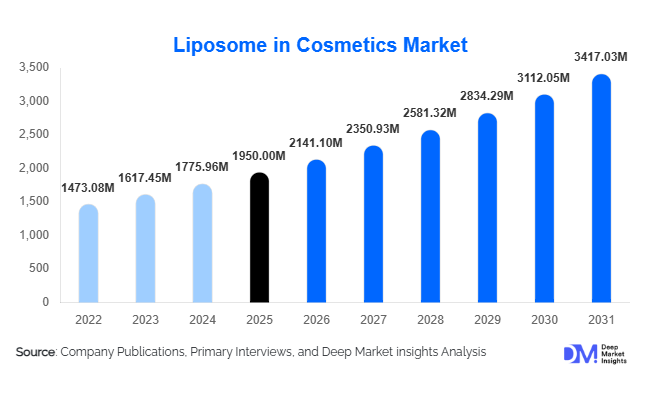
What are the latest trends in the liposome in cosmetics market?
Integration of Nanotechnology in Cosmetic Delivery Systems
The market is witnessing strong adoption of nanoliposome-based systems that significantly improve the delivery efficiency of active ingredients such as vitamins, peptides, and antioxidants. These advanced systems allow deeper skin penetration and controlled release, improving product performance in anti-aging and therapeutic skincare formulations. Cosmetic companies are increasingly investing in nano-engineered liposomes to differentiate premium product lines and enhance clinical efficacy claims. This trend is particularly strong in luxury skincare brands and dermatology-backed cosmetic formulations.
Rise of Clean-Label and Bioactive Encapsulation
Consumers are increasingly demanding clean-label cosmetics, pushing manufacturers to replace synthetic delivery enhancers with bio-based liposomal systems. Liposomes are being used to stabilize natural extracts, botanical oils, and sensitive vitamins without compromising efficacy. This trend is accelerating the adoption of liposomal formulations in organic and vegan cosmetics. Regulatory support for safer cosmetic ingredients in Europe and North America is further reinforcing this shift toward sustainable encapsulation technologies.
What are the key drivers in the liposome in cosmetics market?
Growing Demand for Advanced Anti-Aging Solutions
The rising global aging population and increasing consumer focus on skin health are driving demand for anti-aging skincare products. Liposomes enhance the delivery of active compounds such as retinol and vitamin C, making them highly effective in reducing wrinkles and improving skin texture. This has led to widespread adoption across premium skincare brands globally.
Expansion of Cosmeceutical Industry
The convergence of cosmetics and pharmaceuticals is accelerating market growth. Dermatologist-recommended skincare products increasingly rely on liposomal delivery systems for targeted treatment of acne, hyperpigmentation, and sensitive skin conditions. This has significantly expanded the use of liposomes in clinical skincare applications.
Technological Advancements in Encapsulation Science
Continuous R&D investments in nanotechnology and biotechnology are improving liposome stability, scalability, and cost efficiency. Innovations such as multilayer liposomes and hybrid vesicle systems are enabling broader application across skincare, haircare, and personal care segments.
What are the restraints for the global market?
High Production and Formulation Costs
Liposome manufacturing requires advanced equipment and controlled environments, resulting in high production costs. This limits adoption in mass-market cosmetic products and restricts usage largely to premium and luxury segments.
Stability and Regulatory Challenges
Liposomal formulations face stability issues during storage and transportation, which can reduce product effectiveness over time. Additionally, strict cosmetic regulations in regions like Europe and North America require extensive testing and compliance, increasing time-to-market and development costs.
What are the key opportunities in the liposome in the cosmetics industry?
Personalized Skincare and AI-Driven Formulations
The integration of AI-based skin analysis with liposomal formulation technology is enabling highly personalized skincare solutions. Brands are developing customized serums and creams based on individual skin profiles, enhancing product effectiveness and consumer engagement.
Expansion in Emerging Markets
Rapid urbanization and rising disposable incomes in countries such as India, China, and Brazil are creating strong demand for premium skincare products. Local manufacturing and regional customization of liposomal cosmetics present significant growth opportunities for global and domestic players.
Hybrid Natural-Cosmetic Innovation
Increasing demand for natural and organic cosmetics is encouraging the combination of botanical ingredients with liposomal delivery systems. This hybrid approach enhances ingredient stability and absorption, opening new product development avenues in clean beauty markets.
Report Scope
| Report Metric | Details |
|---|---|
| Market Size in 2025 | USD 1950 Million |
| Market Size in 2026 | USD 2141.10 Million |
| Market Size in 2031 | USD 3417.03 Million |
| CAGR | 9.8% (2026-2031) |
| Base Year for Estimation | 2025 |
| Historical Data | 2022-2024 |
| Forecast Period | 2026-2031 |
| Report Coverage | Revenue Forecast, Competitive Landscape, Supply Chain Disruption, Growth Factors, Environment & Regulatory Landscape and Trends |
| Geographies Covered | North America, Europe, APAC, Middle East and Africa, LATAM |
| Countries Covered | U.S., Canada, U.K., Germany, France, Spain, Italy, Russia, Nordic, Benelux, Rest of Europe, China, Korea, Japan, India, Australia, Singapore, Taiwan, South East Asia, Rest of Asia-Pacific, UAE, Turky, Saudi Arabia, South Africa, Egypt, Nigeria, Rest of MEA, Brazil, Mexico, Argentina, Chile, Colombia, Rest of LATAM |
Explore more data points, trends and opportunities Download Free Sample Report
Product Type Insights
Nanoliposomes dominate the liposome in cosmetics market, accounting for approximately 32% share in 2025, primarily due to their enhanced ability to penetrate deeper skin layers and deliver active ingredients with higher efficiency. Their smaller particle size and improved encapsulation stability make them the preferred choice for premium skincare and cosmeceutical applications. The growth of this segment is further driven by increasing demand for high-performance anti-aging products and advancements in nanotechnology-based formulations.
Conventional liposomes continue to hold a strong presence in mass-market cosmetic formulations due to their cost-effectiveness and ease of production. Meanwhile, PEGylated liposomes are gaining traction in advanced dermatological and therapeutic skincare products, as they offer extended stability and prolonged release of active compounds. Cationic and anionic liposomes are primarily used in niche applications requiring targeted delivery and enhanced interaction with specific skin layers, particularly in medicated and professional skincare treatments.
Application Insights
Skin care remains the dominant application segment, accounting for nearly 55% of total market share, driven by strong demand for anti-aging creams, moisturizers, and brightening formulations. The leading position of this segment is supported by rising consumer awareness regarding skin health, increasing aging populations, and growing preference for scientifically backed skincare products that offer visible results.
Hair care applications are witnessing steady growth, supported by increasing focus on scalp health, hair repair, and damage prevention. Liposomal delivery systems are being incorporated into shampoos, conditioners, and serums to enhance nutrient absorption and improve hair strength. In the makeup segment, liposomes are increasingly used to improve pigment dispersion, hydration, and skin compatibility, particularly in foundations and lip products. Additionally, personal care applications such as body lotions, deodorants, and multifunctional products are expanding, driven by demand for products that combine skincare benefits with daily-use convenience.
Distribution Channel Insights
Online retail is the fastest-growing distribution channel, driven by the rapid expansion of direct-to-consumer (D2C) cosmetic brands, digital marketing strategies, and influencer-led promotions. Consumers increasingly prefer online platforms due to convenience, product variety, and access to detailed product information and reviews. This channel is expected to witness double-digit growth over the forecast period.
Specialty stores and pharmacies continue to play a critical role in the distribution of premium and dermatology-focused liposomal products, as consumers rely on expert recommendations and product authenticity. Supermarkets and hypermarkets dominate the mass-market segment, offering high product visibility and accessibility. Professional dermatology channels are gaining importance for clinical-grade liposomal formulations, particularly in therapeutic and prescription-based skincare treatments.
End-Use Insights
Cosmetic manufacturers represent the largest end-use segment, accounting for over 60% of total demand, as they integrate liposomal technologies into a wide range of skincare, haircare, and personal care products. This segment is leading due to continuous product innovation, strong R&D investments, and increasing demand for differentiated formulations in a highly competitive beauty market.
Dermatology clinics are emerging as a high-growth segment, driven by rising demand for medically backed skincare treatments and targeted therapies for conditions such as acne, pigmentation, and aging. The premium beauty segment is expanding rapidly, supported by increasing consumer willingness to pay for high-efficacy and technologically advanced products. Additionally, direct-to-consumer brands are leveraging liposomal formulations to create niche, high-margin product lines.
Explore more data points, trends and opportunities Download Free Sample Report
Liposome in Cosmetics Market Segmentations
By Product Type
- Conventional Liposomes
- PEGylated Liposomes
- Cationic Liposomes
- Anionic Liposomes
- Neutral Liposomes
- Nanoliposomes
By Application
- Skin Care
- Hair Care
- Makeup/Cosmetics
- Personal Care & Others
By Formulation Type
- Creams
- Gels
- Lotions
- Serums
- Sprays
By End-User
- Cosmetic Manufacturers (B2B)
- Dermatology Clinics & Professional Use
- Direct-to-Consumer
By Distribution Channel
- Online Retail
- Specialty Stores
- Supermarkets/Hypermarkets
- Pharmacies & Drugstores
- Professional Channels
Regional Insights
Asia-Pacific
Asia-Pacific leads the global market with approximately 38% share in 2025, driven by strong demand from China, Japan, South Korea, and India. China alone accounts for nearly 18% of global demand due to its large consumer base and rapidly expanding cosmetics industry. The region’s dominance is supported by increasing disposable incomes, growing urbanization, and rising beauty consciousness among consumers.
South Korea serves as a global innovation hub for advanced skincare technologies, particularly in K-beauty formulations incorporating liposomal delivery systems. Japan contributes through its strong focus on high-quality and technologically advanced skincare products. India is emerging as the fastest-growing market in the region, driven by an expanding middle-class population, increasing penetration of premium beauty products, and the growth of e-commerce platforms. Additionally, regional manufacturing capabilities and export-oriented cosmetic industries are further accelerating market growth.
North America
North America holds around 27% market share, with the United States being the dominant contributor. The region’s growth is driven by high consumer spending on premium skincare, strong adoption of anti-aging products, and increasing demand for dermatologist-recommended formulations. Advanced R&D infrastructure and early adoption of innovative technologies further support market expansion.
The presence of major cosmetic companies and biotechnology firms enables continuous innovation in liposomal delivery systems. Additionally, growing awareness of skin health, increasing prevalence of skin-related concerns, and demand for clean-label and clinically proven products are key drivers of regional growth.
Europe
Europe accounts for approximately 25% of global demand, led by countries such as France, Germany, and the United Kingdom. The region’s growth is strongly influenced by stringent regulatory frameworks that emphasize product safety, efficacy, and sustainability.
Demand is driven by increasing consumer preference for clean beauty, organic ingredients, and environmentally friendly formulations. France leads in luxury cosmetics and innovation, while Germany focuses on dermatological and scientifically validated skincare products. The UK market is characterized by strong demand for premium and personalized beauty solutions. The region’s commitment to sustainability and eco-friendly packaging further supports the adoption of liposomal formulations.
Latin America & Middle East & Africa
Latin America and the Middle East & Africa collectively account for around 10% of global market share, with Brazil, the UAE, and South Africa emerging as key growth markets. In Latin America, Brazil leads due to its large beauty and personal care market, strong consumer interest in skincare, and increasing adoption of premium cosmetic products.
In the Middle East, countries such as the UAE and Saudi Arabia are witnessing rising demand for luxury and high-performance skincare products, driven by high disposable incomes and a strong preference for premium brands. In Africa, South Africa is a key market supported by growing urbanization and expanding retail infrastructure. Across these regions, increasing awareness of advanced skincare technologies, a rising middle-class population, and expanding distribution networks are key drivers supporting steady market growth.