Lip Care Products Market Size
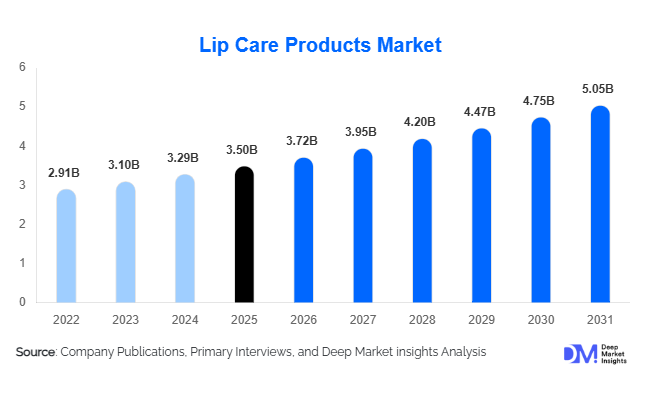
According to Deep Market Insights, the global lip care products market size was valued at USD 3.5 billion in 2025 and is projected to grow from USD 3.72 billion in 2026 to reach USD 5.05 billion by 2031, expanding at a CAGR of 6.3% during the forecast period (2026–2031). The lip care products market growth is primarily driven by increasing consumer awareness regarding lip hydration and protection, rising adoption of multifunctional beauty products, and the growing popularity of premium and organic lip care formulations. Consumers are increasingly incorporating lip care into daily skincare routines, leading to sustained demand for products such as lip balms, lip oils, overnight lip masks, SPF-infused products, and therapeutic lip treatments.
Key Market Insights
- Natural and organic lip care products are witnessing strong global demand, driven by increasing preference for clean-label, vegan, and cruelty-free formulations.
- SPF-infused and therapeutic lip care solutions are becoming mainstream, supported by rising awareness regarding UV protection, dryness prevention, and skin barrier repair.
- Asia-Pacific dominates the global market, led by strong consumer demand in China, India, Japan, and South Korea.
- North America remains a major premium market, with high demand for dermatologist-recommended and multifunctional lip products.
- E-commerce and direct-to-consumer channels are transforming product distribution, enabling rapid penetration of indie and premium beauty brands globally.
- Advanced skincare ingredients such as hyaluronic acid, ceramides, peptides, and botanical oils are increasingly integrated into lip care formulations to improve hydration and anti-aging benefits.
Lip Care Products Market Trends
Clean-Label and Sustainable Lip Care Gaining Traction
Consumers are increasingly prioritizing ingredient transparency and environmentally sustainable beauty products, significantly influencing the lip care products market. Brands are rapidly shifting toward vegan, paraben-free, petroleum-free, and cruelty-free formulations to align with evolving consumer preferences. Natural ingredients such as shea butter, cocoa butter, coconut oil, beeswax alternatives, and botanical extracts are gaining popularity among health-conscious consumers seeking safer and eco-friendly skincare options. In parallel, sustainable packaging innovations including recyclable tubes, refillable containers, biodegradable materials, and reduced-plastic packaging formats are becoming key competitive differentiators. Major beauty brands are also strengthening ESG commitments and introducing carbon-conscious manufacturing processes to appeal to environmentally aware consumers.
Rise of Skincare-Integrated Lip Products
The convergence of skincare and cosmetics is reshaping the global lip care products market. Consumers are increasingly seeking multifunctional products that combine hydration, cosmetic enhancement, anti-aging, and therapeutic benefits within a single formulation. Lip care products infused with hyaluronic acid, peptides, ceramides, collagen boosters, vitamins, and SPF protection are experiencing strong growth across both premium and mass-market categories. Overnight lip masks, tinted treatment balms, and serum-infused lip oils are particularly popular among younger demographics influenced by social media beauty trends. Dermatology-inspired lip care products are also expanding rapidly as consumers seek clinically backed solutions for pigmentation, dryness, inflammation, and lip barrier repair.
Lip Care Products Market Drivers
Growing Consumer Awareness Regarding Lip Health
Rising awareness regarding the harmful effects of environmental exposure, dehydration, UV radiation, pollution, and changing climatic conditions is significantly driving lip care product adoption globally. Consumers increasingly recognize the importance of year-round lip protection and hydration, transforming lip care from a seasonal purchase into a daily-use personal care essential. SPF-infused lip balms and therapeutic lip repair products are witnessing particularly strong demand across urban markets. The increasing prevalence of dry skin conditions and heightened skincare awareness among younger consumers further support sustained market growth.
Expansion of Premium Beauty and Personal Care Spending
The rapid premiumization of the global beauty industry is positively impacting the lip care products market. Consumers are increasingly willing to spend on premium and luxury lip care products offering advanced skincare ingredients, dermatological testing, superior textures, and multifunctional benefits. Premium lip oils, overnight masks, peptide-based lip serums, and anti-aging lip treatments are commanding higher price points due to growing demand for performance-oriented cosmetic products. Increasing disposable incomes across Asia-Pacific and the Middle East are further accelerating adoption of premium beauty and skincare solutions.
Lip Care Products Market Restraints
Volatility in Raw Material Prices
Fluctuating prices of key natural ingredients such as shea butter, beeswax, cocoa butter, essential oils, and specialty botanical extracts remain a major challenge for lip care product manufacturers. Supply chain disruptions, agricultural dependency, and geopolitical uncertainties can significantly increase input costs and pressure profit margins, particularly for organic and premium product manufacturers. Rising packaging material costs also contribute to operational challenges across the industry.
Intense Market Competition and Product Saturation
The lip care products market is highly fragmented and characterized by intense competition among multinational corporations, indie beauty brands, and local skincare manufacturers. Low entry barriers have resulted in rapid proliferation of products across online and offline channels, intensifying pricing pressures and increasing marketing expenditures. Smaller brands often face difficulties in achieving long-term differentiation due to aggressive promotional campaigns and extensive retail dominance by established beauty companies.
Lip Care Products Market Opportunities
Growth of Men’s Grooming and Gender-Neutral Beauty
The expanding global men’s grooming industry presents a major growth opportunity for lip care manufacturers. Male consumers are increasingly adopting skincare and personal grooming routines, particularly in urban markets across North America and Asia-Pacific. Demand for fragrance-free, medicated, and protective lip products tailored toward male and gender-neutral consumers is rising steadily. Brands introducing minimalist packaging and unisex formulations are expected to benefit from expanding demographic reach and growing acceptance of inclusive beauty products.
Expansion of Digital Beauty Commerce
The rapid growth of e-commerce, influencer marketing, and social commerce platforms is creating significant opportunities for both established companies and emerging beauty startups. Digital-first brands are leveraging TikTok, Instagram, YouTube, and online beauty marketplaces to launch targeted lip care products with strong customer engagement strategies. Direct-to-consumer business models improve margins while enabling personalized marketing, subscription services, and rapid product testing. Emerging markets such as India, Indonesia, Brazil, and Southeast Asia offer substantial untapped potential due to rising smartphone penetration and increasing online beauty purchases.
Report Scope
| Report Metric | Details |
|---|---|
| Market Size in 2025 | USD 3.5 Billion |
| Market Size in 2026 | USD 3.72 Billion |
| Market Size in 2031 | USD 5.05 Billion |
| CAGR | 6.3% (2026-2031) |
| Base Year for Estimation | 2025 |
| Historical Data | 2022-2024 |
| Forecast Period | 2026-2031 |
| Report Coverage | Revenue Forecast, Competitive Landscape, Supply Chain Disruption, Growth Factors, Environment & Regulatory Landscape and Trends |
| Geographies Covered | North America, Europe, APAC, Middle East and Africa, LATAM |
| Countries Covered | U.S., Canada, U.K., Germany, France, Spain, Italy, Russia, Nordic, Benelux, Rest of Europe, China, Korea, Japan, India, Australia, Singapore, Taiwan, South East Asia, Rest of Asia-Pacific, UAE, Turky, Saudi Arabia, South Africa, Egypt, Nigeria, Rest of MEA, Brazil, Mexico, Argentina, Chile, Colombia, Rest of LATAM |
Explore more data points, trends and opportunities Download Free Sample Report
Product Type Insights
Lip balms dominate the global lip care products market, accounting for the largest share due to their affordability, convenience, and broad daily-use application across all age groups. Stick-based lip balms remain the most widely consumed format because of portability and ease of use, while tinted and SPF-based variants are experiencing strong growth among younger consumers. Lip oils and overnight lip masks represent some of the fastest-growing product categories, driven by increasing consumer preference for skincare-integrated cosmetic products. Medicated lip care products are also gaining traction due to rising awareness regarding therapeutic lip treatment and skin barrier repair. Premium lip serums and anti-aging lip treatments are expanding rapidly in developed markets where consumers increasingly prioritize multifunctional beauty products with hydration and cosmetic enhancement benefits.
Ingredient Type Insights
Natural and organic ingredients account for a significant portion of global demand as consumers increasingly seek clean-label and plant-based formulations. Ingredients such as shea butter, cocoa butter, jojoba oil, coconut oil, and botanical waxes are widely preferred due to their moisturizing and therapeutic properties. Functional active ingredients including hyaluronic acid, peptides, ceramides, collagen boosters, and vitamin complexes are rapidly gaining popularity in premium skincare-inspired lip products. Synthetic ingredient-based products continue to hold substantial market share in the mass-market category due to affordability and product stability; however, consumer preference is gradually shifting toward sustainable and skin-friendly formulations with minimal synthetic additives.
Distribution Channel Insights
Supermarkets and pharmacies continue to account for a major share of lip care product sales due to strong product accessibility and high consumer trust in personal care retail channels. However, e-commerce platforms have emerged as the fastest-growing distribution segment globally. Online beauty marketplaces and direct-to-consumer websites allow brands to expand market reach, improve customer engagement, and launch niche products more efficiently. Social media-driven purchasing behavior and influencer marketing have significantly accelerated online sales growth. Specialty beauty retailers and dermatology clinics are also witnessing increased demand for premium, therapeutic, and dermatologist-recommended lip care solutions.
Consumer Group Insights
Women represent the dominant consumer segment in the lip care products market, accounting for the majority of global demand due to higher cosmetic usage frequency and broader beauty product adoption. However, the men’s grooming segment is growing rapidly as male consumers increasingly incorporate skincare products into daily routines. Teenagers and Gen Z consumers are driving demand for tinted balms, lip oils, gloss-care hybrids, and aesthetic-focused products influenced by social media beauty trends. Gender-neutral beauty positioning is also becoming increasingly relevant as brands introduce inclusive marketing strategies and multifunctional products targeting broader demographic groups.
Application Insights
Daily moisturization remains the primary application segment within the lip care products market, supported by year-round usage patterns and increasing skincare awareness. Lip repair and healing applications are expanding rapidly due to rising consumer concerns regarding chapped lips, pigmentation, and environmental damage. Cosmetic enhancement applications, including tinted lip balms and gloss-care hybrids, are gaining strong traction among younger consumers seeking lightweight makeup alternatives. Anti-aging and volumizing lip treatments are also emerging as premium application categories, particularly in developed beauty markets where skincare-focused cosmetics are increasingly preferred.
Explore more data points, trends and opportunities Download Free Sample Report
Lip Care Products Market Segmentations
By Product Type
- Lip Balms
- Medicated & Therapeutic Lip Care
- Lip Scrubs & Exfoliators
- Lip Masks & Sleeping Packs
- Lip Oils & Serums
- Lip Butter & Creams
- Sun Protection Lip Care
- Cosmetic Hybrid Lip Care
By Ingredient Type
- Natural & Organic
- Synthetic/Conventional
- Functional Active Ingredient-Based
By Consumer Group
- Women
- Men
- Children & Teens
- Gender-neutral/Unisex Consumers
By Distribution Channel
- Hypermarkets & Supermarkets
- Pharmacies & Drug Stores
- Specialty Beauty Retailers
- E-commerce Platforms
- Direct-to-Consumer (DTC)
- Convenience Stores
- Salons & Dermatology Clinics
By Application
- Daily Moisturization
- Sun Protection
- Lip Repair & Healing
- Cosmetic Enhancement
- Anti-aging & Lip Volumizing
- Therapeutic/Dermatological Care
Regional Insights
North America
North America accounts for approximately 31% of the global lip care products market, led primarily by the United States. Strong consumer awareness regarding skincare, premium beauty spending, and high adoption of dermatologist-recommended products support market growth in the region. Consumers increasingly prefer SPF-based, vegan, and therapeutic lip care solutions with advanced skincare ingredients. Canada also demonstrates rising demand for clean-label and environmentally sustainable beauty products, further contributing to regional market expansion.
Europe
Europe remains a significant market for lip care products, driven by strong consumer preference for natural formulations, cruelty-free cosmetics, and sustainable packaging solutions. Germany, France, the United Kingdom, and Italy represent major regional markets. European consumers are highly responsive to vegan beauty trends and ingredient transparency, encouraging manufacturers to invest heavily in organic product development and recyclable packaging technologies. Premium beauty and dermatological lip care products continue to perform strongly across Western Europe.
Asia-Pacific
Asia-Pacific dominates the global lip care products market with nearly 39% market share in 2025. China, Japan, South Korea, and India are key contributors to regional growth. South Korea continues to influence global lip care innovation through skincare-integrated cosmetic products and advanced formulations. India represents one of the fastest-growing markets globally due to rising disposable incomes, increasing urbanization, and growing demand for herbal and Ayurvedic beauty products. China remains a major consumption hub supported by strong domestic beauty brands and rapidly expanding online beauty retail ecosystems.
Latin America
Latin America is experiencing moderate but steady growth in the lip care products market, particularly across Brazil and Mexico. Rising beauty consciousness, increasing social media influence, and expanding middle-class populations are supporting market growth in the region. Consumers increasingly prefer affordable tinted lip balms and multifunctional skincare products. E-commerce penetration is also improving product accessibility across major urban markets.
Middle East & Africa
The Middle East & Africa region presents significant long-term growth potential for lip care products. Rising disposable incomes, expanding beauty retail infrastructure, and increasing adoption of premium personal care products are supporting market demand across the UAE, Saudi Arabia, and South Africa. Harsh climatic conditions and high sun exposure levels further drive demand for SPF-based and hydrating lip care solutions. International beauty brands are increasingly targeting affluent Middle Eastern consumers through luxury beauty retail partnerships and premium product launches.
Key Players in the Lip Care Products Market
- L'Oréal S.A.
- Unilever PLC
- Beiersdorf AG
- The Estée Lauder Companies Inc.
- Procter & Gamble
- Johnson & Johnson
- Shiseido Company, Limited
- Kao Corporation
- Coty Inc.
- Revlon, Inc.
- Himalaya Wellness Company
- Natura & Co.
- Biotique
- Avon Products, Inc.
- Brinton Pharmaceuticals Ltd.