Lip and Face Oil Market Size
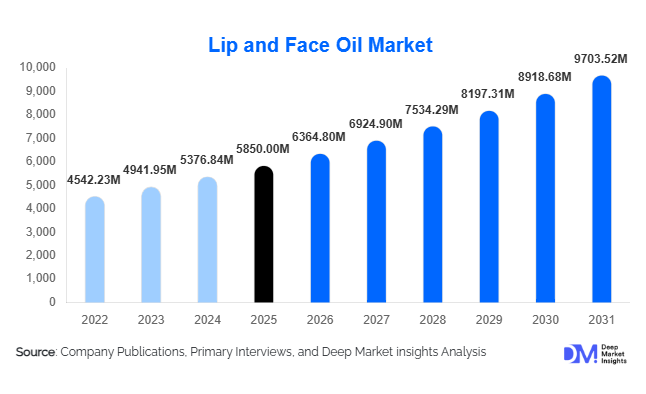
According to Deep Market Insights, the global lip and face oil market size was valued at USD 5,850 million in 2025 and is projected to grow from USD 6,364.80 million in 2026 to reach USD 9,703.52 million by 2031, expanding at a CAGR of 8.8% during the forecast period (2026–2031). The lip and face oil market growth is primarily driven by the increasing consumer shift toward clean beauty products, rising demand for botanical skincare formulations, and the growing popularity of multifunctional cosmetics that combine skincare benefits with aesthetic appeal. Lip oils and facial oils are increasingly being integrated into everyday skincare routines due to their ability to deliver intense hydration, antioxidant protection, and skin barrier repair.
Key Market Insights
- Plant-based and botanical oil formulations are gaining strong consumer traction, driven by rising demand for natural, organic, and vegan skincare products.
- Premium skincare brands are expanding their facial oil portfolios, offering advanced formulations enriched with antioxidants, vitamins, and rare botanical extracts.
- North America dominates the global market, supported by high consumer spending on premium beauty products and strong clean beauty adoption.
- Asia-Pacific is the fastest-growing regional market, driven by expanding middle-class populations and the increasing influence of K-beauty skincare routines.
- E-commerce channels are transforming beauty retail, enabling direct-to-consumer brands to scale rapidly through digital marketing and influencer partnerships.
- Multifunctional cosmetic products, such as lip oils that provide both hydration and gloss effects, are becoming increasingly popular among younger consumers.
What are the latest trends in the lip and face oil market?
Growing Popularity of Clean Beauty and Botanical Oils
Consumers across the global beauty industry are increasingly prioritizing clean beauty products formulated with natural and ethically sourced ingredients. Facial oils containing plant-derived ingredients such as argan oil, rosehip oil, marula oil, and jojoba oil are gaining widespread popularity due to their antioxidant and anti-aging properties. Beauty brands are responding to this trend by launching vegan, cruelty-free, and sustainable oil-based skincare products that appeal to environmentally conscious consumers. Many manufacturers are also highlighting ingredient transparency and ethical sourcing to build stronger brand trust among consumers. As a result, botanical facial oils are rapidly replacing synthetic formulations in premium skincare segments.
Rise of Hybrid Skincare and Cosmetic Products
Hybrid beauty products that combine skincare benefits with cosmetic functionality are becoming a defining trend within the lip and face oil market. Lip oils, for instance, provide the moisturizing benefits of lip balms while delivering the glossy finish of lip gloss products. Similarly, facial oils are increasingly used as makeup primers, highlighting oils, and overnight skin repair treatments. This multifunctionality enhances product utility and encourages consumers to incorporate oils into daily beauty routines. The trend is particularly popular among younger consumers who prefer simplified skincare regimens with fewer but more effective products.
What are the key drivers in the lip and face oil market?
Increasing Demand for Skin Hydration and Barrier Protection
The growing focus on skin hydration and barrier repair is a major driver of the lip and face oil market. Urban pollution, harsh weather conditions, and prolonged exposure to digital screens have increased consumer awareness of skin damage and dehydration. Facial oils are widely recognized for their ability to restore moisture balance and strengthen the skin barrier through essential fatty acids and vitamins. Dermatologists and skincare professionals frequently recommend oil-based products to repair damaged skin and maintain long-term skin health, contributing to rising market demand.
Expansion of Premium Skincare Industry
The premium skincare sector is expanding rapidly, with consumers increasingly willing to invest in high-quality products that deliver measurable results. Luxury facial oils formulated with rare botanical extracts, vitamins, and active skincare compounds are gaining popularity among affluent consumers. Beauty companies are also focusing on high-end packaging, clinical testing, and personalized skincare solutions to differentiate premium oil products in the market. This trend is particularly strong in developed regions such as North America and Europe, where consumers prioritize quality and product performance over price.
What are the restraints for the global market?
Consumer Misconceptions Regarding Oil-Based Skincare
Despite growing acceptance of facial oils, certain consumer segments remain hesitant to adopt oil-based skincare products due to concerns that they may clog pores or worsen acne. These misconceptions can restrict adoption among individuals with oily or acne-prone skin types. Educating consumers regarding non-comedogenic oil formulations and dermatologically tested products remains essential for expanding market penetration.
Price Sensitivity in Emerging Markets
Premium lip and facial oil products are often priced significantly higher than traditional moisturizers or lip care products. This price disparity can limit adoption in price-sensitive markets, particularly across developing economies where disposable income remains relatively lower. Manufacturers are addressing this challenge by introducing smaller packaging formats and affordable product lines targeted toward emerging markets.
What are the key opportunities in the lip and face oil industry?
Expansion of E-Commerce Beauty Brands
The rapid expansion of online beauty retail channels is creating significant opportunities for lip and face oil manufacturers. Direct-to-consumer brands are leveraging digital marketing, influencer collaborations, and social media campaigns to reach global audiences more effectively than traditional retail models. Online platforms allow brands to launch new products quickly, test market demand, and build direct relationships with consumers. Subscription-based skincare services and personalized product recommendations are also emerging as new revenue streams for online beauty brands.
Growing Demand in Emerging Economies
Emerging economies across Asia-Pacific, Latin America, and the Middle East are creating strong growth opportunities for the lip and face oil market. Rising urbanization, increasing disposable income, and expanding beauty awareness among younger consumers are fueling demand for premium skincare products. Countries such as China, India, Brazil, and Indonesia are witnessing rapid growth in digital beauty retail and international cosmetic brand presence. As a result, global manufacturers are increasingly investing in localized manufacturing, regional partnerships, and product customization tailored to regional skin types and climate conditions.
Report Scope
| Report Metric | Details |
|---|---|
| Market Size in 2025 | USD 5850 Million |
| Market Size in 2026 | USD 6364.80 Million |
| Market Size in 2031 | USD 9703.52 Million |
| CAGR | 8.8% (2026-2031) |
| Base Year for Estimation | 2025 |
| Historical Data | 2022-2024 |
| Forecast Period | 2026-2031 |
| Report Coverage | Revenue Forecast, Competitive Landscape, Supply Chain Disruption, Growth Factors, Environment & Regulatory Landscape and Trends |
| Geographies Covered | North America, Europe, APAC, Middle East and Africa, LATAM |
| Countries Covered | U.S., Canada, U.K., Germany, France, Spain, Italy, Russia, Nordic, Benelux, Rest of Europe, China, Korea, Japan, India, Australia, Singapore, Taiwan, South East Asia, Rest of Asia-Pacific, UAE, Turky, Saudi Arabia, South Africa, Egypt, Nigeria, Rest of MEA, Brazil, Mexico, Argentina, Chile, Colombia, Rest of LATAM |
Explore more data points, trends and opportunities Download Free Sample Report
Product Type Insights
Face oils dominate the market, accounting for approximately 64% of total global demand. These products are widely used for hydration, anti-aging treatments, and skin barrier repair. The increasing popularity of multi-step skincare routines, particularly influenced by Asian beauty trends, has strengthened demand for facial oils as a final moisturizing layer. Lip oils represent a fast-growing product segment, benefiting from their dual functionality as both cosmetic gloss and lip treatment products. Their lightweight texture and nourishing ingredients have made them particularly popular among younger consumers seeking everyday lip care solutions.
Ingredient Type Insights
Plant-based oils represent the largest ingredient category within the market, accounting for approximately 58% of global demand. Botanical oils such as argan oil, rosehip oil, jojoba oil, and coconut oil are highly valued for their natural antioxidant properties and skin nourishment benefits. Synthetic and mineral oil formulations remain present in the mass-market segment due to their lower cost and stable shelf life. Hybrid formulations that combine botanical oils with active ingredients such as vitamin C and hyaluronic acid are emerging as a premium skincare trend, offering enhanced functionality and targeted skin benefits.
Distribution Channel Insights
E-commerce platforms represent one of the fastest-growing distribution channels for lip and face oil products, accounting for nearly 33% of global sales. Online beauty retail allows consumers to access a wide range of international brands, compare product reviews, and benefit from digital promotions. Specialty beauty stores and department stores continue to play a critical role in premium product sales by offering personalized consultations and product demonstrations. Pharmacies and drugstores are also expanding their skincare portfolios to include dermatologically tested facial oils, supporting market growth among health-conscious consumers.
End-Use Insights
Personal consumer use accounts for the majority of demand within the lip and face oil market, representing more than 78% of total product consumption. Increasing awareness of skincare routines and beauty influencers has encouraged consumers to incorporate facial oils into their daily regimens. Professional salons and spa centers represent another important end-use segment, where facial oils are widely used in facial massage therapy and aromatherapy treatments. Dermatology clinics and medical aesthetic centers are emerging as niche users of facial oils, particularly for post-treatment skin repair and hydration following cosmetic procedures.
Explore more data points, trends and opportunities Download Free Sample Report
Lip and Face Oil Market Segmentations
By Product Type
- Lip Oils
- Face Oils
By Ingredient Type
- Plant-Based / Botanical Oils
- Synthetic & Mineral Oils
- Hybrid Formulations (Botanical + Active Ingredients)
By Functionality
- Hydrating & Moisturizing Oils
- Anti-Aging Oils
- Brightening & Skin Tone Correcting Oils
- Barrier Repair / Sensitive Skin Oils
- Sun Protection / UV Protective Oils
By Distribution Channel
- Supermarkets & Hypermarkets
- Specialty Beauty Stores
- Pharmacies & Drugstores
- E-Commerce Platforms
- Direct-to-Consumer Brand Websites
By End-Use
- Personal Consumer Use
- Professional Salon & Spa Use
- Dermatology Clinics / Medical Aesthetic Use
Regional Insights
North America
North America represents the largest regional market for lip and face oils, accounting for approximately 32% of global demand. The United States dominates regional consumption due to strong consumer spending on premium skincare products and high awareness of clean beauty trends. Consumers in this region increasingly prefer plant-based and dermatologist-tested skincare products, supporting strong demand for facial oils formulated with natural ingredients.
Europe
Europe accounts for roughly 28% of global market demand, with major consumption centers in France, Germany, the United Kingdom, and Italy. European consumers strongly prioritize sustainability, organic ingredients, and environmentally responsible cosmetic manufacturing. France remains a key production hub for luxury skincare brands, while Germany and the United Kingdom represent large consumer markets for premium cosmetic products.
Asia-Pacific
Asia-Pacific is the fastest-growing market for lip and face oils, driven by rising skincare awareness in China, Japan, South Korea, and India. Chinese consumers represent a major growth driver due to expanding online beauty retail and strong interest in premium skincare brands. South Korea continues to influence global skincare trends through K-beauty innovations and export-driven cosmetic manufacturing.
Latin America
Latin America accounts for approximately 7% of global demand, with Brazil and Mexico representing the largest regional markets. Growing consumer interest in premium beauty products and expanding e-commerce penetration are supporting regional market expansion.
Middle East & Africa
The Middle East and Africa region represents approximately 5% of global demand but is experiencing steady growth. Countries such as the United Arab Emirates and Saudi Arabia are witnessing increasing luxury beauty consumption supported by rising disposable income and tourism-driven retail expansion.
Key Players in the Lip and Face Oil Market
- L'Oréal
- Estée Lauder Companies
- Shiseido
- Procter & Gamble
- Unilever
- Beiersdorf
- Coty
- Amorepacific
- Johnson & Johnson
- Kao Corporation
- Clarins Group
- Oriflame Holding
- Revlon
- Mary Kay
- The Body Shop