LED Mirrors Market Size
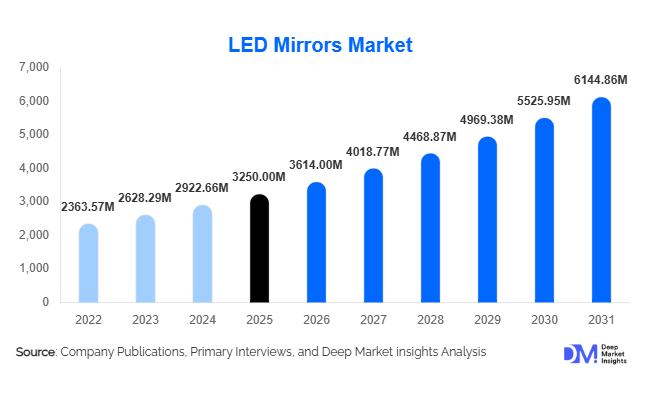
According to Deep Market Insights, the global LED mirrors market size was valued at USD 3,250 million in 2025 and is projected to grow from USD 3,614.00 million in 2026 to reach USD 6,144.86 million by 2031, expanding at a CAGR of 11.2% during the forecast period (2026–2031). The LED mirrors market growth is primarily driven by the increasing adoption of smart home technologies, rising demand for energy-efficient lighting solutions, and growing emphasis on modern interior aesthetics across residential and commercial spaces.
Key Market Insights
- Smart LED mirrors are gaining traction globally, driven by integration with IoT, voice assistants, and multifunctional digital displays.
- Residential applications dominate the market, supported by rising home renovation and remodeling activities worldwide.
- Asia-Pacific leads the market, accounting for nearly 36% share, fueled by rapid urbanization and construction growth.
- Hospitality and commercial sectors are the fastest-growing segments, driven by premium customer experience requirements.
- The mid-range pricing segment holds the largest share, balancing affordability and advanced features.
- Technological innovations such as anti-fog systems, touch controls, and adjustable lighting are reshaping product demand.
What are the latest trends in the LED mirrors market?
Smart and Connected Mirror Adoption
The LED mirrors market is witnessing a strong shift toward smart and connected products. Mirrors integrated with Bluetooth, voice assistants, and digital displays offering weather updates, time, and news are becoming increasingly popular among urban consumers. These smart mirrors are gaining traction in premium residential spaces as well as hospitality environments where an enhanced user experience is critical. Manufacturers are also incorporating health monitoring features and AI-based personalization, further expanding the functionality of mirrors beyond traditional usage. The convergence of home automation ecosystems with LED mirrors is expected to accelerate demand, especially in developed markets.
Design-Centric and Customization Trends
Consumers are increasingly prioritizing design aesthetics alongside functionality, leading to demand for customizable LED mirrors in various shapes, sizes, and lighting configurations. Minimalist designs, frameless structures, and backlit illumination are trending across modern interiors. Customization options such as adjustable brightness, color temperature control, and unique shapes are gaining popularity in both residential and commercial segments. This trend is particularly strong in luxury real estate and boutique hospitality projects, where differentiation through design is a key factor. Manufacturers are focusing on modular and customizable offerings to cater to evolving consumer preferences.
What are the key drivers in the LED mirrors market?
Growth in Smart Homes and Modern Interiors
The increasing adoption of smart home technologies is a major driver for the LED mirrors market. Consumers are investing in intelligent home solutions that enhance convenience and efficiency, making LED mirrors an essential component of modern bathrooms. Features such as touch sensors, motion detection, and smart connectivity are driving higher adoption rates across urban households.
Rising Construction and Renovation Activities
Global growth in residential and commercial construction, along with increasing renovation activities, is significantly boosting demand for LED mirrors. The global home improvement industry, valued at over USD 900 billion, continues to expand, providing strong support to market growth. New housing projects and remodeling trends are driving installations, particularly in emerging economies.
Energy Efficiency and Sustainability Focus
LED mirrors offer superior energy efficiency compared to traditional lighting systems, aligning with global sustainability goals. Governments and regulatory bodies are promoting energy-efficient products, encouraging adoption across residential and commercial sectors. The long lifespan and lower energy consumption of LEDs further enhance their appeal.
What are the restraints for the global market?
High Initial Costs
LED mirrors are relatively expensive compared to conventional mirrors, which can limit adoption in price-sensitive markets. The inclusion of advanced features such as smart connectivity and anti-fog technology further increases product costs, restricting penetration among low-income consumers.
Maintenance and Technical Complexity
The integration of electronic components and lighting systems increases maintenance complexity. Repairing or replacing faulty components often requires specialized expertise, which can deter consumers and impact long-term adoption, particularly in developing regions.
What are the key opportunities in the LED mirrors industry?
Expansion in Hospitality and Real Estate Sectors
The rapid expansion of the global hospitality and real estate industries presents significant opportunities for LED mirror manufacturers. Hotels, resorts, and luxury residential projects are increasingly incorporating LED mirrors to enhance aesthetics and customer experience. Emerging markets such as India, Southeast Asia, and the Middle East are witnessing large-scale infrastructure development, creating strong demand for bulk installations.
Integration with Smart Home Ecosystems
The growing penetration of smart home systems provides opportunities for manufacturers to develop advanced LED mirrors integrated with IoT platforms. Features such as voice control, app connectivity, and personalized settings are attracting tech-savvy consumers. This trend is expected to drive innovation and premiumization in the market.
Report Scope
| Report Metric | Details |
|---|---|
| Market Size in 2025 | USD 3250 Million |
| Market Size in 2026 | USD 3614 Million |
| Market Size in 2031 | USD 6144.86 Million |
| CAGR | 11.2% (2026-2031) |
| Base Year for Estimation | 2025 |
| Historical Data | 2022-2024 |
| Forecast Period | 2026-2031 |
| Report Coverage | Revenue Forecast, Competitive Landscape, Supply Chain Disruption, Growth Factors, Environment & Regulatory Landscape and Trends |
| Geographies Covered | North America, Europe, APAC, Middle East and Africa, LATAM |
| Countries Covered | U.S., Canada, U.K., Germany, France, Spain, Italy, Russia, Nordic, Benelux, Rest of Europe, China, Korea, Japan, India, Australia, Singapore, Taiwan, South East Asia, Rest of Asia-Pacific, UAE, Turky, Saudi Arabia, South Africa, Egypt, Nigeria, Rest of MEA, Brazil, Mexico, Argentina, Chile, Colombia, Rest of LATAM |
Explore more data points, trends and opportunities Download Free Sample Report
Product Type Insights
Smart LED mirrors lead the product segment, accounting for approximately 28% of the global market in 2025, primarily driven by the rapid adoption of smart home ecosystems and increasing consumer preference for multifunctional bathroom solutions. The integration of features such as voice assistants, Bluetooth connectivity, anti-fog systems, and embedded displays has transformed mirrors into interactive devices, significantly enhancing their value proposition. This segment is further supported by rising disposable incomes and the growing penetration of IoT-enabled devices across developed and emerging economies.
Wall-mounted LED mirrors continue to hold a substantial share due to their ease of installation, cost-effectiveness, and suitability for space-constrained urban housing. Cabinet LED mirrors are witnessing increasing demand in compact living environments, particularly in metropolitan areas, as they offer dual functionality by combining storage with illumination. Meanwhile, backlit and front-lit mirrors remain widely used across both residential and commercial settings due to their uniform illumination, energy efficiency, and affordability, making them a preferred choice in mid-range projects. The continued innovation in lighting design and integration of customizable features is expected to sustain growth across all product categories.
Application Insights
Residential applications dominate the LED mirrors market, holding around 52% share in 2025, supported by robust growth in home renovation activities and increasing consumer expenditure on interior aesthetics. The shift toward modern bathroom designs, coupled with rising awareness of energy-efficient lighting solutions, has significantly boosted adoption in this segment. Additionally, the growing trend of smart homes is encouraging homeowners to invest in technologically advanced mirrors that enhance both convenience and functionality.
Commercial applications, particularly in hospitality, retail, and corporate spaces, represent the fastest-growing segment, driven by the need to enhance customer experience and brand differentiation. Hotels and luxury resorts are increasingly incorporating LED mirrors as standard fixtures to offer premium amenities. Salons and spas rely on high-quality lighting for precision tasks, further driving demand. Healthcare facilities are also emerging as a niche but growing segment, where LED mirrors are valued for their anti-fog capabilities, hygiene benefits, and consistent illumination. The diversification of applications across industries is expected to provide sustained momentum to overall market growth.
Distribution Channel Insights
Offline retail channels account for approximately 61% of total sales, as consumers often prefer to physically inspect LED mirrors for quality, lighting performance, and design aesthetics before making a purchase. Specialty lighting stores, home improvement retailers, and branded showrooms play a critical role in influencing buying decisions, particularly for mid-range and premium products. Additionally, offline channels are dominant in project-based sales, where bulk procurement for residential complexes, hotels, and commercial establishments is common.
However, online channels are witnessing rapid growth, driven by increasing e-commerce penetration and changing consumer purchasing behavior. Online platforms offer a wider product range, competitive pricing, and convenience, making them attractive to younger consumers and tech-savvy buyers. Manufacturers are also strengthening their direct-to-consumer (D2C) strategies through digital platforms, enhancing brand visibility and customer engagement. The integration of augmented reality (AR) tools for virtual product visualization is further expected to accelerate online adoption.
Price Range Insights
The mid-range segment leads the LED mirrors market with around 44% share, driven by its ability to balance affordability with advanced features such as adjustable lighting, anti-fog functionality, and touch controls. This segment is particularly popular among middle-income consumers and mid-scale residential and commercial projects, making it the most commercially viable category.
Premium LED mirrors are gaining significant traction among high-income consumers, luxury real estate developers, and upscale hospitality projects. These mirrors often feature advanced smart technologies, superior design aesthetics, and high-quality materials, enabling manufacturers to achieve higher profit margins. On the other hand, economy products cater to price-sensitive markets, particularly in developing regions, where basic functionality and affordability are key purchasing criteria. Increasing competition and economies of scale are gradually reducing prices in the mid-range segment, improving accessibility, and driving broader market penetration.
Explore more data points, trends and opportunities Download Free Sample Report
LED Mirrors Market Segmentations
By Product Type
- Wall-Mounted LED Mirrors
- Freestanding LED Mirrors
- Cabinet LED Mirrors
- Smart LED Mirrors
- Backlit LED Mirrors
- Front-Lit LED Mirrors
By Application
- Residential
- Hospitality
- Retail Stores
- Corporate Offices
- Salons & Spas
- Healthcare Facilities
By Distribution Channel
- Online Retail
- Specialty Stores
- Home Improvement Stores
- Direct/Project Sales
By Price Range
- Economy
- Mid-Range
- Premium/Luxury
By Technology Integration
- Anti-Fog Technology
- Touch Sensor Control
- Motion Sensor Mirrors
- Bluetooth/Smart Connectivity
- Integrated Displays
Regional Insights
Asia-Pacific
Asia-Pacific dominates the LED mirrors market with approximately 36% share in 2025, supported by strong macroeconomic and demographic drivers. Rapid urbanization, expanding middle-class population, and significant investments in residential and commercial construction are key growth factors in the region. China contributes nearly 18% of global demand, benefiting from its well-established manufacturing ecosystem, cost advantages, and strong export capabilities. Additionally, government initiatives promoting energy-efficient products are accelerating adoption.
India is the fastest-growing market in the region, with a CAGR of around 14.5%, driven by rising disposable incomes, increasing housing demand, and government-led infrastructure programs such as smart city initiatives. Southeast Asian countries are also witnessing rising demand due to growing tourism infrastructure and urban development. The combination of high production capacity and expanding domestic consumption positions the Asia-Pacific as both a supply and demand hub for LED mirrors.
North America
North America holds around 27% market share, led by the United States, which accounts for nearly 22% of global demand. The region’s growth is primarily driven by high adoption of smart home technologies, strong consumer purchasing power, and a well-established home renovation market. The increasing trend of bathroom remodeling, particularly in aging housing stock, is significantly contributing to demand.
Consumers in North America exhibit a strong preference for premium and technologically advanced products, including smart mirrors with integrated features such as voice control and digital displays. Additionally, the presence of leading manufacturers and strong distribution networks further supports market expansion. Sustainability trends and energy efficiency regulations are also encouraging the adoption of LED-based solutions across residential and commercial sectors.
Europe
Europe accounts for approximately 22% share of the LED mirrors market, driven by stringent energy efficiency regulations and a strong focus on sustainable living. Countries such as Germany, the UK, and France are key contributors, supported by high consumer awareness and demand for eco-friendly products.
The region’s mature construction sector, coupled with increasing renovation activities, is a major growth driver. European consumers place significant emphasis on design aesthetics and product quality, driving demand for premium and customized LED mirrors. Additionally, government policies promoting green buildings and energy-efficient lighting solutions are accelerating market growth. The presence of established premium brands further strengthens the competitive landscape in the region.
Middle East & Africa
The Middle East & Africa region holds around 8% share, with the UAE and Saudi Arabia leading demand. Growth in this region is primarily driven by large-scale investments in luxury real estate, hospitality, and tourism infrastructure. Mega projects, including smart cities and high-end residential developments, are creating strong demand for premium LED mirrors.
The region’s focus on luxury living standards and high per capita income in Gulf countries is supporting the adoption of technologically advanced and aesthetically appealing products. Additionally, the expansion of the tourism sector, particularly in the UAE, is driving demand from hotels and resorts. In Africa, gradual urbanization and infrastructure development are contributing to steady market growth, although at a slower pace compared to the Middle East.
Latin America
Latin America accounts for approximately 7% share, with Brazil and Mexico as the primary markets. Growth in this region is supported by increasing urbanization, a rising middle-class population, and the gradual adoption of modern home improvement products. The expansion of retail infrastructure and e-commerce platforms is also improving product accessibility.
However, price sensitivity remains a key challenge, limiting the adoption of premium LED mirrors. Despite this, the growing construction sector and increasing awareness of energy-efficient solutions are expected to drive steady demand. Government initiatives aimed at improving housing infrastructure and urban development are likely to further support market growth in the coming years.
Key Players in the LED Mirrors Market
- Kohler Co.
- Duravit AG
- LIXIL Group
- Geberit Group
- Roper Rhodes
- Electric Mirror
- Keuco GmbH
- HiB Ltd
- HSIL Limited
- Seura Inc.
- Krugg Reflections
- Paris Mirror
- Majestic Mirror & Frame
- Foshan Eterna Lighting
- Zhongshan Nanguang Electric